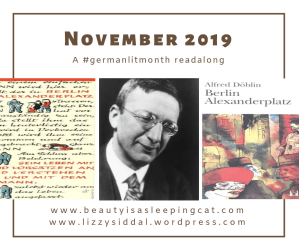
Berlin Alexanderplatz Readalong – Part 1

Due to some time constraints this and next week, my post is very short.

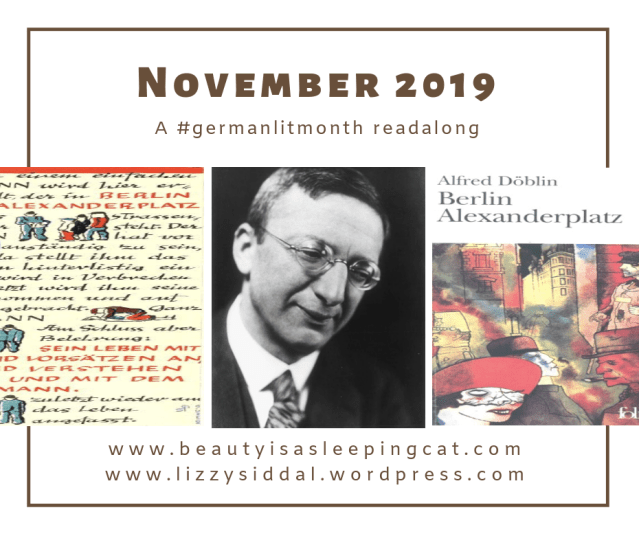
Welcome to the #germanlitmonth readalong of Alfred Döblin’s Berlin Alexanderplatz.  What enticed you to readalong with us?

When I buy a book in a bookshop, I sometimes keep the receipt. I did so in this case and that’s how I know that the book has been on my shelves for 19 years. I bought it in September 2000. I know that when I bought it, I was extremely keen on reading it. But for some reason I didn’t and because I always felt it was a book that had to be read during autumn – possibly because I visited Berlin in autumn – I postponed it from year to year. When Lizzy mentioned she wanted to read it during this GLM, I decided that the time had finally come.

Summarise your initial expectations.  Are they being met?

It’s pretty much how I expected it. Highly readable in some places, and more experimental in others. I struggled more reading the first book than I thought I would. I wasn’t in the right frame of mind, but once I made more time for reading it and saw certain patterns in the storytelling emerge, I was captivated.

Which edition/translation are you using and how is it reading? If you’re reading the original German, is there anything noteworthy about Döblin’s language?

I’m reading the German original and am constantly thinking that it’s almost impossible to translate this adequately because of the extensive use of Berlin vernacular. But since Döblin uses a collage/montage technique there are other challenges. He uses bits from songs, slogans, poetry, and many other sources. Occasionally he uses them verbatim, quite often though, he changes words. Of course, you can translate them, but they won’t mean the same to a foreign reader. With the changes, they might even be more unrecognizable. I was also wondering, if the translators really caught all the allusions and quotes. They would have to be extremely knowledgeable about German culture and literature

The more descriptive passages, especially those in which the narrator/author are present are very beautiful. There’s a rhythm and sound to his sentences that’s unique. The choice of words is very careful.

What are your first impressions of Berlin and Franz Biberkopf?

Because of the way Döblin chose to tell this story, I think of Franz as a guinea pig or a marionette. I feel like I see the threads, the author is using to make him move. I can’t think of him as a real person at all. Interestingly, I feel very differently about Berlin. The city comes across as more of person than Franz. The city comes to life. One has the feeling of experiencing a particular moment in a very particular place.
Welcome to German Literature Month IX 2019

Welcome all! It’s that glorious time of the year again – a full month of Germanic literary indulgence! This is just a quick admin post as there may be newcomers who wonder how this event works.

1. Read anything you want in any language you want … as long as the material was originally written in German.

2. You can follow the themed reading schedule, or ignore it completely by reading as you please for the entire month.

3. If you’re joining in the Berlin Alexanderplatz readalong, please leave an email address to receive the readalong discussion questions.

4. Share what you are reading and what you felt about it by using the tag #germanlitmonth on your blog posts, tweets, instagram shots or booktube videos.

5. Please add a link to each review on the linky at www.germanlitmonth.blogspot.com. (This is an invaluable help when pulling together the author index at the end of the event. Check out the indices from previous years if you’re looking for something to read.)

6. Have fun!

Berlin Alexanderplatz Readalong – German Literature Month 2019

In order to commemorate the centennial of the founding of the Weimar Republic, Lizzy and I are hosting a readalong of Berlin Alexanderplatz  during German Literature Month 2019. Döblin’s tale is one the seminal novels (if not the seminal novel) of that era.

We will discuss the novel over 4 weeks and we are intending to send out discussion questions a week in advance of each date. You can answer these or post your own thoughts, entirely as you please. If you’re intending to participate, please leave a comment and your email below.

The schedule is as follows.  (Each section is circa 100-140 pages in the NYRB classics edition.)

Saturday 9.11.2019 Chapters 1-2

Saturday 16.11.2019 Chapters 3-5

Saturday 23.11.2019 Chapters 6-7

Saturday 30.11.2019 Chapters 8-9

Announcing German Literature Month 2019

2019 is a significant year in terms of German history, both actual and literary. It’s

  • 30 years since the Fall of the Wall;
  • 100 years since the Founding of the Weimar Republic; and
  • 200 years since publication of Goethe’s West-Eastern Divan.

Lizzy and I have decided to include all of the above into the plan for GLM IX!

To commemorate The Fall of the Wall there will be an ex-DDR week. For the founding of the Weimar Republic, the badge has been converted to Bauhaus-favoured sans serif typography and we will host a readalong of Alfred Döblin’s seminal Berlin Alexanderplatz. Last, but definitely not least, there will be a Goethe Reading Week.

There will also be plenty of read-as-you-please time so you can choose from the whole gamut of German-language literary pleasures (writing from outside Germany, historical and crime fiction, graphic novels, etc) entirely according to your heart’s desire.

The reading schedule looks like this:

01-02.11.19 Read as You please
03-09.11.19 Ex-DDR week
10-16.11.19 Read as You Please
17-23.11.19 Goethe Reading Week
24-30.11.19 Read as You Please


The Berlin Alexanderplatz readalong will take place on 4 Saturdays commencing on 9.11. More details and sign-up post to follow shortly.

As always, to participate in German Literature Month you can stick to the plan, pick and choose only the parts that interest you, or follow your own path entirely. You can read in any language you want. The only rule is that whatever you read must have originally been published in German.

All that remains now, is for you to search through your shelves, your library catalogues or maybe undertake a shopping expedition! German Literature Month IX will be here before you know it! Will you join us?


Joseph Roth – Radetzky March Readalong

You may remember talk of a spring Radetzky March readalong (or re-readalong for those who are already acquainted) during 2018 German Literature Month.  All who were interested in participating were asked to comment on their favoured month, and it turned out that April was favoured by most.

Now April is beginning to look rather full. Stu is hosting Penguin Classics week at the beginning of the month (8th-15th) and Karen and Simon are hosting the 1965 club at the end of the month (22nd-28th).  So where can Lizzy and I slot this readalong?

As the novel is divided into 3 parts of nearly equal length, we’ve decided on the first 3 weeks of the month. (There is a Penguin Classics edition, so, if you’re reading that, you can kill two birds with one stone!) And to tie in with #translationthurs, we’ll discuss Part One on Thursday  April 4, Part Two on Thursday April 11 and Part 3 on Thursday April 18.

We both loved the detailed discussion of the Effi Briest readalong, way back when during the first German Literature Month. So we’re intending to send out discussion questions for each part of the discussion.  You can answer these or post your own thoughts, entirely as you please.  If you’re intending to participate, please leave a comment and your email below.

More details nearer the time, but we wanted you to pencil in the dates now – before the month of April just gets too full for most of us!

A Tardy German Literature Month Wrap-up and Radetzky March Readalong Announcement

Does anyone else feel November went fast? I only just wrote a welcome post to German Literature Month and now it’s already over. That’s not why I’m late though. I caught a nasty cold.

I’d like to thank everyone who participated. It’s always wonderful to see all of your choices and your enthusiasm. So, thank you very much.

If you haven’t done so already, please add your posts to the German Literature Month Site. I’m still playing catch up and Lizzy’s collecting links for a final wrap-up post.

If you haven’t seen Lizzy’s post, you might not know that we are planning a Readalong of Joseph Roth’s Radetzky March early next year. The date hasn’t been fixed yet, so I’d like to know what would work for you.

We would like to extend this readalong over the course of one month, posting weekly on predefined portions of the novel. There will be questions, for those who’d like to use them, that will facilitate discussion.

I hope you’ll join us.

And thanks again for your participation.


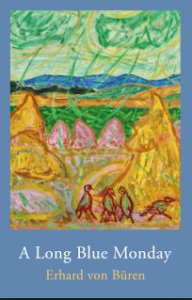
A Long Blue Monday by Erhard von Büren – Swiss Week Readalong

Published in 2013, A Long Blue Monday, is Erhard von Büren’s third novel. His earlier novels Wasp Days and Epitaph for a Working Man were published in 1989 and 2000 respectively. He lives in Solothurn, Switzerland.

A Long Blue Monday tells the story of Paul Ganter, a retired school teacher who has temporarily left his wife and taken an apartment in the city to write a book about Sherwood Anderson. Very possibly he could have done that at home, but we soon learn that this time out is about much more than just writing a book. He uses the time alone to delve into his feelings and memories and relives vividly an unhappy love story that happened over forty years ago, in the summer of 1959. That year he fell in love with Claudia, a girl from a very rich family and, in a desperate attempt to impress her, takes weeks off from school to write a trilogy of plays in the vein of the great American playwrights of the time. Every day he slaves over his work that seems to be a series of soliloquies put on paper. Once it is finished, he gives the play to his crush, hoping it will impress her. Sadly, just like all his other attempts at wooing her, this barely gets a reaction. Clearly, she’s not into him. Looking back, Ganter can’t help but admire the stamina of his younger self. And he realizes that while the result of his writing wasn’t successful, locking himself away, writing daily, going for long walks and experience the changes in the weather and nature surrounding him, was one of the most intense experiences of his life.

The story is told going back and forth in time. In the present, Paul spends a lot of time writing and reminiscing, but he also has long conversations with his daughter who discovers sides of her father she never knew existed. While the love story is central, it isn’t the most important aspect of Paul’s delving into his past. He also remembers vividly what it was like to come from a poor family, in which the men were battling alcoholism. He remembers how difficult it was to know what he wanted to do with his life and to achieve it. Trying to overcome the shortcomings of his upbringing, he became a master student. Unfortunately, for the longest time, he thought that he could master life and love just like he mastered school. This set him up to failure. Being shy didn’t help him either. Love and life choices are explored, but there’s one other important thing—the narrator’s intense love of American culture that finally leads him to become an English teacher and is now one of the reasons for his time out.

I hope my review will have told you several things—this is a very complex, rich book, but it’s neither straightforward, nor plot-driven. Funnily, for a novel that talks so much about American culture, it’s very unlike most American literature I know. It’s introspective and very quiet. Far more analysis of thoughts and feelings, than scenes and action. One could say, more telling than showing. The story meanders, goes back and forth in time, returns to certain events, adds additional information. Just like it happens to all of us in real life. We rarely remember events in a straightforward way.

I liked A Long Blue Monday very much. It’s a quiet book about a quiet, shy man, who feels strongly, struggles and fails, struggles some more, and then succeeds and finds meaning in all sorts of things. My favourite parts were the nature descriptions and if I had read this in English, you’d find dozens of quotes. The descriptions are lyrical and beautifully crafted. They are the most eloquent sign of the narrator’s rich interior life.

While reading A Long Blue Monday, I couldn’t help but think of another Swiss author, who writes similar descriptions— Robert Walser. If you know me, you know this is high praise.

I hope some of you have read this as well. I’m looking forward to the discussion.