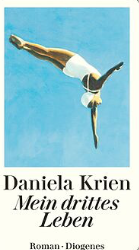
Daniela Krien’s My Third Life (Mein drittes Leben)

German author Daniela Krien who was born in the former G.D.R. published her first novel We Will Tell Each Other Everything (Wir werden uns alles erzählen) in 2011. Long before Kairos she told the story of a passionate love story between a very young woman and a much older man during the final months of the DDR. I found the book a little mawkish but not bad at all, especially in the parts that introduced us to a world that had already been long gone by then. Sure, Erpenbeck is the better writer but if I had to pick one of the two, I’d say I liked Krien’s novel better.

Since then, she’s published four more novels, two of which were translated – The Fire and Love in Case of Emergency (aka Love in Five Acts). While I got the latter on my piles, I haven’t read the others. When I was at the bookshop the other week, I discovered her latest Mein drittes Leben. It hasn’t been translated yet but given the success of some of her other books in translation, I wouldn’t be surprised if a UK or US publisher picked it up.

The book begins after Linda has moved away from Leipzig to the country, while her husband stayed in their flat in Leipzig. They aren’t divorced, nor are they theoretically separated but Linda needs some time on her own. The village and the house she’s staying in aren’t very appealing. But Linda doesn’t care. She’s looking after the chicken of the former owner and her dog and that’s all she seems to need. Her husband, Richard, visits her every other week and she makes a few friends, but mostly she stays on her own.

Bit by bit the reader discovers that Linda once had what she would have called the perfect life: a kind daughter, a husband she’s still in love with after almost twenty years, and a job as a curator of an art foundation that gave her a great deal of satisfaction. But then a tragedy happens. Her seventeen-year-old daughter is run over by a lorry. Linda and Richard grieve deeply but while Richard gets better, Linda doesn’t. On the contrary. It seems to get worse. When she’s diagnosed with cancer on top of that, she knows she can’t go on like before. Once the chemo is over, she moves.

I’ve read a few books about grief, fiction and nonfiction. Guilt is so often part of the grieving process. Here as well. Linda feels particularly guilty because her daughter did something that morning, she wouldn’t have done if Linda had told her not to. But the guilt runs much deeper and that’s where the strength of this book lies. It is tied into her motherhood and the way she became a mother. Richard had been married before and had two beautiful, intelligent children. He didn’t want another child and Linda had to fight very hard for him to give in. Once her daughter is born, Linda wants another child but Richard refuses. Years later, when he finally agrees, it’s too late. One of the things that weighs heavily on Linda’s consciences is the fact that she often compared her daughter to Richard’s first children or to other young people and found her lacking. She seemed too normal, too kind, not particularly beautiful, not fascinating.

Linda has a lot to come to terms with. Her struggles are intense. At times the reader fears she’s going to end it all. And then Richard loses patience. He’s been waiting two years and there is still no sign that Linda will return to Leipzig. The marriage ends when he meets another woman

It may sound like My Third Life is a very depressing book but it’s not. I found it engaging and enjoyable. The way Linda evolves after her marriage ends is uplifting and very relatable. Ultimately, My Third Life is much more than a story about grief, it’s also the story of a marriage. And an exploration of what makes life meaningful. I wouldn’t exactly call My Third Life great literature but it’s very readable. It would make an amazing book club read as it offers so many discussion points. How long should a person grieve? What is the right way to grieve? How do partners survive the loss of a child, especially when they don’t grieve the same way? What about friendships? How do friendships survive something like this?

 

Welcome to German Literature Month XIV November 2024

Welcome to German Literature Month XIV

Hopefully shelves have been scoured, reading material has been chosen, and everyone has a reading list for #germanlitmonth.

Remember anything that was originally written in German can be read during #germanlitmonth.  This year books written in other languages, provided they are about Franz Kafka or inspired by him can be read during Kafka Reading Week (November 15-21).

The full schedule for the month is:

Nov 1-7      Crime Week

Nov 8-14   Read as You Please

Nov 15-21  Franz Kafka week

Nov 22-30 Read as You Please

As always there will be a week’s extension to catch up with any outstanding reviews, while this year’s author index is created. The best way to share those reviews and ensure they show up on the index is to leave a comment below. Alternatively advertise your reviews on Twitter (X), Bluesky, FB or Instagram using the hash tag #germanlitmonth.

With the admin sorted, all that remains is for Lizzy and I to welcome you to German Literature Month XIV and to wish you Viel Vergnügen!

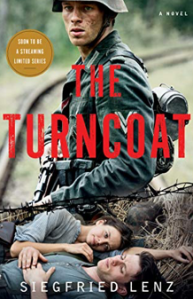
The Turncoat – Der Überläufer by Siegfried Lenz – Literature and War Readalong Meets German Literature Month

The Turncoat, published posthumously in 2016 for the first time, was actually Siegfried Lenz’s second novel. His first novel Es waren Habichte in der Luft came out in 1950. Because it was successful, the publisher signed a contract for a second novel with Lenz. The first draft of the manuscript received a lot of praise but after he rewrote parts of it and handed it in for a second time, the publisher refused to publish it. They didn’t want a novel on a deserter who joined the partisans. The novel was forgotten until 2014, when Lenz told his publisher about it.

The Turncoat tells the story of Walter Proska, a Wehrmacht soldier. It is set on the Eastern Front, towards the end of the war, during summer 1944. The Wehrmacht has already withdrawn from the front, but there’s still a ramshackle Fortress, in the middle of the forest. After almost being blown-up by Polish partisans, Proska, who was looking for his unit, is told to stay at the Fortress. The Fortress is located near the Ukrainian border and run by a Corporal who is constantly drunk and gives the most absurd and shocking orders. It looks like he’s gone completely mad. The Fortress is populated by a motley crew of simple soldiers. Among them is a cook who has a chicken as a friend, a young student whose philosophical ideas slowly awaken Proska, and a soldier who mounts young birch trees in sexual frustration.

Days at the Fortress are absurd and boring. They are filled with dangerous patrols, disgusting food, mosquitoes, and orders the soldiers don’t feel like following. They are surrounded by partisans who try their best to kill them all. After finally being overrun by partisans, Proska and the young student join them.

There is a sort of love story between Proska and a young Polish woman who belongs to the partisans. He meets her before he joins the unit and later again in the woods.

I was surprised by this book. I expected something a little different. Not a book with such a colourful cast of droll, whimsical characters. The novel is satirical, which served to underline the absurdity of these last days of war. The soldiers wonder constantly what the heck they are doing there. What’s going on? What are they fighting for? Not one of these characters is a patriot. They are conscripts and couldn’t care less about the war; they want it to end and go back home.

While it had so many amusing, bizarre scenes, I still found it hard to read. There are several instances of cruelty against animals. Some in flash backs, some happen during the story. Animals and the way they are treated or mistreated is a frequent trope in war stories. It mostly serves to either emphasize that people have lost their humanity or that they are worse than animals. The scenes are short but I still found them upsetting.

What I liked the most was the writing. Lenz is a powerful, evocative, and very descriptive writer. I loved the symbolism, the figures of speech that run through the novel, especially in the nature descriptions. I also liked the way the characters were described. Each one of them is so different, quirky. Their dialogue is often sarcastic and humorous. My only reservation regards the ending. I found it a bit confusing, but that didn’t lessen my appreciation of this book. The Turncoat is one of those novels that show the cruelty and absurdity of war. There are no heroes here, no winners, only losers.

The Turncoat has been made into a mini-series. Unfortunately, I couldn’t find an English trailer.

“The end, we failed it. Both of us.” (Max Frisch) – Ingeborg Bachmann and Max Frisch

When I was in my early twenties, I went through an Ingeborg Bachmann phase and read almost everything I could find by her. I loved her poetry so much. Sometimes when you revisit a writer that you loved ten or twenty years ago, you’re in for a disappointment. But rereading Bachmann’s poetry just made me realize again that she’s one of the greatest poets of all time. Her poems are mysterious and haunting and every time you read them, another part becomes meaningful. It’s not always easy to pin down what exactly her poems are about but that is what makes them so fascinating.

Back when I first read her, I wasn’t aware that she stopped writing poetry in the early 60s. There are still a few late poems, but most of her poetic work was written before 1961, the year she published her short story collection The Thirtieth Year. In an interview, she said she stopped writing poems because she didn’t want to be one of those who’d found a way to write successful poetry and would then go on, writing the same poems over and over again. She didn’t want to imitate herself.

There is, however, another interpretation, which, is more tragic. From 1958 to 1962 Ingeborg Bachmann was in a relationship with Max Frisch. The relationship ended in 1962. Both writers never really got over the ending, as Frisch clearly states in the quote I chose as blog title. “The end, we failed it. Both of us”. While Frisch would struggle until his death to come to terms and make sense of their relationship, the end almost killed Ingeborg Bachmann. She never really recovered.

I remember being surprised, at twenty, when I read that she was in a relationship with Max Frisch. Back then, I found it hard to imagine that a flamboyant personality like Bachmann would be with someone like Frisch who comes across as rather homey. They were so very different. Frisch, who was newly separated and about to get a divorce when they met, was used to a traditional family life. Before becoming a full time writer, he would work as an architect, while his wife was a housewife. Later, he would write in his attic, while his wife would do the housework and cook. It doesn’t seem like he ever expected this of Ingeborg Bachmann, but he expected a more structured life. From the beginning, living together would prove difficult. He found Bachmann rather chaotic. But that wasn’t the only difference. The biography I read pays a lot of attention to the way they experienced their surroundings, notably the landscapes, countries, cities, they lived in. Bachmann always looked for a mirror, an echo to her soul, while Frisch could just admire a landscape, explore a city and enjoy it. They met in Paris but then moved to Frisch’s hometown Zürich. For someone who was used to live in big cities like Vienna, Paris and Rome, Zürich was a shock. Switzerland in the fifties and sixties wasn’t exactly an openminded place. People frowned upon their living together. Bachmann found Switzerland stifling. They then moved out of the city to the country, which was even worse. Finally, Bachmann decided to move back to Rome and Frisch followed her.

Now she was in her territory but still the relationship remained difficult for many reasons. Ingeborg Bachmann would travel a lot and not tell Frisch when she’d be back. She would also keep their relationship apart from other people in her life. Almost as if she was living an affair. Even though, their life together was so dufficult, Frisch wrote continuously, driving Bachmann mad with the constant noise of his typewriter. It seems it even triggered writer’s block in her.

In the end, Frisch, who was genuinely suffering because she always held him at arm’s length, left her for another, much younger woman. Ingeborg Bachmann never really recovered from this blow.  She didn’t see it coming, never would have expected that he’d leave her.

It wasn’t easy to read this book. I felt sorry for Bachmann, but not because Frisch left her, but because the portrait that Ingeborg Gleichauf paints, shows someone who suffers from mental illness. I would even say she had narcissistic traits. One of the things that got to Frisch for example, was that she didn’t seem to have a sense of humour. She took absolutely everything seriously and personally. He had to be very careful what he said and how he said it, because it could trigger difficult reactions. It would be too easy to blame Frisch, because he’s the man, and it looks like he just exchanged her for a younger partner. Bachmann herself seems to have given the story this spin occasionally. She also said that relationships between men and women were murder. There are many instances in her work that refer to that. I would have to read a Bachmann biography to find out more where this came from. It’s clear that she was damaged and suffering long before she met Max Frisch. I can’t blame Frisch for wanting to leave her. I think most people would find it hurtful, not to be introduced to their partner’s friends. Not to be mentioned in phone calls. Not to be told, when the partner would return from a trip. Frisch couldn’t take it any longer. Leaving Bachmann for another woman, was his way to protect himself. Of course, this is problematic, and it seems to have been a pattern in his love life. He often ended things like this. Whenever a relationship got stale or difficult, he would end it and jump right into another one. Preferably with a much younger woman.

Writing this biography wasn’t easy for Gleichauf as the correspondence between Bachmann and Frisch is not available yet. There aren’t even any photos of the two together. We’re told they loved each other very much but it’s hard to understand why they were together.

Bachmann’s life went downhill after the separation. A suicide attempt, abuse of pain killers and other drugs and, finally, her tragic death in Rome, in 1973. Seen from outside, Frisch did much better, but he does admit in interviews that he, too, never got over her.

While their respective work can be read without any knowledge of their relationship, knowing about it helps to understand the deeper meaning. Everything they wrote from then on, always did, to some extent, deal with their failed love story.

This is just a very brief introduction to a chapter in two great writer’s life. One could write much more about this complex and sad story.

Here is one of Bachmann’s most famous poems

Harder Days Are Coming

Harder days are coming.
The loan of borrowed time
will be due on the horizon.
Soon you must lace up your boots
and chase the hounds back to the marsh farms.
For the entrails of fish
have grown cold in the wind.
Dimly burns the light of lupines.
Your gaze makes out in fog:
the loan of borrowed time
will be due on the horizon.

There your loved one sinks in sand;
it rises up to her windblown hair,
it cuts her short,
it commands her to be silent,
it discovers she’s mortal
and willing to leave you
after every embrace.

Don’t look around.
Lace up your boots.
Chase back the hounds.
Throw the fish into the sea.
Put out the lupines!

Harder days are coming.


Here’s a short documentary on Bachmann. It’s well worth watching. Unfortunately, it’s only available in German.


Welcome to German Literature Month X 2020

The first of November is here and it’s finally time for German Literature Month.

As you may know from our intro posts, we have two parallel programs this year. Lizzy is reading literature from all of the German Bundesländer, while I host four author weeks, including a Literature and War readalong of a newly discovered Siegfried Lenz novel – The Turncoat– on November 27.

Week 1 – November 1-7  Sophie von La Roche week

Week 2 – November 8-14 Max Frisch week

Week 3 – November 15-21 Ingeborg Bachmann week

Week 4 – November 22-28 Siegfried Lenz week

Feel free to join us or read as you please. As long as you enjoy yourself.

Here’s the link to our dedicated GERMAN LITERATURE MONTH PAGE – please do add your reviews so we can find and read them.

Announcing German Literature Month X

10 years, who would have thought it?  But here we are, and in a year when there has been plenty to be glum about, Lizzy and I thought we should buck the trend, and celebrate ten years with a bang! Hence the badge.

Thanks to all who have travelled with us thus far.  We hope you’ll accompany us again. For those who may be new to this, German Literature Month is the month for reading all things originally written in German – in whatever language you wish to read it – and then telling the world about it. Blogs, Twitter, Facebook, Instagram, YouTube, Goodreads. All good. Just use the hashtag #germanlitmonth when you share your thoughts.

Don’t have a clue what to read?  There’s a veritable database of reviews over at www.germanlitmonth.blogspot.com to help you find something appealing.

This year’s programme is a little different. Or, to be more precise, there are two programmes.

Programme 1

Unable to visit Germany this year for pandemic related reasons, Lizzy has an acute case of Fernweh, and has therefore decided on a virtual tour of Germany. One which will include all 16 Bundesländer, one way or another. Primarily through literature interwoven with memory.

Programme 2

I have decided to focus on four authors of interest, and chosen authors mean that there are weeks in which the spotlight will also  shine on Austria and Switzerland. My itinerary looks like this:

November 1-7  Sophie von La Roche

November 8-14 Max Frisch

November 15-21 Ingeborg Bachmann

November 22-28 Siegfried Lenz

The fourth week will include a Literature and War readalong of a recently discovered Lenz novel, The Turncoat. The discussion will take place on Friday 27.11.

As always, you can read as you please throughout the entire month.

We look forward to your company and discovering some scintillating German-language literature together.

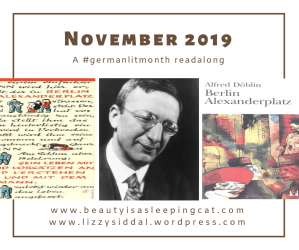
Berlin Alexanderplatz Readalong – Part 4

Berlin Alexanderplatz Readalong Part 3 – “Chapters” 8/9


  1. Reinhold is possibly the biggest villain in the story. Would you agree? Do you find his punishment satisfying?


I found him the biggest villain because he seems so harmless at first. Almost helpless. He really tricked Franz, making him help him, trusting him. But even without that, the Mieze story shows his cruelty and viciousness and then, on top of everything else, trying to frame his “friend” shows the extent of his depravity. In light of this, no, I don’t think his punishment was satisfying.


  1. The quote that returns most frequently in the last chapters – at least as far I could see – is taken from Ecclesiastes (There is a time for everything, and a season for every activity under heaven . . . ) How did you feel about this use? Did you find it effective?


I found it downright creepy. Especially how it was used in the Mieze section, but also later on. Like an echo of evilness. It’s obviously not used in context. It’s one of those instances that made me want to read up on the book.


  1. Were you surprised by the ending?


I was surprised and somewhat disappointed. I’m not entirely sure what I expected but not this. First the episode in which Franz is catatonic, and at a mental institution and then picking up work, like everything that happened before didn’t take place. Possibly, Döblin wanted to tell us he redeemed himself. His love for Mieze, is certainly a redeeming factor.


  1. Looking back, what did you like the most about the book and what did you like the least?


At times I read it like a puzzle. Not the story itself, but the way Döblin used collage technique. Quoted songs, poems, the bible . . . It was fascinating to hunt them. Unfortunately, those were also the elements that I found annoying at times. There’s just too much and while it’s interesting to see what quotes he chose and how he changed parts of them, it made the book frustrating at times. It’s a book that requires close reading and I didn’t have the time to do that.


  1. Would you reread it and/ or are you glad you read Berlin Alexanderplatz?


My answer is a resounding no. I will definitely not read it again. I’m glad I read it. as I always felt I was missing out because I hadn’t read it yet. I found it intellectually stimulating but not exactly enjoyable. At other times in my life, the stimulating part would have been enough. Not so now. I didn’t realize before starting it that it’s so long. My edition has just 400 pages, but they are densely packed. The copies in translation showed that it was closer to 600.