The first of November is here and it’s finally time for German Literature Month.
As you may know from our intro posts, we have two parallel programs this year. Lizzy is reading literature from all of the German Bundesländer, while I host four author weeks, including a Literature and War readalong of a newly discovered Siegfried Lenz novel – The Turncoat– on November 27.
Week 1 – November 1-7 Sophie von La Roche week
Week 2 – November 8-14 Max Frisch week
Week 3 – November 15-21 Ingeborg Bachmann week
Week 4 – November 22-28 Siegfried Lenz week
Feel free to join us or read as you please. As long as you enjoy yourself.
Here’s the link to our dedicatedGERMAN LITERATURE MONTH PAGE– please do add your reviews so we can find and read them.
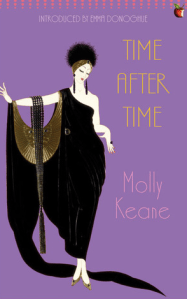
Published in 1983, Time After Time, is Anglo-Irish writer Molly Keane’s second novel under her own name. Before that she published ten novels under her pseudonym M. J. Farrell. There was a break of almost thirty years between her first ten and her last three novels. The early death of her husband was the reason for that long silence. Molly Keane also wrote plays.
Time After Time is my second Molly Keane. Back in 2011, I read and reviewed Two Days in Aragon which I liked very much. At the time, I wanted to know which one to read next and several people recommended Time After Time. Now, finally, nine years later, I picked it up.
What a wild ride. Not what I expected and not how I remember Two Days in Aragon, which was far more about the end of an era, but that doesn’t mean I didn’t like Time After Time. Molly Keane is a brilliant writer. She’s sharp, witty, and has a very distinct sense of humour.
The Swifts, four siblings in their sixties and seventies, live in a ramshackle mansion, Durraghglass, that has seen better days. Their fortune is long gone and so is their youth. The only thing they seem to have in common is a love for their late mother. Because of their mother’s will, they are bound to live together under the same roof. Jasper, May and June have never been married. The oldest sister, April is a widow. If it wasn’t for her and the money she inherited from her late husband, they would have had to sell most of their land. Still, it’s obvious they have no money as the house is constantly cold and decaying.
It becomes obvious very soon that this isn’t an entirely realistic novel. Each of the four characters has a disability. Jasper is one-eyed, April is deaf, May has a hand with only two fingers, and June, the youngest, never went to school because she’s dyslexic. They each have a pet, the sisters have dogs, Jasper has a cat. Just like the siblings, the pets are at each other’s throat constantly. This isn’t a harmonious household. On the contrary. These are four, selfish eccentrics who hate each other.
The character’s eccentricities and aversions, their feelings of self-importance, made reading this so much fun. The dialogue is sharp and witty. The characters behave a lot like characters in one of those hotel novels, we all like so much. Thrown together by fate but kept together by some sort of lethargy. They could avoid each other, but no, they always eat together. And since Jasper reigns over the kitchen, together with his formidable cat, he holds a lot of power. When he wants to punish his sisters, he lets them wait for their dinner or serves something he knows they hate. The meals are, invariably, accompanied by bickering and snide remarks. Here’s a short snippet
(. . . ) there was silence until Jasper broke it with a curious cry: “What are you doing May? Picking the cucumber out of your salad?”
“You rather forgot my ulcer – I can’t eat cucumber.”
“Can’t eat this, can’t eat that. Why must you have such a lower middle-class stomach?”
“Perhaps it has something to do with your idea of Cordon Bleu cooking?”
“It takes imagination and a reasonable digestion to appreciate good cooking.”
“You don’t usually cook cucumber, do you?” The argument drifted into silence.
Pudding time came. Baby rhubarb and rice cream with a vaporous suggestion of nutmeg.
“I hope the rhubarb isn’t too acid for your ulcer.” Jasper eyed May’s lavish helping.
“My ulcer must take its chances (. . . )”
While the book is often farcical, the characters aren’t devoid of tragedy. They are all elderly and suffer from different ailments. Even though they try to hide it as best as they can, they are very lonely. This and many other uncomfortable truths are brought out into the open when a long-lost childhood friend appears on their doorstep —cousin Leda from Vienna, who they believed had died in a concentration camp. Leda, who once was a great beauty, is now very fond of alcohol and food. But since she’s blind, she still believes she’s charming and imagines her friends to be still as young and charming as herself.
These were the submerged days that Leda’s coming rescued from a deep oblivion. Since she could not see Durraghglass in its cold decay, or her cousins in their proper ages, timeless grace was given to them in her assumption that they looked as though all the years between were empty myths. Because they knew themselves so imagined, their youth was present to them, a mirage trembling in her flattery as air trembles close to the surface of summer roads.
The safety and monotony of their days is soon gone because Leda isn’t as cute or nice as they remember her. Oh no. She’s rather diabolical and a master schemer. If they weren’t so desperate for company and flattery, they might have been able to see through her. Being gullible, they fall into her traps. By the end of the novel, the siblings must face unflattering truths about themselves and nothing is as it was before.
In her foreword Emma Donoghue compares Molly Keane to Jane Austen and Charles Dickens. The book combines, as she says, social comedy, grotesque descriptions and plot twists. I’m not so fond of comparisons like that, but I agree, Time After Time, has all these elements, combined with a terrific writing style, that’s very much her own. For some people these characters might be a bit over the top, but I liked them very much. They are eccentric and mean, but tragic in their own way. And, most importantly, never dull.
Alex Beer is an Austrian crime writer whose books have won many prestigious prizes. The Leo Perutz Preis and the Austrian Krimipreis, among others. Alex Beer was born in Bregenz. She lives in Vienna. The August Emmerich series is her first series. She’s now writing another one with a protagonist called Isaak Rubinstein.
I discovered her August Emmerich crime series at the book shop a while ago. Usually I don’t read historical crime, or very rarely, but the setting – Vienna after WWI – immediately caught my attention. It’s such a fascinating period. Unfortunately, they didn’t have book one at the book shop, so I picked the third in the series instead. That was a mistake, as I liked it very much, and will now have to go back and start with book one. That’s the reason, why this isn’t a proper review, as, so far, only the first in the series, The Second Rider, was translated. I’m sure it’s every bit as good as the third one though. I wish I had waited and ordered the first as some of what happens in Emmerich’s life in book three, spoils the first two books.
The main protagonists of the series are August Emmerich and his side-kick Ferdinand Winter, of the Austrian police force. Emmerich is a war veteran. Because of a war injury he’s in a lot of pain and has a tough time running or walking. Winter comes from a formerly rich family who has lost everything during the war. As he’s so good looking, women warm to him quite a bit. They are both likable, complex characters and I enjoyed their relationship very much.
While they are police detectives, they don’t shy away from bending the rules, if necessary. In book three, they also hunt a crime boss for personal reasons, which makes the series a bit of blend between a police procedural and a PI novel. The descriptions, mood, and atmosphere, all contribute to that as well.
The crime they must solve in book three, is suspenseful and so is the subplot, involving the crime boss, but that’s not what won me over. What I absolutely loved, besides the atmosphere, was the way Vienna was described. People are so poor. The city’s rife with criminals. There are hardly any goods available outside of the black market, where they cost a fortune. People are hungry, kids are starving. Antisemitism is on the rise. People already shout they want the annexation of Austria into Germany. The books, set in 1919 and 1920 respectively, show a country under shock. The massive multilingual Empire has been dissolved. All that remains is the comparatively small Austria, mourning its former glory.
While reading Joseph Roth, I got a feel for how huge the Austro-Hungarian Empire was. When you see what’s left after WWI, you can understand why so many think it’s all a very bad dream. Add to that the poverty and criminality, which make Vienna a very unsafe place, and you can imagine how desperate the people were.
Historical novels excel when they give you a feel for a period but also when they pique your curiosity and entice you to read more about a certain time and place. Alex Beer’s novels do exactly that. This was way more than an entertaining book. It’s rich in atmosphere and full of fascinating details. An excellent choice for those who like to read women/crime in translation.
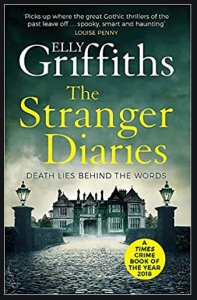
I’ve long been a fan of Elly Griffith’s Dr Ruth Galloway mysteries, slowly reading one book after the other. There are twelve books by now, four of which I’ve read. She’s also been writing a new series, The Stephens and Mephisto mysteries. I was quite pleased to see that she’s now also writing standalone novels and since The Stranger Diaries, published last year, has gotten so much praise and was called a “modern Gothic”, I decided to read it.
The story is told from three different points of view. Clare Cassidy, a fortysomething English teacher, Detective Inspector Harbinder Kaur, and Georgia or Georgie, Clare’s daughter.
Clare teaches English at a school, parts of which are located in the house of a Victorian writer. R. M. Holland was famous for his chilling short story The Stranger. In her spare time, Clare is writing a book on the author. She used to be best friends with another English teacher, Ella, but for some reason, they aren’t really close anymore. When Ella is found murdered, Clare is unsettled for many reasons, one of which is a note found next to the body. It’s a line taken from The Stranger, a short story that hardly anyone knows.
Detective Kaur instantly dislikes the tall, beautiful Clare and suspects her to either know more than she admits or to be involved in the murder. When another body is found, under even more sinister circumstances, Clare begins to fear that she and her daughter might be next.
I absolutely loved the beginning of the story, told from Clare’s point of view. I loved the setting, the mystery, the characters, but then the book switched to Detective Kaur’s point of view and while her POV is convincing, I found the book immediately lost some of its drive and most of the atmosphere. When the third narrator was introduced, Georgie, it fizzled out even more. I did not care for her parts and would have wished they’d been left out.
That said, there were still elements that made this a gripping read, I just wished, she’d told it differently. What did not work for me at all was the ending. Was it a twist? Yes. Was it believable? Absolutely not.
I’m really in two minds about this book. There’s a lot to like here but, ultimately, because of the ending, it was a disappointment. I’ll still read more of Elly Griffiths but stick to the Ruth Galloway mysteries.
I own everything Annie Ernaux has written up to The Years but have only read a few of her books. Since her books are so short, she seemed an excellent choice for my May project.
Annie Ernaux is divisive. Some people adore what she does, others are put off. Those who love her, praise her honesty, those who don’t, find her indecent. I go back and forth between these two reactions. Sometimes I find it a bit too much, as well. At other times, I’m just so fascinated.
What helped me get along with her better, was to see her oeuvre as a whole. Sure, you can read single books, but you will get so much more out of reading her, when you read more or all of her. It’s never just about the story or the topics of a book with her, it’s always about the process of writing and giving meaning. Writing about a woman’s life, her body, and often, her sexuality.
Several books have been rewritten Simple Passion, her account of her love affair with a Russian diplomat, is one of those. She wrote another book about her affair many years later – Se perdre (To lose oneself – not translated, I think). Aa a reader, you often wonder – Why does she write about this? Why does she have to reveal herself like this and so does she. You’re always part of the writing process as well, part of the thought processes behind the writing.
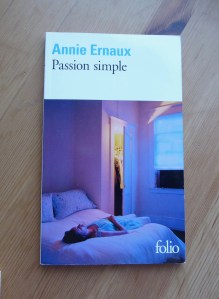
In Simple Passion (Passion Simple), Annie Ernaux analyses a love affair she had with a married man, the previous year. The affair lasted over a year and was all-consuming. She couldn’t think of anything else but him. Couldn’t find interest in anything else or anyone else, unless they somehow reminded her of him or had something in common with him. She sat whole days next to the telephone, waiting for his call. Spent whole afternoons preparing for his arrival; shopping new clothes, painting her nails, applying new make-up.
The absence of a call is agony. A call is bliss. She’s completely dependent on this man and doesn’t exist outside of their meetings. It’s never as apparent as when she goes on a holiday to Florence. She doesn’t even want to look at anything. Just wants to think of him, imagine how he would see the place.
The book describes everything. Her weakness, her dependence, her desire, her obsession. It’s like reading the account of a drug addict. She’s aware of that herself but there isn’t anything she can do. She wonders sometimes, if he feels the same, but she has no idea. Conversation isn’t exactly part of the whole affair. Sex is important, everything else, not so much. But that is also because of the language barrier. It’s not said in this book that he’s Russian, but in a later book it is revealed. She doesn’t speak Russian, and his French, while good, is not always accurate. He has difficulties to translate deeper meaning.
Since he’s a diplomat, it’s always clear, the affair will end. When it does, she’s shattered. And she takes note of the world around her again. And writes about her affair. It takes her five months during which the Berlin wall falls and the Ceaușescus are executed.
After having finished to write about her affair, she suddenly feels shame. A shame she never felt during the affair, a shame that comes from the idea to publish.
I found the way she described this affair interesting. Most of it rang so true. Haven’t we all waited next to a phone before? Spent afternoons getting ready or endlessly talking and thinking about our love interest? I never found it problematic, that she’s honest. I found it problematic that she never questions having an affair with a married man. Not once. It’s all about her and her feelings. He’s only interesting as far as he’s the object of her desire. And the other woman? It’s as if she doesn’t exist. Obviously, this shows how honest she is, as it doesn’t really make her look good.
People were shocked when this came out in the 90s. Also, because it was a departure from her earlier work and because it’s so explicit about female desire and sexuality. It was certainly courageous to write and publish this at the time. Nowadays, I find it a bit sordid. Not because of the descriptions – it’s never very explicit anyway – but, as I mentioned, because there’s another woman. If it’s a feminist act to live our passions, isn’t it also a feminist act to think of the other woman? I’m not judging that it happened, that would be naive, these things do happen, but that she’s never thinking or writing about it.
After the translation of The Years, Annie Ernaux received a lot of attention outside of France. She’s interesting, well worth exploring, but I’d say, this isn’t the best entry point to her work.
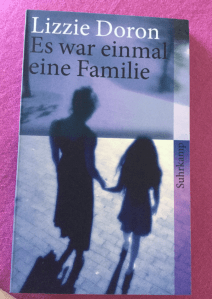
Lizzie Doron is a prize-winning Israeli writer. In her work, she often uses autobiographical elements. She was born in Israel to a mother who was a Holocaust survivor. She lives in Tel Aviv. Her books have been translated into German, French, Italian but not English.
Once There Was A Family, as one would translate the Hebrew title Hajta po pa’am mischpacha, is set in Tel Aviv in the 90s. Elisabeth’s mother, Helena, has died. Elisabeth who has left the neighbourhood, in which she grew up as a teenager, returns to observe shiva in her mother’s apartment. During the seven days of the shiva, many people come to pay respect and keep her company. Some she still remembers, some are strangers. The seven days of the shiva are a journey of remembrance for Elisabeth. She dives deep into memories of her childhood, the neighbourhood, and its people.
Born in 1953, like the author, Elisabeth is second-generation, as the children of Holocaust survivors are called. She grew up alone with her mother in a neighbourhood predominantly inhabited by survivors of the Shoah. Everything turns around their memories. Everything is tainted by their memories. Sadness is everywhere. To the sadness of those who survived, often only physically, the sadness of recent wars is added. Many of the children Elisabeth grew up with die during the Six-Day war in 1963 and the Yom-Kippur war in 1973. Like the author, Elisabeth leaves the neighbourhood at eighteen, joins the army and later goes to live in a kibbutz.
I have never read a book like this before. I have read other Israeli authors, but they didn’t focus on the aftermath of the Holocaust. This book is so moving and sad, but never depressing. It allows us to enter a world, that is long lost but has left its mark on many who are still alive. There are so many books about the Holocaust, but not that many, I know of, which tell about the life in Israel, right after the war. There is no escaping the Holocaust. People feel close, because they went through the same. They differentiate each other, often calling others not by their surname but by the camp they have been in. There is one person called Itta Theresienstadt. They all have this in common – they seem to cling to the past. One of them says “I do not want to be well. I don’t want to sleep. I don’t want to forget.”
And it’s hard to forget as Elisabeth is reminded when the first guests come to the shiva. “One of them was small and scrawny, only bones and wrinkles, the second one tall and big. They stood in the door with crossed arms, as erect as possible, and in the candlelight, one could see the numbers on their arms”.
When there was a festivity in the past, many of the older people got annoyed. “Who are you going to invite? Your mother and father from Treblinka? Uncle Jisruel and aunt Mira from Majdanek? Your grandfather from Dachau?”
Sometimes, the memories are so overwhelming, the inhabitants of the neighbourhood, when asked where they live, still answer with the number of their barracks in Auschwitz, Dachau or Treblinka.
The longer the shiva goes on, the more Elisabeth remembers the good things; not everything was overshadowed by the pervading sadness. Because of the shared past, there was a connection that made them all feel like family. You could rely on your neighbours. They would always help. They would always care. Proof of that are the many flickering remembrance candles in everyone’s apartment.
There is tragedy too. Some cannot shake off the past and eventually choose to kill themselves.
One of the most poignant scenes comes towards the end of the book. Elisabeth remembers the day when she went to the hospital with her mother. The doctor insisted he needed to know something about the family history to diagnose her properly. What illnesses were there in the in the family? Elisabeth tells him that she doesn’t know. “They all died young and healthy.”
“Maybe there are family members you could ask,” the doctor insists. “Oh yes”, Elisabeth says, “of course, we could hold a seance.” The doctor does absolutely not understand why she is so unhelpful and finally gets a social worker who scolds him.“It’s a second-generation case, doctor.”
This last scene is so important because it shows that even in Israel, some might have forgotten that whole families, several generations of them, were wiped out.
I don’t understand why this or other books by Lizzie Doron haven’t been translated into English. It’s a massive omission. This book is so beautiful and important that everyone should be able to read it. Especially if they are interested in the Holocaust and Israel.
In later books, Lizzie Doron focusses more on the relationship between Israelis and Palestinians. I’m very keen on reading them as well.
Here’s a very short video in which she talks about how she experiences the lockdown in Tel Aviv and her fear of dictatorship.
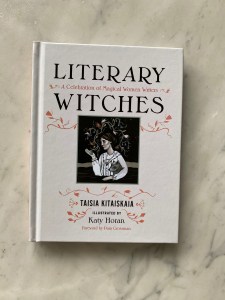
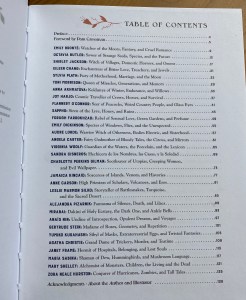
In thirty chapters, Kitaiskaia and Horan pay homage to as many writers. Some like Emily Brontë, Sylvia Plath, Virginia Woolf, Agatha Christie, and Toni Morrison are well known. Others, like Iranian poet Forugh Farrokhzad or Argentinian poet Alejandra Pizarnik, might be a little less familiar. Or, at least, I didn’t know them. The wide range allows many readers to discover new names.
Here is the Table of Contents.
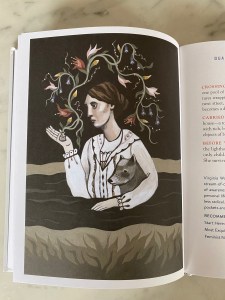
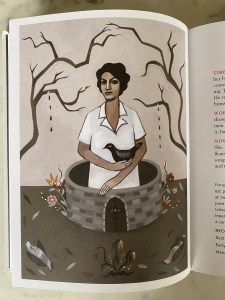
The biggest difference between this and We Are Artists is the way it is presented. The biographies are only one paragraph long and not seven pages like in the book about artists. The illustrations also depict the women and something that symbolizes their writing.
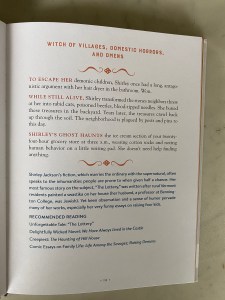
Additionally to the biographical paragraph, you find, on the same page, three fictional paragraphs, inspired by the authors. You could call them flash fiction pieces. They are dreamlike explorations of the writer’s consciousness.
What I liked best are the illustrations. I think Katy Horan is terrific. And I also find the biographical paragraphs useful, especially because there’s also a list of the most important works of the authors.
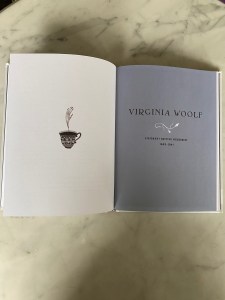
To give you a better idea I’ve chosen three chapters that should help illustrate the book.
Virginia Woolf’s chapter
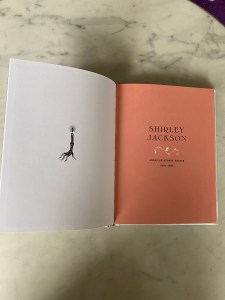
And Shirley Jackson
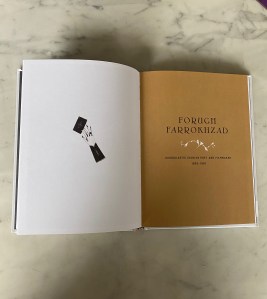
And Iranian poet Forugh Farrokhzad
Literary Witches was published in 2017 and I think I’ve had it since then. I pick it up quite frequently as I like it very much. It’s not the kind of book that I read from beginning to end, more one that I browse.








 Beauty is a Sleeping Cat