Philippe Lioret’s Je vais bien, ne t’en fais pas aka Don’t Worry, I’m Fine (2006)

What if the person you feel closest to would disappear one day without leaving a note? Just like that, without real reason, without explanation. Would you survive to be ripped apart like this?

When Lili returns home from a summer camp and hears that her twin brother has disappeared, she is devastated.  Lili cannot believe it. Her parents tell her that he had a fight with their father and left in anger, just taking his guitar.

Lili cannot understand. He would never leave like this, not call her, not wait for her. She breaks into pieces, doesn’t eat anymore, let’s herself die until she is finally brought to a psychiatric hospital. But that doesn’t help, it is making it even worse. Only when her brother finally sends a post card, telling her not to worry and that he is fine and travelling from one town to the next, she slowly returns to life.

Bookaroundthercorner reviewed the novel by Olivier Adam (not yet translated) on which the movie Je vais bien, ne t’en fais pas is based and mentioned that the movie was as good as the novel. After having read what she wrote I had to see it.

It isn’t easy to write about this movie without spoiling it. Let me just tell you that this must be one of the most moving and touching movies I have ever seen. It is heartbreakingly sad and the ending is not at all what you would expect. It is very well acted. The music is perfect and pulls your heartstrings. It is sad and at the same time it looks at life in a middle class French family, the boredom and the routine but also the dreams hidden under the surface, the clumsy way of communicating and the incredible choices everybody makes. This is a movie that will make you question yourself. What would you have done, how would you have acted and reacted. Each and every one of the four main characters at the core of the story must make decisions, decide whether or not to speak.

Like in most French movies there is also a love story and it is also very touching. As sad as it is, there is a lot of beauty in this movie.

I have to admit that this movie got me all teary eyed which is something that doesn’t happen very often.

The title song of the film has been composed by the French duo AaRON here is their website. In the movie it is said to have been composed by Lili’s bother.

Mélanie Laurent, as Lili, is a really good and very cute actress and also Kad Merad as the father is very convincig. This is the second time I have seen Julien Boisselier in a week (the last time in Les femmes de l’ombre that I didn’t like) and both times I found him very good..

Ed Harris’ Pollock (2000) The Man Behind Drip Painting

Who was the man behind the term Drip Painting, also part of the so-called Action Painting? Did you ever wonder? Before I watched the movie Pollock I was always awed by his paintings, their power, their originality and how easily we could attribute them to the painter. Now I am infuriated. What an asshole.

Be it as it may, this is an excellent movie, showing the struggles of a painter against the backdrop of New York’s art scene in the 40s. We see all the important people of the time, Peggy Guggenheim, Willem de Kooning, Lee Krasner. During that time, important art mostly came from Europe. If it hadn’t been for de Kooning and Pollock, the American art would never have become as important as it finally did.

If it hadn’t been for Lee Krasner, what would Pollock have become? Nothing, I would say and that is what infuriated me. The guy was a mean alcoholic who went on drinking sprees that lasted days and maybe weeks until he woke up somewhere, anywhere, shivering, sweating and without any specific memory of what had happened. Into this mess enters Lee Krasner, a young g aspiring painter herself, immediately she sees Pollock’s genius and does everything to help him. She moves in with him, takes care of him, phones and invites journalists and galleries and rich people.

After a few years they get married. In order to help him stay sober, she convinces him to move to the country where they seem to be happy at first. It is here that he develops his art and goes from abstract expressionism to action painting and later explores the technique of drip painting for which he is so famous. It is fascinating to watch him paint and Ed Harris does an extremely good job.

Unfortunately Pollock doesn’t realize how blessed he is and after being sober for two years he starts to drink again. Only worse this time. He also begins an affair with a much younger woman. After a day of heavy drinking he drives her and her best friend to a party and crashes the car on the way home. Pollock and the friend die.

We never really get know why he is drinking. He just does. And the more Lee Krasner tries to keep him away from it, the more he drinks. It’s common knowledge that no alcoholic will just change because you threaten to leave him. You have to do it. She never does. It doesn’t mean he would have stopped if she had left but to simply threaten him didn’t change one thing and she suffered as well. Apart from a fascination and admiration for his painting, I have no clue what she saw in him. We don’t see them in many intimate moments. They never seem to talk. The Pollock we see in this movie may have been a great painter but he as a very unlikable, selfish character.

Lucky for Lee Krasner she wasn’t in the car, when he crashed it. She lived another thirty years and did her best work after his death.

I really admired her for saying no to his plea to have a child. She correctly saw that this would leave her in charge of two people. Apart from that most of the time they were broke as it took quite a long time until his art was recognized for what it was.

Pollock is a very esthetic movie with a great score featuring jazz from the 40s, Benny Goodman, Billy Holliday, which makes for great atmosphere. All in all it’s extremely well done, highly watchable and interesting.

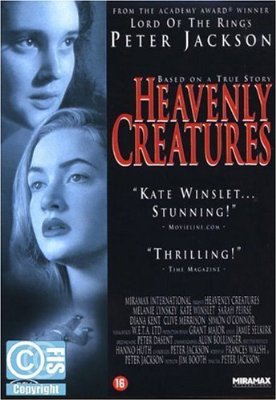
Peter Jackson’s Heavenly Creatures (1994)

A while back Bookaroundthecorner left a comment on one of my posts mentioning that the author of Victorian detective novels, Anne Perry, had committed a murder when she was a young girl. I had never heard of this before and a google search soon led me to more details and to Heavenly Creatures by Peter Jackson entirely based on this story.

I watched it recently and must say it was an utterly disturbing movie. I’m not giving away too much when I tell you what actually happened as it also written on the DVD covers and descriptions of the movie and many people know it anyway. Pauline Parker (Melanie Lysnkey) and Juliet Henry Hulme (Kate Winslet) met in New Zealand in the 50s. The unlikely couple formed a friendship that soon became an obsession, they lived in dream worlds, made up stories and were completely dependent on each other. Juliet (the future Anne Perry) had a very fragile health, a reason why her parents often chose to send her away. The marriage of Juliet’s parents is not working and they want to get a divorce. They decide to send Juliet to South Africa. The girls hope that Pauline will be allowed to come with her but Pauline’s mother is against it. She doesn’t approve of their friendship, correctly senses how unwholesome it is. That’s when the tragedy unfolds. Pauline who hates and despises her mother develops a plan that should allow them to stay together forever. In minute details she plans the murder of her own mother.

The brutality with which they execute their plan is quite a shocker. I still see the pictures in my mind.

They get caught because Pauline carelessly writes down everything in a diary. Both are sentenced but are left out of the correctional institution after two years. There is a condition however; they are not allowed to see each other again.

It wouldn’t be a Peter Jackson movie without any fantastic elements. He chose to show the fantasies of the girls, their dream world. I think I would have opted for a more sober way.

The two actresses are very good, they manage to convey the folly of the two girls brilliantly.

I found the movie to be disturbing for many reasons. Not only because they kill Pauline’s mother, which is quite horrible in itself, but also because I was wondering how you could go on living with a murder like this on your conscience and on top of that being separated from the most important person in your life. I would be interested to know how Pauline dealt with this. I did pity these two deluded girls.

As I said before, this is a highly disturbing movie but one that will keep you thinking for a long time. Also about the narrative technique chosen by Peter Jackson. What kind of movie would this have been, done by another director?

Last but not least, doesn’t it strike you as  highly uncanny to know that someone who committed such a brutal murder makes a living writing murder mysteries. Is this a means to come to terms with the past?

Crimeculture – Books, Movies and More

victorian


I found this great site Crimeculture today and wanted to share it with you as I know that many of you also love crime, thriller, detective and suspense novels and movies. It contains a lot of information, essays, articles, lists on books and films. You will find the books and movies organized by subgenres like Victorian Detective Fiction, Classic Detective Novels, Early Hard-Boiled… Film Noir, Neo Noir, Asian Detectives. I hope you will enjoy it as much as I do. It’s a great resource.

Kubrick’s Barry Lyndon (1975)

I finally watched Barry Lyndon thanks to a comment on  Guy Savage‘s review of one of Thackeray’s novels and after seeing Kubrick mentioned again the very same day on Tuulenhaiven’s blog.

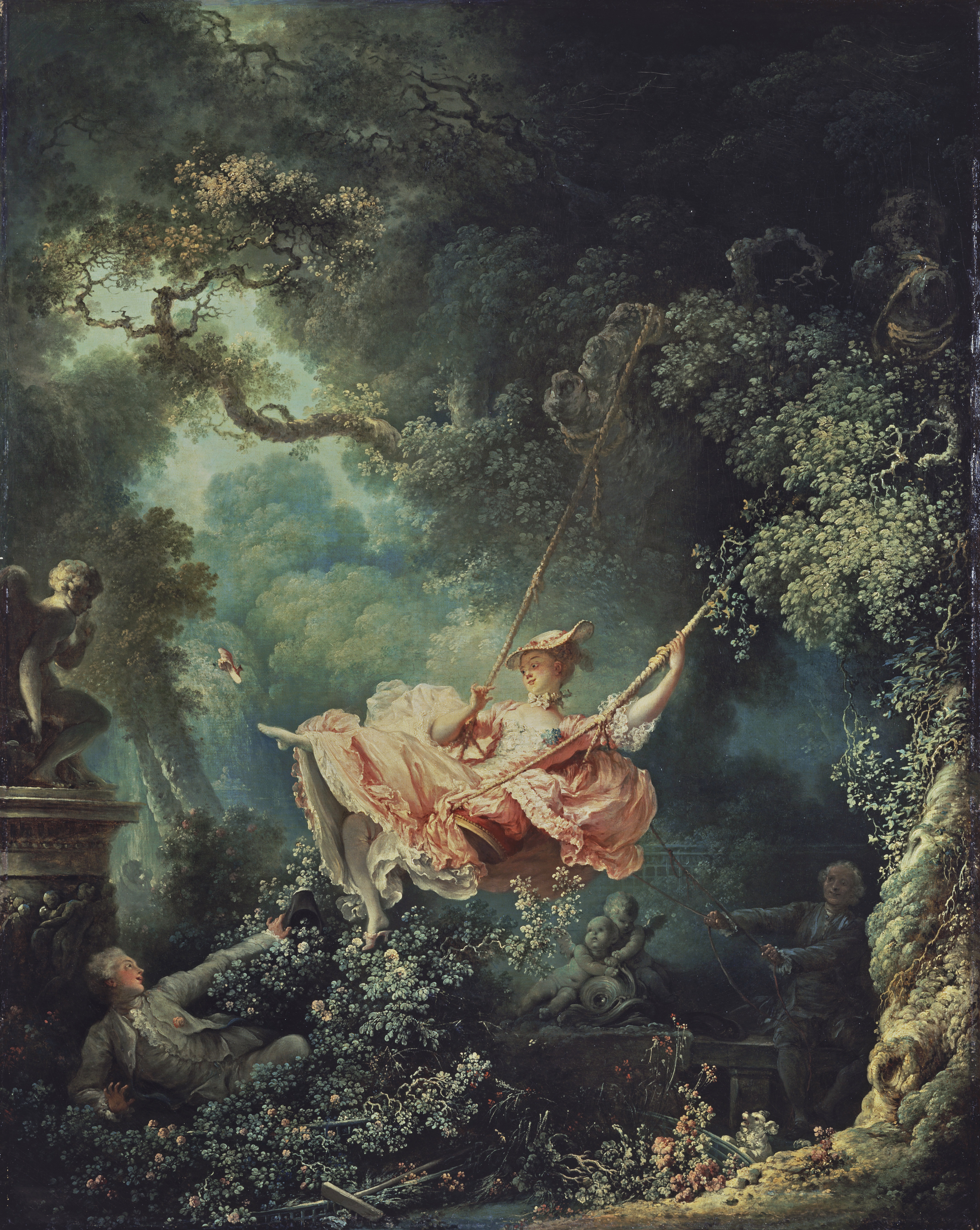
Watching Barry Lyndon is like seeing a Rococo  painting come to life. It reminded me of Fragonard and Watteau. It’s visually astonishing with a sorrowful and beautiful soundtrack (click the second YouTube link if you’d like to listen to it while reading), sumptuous costumes and a lush decor. It is a picaresque story, at least all through the first half. Redmond Barry (Ryan O’Neil), an Irishman who is neither rich nor noble, falls in love with a girl whose family is in need of some substantial financial assistance. Easy to understand that they don’t think that Redmond is a good match. Unluckily he is young and stubborn and thus provokes a duel with the future husband of the girl he loves.

File:Fragonard, The Swing.jpg

After shooting him and seeing his opponent sink down, Redmond is led to believe, he has killed him and is sent off to Dublin with the money of his mother and of a friend of the family. Unfortunately the money is stolen from him on his journey. As is typical for picaresque stories Redmond stumbles from one mishap into the other. He ends up serving with the English army in the seven-year war, deserts, serves with the German army, meets a gambler, helps him… As visually stupendous as the first half is, I wasn’t entirely interested but that changed completely with part two.

In the second half of the film Redmond meets Lady Honoria Lyndon (Marisa Berenson), fancies and seduces her and, after her geriatric husband dies suddenly, he marries her. She is a very rich woman and he will do his very best to spend her fortune. Unfortunately for him and the son she gives him,  he doesn’t automatically acquire a title as well.

The misfortunes and mishaps continue throughout the movie until the end. Redmond brings a lot of those onto himself and I never really liked him until I had time to think about he movie later on.

What made me like the second part is Honoria Lyndon. One of the crucial moments in the movie is when the newlyweds sit together in the carriage. His young wife begs Redmond not to smoke in the carriage and he not only continues but deliberately blows the smoke into her face. At that moment Honoria Lyndon reminded me of Henry James’ Isabel Archer, when she discovers that she has been trapped and that there is no real love in her marriage. The disappointment and disillusionment in her beautiful face was very moving. As said before, I started to be truly interested in what happened once Honoria was introduced. She is such a tragic figure. Redmond gets more and more hateful but in the end, after the movie was over and looking back on all that has happened to him and where he came from, I felt pity for him as well.

Barry Lyndon is a very long and very slow movie. We are meant to dwell on those pictures and – given the choice of the music, Händel’s Sarabande – we can see this movie as a meditation on hope and sorrow.

I don’t know how true the movie is to Thackeray’s novel. We often hear a voice-over commenting Redmond’s actions which sounds as if it was taken directly from the novel. Maybe anyone has read it?

Martin Provost’s Séraphine (2008) The Movie and the Woman Behind it

I come from a family of painters. Everything related to painting has always fascinated me. I remember the smell of oil paint from my childhood. Someone was always fiddling around with paint and turpentine, heavy cigarette smoke in the air… Creativity, inspiration and spirituality are some of the most important things to me. All this and much more is captured in this heartbreaking movie.

Séraphine is one of the most tragic movies I have ever seen. It is based on a true story, on the life of the painter Séraphine de Senlis, cleaning woman, artist, visionary, madwoman. But first, and most touchingly, a vulnerable human being. The actress Yolande Moreau does an absolutely outstanding job in this role. Ulrich Tukur starring as the famous German art collector Wilhelm Uhde is equally good.

In 1914 Uhde rents an apartment in Senlis, some 40 kilometers from Paris, to recover from his stressful life. The cleaning woman his landlaydy hires for him startles him at first. She is very rough and hardly speaks a word, seems completely uneducated. Séraphine is pitied by all and hardly taken seriously. People think that she is slightly mad and very odd. During the days she cleans houses and washes people’s laundry, at night she paints and sings. She produces her own paint, mixtures from blood, wax, juices and other substances. When Uhde sees one of her paintings in the appartment of his landlady, he is astonished. To him, who collects the work of the so-called Primitives,  this is the work of a genius and he can hardly believe it has been painted by someone with no schooling. He asks her to paint more for him and to improve herself. The paintings she produces from now on are getting better and better but when the war breaks out, Uhde abandons Séraphine and flees back to Germany.

He doesn’t go back to Senlis for almost twenty years but when he comes back he finds Séraphine again. She is by now totally impoverished but still paints the most magnificent pictures. He helps her sell them and in a short time she makes a lot of money that she spends without restraint until the second world war announces itself through a huge economic crisis. Uhde looses a lot of money and can no longer support Séraphine. But worst of all, the big exhibition in Paris, to which she has been looking forward to for years, will not take place.

Séraphine doesn’t recover from this shock and goes mad. The scene in which she walks through the village, barefoot and in a silken marriage dress is haunting. She is finally  taken to an asylum where she will stay until her death.

Séraphine’s story is sad but also very mysterious. Where did a simple woman without any background or education take her inspiration from? How did she learn to paint? Séraphine said that the virgin Mary inspired her, she sounded like a visionary, not unlike Hildegard von Bingen who painted too.

She also seesm to have communicated with nature. Many of the visually most powerful scenes of the movie show Séraphine walking over fields, hugging trees. This is her way to connect an refuel.

Séraphine is a thoughtful, almost meditative movie, heartbreaking, moving and utterly fascinating. It is slow-paced and takes its time to unfold.

There are so many mysteries in the world. Art, creativity, inspiration and spirituality are some of the most powerful ones. Thanks to movies like Séraphine, we are reminded of this.

For those who want to see more of Séraphine de Senlis’ paintings, I attached this interesting documentary.

Dennis Gansel’s Die Welle aka The Wave (2008)

Gansel’s movie Die Welle or The Wave is based on a true event that took place in Cubberley Senior High School in Palo Alto, CA, in March/April 1967. The movie is set in present-day Germany which makes it much more powerful. It’s not a flawless movie but it is highly watchable for many reasons notably a outstandig performance of one of the very best German actors, Jürgen Vogel. I simply love this guy. I have never seen him in anything bad but I am afraid he is not widely known outside of Germany, unlike the internationally acclaimed Thomas Kretschmann (King Kong), Till Schweiger (King Arthur, Inglorious Basterds)  and the latest addition of German actors to the Hollywood pantheon, Michael Fassbender (Inglorious Basterds) who is  going to star as Mr. Rochester in the upcoming Jane Eyre.

Gansel has already done an outstanding movie on the Nazi elite training camps, NaPolA aka Before the Fall, so I was pretty sure this couldn’t be bad.

The Wave was an experiment conducted by a teacher  in the US that went very wrong. He wanted to prove to his pupils, who were saying that something like the Third Reich couldn’t happen anymore nowadays, that they were wrong. As said before, to take the same premise and set it in present-day Germany was a great idea. It’s a creepy movie.

Rainer Wenger (Jürgen Vogel), a much liked  teacher (he is anti-authoritarian, young, cool) must lead a project week on autocracy although he wanted to teach anarchy. He is pretty bored by his assignment but he understands soon that the kids in front of him think that totalitarianism, dictatorship and despotism couldn’t exist anymore, that the 3rd Reich wouldn’t be possible in our time. This gets him thinking and he decides to show them that they are mistaken. It is extremely subtle how he proves the contrary and that is why it is so creepy. Watching this movie you think it would not only work in the movie but could really be achieved in real life. The methods Wenger applies are not much different from those used by sects. He first shows them their weaknesses, then strengthens them, tells them how important it is to stick together, that it is only as a group that they are strong… Soon they follow his every word, wear a uniform, want to greet each other a special way… It is not long before they will ostracize those who do not comply. And then it gets out of hand. The kids forget that this is a school project and that they might be taking part in an experiment. They end up taking  it far too seriously and so does the teacher after a certain point.

I really liked the topic of the movie, the way it was done is entertaining and thought-provoking at the same time. And the acting is great. Die Welle encourages you to question assumptions about freedom, individuality, independence, and responsibility. The end is exaggerated, I think, I haven’t read the book or done much research. Die Welle also explores how much power teachers and other authoritative figures have over their charges who admire them and how easily they might be tempted to abuse it.

I would say, this movie is another example of the fact that Germany offers some of the best filmmaking there is.