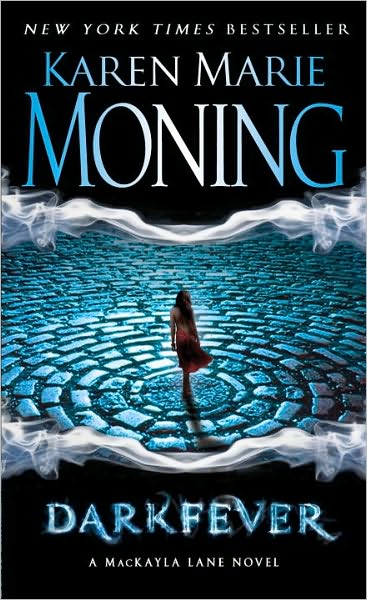
Karen Marie Moning: Darkfever ( 2006) Fever Series I

My philosophy is pretty simple: any day nobody’s trying to kill me is a good day in my book. I haven’t had many good days lately.’ When her sister is murdered, leaving a single clue to her death – a cryptic message on Mac’s cell phone – Mac journeys to Ireland in search of answers. 

What a romp. This was so much fun. If anyone has been looking for a Dark Fantasy version of Janet Evanovich’s Stephanie Plum series, there is good news, Darkfever is exactly what you have been looking for. This is the first in the series of this urban fantasy goes crime of Karen Marie Moning who is better known as a romance writer. Don’t get alarmed, this is not a romance novel although there is a certain undercurrent in it, no, this is a real whodunit, spiced up by some nasty supernatural happenings. There are also some explicit sex scenes and judging from Book Rain’s review, the series is getting steamier from book to book. I’m grateful I read her review because now I know that not only the series ends, but that it is rather like a whole novel in five parts. Although part one has some sort of denouement, the end is a cliffhanger.

Mac (short for Mackayla) is a very naive character. She is also clumsy which is a common cliché in paranormal crime. And she was definitely into the Disney Princesses as a child and still loves pink more than anything else. But having a character like that encounter dark and malevolent beings makes for slapsticky fun.

Trying to overcome the grief over her sister’s murder and in attempt to urge the police to solve the crime, Mac decides to take things into her own hands and flies from the US to Dublin where her sister studied. Before her sister died she left a cryptic message on Mac’s cell phone saying that she had been wrong about someone and something needed to be found. All this is very strange and as soon as Mac arrives in Dublin things get even more mysterious. Despite an intense aversion she befriends Barrons, the handsome but moody owner of a book shop.He agrees to help her find the murderer of her sister but only because Mac can help him find an old and very dangerous book.

Mac, as she soon finds out, is what is called a Sidhe-Seer, someone who can see faeries and other supernatural creatures. This helps her to avoid that some encounters end deadly but it also exposes her. The moment faeries know she can see them she is a threat to them and they hunt her. Additionally she can spot magic objects and since absolutely everyone in this novel seems to hunt for the same magical book Barrons is after, they are all threats to her.

This is a fast-paced novel in which a lot of the action takes place in unlit streets roamed by dark creatures. It’s a decent crime story too and there are a lot of other riddles to be solved and characters who have a hidden side which makes it well worth reading.

In any case, this was a true guilty pleasure and I will definitely read the next in the series.

Louise Welsh: Tamburlaine Must Die (2004)

It’s 1593 and London is a city on edge. Under threat from plague and war, it’s a desperate place where strangers are unwelcome and severed heads grin from spikes on Tower Bridge. Playwright, poet, spy, Christopher Marlowe has three days to live. Three days in which he confronts dangerous government factions, double agents, necromancy, betrayal and revenge in his search for the murderous Tamburlaine, a killer who has escaped from between the pages of Marlowe’s most violent play. The Final Testament of Christopher Marlowe is a swashbuckling adventure story of a man who dares to defy God and state and who discovers that there are worse fates than damnation.

I really enjoyed Tamburlaine Must Die. I liked Louise Welsh’s latest novel Naming the Bones (here’s the review) and wanted to read another one and I wasn’t disappointed. However I know the book got very mixed reviews and this mainly because of the language. Clearly Welsh tried to write 16th century English and might not have been 100% successful. I didn’t care or – because I’m not a native speaker – didn’t notice. I thought the language was beautiful.

In her novella Louise Welsh lets Christopher Marlowe, the famous playwright, tell his final ten days. Someone has written a libel in his name, imitating his writing, signing with the name of the main-protagonist of one of his plays, Tamburlaine. Welsh imgines how and why he must have been killed, how he spent his last days, sleeping with men and women, drinking too much, picking fights, putting himself in danger through his blasphemies.

I think Christopher Marlowe is one of the most fascinating figures of literature. An immensely gifted writer, a rake, a debauchee, a spy, a rough neck, a ruffian, an innovator and subversive man  and many other things. The book is atmospheric and evocative, you see the streets of London, the intrigue, the danger of a city afflicted by the plague, the violence of the times. Any sign of not following the Church, not being loyal to the Queen, being a homosexual were highly dangerous.

We know Marlowe escaped the dungeon but only to face death through an unknown enemy. His murder has never been solved and to this day there are many speculations.

I think I start to realize what type of historical novels I like. I like it when a writer manages to give a voice to historical figures, makes them come alive, imagines how they thought and felt.

One thing that has been criticized is that she didn’t depict a fear-ridden Marlowe although he knew he was going to be killed. I think from what I know of the man, he wasn’t too anxious, he threw himself into life until his last moment. He would have gladly gone on living, writing more plays but if this wasn’t to be, then it wasn’t. As simple as that.

The best about the book is that it sparked my imagination. I’m in the mood to read Marlowe’s Tamburlaine, The Great and Doctor Faustus which influenced Goethe and Thomas Mann and I would also be interested in reading about him.

Louise Welsh based her book to a large part on Charles Nicholl’s The Reckoning: The Murder of Christopher Marlowe but David Rigg’s The World of Christopher Marlowe sounds equally interesting.

Has anyone read any of these or other books about Tudor England?

Jenn Ashworth: Cold Light (2011) Crime and Social Realism

An unsettling, darkly humorous tale of teenage girls in a predatory adult world, and a cocktail of lies, jealousy and unworldliness that leads to tragedy.

I have been looking forward to Jenn Ashworth’s new novel since I read A Kind of Intimacy at the beginning of the year (here’s the review). I had a bit of a problem not comparing the two books but once I let go of that I really liked this novel, it’s disturbing and chilling and you only find out at the very end what really happened.

Cold Light is a very appropriate title for this novel, although – as will be explained towards the end – it refers to bioluminescence.  It is a cold world in which today’s girls move and a predatory one. But is this really all that new? There is a lot that reminded me of my own coming of age. Not for anything in the world would I want to be 14 again. The competitions, the jealousy, the insecurity and the constant fighting off of boys or hoping to be noticed by them – depending on where on the good-looking scale you were positioned – was by far too upsetting. It’s all very horrible and can damage you for life. But there are other things young girls have to cope with nowadays that were not even thinkable 10-20 years ago. And today’s Britain (I’m just finishing Kat Banyard’s book The Equality Illusion and it echoes Cold Light) seems to be even worse than many other places.

Chloe is dead. Chloe will be 14 forever, 14, pretty and romantic. Since her presumed suicide 10 years ago she has become something like a cult figure. A symbol for young love and innocence. Now, ten years later, her former best friend Laura sits in front of her TV in a shabby little apartment and watches the groundbreaking ceremony for her memorial. The ceremony comes to an abrupt and macabre end when human bones are found in the damp soil. Laura nows whose bones they are and from this very first scene in the novel we know that some things must have gone seriously wrong ten years ago and we also know that there is a lot to be found out about Chloe, her ex-boyfriend who died with her and everyone else who was involved.

Laura will be watching TV all night, later joined by Emma with whom she is still in contact. They will be smoking and drinking until the early morning. Through flash backs and parts of their discussion the truth is slowly revealed. It’s the story of three friends who are jealous of one another, an older boyfriend who seems weird, a town in a state of alarm as a flasher who is getting more and more violent is chasing young girls. The three girls are only 14 yet they smoke, drink and have sex. We also hear a lot about innocent Chloe, how she exploited the obsessive best friend feelings of the others, how narcissistic and bullying she was, her delinquency and how she always got away with everything just because she was so pretty. Reading the story from Laura’s point of view we discover a lot about her family, the sadness of her childhood, about her father who seems to suffer from some kind of mental illness, her controlling mother and her obsession with Chloe that turns her into a stalker.

It’s an excellent book, disturbing and accurate and reminded me a great deal of the movie Fish Tank. I also thought of Harry Brown. Both movies paint a bleak picture of British youth. The first one also focusing on young girls being as well prey, victims and perpetrators.

Thanks again to Hodder and Stoughton who send me a review copy.

Winners of the Giveaway of Jenn Ashworth’s Cold Light

As promised, I am announcing the winners of the giveaway today. I have used random. org’s list generator.

The two copies go to

Litlove from Tales from the Reading Room

and

Amy from The House of the Seven Tails

Congratulations.

I will contact you per e-mail or you can send me your address via e-mail.

I have read my copy already and will be posting on it soon.

Georges Simenon: Maigret et les Vieillards aka Maigret in Society (1960)

Last year I felt the urge to read some Maigret and got four books. I reviewed the first Un Noël de Maigret aka Maigret’s Christmas. I liked quite a few things about it and since they are all short, under 200 pages, I thought I might try another one.

I’m not sufficiently familiar with Simenon’s Maigret novels to know which of the two that I have read is the more typical one. All I can say is that I liked the first but I’m completely underwhelmed by the second.

In Maigret et les Vieillard aka Maigret in Society Maigret has to solve the murder of an aristocratic ex-ambassador. He has been shot four times, in his own apartment, in the middle of the night. His old servant found him towards the morning and reports the murder at the Ministry of Foreign Affairs.

Maigret has the pleasure to interview people belonging to the Parisian High Society. A breed he isn’t exactly fond of. Although – typical for Maigret – he never judges people, we still understand how much he disapproves of them and thinks they are all a bit odd.

The Count had a “lover”, a princess, who was married to someone else. For over fifty years he wrote a daily letter to the princess which she would promptly answer. They had intended to get married after the death of her husband which had just occurred before the murder.

Despite the strange habits and a few questionable things he discovers, Maigret doesn’t see a motif or find a suspect.

I’m not sure whether this is a trait of Simenon or the Maigret novels but 80% of the book consists of dialogue. The lack of description and scenes was not to my liking. I love good dialogue but it was a bit average. He got the different talking styles of the people very well but the exchange wasn’t very interesting.

All in all I cannot recommend this novel. I’m also not keen on a detective who smokes a pipe and whose homey wife stays at home waiting for him with the dinner and his slippers …

The thing that I found most interesting is the fact how the books are rooted in their time. The mentioning of the death penalty startled me at first and then I vaguely remembered that the Capital punishment existed in France until the 80s. Should you, for one reason or the other, feel nostalgic about the 60s in France, you might like this.

Since I still have two other books sitting here, my final verdict is outstanding… I already have a feeling that I will have to look somewhere else for a detective series that is really to my liking or stick to those I already know. I think I need to get back to Simenon’s romans durs. They are definitely worth reading.

Jenn Ashworth: Cold Light (2011) Giveaway

This is the tale of three fourteen-year-old girls and a volatile combination of lies, jealousy and perversion that ends in tragedy. Except the tragedy is even darker and more tangled than their tight-knit community has been persuaded to believe.
Blackly funny and with a surreal edge to its portrait of a northern English town, Jenn Ashworth’s gripping novel captures the intensity of girls’ friendships and the dangers they face in a predatory adult world they think they can handle. And it shows just how far that world is willing to let sentiment get in the way of the truth.

Anyone who follows this blog knows how much I loved Jenn Ashworth’s novel A Kind of Intimacy (here is my review). That’s why I am especially pleased to be able to giveaway 2 copies of her new book Cold Light courtesy of Hodder.co.uk.

The giveaway is open internationally. All you need to do is leave a comment and tell me if you would like one of the books. If there is a lot of interest, I will determine the winners with the help of random.org. They will be announced next Monday.

I started reading my review copy and so far I’m enjoying it a lot. It’s different from A Kind of Intimacy but quite captivating as well.

The giveaway ends Sunday June 5 2011.

Gianrico Carofiglio: Involuntary Witness aka Testimone inconsapevole (2002) First in an Italian Legal Thriller Series

A nine-year-old boy is found murdered at the bottom of a well near a popular beach resort in southern Italy. In what looks like a hopeless case for Guido Guerrieri, counsel for the defence, a Senegalese peddler is accused of the crime. Faced with small-town racism fuelled by the recent immigration from Africa, Guido attempts to exploit the esoteric workings of the Italian courts. More than a perfectly paced legal thriller, this relentless suspense novel transcends the genre. A powerful attack on racism, and a fascinating insight into the Italian judicial process, it is also an affectionate portrait of a deeply humane hero.

Former anti-Mafia prosecutor Gianrico Carofiglio is said to write some of the best legal thrillers Italy has to offer. I am not an expert when it comes to legal thrillers but  his novel Involuntary Witness, the first in the series centering on Avvocato Guido Guerrieri, is really good. Guerrieri is such a likable character and the themes of the novel are varied, spanning from racism, immigration, relationships and marriage, the meaning of life, to the Italian criminal system.

Guerrieri has recently been divorced and is very depressed. At the beginning of the novel he has panic attacks, can hardly sleep. He is a vulnerable, pensive  man who likes to read, have long discussions about books, movies and music. He loves St. Exupéry, Picnic at Hanging Rock and the music of David Gray. As a criminal lawyer he has to do some dubious things and tries to ignore whether his clients are guilty or not. After all, he is paid to get them out, no matter what they did. But Guerrieri has  a conscience that’s why he often wonders if what he does is really right. He also lives dangerously occasionally.
One of the best parts of the novel is the change Guerrieri undergoes. The person at the beginning of the novel isn’t the same as the one at the end. Just to watch him, follow him, first through his misery and later when he starts to enjoy life again, feels so realistic. I started to believe after a while that the description was based on a real person.

Guerrieri is good at his job, no doubt about it. There is always work for him. We sense that Carofiglio knows what he is writing about. The descriptions of the city and the court, the people, the lawyers, judges, policemen, prosecutors are realistic. The series is set in the Southern Italian town of Bari, an attractive location, close to the sea.

The story is rather simple. A nine year old boy is found murdered in a well. Due to some unfortunate circumstances a Senegalese immigrant is accused of the murder. The case looks hopeless as there is a lot of evidence against the man. Guerrieri isn’t even sure at first whether he should accept to defend him but he feels pity and finally accepts.

I wasn’t familiar with the subgenre of the legal thriller. At least not in book form. The focus is really on the trial and whether the accused will be sentenced or not. Guerrieri isn’t playing the role of an investigator. He thinks his client is innocent but he doesn’t try to find someone who might have done it or even find out why the child has been killed.

In Italy Carofiglio’s novels are considered to be much more than just thrillers and I can see why. The books seem to tell the story of an interesting man who happens to be a criminal lawyer and is excellent in his job, but this isn’t the most important element of the books. Guerrieri’s outlook on life, the way he sees and analyses people is far more important.

Involuntary Witness is an excellent book and I am certainly going to read the next in the series. I absolutely want to know what happens to Guerrieri and where life and love will lead him.

Do you know the series or any other legal thrillers that you like?