The Radetzky March Readalong – Part 1


SPOILER WARNING – The answers and questions give away important plot points


Welcome to the #germanlitmonth spring readalong of Joseph Roth’s more famous novel, The Radetzky March.  What enticed you to readalong with us?

I’ve read the book ages ago, in school, however, because we started it towards the end of a semester, we never finished it and because we were moving on to other books, I also never finished it for myself. Although more than one book has been spoilt because I read it in the class room, this one wasn’t. I really loved it, just never found the time to get back to it. The longer I waited, the clearer it became, that I couldn’t just read the final chapters but had to start from the beginning.

Which edition/translation are you using and how is it reading?

I’m reading it in the German original. A paperback edition. Unfortunately it is one of those without any introduction or notes. This is decidedly one of those books where notes would have come in handy.

Is the novel living up to your expectations?

It’s in many ways much better than I remembered it. I don’t think I caught how intertwined the themes of death, dying, and the end of an era were. I also didn’t remember how much it focussed on one person and how male-dominated it was.

How would you comment on the first few sentences? Is this an effective opening? “The Trottas were not an old family.  Their founder had been ennobled following the battle of Solferino.  He was a Slovene. The name of his village – Sipolje – was taken into his title.  Fate had singled him out for a particular deed. He subsequently did everything he could to return himself to obscurity.” (Translation: Michael Hofmann)

I found this very typical for its time, but a bit clunky for a contemporary reader. It’s vital information, of course. It also works as foreshadowing of many of the themes, especially the last sentence. It’s just not the kind of beginning that invites you with open arms, so to speak.

Roth subscribed to Chekhov’s view that a writer “should not be a judge of his characters or what they say, but an impartial witness”.  That doesn’t mean that we as readers need to be the same! How do you feel about the hero of Solferino’s crusade to return to obscurity? What are the ramifications of this for his descendants?

I got where he was coming from. I didn’t think he ever saw himself as particularly heroic and the way what he did was described in the school book made him seem even more heroic. On the other hand, his behaviour is typical of the older Trotta’s. They are such a strict, pedantic, joyless lot. And it seemed like he didn’t feel he was deserving of his title.

Carl Josef von Trotta follows his grandfather into the military.  Is his life there honourable and meaningful? Is his fateful relationship with Dr Demant’s wife innocent?

I was wondering while reading these chapters and came to the conclusion that the relationship possibly was innocent. Roth mentions physical contact when it happens but he doesn’t mention it here. I could be wrong, of course, but it would make Demant’s death even more tragic.

Roth may not judge his characters, but his sights are aimed at other targets: the social order and the military code of honour, for instance.  How does Roth critique these?

I think the duel and subsequent death of two officers shows very well how Roth felt about the code of honour. The whole story is absurd and so is the outcome. It doesn’t even matter, whether or not Trotta and Demant’s wife were having an affair. One has also the feeling Demant doesn’t even do it because of his pride, but because he thinks he has to. I’ve come across other duels in novels and they are always used as a means to show how cruel the code of honour was. But I don’t think I’ve ever come across one with quite that outcome. The double death makes it even more cruel and absurd.

Do you have any further comments on this section?

What struck me the most in this section was Carl Joseph’s reaction to Mme Slama’s death. It’s almost as if it hit his core and he wasn’t the same from then on. He immediately associated her death with the decay of her body. I suspect, although I have no proof whatsoever, that this is rather how Roth felt about death. The images of worms eating decaying bodies is recurring. Obviously, it also echoes the death of the monarchy. As a reaction of such a young man, it seemed extreme, but her death could also have triggered an underlying depression, which became aparent in these morbid thoughts.


 

Peach by Emma Glass – Dylan Thomas Prize 2019 Blog Tour @dylanthomprize

Emma Glass’ Peach is one of the books on this year’s Dylan Thomas Prize Long List. The prize is awarded for the best published literary work in the English language, written by an author aged 39 or under. The prize is named after the Swansea-born writer, Dylan Thomas, and celebrates his 39 years of creativity and productivity. I’m very glad I was invited to participate in the blog tour.

When I chose Peach from the longlist, I wasn’t entirely aware of what type of book this would be. I knew it was about a teenage girl who goes to college, has a boyfriend named Green, a best friend, a cat, a baby brother and parents who just seem to have rediscovered sex. And I knew that something horrible, a sexual assault, happens to her. What I didn’t realize was how artful this book would be. I don’t think I’ve ever read anything quite like it outside of poetry or flash fiction. The way Emma Glass works with sound, repetitions, alliterations, onomatopoeia is astounding. What is even more astounding is that this book, while experimental to some degree, still is immensely readable. In many ways, the style she uses seems to tell us that the unspeakable cannot be named. It has to be evoked.

Given the topic, the book isn’t for the faint of heart and it had one of those moments I’ve come to dread – cruelty against an animal. (Spoiler – why do most perverted people in books always, sooner or later torture an animal – mostly, like in this case, a cat?)

I’ve seen some critics argue that this book fell flat because it’s surreal and, at the end, Peach seems to disintegrate. I would disagree. It’s a shocking topic, told in quite horrific short chapters, but there are also some playful absurd moments that I found very impressive and convincing. Many authors who write about horrible things, like Kafka, to name one of the most famous, used the absurd to describe what’s too awful to name. And Emma Glass does just that.

To give you an impression of her stellar writing, I’ll leave you with a few quotes. Nothing captures this book as well as quotes.

The first sentences:

Thick stick sticky wet ragged wool winding round the wounds, stitching the sliced skin together as I walk, scraping my mittened hand against the wall. Rough red bricks ripping the wool. Ripping the skin. Rough red skin.

Page 39

My legs feel heavy and I’m dragging my feet. Shovelling snow with my shoes. Leaving lines behind from my lead legs.

Page 72/73

I lie down on the sofa and shut my eyes. My hands fall straight down to my tummy. Strange. How strange it is. Naturally grasping the firm mass doesn’t feel so strange any more. The lump I have been lugging though loathsome heavy hurting full, it feels like me, like part of me. Ingrained. Embedded. I think about cells, multiplying, millions, every second, every millisecond for millions of seconds how big can I get? How big will I be before I burst? Cells linking, holding hands, making chains, chains winding, chains winding around my core. Spores sporing, pouring.

One more element I’d like to mention are the chapter headings which are equally artful and playful. Here are just a few:

Seam Stress

Sun Screen

Forest for Rest

Final Pieces, Final Peace

Emma Glass was born in Swansea. She studied English Literature and Creative Writing at the University of Kent, then decided to become a nurse and went back to study Children’s Nursing at Swansea University. She lives and works in London. Peach is her first book.

Thanks to Bloomsbury Publishing for a review copy

This year’s longlist of 12 books comprises eight novels, two short story collections and two poetry collections:

  • Nana Kwame Adjei-Brenyah, Friday Black (Houghton Mifflin Harcourt (US) and Riverrun (UK))
  • Michael Donkor, Hold (4th Estate)
  • Clare Fisher, How the Light Gets In (Influx Press)
  • Zoe Gilbert, Folk (Bloomsbury Publishing)
  • Emma Glass, Peach ((Bloomsbury Publishing)
  • Guy Gunaratne, In Our Mad and Furious City (Tinder Press, Headline)
  • Louisa Hall, Trinity (Ecco)
  • Sarah Perry, Melmoth (Serpent’s Tail)
  • Sally Rooney, Normal People (Faber & Faber)
  • Richard Scott, Soho (Faber & Faber)
  • Novuyo Rosa Tshuma, House of Stone (Atlantic Books)
  • Jenny Xie, Eye Level (Graywolf Press)

César Aira – El Tilo – The Lime Tree

Argentinian writer César Aira has been on my radar for a while. I don’t think I have come across any negative reviews of his work so far. On the contrary, most of his readers were more than enthusiastic. Aira is known to be one of the most prolific writers. To this day, he’s written over one hundred books. Obviously, his books are mostly on the short side, nonetheless, it’s an impressive number. It’s also a number that makes it difficult for first time readers to choose a book. Since I’d read a few rave reviews of The Lime Tree, I decided to start with that.

The Lime Tree tells a fictional childhood memoir, set right after the fall of Peronism. The narrator is an older man, looking back on his childhood, exploring the role of History on his personal history. The distinction between History with a capital H and history is a major theme of this novel. The way families, in this case, poor Argentinian families are influenced by the History of the country, its politics, is central. For someone who knows little about Latin American – or Argentinian history – it was very interesting. The book explained very well how someone like Perón could be so popular with the working classes who were hoping for social mobility.

Perón and the fall of Perón, were important for the narrator’s family and therefore also for the narrator himself. But there were other things that would play a role. His father, a very good-looking man, was ‘black’, probably of Indian descent, while his mother is described as dwarf-like and very ugly. His father, an ardent Peronist, suffered from his nerves, after the end of Peronism, and hardly spoke while his mother was a loud, chatty woman.

This duality might help to explain his marriage. My mother was white; she came from a respectable, middle-class family, and if she had acquiesced to an alliance with the ‘black’ populace, it was because her physical deformity made it impossible for her to marry at her own level. The alternative would have been to remain unmarried, and as far back as I can remember, she was always expressing her horror at the condition of ‘spinster’.

For the reader, many of the episodes in the novel are amusing, but when you look at them closely, you notice how much pain and tragedy these parents experienced.

Some readers have complained that Aria doesn’t write chronological tales and that it can be quite challenging to read him. I didn’t mind this at all. Reading The Lime Tree was like listening to the monologue of an older relative who is reminiscing, telling stories of his life, jumping from one topic to the next but always picking up the lost thread again. As with many elements of this book, there’s an echo of this reading experience in the text.

Back then, people had so much time, they would tolerate the craziest monologues. I can’t have been the only one who listened to them with pleasure.

It was fascinating to learn more about a place, Colonel Pringles, in Argentina, during a specific period, the 50s. I found Aria’s approach to telling a story interesting because it mirrored his topic – History and personal history and the way they influence each other. And there are many wonderful, colourful scenes and story elements that I liked a lot, like the description of the way they lived – in one room of an abandoned inn. I would actually love to see this made into a movie.

Will I read more of Aira? It’s possible, but I don’t think I would read him in English again. I just felt very far from the original text. That doesn’t mean the translation isn’t good. I’m sure it is. I just wanted to hear the original cadence. I noticed that there’s a new collection in Spanish due to come out in May – here. It contains ten of his short books. Maybe I’ll pick it up.


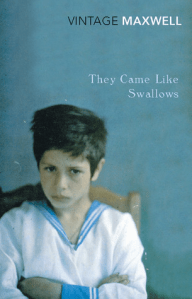
William Maxwell: They Came Like Swallows (1937)

They Came Like Swallows is American author William Maxwell’s second novel. Maxwell was famous as an author and editor. He helped shape the careers of writers like Eudora Welty, John Cheever, John Updike, John O’Hara and many others. I read and reviewed one of his later novels, So Long, See You Tomorrow in the early days of this blog. I was very impressed with it and keen on reading more of his work. Two of his books were suggested in the comments – One was They Came Like Swallows, the other one was The Château. Although I was so keen, it took me eight years to return to him. While I liked So Long, See You Tomorrow more, I found a lot to admire in They came Like Swallows. Once again, it is obvious why he’s called a “writer’s writer”. He’s so skillful.

They Came Like Swallows is a tragic book, even more so because we know it’s based on Maxwell’s childhood story. It’s set at the end of WWI, during the flu pandemic that killed twenty to forty million people. The story is told in three parts, each part told by another narrator. They don’t tell the same story from different angles, but each of them begins, where the other one stops.

Part one is told by eight-year-old Bunny, the younger child of the Morison family. His world turns around his mother and his mother only. He’s a very sensitive child, needs constant encouragement. He also has a keen imagination. Through his eyes we see the world transform into small villages, battles take place, fantastical things happen. His relationship with his older brother Robert is a source of terror. Robert is eight years older than Bunny and has little patience for the kid. At the end of part one, Bunny has been told, his mother’s expecting another child and he has come down with the flu.

Part two is told from Robert’s point of view. The tone is completely different. Robert has sorrows of his own. He’s lost a leg in an accident and tries hard to live a life like any other boy his age. He’s in this in-between state, not a kid anymore, but not yet a grownup. Because his mother had difficult pregnancies in the past, she and the boys’ father leave the kids with an aunt. Robert too, gets the flu and soon they hear that their parents have come down with it as well.

Part three is told from James Morison’s point of view and it’s the most devastating part. It’s obvious from the beginning, the mother will die, it’s only not clear, if anyone else will die, so I’m not going to mention that. The dad’s account is devastating on many levels. He’s lost his wife and the way grief grabs him and threatens to destroy him, is so well described. Equally well described are the reactions of the people who come to the funeral. I always find people are notoriously bad at expressing their sentiments when they hear of someone’s death. All the awkward phrases, the awkward and often unemphatic reactions are captured so well here.

I’m not so keen on stories told by kids usually but it’s done exceptionally well here because William Maxwell uses the kid’s imaginations. He doesn’t try to sound like a child but to let us experience the world through the eyes of a small child and a teenager and, later, a bereaved husband.

Something that struck me was the way the children were treated. Nowadays we have a tendency to treat even small children like grownups and a boy of sixteen would definitely be treated like that. Not so here. The book is eighty years old and to see how much the way we treat children has changed was really interesting.

While I didn’t love this book as much as the last one I read, I’m full of admiration for the craft and looking forward to reading The Château next. And I think it’s an outstanding portrayal of grief and the awkward ways people treat the bereaved. It also shows very well how devastating the pandemic was.

Should you wonder – the title is taken from Coole Park, a poem by William Butler Yeats.

I meditate upon a swallow’s flight,
Upon a aged woman and her house,
A sycamore and lime-tree lost in night
Although that western cloud is luminous,
Great works constructed there in nature’s spite
For scholars and for poets after us,
Thoughts long knitted into a single thought,
A dance-like glory that those walls begot.

There Hyde before he had beaten into prose
That noble blade the Muses buckled on,
There one that ruffled in a manly pose
For all his timid heart, there that slow man,
That meditative man, John Synge, and those
Impetuous men, Shawe-Taylor and Hugh Lane,
Found pride established in humility,
A scene well Set and excellent company.

They came like swallows and like swallows went,
And yet a woman’s powerful character
Could keep a Swallow to its first intent;
And half a dozen in formation there,
That seemed to whirl upon a compass-point,
Found certainty upon the dreaming air,
The intellectual sweetness of those lines
That cut through time or cross it withershins.

Here, traveller, scholar, poet, take your stand
When all those rooms and passages are gone,
When nettles wave upon a shapeless mound
And saplings root among the broken stone,
And dedicate – eyes bent upon the ground,
Back turned upon the brightness of the sun
And all the sensuality of the shade –
A moment’s memory to that laurelled head.

Have you read William Maxwell? Which of his books did you like the most?

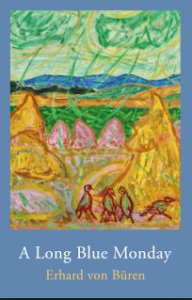
A Long Blue Monday by Erhard von Büren – Swiss Week Readalong

Published in 2013, A Long Blue Monday, is Erhard von Büren’s third novel. His earlier novels Wasp Days and Epitaph for a Working Man were published in 1989 and 2000 respectively. He lives in Solothurn, Switzerland.

A Long Blue Monday tells the story of Paul Ganter, a retired school teacher who has temporarily left his wife and taken an apartment in the city to write a book about Sherwood Anderson. Very possibly he could have done that at home, but we soon learn that this time out is about much more than just writing a book. He uses the time alone to delve into his feelings and memories and relives vividly an unhappy love story that happened over forty years ago, in the summer of 1959. That year he fell in love with Claudia, a girl from a very rich family and, in a desperate attempt to impress her, takes weeks off from school to write a trilogy of plays in the vein of the great American playwrights of the time. Every day he slaves over his work that seems to be a series of soliloquies put on paper. Once it is finished, he gives the play to his crush, hoping it will impress her. Sadly, just like all his other attempts at wooing her, this barely gets a reaction. Clearly, she’s not into him. Looking back, Ganter can’t help but admire the stamina of his younger self. And he realizes that while the result of his writing wasn’t successful, locking himself away, writing daily, going for long walks and experience the changes in the weather and nature surrounding him, was one of the most intense experiences of his life.

The story is told going back and forth in time. In the present, Paul spends a lot of time writing and reminiscing, but he also has long conversations with his daughter who discovers sides of her father she never knew existed. While the love story is central, it isn’t the most important aspect of Paul’s delving into his past. He also remembers vividly what it was like to come from a poor family, in which the men were battling alcoholism. He remembers how difficult it was to know what he wanted to do with his life and to achieve it. Trying to overcome the shortcomings of his upbringing, he became a master student. Unfortunately, for the longest time, he thought that he could master life and love just like he mastered school. This set him up to failure. Being shy didn’t help him either. Love and life choices are explored, but there’s one other important thing—the narrator’s intense love of American culture that finally leads him to become an English teacher and is now one of the reasons for his time out.

I hope my review will have told you several things—this is a very complex, rich book, but it’s neither straightforward, nor plot-driven. Funnily, for a novel that talks so much about American culture, it’s very unlike most American literature I know. It’s introspective and very quiet. Far more analysis of thoughts and feelings, than scenes and action. One could say, more telling than showing. The story meanders, goes back and forth in time, returns to certain events, adds additional information. Just like it happens to all of us in real life. We rarely remember events in a straightforward way.

I liked A Long Blue Monday very much. It’s a quiet book about a quiet, shy man, who feels strongly, struggles and fails, struggles some more, and then succeeds and finds meaning in all sorts of things. My favourite parts were the nature descriptions and if I had read this in English, you’d find dozens of quotes. The descriptions are lyrical and beautifully crafted. They are the most eloquent sign of the narrator’s rich interior life.

While reading A Long Blue Monday, I couldn’t help but think of another Swiss author, who writes similar descriptions— Robert Walser. If you know me, you know this is high praise.

I hope some of you have read this as well. I’m looking forward to the discussion.

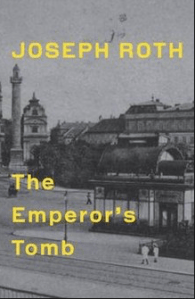
Some thoughts on Joseph Roth’s The Emperor’s Tomb – Die Kapuzinergruft

Published in 1938, Die KapuzinergruftThe Emperor’s Tomb, was one of Joseph Roth’s last novels and the last that was published during his lifetime. Roth died in 1939, in exile, of the complications of a double pneumonia, that was possibly aggravated due to the sudden withdrawal of alcohol.

The Emperor’s Tomb tells the story of Franz Ferdinand Trotta and begins shortly before the first world war and ends with Austria’s Anschluss, the annexation of Austria into Nazi Germany. In many ways the book can be seen as a sequel to The Radetzky March, Joseph Roth’s most famous novel. Usually I would write a brief summary but since this review is part of a readalong and since Emma has already posted an excellent summary of the book, I’ll skip this part and add a link to her post instead – here.

For this post, I’d like to focus on some topics I found of interest.

WWI

As many of the readers of this blog know/may remember, for many years, I hosted a Literature and War readalong. Roth had been a chosen author in the past, even though he doesn’t portray the war as such, as rather the mental state of war, or people during war time. I ususally like this approach but in this novel, it was puzzling for several reasons. As I said before, the book begins before WWI, in 1913, and ends in 1938. While Roth describes the time before and after the war years in great detail, things get blurry from 1914 to 1918, although, allegedly, Trotta spends his years in a Russian POW camp in Siberia. If you’d never read anything about any prisoner of war camps, reading this novel would make you think it was a bit of harsher version of a boy scout camp. There aren’t any details described. No fighting happens. This is puzzling, if not bizarre. My knowledge of war literature made me assume one thing – Roth spent his WWI years sheltered. Although I own a huge Roth biography, I haven’t read it yet, but I picked it up and overflew some passages that confirmed what I suspected. He was enlisted but since he was initially considered unfit for military service, he never saw any action, but spent the war years behind a desk. Apparently, to explain why he hadn’t seen any action during the war, he pretended that he had been in Russian captivity, which isn’t true. I think this shows clearly that he must have felt guilty. While I’m not familiar with his earlier years, I know a bit about his final years, and guilt has been a defining emotion for Roth. Once it’s clear that this is why the book is so unspecific when it comes to the actual war, one can move on and concentrate on other elements. As a portrayal of the end of an era and the end of a class system, this is absolutely brilliant and nuanced. And while Trotta’s war experience lacks realism, the way he feels when he comes home doesn’t, because the strong feeling of alienation and of being a stranger in one’s own country was something many Austrians felt at that time.

Women

Before going to war, Trotta marries a girl, Elisabeth, he’d been in love with for ages. Due to a sad story, involving a servant, the marriage isn’t consummated and his new wife flees, angry. When he returns from the war, she’s not exactly keen on seeing him. Like so many women back then, she’s learned to live a life according to her own choices. She certainly doesn’t want to abandon her freedom. And she is living with another woman with whom she clearly is in a physical relationship. Trotta isn’t happy about this but he’s not prejudiced. If it had been a man, it would have been the same to him. Only he might have felt more threatened as the only reason why his wife, in the end returns to him, is because she wants a child. Once the child is born, however, it doesn’t hold her back and she leaves it with his father. I found this surprisingly modern. I’m sure Roth was freethinking when it came to relationships, but I also think that Elisabeth is a character that was quite common at the time. It’s sad to think that so much of that freedom was lost again later.

Austrian pre-war diversity

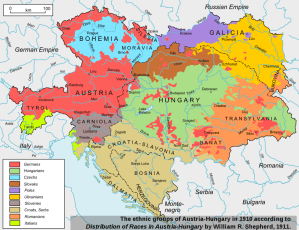
I don’t think I’ve ever read an author that made me realize just how diverse the Austro-Hungarian Empire was. It was a multinational state, with people speaking different languages, following different religions. In this book Trotta, who is descendant of the non-aristocratic line of the “von Trottas”, feels a stronger connection with the peasant side of his family. While he’s called “Herr Baron”, he doesn’t identify with the aristocracy. When a cousin from Sipolje comes to claim a part of his inheritance, he also introduces Trotta to a friend. That friend invites Trotta to spend time with him in Galicia. Then the war breaks out. Trotta suddenly feel estranged from his former aristocratic friends and asks to be transferred to the regiment in which his cousin and the friend serve. Back in Vienna, after the war, Trotta mourns not only the past but the missed opportunity. He believes that Austria-Hungary could have been a really great state, especially due to its diversity, but instead, it only chose the German part.

Final thoughts

This is a flawed book. The structure is uneven and the war section is so far from realistic, it’s almost painful. Nonetheless, I loved this book. I love Roth’s writing, the mournful tone, his description, his humanity. And there’s also some gentle humour. Roth is outstanding at showing people’s quirks. The portrait of the mother in this book, is an excellent example. At first, she’s very rooted in her old ways, but once change has come, she embraces it and enjoys it because it means there’s new life, where there was only stuffiness before. Sadly, it’s all an illusion, but she’ll never really find out.

I’m glad, Lizzy chose this novel for her readalong. You can find her thoughts here.

This was my fifth Joseph Roth novel and so far, I’ve liked them all. If you’re interested, here are my reviews of Weights and MeasuresHotel Savoy and of Flight Without End.I’ve read The Radetzky March pre-blogging.

Simone Buchholz – Blue Night – Blaue Nacht – German Literature Month Crime Readalong

Blue NightBlaue Nacht is the sixth book in Simone Buchholz’ Chastity Riley series and the first to be translated into English. I discovered the book last year in a book shop, not realizing it was part of a series, or I would have started with book one. Oddly, the English translation has the subtitle “Chastity Riley book 1”. Be it as it may, I’m so glad I finally read it. I love noir and this is noir at its best.

State attorney Chastity Riley has done a few stupid things and so she’s not working in the state attorney’s department anymore but for the witness protection. This bores her no end. Feeling she needs some change, she takes her car and drives to the country. The car breaks down and Chastity is stranded somewhere on the road. Where other people would look for the beauty around them, all she sees is a lack of streets and people. And too much countryside. Yikes. Barely gone for a few minutes, she misses Hamburg, the Reeperbahn, the seedy haunts, her ex-gangster lover Klatsche, and the bars where she drinks until the early hours. This beginning sets the tone and introduces a character who is witty, sarcastic, laconic, lyrical, and always different.

Back in Hamburg, she’s assigned to look after a man who has almost been killed. He’s been beaten up severely and has lost one finger. It looks a lot like retribution. With cunning, kindness, and a lot of beer, Chastity manages to get his trust. While he doesn’t reveal his identity, he gives her enough information to begin investigating a crime ring.

The story is definitely interesting and offers a look into the drug problems big cities with large ports like Hamburg face these days. Cheap, dangerous drugs, produced in the East, are distributed in the West with maximum profit. The people in charge are able to wash their money and while everyone knows it, the law can’t touch them.

As interesting as the story is, it pales in comparison to the cast of characters and the style. Chastity Riley is a loner at heart but one with a crowd of friends. Some were formerly criminals, some are policemen, bar tenders, restaurant owners. A charming element of the book is that they all get a voice. In between the regular chapters are chapters in which each of the protagonists, including the nameless man, the criminals, Chastity and her friends get their say. In some books this type of approach doesn’t work, but here it lifts the book to another level.

I read a lot of crime novels this year, but this is the one I liked the most. The voice is so unique, the style so brilliant that it can keep up with a lot of literary fiction that is published these days. And the mood and tone are reminiscent of some of the best noir I’ve read in recent years.

I read this in German, that’s why there are no quotes. Please visit Pat’s blog (added below) to get an idea of the style

Other reviews:

Pat – South of Paris Books