Georges Simenon: Maigret et les Vieillards aka Maigret in Society (1960)

Last year I felt the urge to read some Maigret and got four books. I reviewed the first Un Noël de Maigret aka Maigret’s Christmas. I liked quite a few things about it and since they are all short, under 200 pages, I thought I might try another one.

I’m not sufficiently familiar with Simenon’s Maigret novels to know which of the two that I have read is the more typical one. All I can say is that I liked the first but I’m completely underwhelmed by the second.

In Maigret et les Vieillard aka Maigret in Society Maigret has to solve the murder of an aristocratic ex-ambassador. He has been shot four times, in his own apartment, in the middle of the night. His old servant found him towards the morning and reports the murder at the Ministry of Foreign Affairs.

Maigret has the pleasure to interview people belonging to the Parisian High Society. A breed he isn’t exactly fond of. Although – typical for Maigret – he never judges people, we still understand how much he disapproves of them and thinks they are all a bit odd.

The Count had a “lover”, a princess, who was married to someone else. For over fifty years he wrote a daily letter to the princess which she would promptly answer. They had intended to get married after the death of her husband which had just occurred before the murder.

Despite the strange habits and a few questionable things he discovers, Maigret doesn’t see a motif or find a suspect.

I’m not sure whether this is a trait of Simenon or the Maigret novels but 80% of the book consists of dialogue. The lack of description and scenes was not to my liking. I love good dialogue but it was a bit average. He got the different talking styles of the people very well but the exchange wasn’t very interesting.

All in all I cannot recommend this novel. I’m also not keen on a detective who smokes a pipe and whose homey wife stays at home waiting for him with the dinner and his slippers …

The thing that I found most interesting is the fact how the books are rooted in their time. The mentioning of the death penalty startled me at first and then I vaguely remembered that the Capital punishment existed in France until the 80s. Should you, for one reason or the other, feel nostalgic about the 60s in France, you might like this.

Since I still have two other books sitting here, my final verdict is outstanding… I already have a feeling that I will have to look somewhere else for a detective series that is really to my liking or stick to those I already know. I think I need to get back to Simenon’s romans durs. They are definitely worth reading.

Franz Kafka: Brief an den Vater – Letter to My Father (1919)

This letter is the closest that Kafka came to setting down his autobiography. He was driven to write it by his father’s opposition to his engagement with Julie Wohryzek. The marriage did not take place; the letter was not delivered.

In his preface he [the translator Howard Colyer] states that he was most concerned to reproduce the raw “venting of feelings” in the letter as well as the extraordinary “momentum of the prose.” In both these aims he succeeds. Unlike earlier, and fussier, versions, his translation catches the naked energy of the original.

Written in 1919 and published posthumously in 1952 Brief and den Vater or, in its latest English translation, Letter to My Father, is a unique piece of writing. Although decidedly a letter, Max Brod, did not include it in Kafka’s correspondence but in his other work.

Before going into details I have to say a few words about the title. Being a native German/French speaker I did read the German original but since this blog is written in English I attached the English cover.  This latest translation is called Letter to My Father while former translations were either known as  Letter to His Father or Dearest Father. The title of the German, which of course hasn’t been given by Kafka himself,  would best be translated as Letter to the Father. I think that choosing a pronoun wasn’t a good idea, be it “his” or “my”. Dearest Father isn’t satisfying either. It is the opening of the letter but it gives the wrong idea. This isn’t a nice letter by a loving son. A neutral title like the one chosen for the German original is by far the best version, closely followed by Letter to His Father. Why a translator, who claims to want to stay close to the raw venting of feelings, chooses the possessive determiner “my” eludes me.

Putting aside my reservations regarding the choice of the English title, I would really like to urge anyone interested in Kafka who hasn’t done so already to read this book. It is incredibly precious and sheds a light on many of Kafka’s novels and stories, and can show where a lot of the angst and torment came from.

Kafka was already 36 years old when he wrote this letter that he never gave or sent to his father. Five years later Kafka would be dead. The trigger for the letter was his father’s reaction to Kafka’s engagement with Julie Wohryzeck. This is the second engagement in Kafka’s life, the first to Felice Bauer was equally broken off.

In his long letter Kafka gets square with his father. He describes in detail his upbringing, analyzes his father and himself and leaves almost nothing unsaid. It would have been interesting to know how his father would have taken such a letter but judging from the descriptions he wouldn’t have been impressed.

Reading the letter was equally fascinating and painful. We understand how much Kafka was afraid of this Über-Vater who was nothing less than a preposterous tyrant. Whatever he said was the abolute truth. He never doubted himself for one second and would never tolerate any contradiction. One of his favourite methods of education was irony and crushing his children with his verbal superiority. He would abuse and swear and make them look ridiculous. All of Kafka’s friends were criticized, all of his ideas were ridiculed.

The worst was how different the two men were. Hermann Kafka was a strong, vulgar, muscular, irascible, energetic man with a very loud and overbearing voice. He loved to eat huge amounts of food and swallow them down very fast. Franz on the other hand was weak and frail, sensitive, hesitant and delicate and represented everything his father despised.

The constant bullying and criticism infused him with feelings of guilt, anxiety and insecurity. But he also realized that his father wasn’t a superior being at all. Being degraded by someone who isn’t special must have made him feel even worse. His father scolded the children when they misbehaved at the dinner table but everything he asked of them, he didn’t do.

One part I found particularly interesting was Kafka’s analysis of his father’s Judaism. He clearly saw it as what it really was, a phony way of being accepted by society. He didn’t really believe or live according to the religion, he only used it to show himself in public and to further intimidate his son.

An endless source of pain were the different ways of seeing sexuality. When barley 16, Kafka’s father urges the young man to visit brothel,s and every time he wants to get married, he tells him to go and see prostitutes instead of getting married to the next best woman.

I can imagine how painful, crushing and ultimately damaging it must have been to grow up with such an egotistical bully.

The letter is very dense and offers much more on different other topics. If you are interested in Kafka and like his work, you shouldn’t hesitate to read it. The fear of the father hasn’t often been put into such eloquent words.

Jenn Ashworth: Cold Light (2011) Giveaway

This is the tale of three fourteen-year-old girls and a volatile combination of lies, jealousy and perversion that ends in tragedy. Except the tragedy is even darker and more tangled than their tight-knit community has been persuaded to believe.
Blackly funny and with a surreal edge to its portrait of a northern English town, Jenn Ashworth’s gripping novel captures the intensity of girls’ friendships and the dangers they face in a predatory adult world they think they can handle. And it shows just how far that world is willing to let sentiment get in the way of the truth.

Anyone who follows this blog knows how much I loved Jenn Ashworth’s novel A Kind of Intimacy (here is my review). That’s why I am especially pleased to be able to giveaway 2 copies of her new book Cold Light courtesy of Hodder.co.uk.

The giveaway is open internationally. All you need to do is leave a comment and tell me if you would like one of the books. If there is a lot of interest, I will determine the winners with the help of random.org. They will be announced next Monday.

I started reading my review copy and so far I’m enjoying it a lot. It’s different from A Kind of Intimacy but quite captivating as well.

The giveaway ends Sunday June 5 2011.

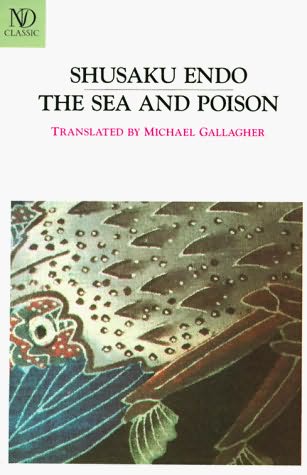
Shusaku Endo: The Sea and Poison aka Umi to dokuyaku (1958) Literature and War Readalong May

Against the backdrop of World War II, Japanese writer Endo ( Scandal ) explores the nature of morality. In this novel, originally published in Japan in 1958, the author examines the inner lives of three characters in the central drama, a grisly vivisection of an American prisoner of war, in an attempt to understand what conscience, or lack of conscience, allowed them to participate in such an atrocity.

The Sea and Poison is the first novel in this readalong that truly upset me. It’s an excellent book but so depressing and bleak, it reminded me of Kafka’s In the Penal Colony which was so far one of the most disturbing books I have ever read. I was afraid that the part on the vivisection might be too graphic but Endo is far to subtle a writer to be too explicit. The horror lies somewhere else.

The Sea and Poison is divided in three parts plus a prologue. Each part is told from another point of view, part 2 from different points of view. It is set during WWII in a hospital outside of the city of Fukuoka. Before we even hear about the planned vivisection on American prisoners of war we get to see the doctors at work. What we see is highly depressing. They do not seem guided by the love of their fellow human beings but purely because they are careerists and love power. Seldom have I read such an utterly negative depiction of doctors. This is best shown in the way they treat poor patients. They are unfriendly and heartless, whether they die or not, it doesn’t matter. It seems as if they did try to excuse this with the war as Suguro thinks:

No doubt it was a time when everybody was on the way out. If a man didn’t breathe his last in the hospital, he might well die that night in an air raid.

The central story is the vivisection which isn’t described in great detail. What is at the core is the study of the people who take part in it. “The old man”, chief surgeon Dr. Hashimoto and Dr. Asai are in charge. Dr. Toda and Dr. Suguro, two young interns, will assist, and two nurses will help as well. We do not hear much about Hashimoto’s motivations or only what Toda explains to Suguro:

“Doctors aren’t saints. They want to be successful. They want to become full professors. And when they want to try out new techniques, they don’t limit their experiments to monkeys and dogs. Suguro, this is the world and you ought to take a closer look at it. “

However we get to know Toda, the nurse and Suguro’s motivations and their stories. What is important is to underline that they could have refused. All three of them were asked whether they were willing to particpate and none of them refused.

Suguro is the only one with a conscience, still he accepts because the proposal comes at a moment of utter disillusionment. He has lost a patient and has seen how “The Old Man” lied about a patient he lost. He sees how many people are killed in air raids, how hopeless it is to help. When he is asked he doesn’t really say yes but he can’t refuse. Only at the last moment does he back off and doesn’t want to touch the patient.

The nurse has a complicated and sad life story. It seems as if there is nothing in this world for her anymore after her personal tragedy. It looks as if she was thinking “If I am miserable, why shouldn’t the others be?”

And Toda? Toda is a being without any feelings. Since his early childhood he is aware that he doesn’t care about other people, that he cannot connect. He has no empathy, no compassion. Occasionally he wonders if there is something wrong with him but at the end of the day he thinks that most people are like him.

I would like to ask you. Aren’t you too, deep down, unmoved by the death and sufferings of others? Aren’t we brothers under the skin perhaps? Haven’t you, too, lived your life up to now without excessive self-recrimination and shame? And then someday doesn’t there stir in you, too, the thought that you are a bit strange?

The questions the novel poses are manyfold and extremely interesting. One could ask whether those who do not directly kill the prisoners are as guilty as those who kill them. Is Suguro who can’t say no and watches but doesn’t touch the patient less guilty than the chief surgeon who performs the surgery?

And what about the chief surgeon? He is a man who is responsible for the death of many people. He performs a surgery and it goes wrong. He makes mistakes, people die. Is he less guilty of those deaths than of those of the American prisoners?

The type of questions this novel poses are the same that were asked in Germany after the war as well. Were those who watched and let things happen less guilty than those who took an active part? This made me think of Macbeth. Who is guiltier? Macbeth who did the killing or Lady Macbeth who had the idea?

I know it is said that this novel explores individual responsibility in wartime. I’m sure that is an important topic but I think two other things were far more important. I think this book criticises doctors and health care professionals in general, showing them as too keen on success and power, as heartless and inhuman. And it also wants to illustrate that people are selfish and mean.

I cannot say I “liked” this book but I did find it extremely thought-provoking, the writing is captivating and the character studies interesting.

I’m really looking forward to read what you thought of it.

Please read also what others wrote:

Anna (Diary of an Eccentric)

Danielle (A Work in Progress)

Gary (The Parrish Lantern)

Mytwostotinki

Novroz (Polychrome Interest)

*****

The Sea and Poison was the fifth book in the Literature and War Readalong. The next one will be Primo Levi’s If This is a Man aka Se questo è un uomo. Discussion starts on Friday June 24, 2011 .


Dutch Reading Month in June

I just wanted to raise awareness for the upcoming Dutch reading month that will be organized by Iris on Books. She already hosted the read along for Harry Mulisch’s The Discovery of Heaven and now, all through June, we will be reading Dutch books. There are already quite a lot of people who want to participate. I did a post a while back with Dutch reading recommendations. If you would like to participate, have a look at my Dutch Book Recommendations or at those Iris is giving on her Blog.

I’m not sure what I will read but I enjoy the fact that I don’t have to decide in advance.  I have two new books on my TBR pile, one is Tommy Wieringa’s Caesarion, the other one Willem Frederik Herman’s The Darkroom of Damocles. Both have been recommended by Lizzy (Lizzy’s Literary Life) and by Iris.

You can also find recommendations on The Dutch Foundation For Literature.


Bernice L. McFadden: Glorious (2010)

Glorious is set against the backdrops of the Jim Crow South, the Harlem Renaissance, and the Civil Rights era. Blending fact and fiction, Glorious is the story of Easter Venetta Bartlett, a fictional Harlem Renaissance writer whose tumultuous path to success, ruin, and ultimately revival offers a candid and true portrait of the American experience in all its beauty and cruelty.

What an entertaining and well written book! I always say that I don’t like historical novels but I really liked this one a great deal. I had a feeling I had only just started when it was already finished.

Glorious tells the story of the fictitious Harlem Renaissance writer E.V. Gibbs whose maiden name was Easter Venetta Bartlett.

Easter’s story is a blend of fact and fiction and from what I can judge McFadden put a lot of effort into the research of her topic and manages to weave it artfully into the story.

I was drawn into the book from the first pages on. In the prologue we read about the tragic beginning of Easter’s story. I liked the way McFadden did this in adding a long list of sentences  and paragraphs all starting with “If….” It exemplifies something that is on my mind a lot, namely the one single instance or occurrence in which a fatal or happy series of events is triggered, the one crucial point that determines the course a life will take.

If her father hadn’t won a boxing match, Easter’s sister wouldn’t have been raped. If that hadn’t happened her father wouldn’t have had an affair and her mother wouldn’t have died. If her mother hadn’t died, Easter wouldn’t have left her hometown and if….

But it did happen and Easter leaves. First she stays with relatives in the Jim Crow South until she witnesses a lynching.  She escapes and joins a travelling circus where she meets the charismatic, lesbian Rain. Easter will not stay very long with the circus and moves on. After some more trials and tribulations she arrives in New York.

She settles down in New York, finds a job that pays he bills, meets a man from the Caribbean and gets married.

Since her early days Easter has always written stories. In New York, after having met Rain again and been introduced to Meredith Tomas, the rich wife of a Cuban plantation owner, she is discovered as the great hidden talent she is. All the prominent people of the Harlem  Renaissance like her writing and she is very influential.

Chance however is not on her side. Her husband who attempts to murder Marcus Garvey, dies soon after her talent has been discovered and Meredith, consumed by envy of her talent, steals Easter’s novel.

The last chapters fast forward some 4o years and we see what has become of  Easter who is now an elderly woman working as a maid in her hometown.

As I said, this book is based on a lot of facts and I’m pretty sure, that it is to a large extent inspired by Nella Larsen’s biography whose career did also end with an accusation of plagiarism.

The beginning in the Jim Crow South is maybe the best part of the novel. The descriptions are very powerful and almost cinematographic. What a monstrosity the South of those days was. It made me think of the song Strange Fruit. I have been collecting versions of it for years now.

Glorious will not be my last Bernice McFadden novel. She really is a very talented writer and it was a highly entertaining read. I already got her first novel Sugar here.

I’m amazed that she hasn’t been translated into German. If there is one market for which her novel would be perfect, it is the German one.

I wouldn’t have read this book if it hadn’t been for a comment by Anna (Diary of an Eccentric) who mentioned it on my first Nella Larsen post.

Here is the link to Anna’s review and to my first Nella Larsen post on Quicksand and to the second on Passing.

Last but not least here is the link to Bernice McFadden’s Blog.

I couldn’t resist and have attached one of my favourite Strange Fruit versions sung by Nina Simone. The video is worth watching as well. It’s very shocking.

Anton Chekhov: The Black Monk aka Чёрный монах (1894) and Peasants aka Мужики (1897) Stories

The Black Monk (Penguin 60s)

Unlike Tolstoy or Dostoyevsky, Chekhov isn’t known for his novels but for his short stories and his theater plays. Some people believe that there has never been a finer short story writer than him. I agree, he is an accomplished writer and reading him is a real joy. I had this little Penguin book containing The Black Monk and Peasants for years now but never got around to reading it.

I have read many of Chekhov’s stories and I’m well aware that he was someone who was interested in the fate of the Russian peasant and the poor, nevertheless I don’t think I have ever read anything by him that was as bleak as these two stories.

They are very different but there is a common topic in those stories which is illness. Mental illness in the first and a neurological illness in the second.

The Black Monk tells the story of the Master of Arts Andrey Kovrin. Kovrin feels exhausted and tired and decides to go and spend the summer with his former mentor, the famous horticulturalist Pesotsky and his daughter. Being an orphan, Korvin grew up with Pesotsky and loves him dearly. The old man has a wonderful estate with beautiful gardens and orchards that produce a lot of fruit and vegetables.

The beginning of the story is very idyllic. Korvin enjoys the beauty of the gardens, the company of his friend and to work on his numerous projects. Nobody seems to be aware at first that he hardly sleeps. He is very nervous and overeager and works like a mad man. Strange thoughts haunt him and he constantly thinks of a tale that he once read about a black monk who is a real person in one place but a sort of mirage in others.

As idyllic as the story starts it soon gets darker when Korvin not only to sees the black monk but speaks to him as well and finally has a nervous breakdown. I found this a highly interesting story as we think at first that it is a ghost story and then realize that Korvin is psychotic. This reminded me a lot of Maupassant’s Le Horla and there could be an influence. The Black Monk is a story of a nervous breakdown that leads to hallucinations and visions that are so intense that Korvin takes them for real. He believes everything the monk tells him and what he tells him flatters him.

The black monk says to Korvin that he is one of the chosen ones, an artist and that artists never see the world like everybody else.

But how do you know that men of genius, in whom the whole world puts its faith, haven’t seen ghosts too? Nowadays scientists say genius is akin to madness. My friend, only the mediocre, the common herd are healthy and normal.

After the breakdown Korvin undergoes a treatment with bromides, gets a lot of rest and becomes extremely depressed. His visions are gone and so is his feeling of grandeur. Being cured is insufferable to him. Chekhov’s psychological insight is really amazing. I’m not sure whether Korvin suffers of schizophrenia but it could be. He could also be bipolar. Both explanations are possible and both illnesses have the trait that during the moments of (megalo)mania the patient is quite happy. Often however they don’t sleep, don’t eat, are highly agitated and a break down mostly puts an end to the high.

Peasants is a completely different story. Nikolay Chikildeyev is a waiter in Moscow when he starts to develop a strange illness. His legs get numb and he cannot work anymore as he falls constantly. It isn’t said what it is but it could have been a neurological affliction or MS. In any case he decides to go back to the country and take his wife and his daughter with him.

What follows is unbelievable and I think it must be one of the bleakest stories I have ever read. Chikildeyev’s family are peasants and so incredibly poor, it would be heartbreaking. I did say “would” on purpose because these people are not only poor, they are dirty and brutal, constantly drunk, they hate each other and life, they are mean and abusive.

During the summer and winter months there were hours and days when these people appeared to live worse than cattle, and life with them was really terrible. They were coarse, dishonest, filthy, drunk, always quarreling and arguing amongst themselves, with no respect for one another and living in mutual fear and suspicion.

On the other hand they are extremely religious but in a very irrational way. No one can read and would really know what is in the Bible but they mix up elements the priests said, with Bible quotes and childish beliefs and wishes and pure superstitions. They believe in heaven and hell and the Virgin Mary but without a clear idea what each of them really means. The holidays are followed religiously as each of them is an opportunity to get drunk.

If they could choose they would rather be dead than alive but on the other hand they are extremely scared of being ill and hate Chikildeyev because he is a mirror of their own frailty.

Far from having any fear of death, Marya was only sorry it was such a long time coming, and she was glad when any of her children died.

What is also amazing is the fact that some of the older peasants wish themselves back to serfdom as they were at least fed regularly.

I have never read anything like it and it felt almost like reading nonfiction as it is written in a very realistic and detailed way. It seems as if  Chikildeyev’s illness was just a pretext to have these outsiders come to that place of desolation and depravity. The story also underlines that when you have lived under such circumstances for a long time you hardly see them any more and certainly do not see that you are part of the problem.

Both stories are amazing and show how talented Chekhov was. I cannot say I “liked” them but I would recommend them because they are very enlightening. They show you the talent of an author and the reality of a society of which we don’t know that much anymore but that has certain traits and elements that can still be found nowadays.