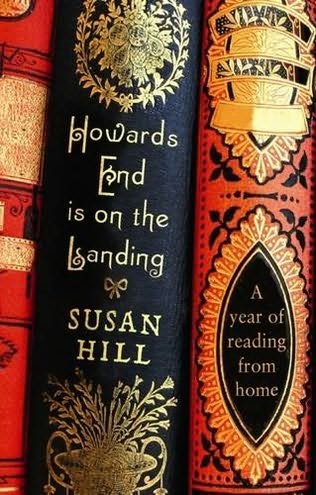
Susan Hill: Howards End is on the Landing (2009) A Bookish Memoir

Early one autumn afternoon in pursuit of an elusive book on her shelves, Susan Hill encountered dozens of others that she had never read, or forgotten she owned, or wanted to read for a second time. The discovery inspired her to embark on a year-long voyage through her books, forsaking new purchases in order to get to know her own collection again. A book which is left on a shelf for a decade is a dead thing, but it is also a chrysalis, packed with the potential to burst into new life. Wandering through her house that day, Hill’s eyes were opened to how much of that life was stored in her home, neglected for years. Howard’s End is on the Landing charts the journey of one of the nation’s most accomplished authors as she revisits the conversations, libraries and bookshelves of the past that have informed a lifetime of reading and writing.

I can’t tell you exactly how long it took to read this book. An evening? Two? Certainly not longer. I devoured it. What is more fascinating to read than a bookish memoir? And written by a writer. On top of that Howards End is on the Landing also contains some information on Strange Meeting, the first book I chose for my Literature and War Readalong.

Shouldn’t we all stop buying books from time to time and first read what is at hand, on our own shelves? This is exactly what Susan Hill did for a whole year. During this year she discovered and rediscovered a lot of books and writers, was reminded of many memories that are linked to books and writing and chose her own personal canon of 40 books.

It is an extremely interesting and entertaining and at times frankly puzzling book. Susan Hill doesn’t read Canadian or Australian literature. Why not? Too foreign. She thinks Joyce, Proust and a few others are unreadable. Are they? There were bits and pieces of information like this that did surprise me. But she is honest. She isn’t pretending for one second. It is obvious that this is the book of a reader, it is nothing like Francine Prose’s outstanding Reading Like a Writer, it is only about personal choices and tastes. There are whole chapters dedicated to her favourite female writers: Barbara Pym, Anita Brookner, Virginia Woolf, Penelope Fitzgerald and Iris Murdoch.  She has met quite many of the writers she mentions and tells anecdotes that are interesting too.

One whole chapter is dedicated to diaries, another one to picture books, one to things that fall out of books, another one is dedicated to annotations in books and  she muses over short stories (not her favourite form).

Sebald gets a whole chapter which surprised me after what she said about Proust and Joyce and others. I’m glad I am already reading his Austerlitz or I would have to rush and get one of his books. She really makes him sound appealing. I agree with her, there is no writer like Sebald.

His subject matter is extraordinary, unpredictable and odd – he seems to collect the unusual and be interested in the outlandish, but, through his eyes, even the ordinary and prosaic becomes somehow strange. Everything he sees, everywhere he goes, every person he meets, all are filtered through some curious lens of his own devising.

Something that I liked is her evaluating some of the classics and giving advice with which one of their novels one should start. One should read Hardy’s The Mayor of Casterbridge and not start with Tess of the d’Urbervilles or Jude the Obscure. Sounds sensible.

If she had two choose among the ghost stories she knows, she would choose M.R. James’ O Whistle and I’ll Come to You and Edith Wharton’s  Mr Jones. Given that it’s a genre in which she excels, I take her word for it.

When it comes to short stories in general she likes John McGahern, William Trevor and Katherine Mansfield.

Travel books are also covered and here it is Patrick Leigh Fermor who gets a special mention. He is also mentioned in her chapter on editing books, something she has also been doing for quite a while. Fermor is one of her authors.

One chapter I enjoyed particularly was the one on diaries. I would have liked to start all the books mentioned right away and have never heard of some the authors she loves to read and reread. Namely the Reverend Francis Kilvert and Frances Partridge. But she also loves Virginia Woolf’s A Writer’s Diary and, surprisingly (as she doesn’t like his novels at all), The Journal of Sir Walter Scott.

All in all I highly recommend this book. It’s very colloquial and reading it feels like talking to a good friend about the books and stories he or she likes. I found a lot of books I’m looking forward to reading now, especially those that are waiting on my shelves. In this sense it is an inspiring book that put me in the mood to concentrate more on the books I already have and not acquire so many news ones.

Out of the list of 40 novels she indicates, I chose to reproduce a list of the novels written by women that she thinks to be among the best. I chose only the women because a) they are not as numerous and b) I would like to read more female authors this year and c) you should still have a reason to read her memoir.

I read and reviewed Carson McCullers and read To the Lighthouse as I have read all the novels by Virginia Woolf (except Voyage Out). The Rector’s Daughter and The Blue Flower are those I am most curious about.

Which ones of these novels do you know and like?

The Ballad of the Sad Café by Carson McCullers

The Last September by Elizabeth Bowen

Middlemarch by George Eliott

The Blue Flower by Penelope Fitzgerald

To the Lightouse by Virginia Woolf

The House of Mirth by Edith Wharton

The Rector’s Daughter by F.M Mayor

The Pursuit of Love by Nancy Mitford

The Bell by Iris Murdoch

Family and Friends by Anita Brookner

The Finn Family Moomintroll by Tove Jansson
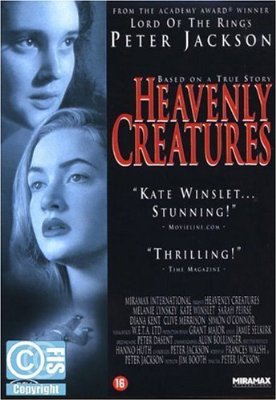
Peter Jackson’s Heavenly Creatures (1994)

A while back Bookaroundthecorner left a comment on one of my posts mentioning that the author of Victorian detective novels, Anne Perry, had committed a murder when she was a young girl. I had never heard of this before and a google search soon led me to more details and to Heavenly Creatures by Peter Jackson entirely based on this story.

I watched it recently and must say it was an utterly disturbing movie. I’m not giving away too much when I tell you what actually happened as it also written on the DVD covers and descriptions of the movie and many people know it anyway. Pauline Parker (Melanie Lysnkey) and Juliet Henry Hulme (Kate Winslet) met in New Zealand in the 50s. The unlikely couple formed a friendship that soon became an obsession, they lived in dream worlds, made up stories and were completely dependent on each other. Juliet (the future Anne Perry) had a very fragile health, a reason why her parents often chose to send her away. The marriage of Juliet’s parents is not working and they want to get a divorce. They decide to send Juliet to South Africa. The girls hope that Pauline will be allowed to come with her but Pauline’s mother is against it. She doesn’t approve of their friendship, correctly senses how unwholesome it is. That’s when the tragedy unfolds. Pauline who hates and despises her mother develops a plan that should allow them to stay together forever. In minute details she plans the murder of her own mother.

The brutality with which they execute their plan is quite a shocker. I still see the pictures in my mind.

They get caught because Pauline carelessly writes down everything in a diary. Both are sentenced but are left out of the correctional institution after two years. There is a condition however; they are not allowed to see each other again.

It wouldn’t be a Peter Jackson movie without any fantastic elements. He chose to show the fantasies of the girls, their dream world. I think I would have opted for a more sober way.

The two actresses are very good, they manage to convey the folly of the two girls brilliantly.

I found the movie to be disturbing for many reasons. Not only because they kill Pauline’s mother, which is quite horrible in itself, but also because I was wondering how you could go on living with a murder like this on your conscience and on top of that being separated from the most important person in your life. I would be interested to know how Pauline dealt with this. I did pity these two deluded girls.

As I said before, this is a highly disturbing movie but one that will keep you thinking for a long time. Also about the narrative technique chosen by Peter Jackson. What kind of movie would this have been, done by another director?

Last but not least, doesn’t it strike you as  highly uncanny to know that someone who committed such a brutal murder makes a living writing murder mysteries. Is this a means to come to terms with the past?

John Marsden: Tomorrow, When the War Began (1993) An Australian Page-turner

When Ellie and her friends go camping, they have no idea they’re leaving their old lives behind forever. Despite a less-than-tragic food shortage and a secret crush or two, everything goes as planned. But a week later, they return home to find their houses empty and their pets starving. Something has gone wrong–horribly wrong. Before long, they realize the country has been invaded, and the entire town has been captured–including their families and all their friends. Ellie and the other survivors face an impossible decision: They can flee for the mountains or surrender. Or they can fight.

Sometimes you want to read for pure entertainment, something that is fast-paced, action-packed but still interesting. Tomorrow, When the War Began is exactly like that, a real page-turner. I discovered the book on Jenclair’s blog last year and am really glad I read it. I am not too much into  series but this start into the Tomorrow Series was really gripping. Too bad that it isn’t an independent book. It’s rather a series in the spirit of the TV series Lost. It always ends when it’s most supenseful, when something big happens. You really have to go on reading if you want to know what’s going to happen next. Jenclair has read all the books meanwhile. You can find her second review here.

Ellie and her friends go camping instead of participating in a cattle show that takes place during Commemoration Day. They make a trip into the Australian mountains and discover a place that very possibly no one has ever seen before. Or only one person, a hermit, who is said to have lived there. The hermit is a man who has been accused of the murder of his wife and baby and escaped into the mountains.

The place they discover is enchanted. It seems to belong to another world, untouched by civilization. They enjoy their stay a lot and leave only reluctantly. When they arrive at their homes, the coming back is a brutal one. Their houses and farms have been abandoned, their animals are dead or dying. Bit by bit they discover that Australia has been invaded and all the people are captives.

The adventures that follow are numerous and dangerous. They first need to find out what happened, then they need to make decisions. How are they going to live and where? How will they hide, what will they eat? It seems natural that they return to the hidden place in the mountains. The country is swarming with foreign soldiers and every expedition is a trial.

We never hear who has invaded the country but we learn why. People in neighbouring poor countries couldn’t accept that a lot belongs to a few rich people and they came to redistribute what is here.

What I liked particularly is the setting. I have never been to Australia but I have seen movies and it is a country whose landscape fascinates me. The setting is rendered very well, in a very descriptive manner. I liked the exploration of topics like war, murder, social justice and injustice. I was just wondering for a moment if it is ethical, to base a book on the idea that poor people or a poor country could act in such an aggressive way. I think what Marsden had in mind, was raising the awareness that there are people less well off than those in the Western hemisphere. Another question that arose was whether they would have the military power to invade.

The characters are not all equally well drawn, two stay a bit schematic but that may change in the future books, maybe they will be more developed.

If you want to read something that is really absorbing, this is a good choice.

Did I mention it is a YA novel? I often enjoy the topics they explore and this is no different. Part one of the series has been made into a film. I haven’t seen it, no idea if it is any good.

Do you like series and if so which ones?

Edith Wharton: Madame de Treymes (1907) Novella with Parisian Setting

Madame de Treymes (Penguin 60s)

Set in Paris, Wharton’s 1907 novel explores the theme she and Henry James so often examined; the conflict between American innocence and corrupt Europe.

Even a short novel like Madame de Treymes (just 80 pages long) shows you what a masterful writer Edith Wharton was. This is the oldest of her novels that I have read so far. It came out after her enormous success The House of Mirth (1917) which I want to read very soon as well. The Age of Innocence (1920) and Ethan Frome (1911), both books that I have read, are later ones. Another one that I have found in my hopelessly overstuffed book shelves is Summer (1917).

Madame de Treymes has a Parisian setting which always appeals to me, as sentimental as this may be. It is a cruel little book and a very surprising one. All in all there is not a lot of description of the city itself, the novel rather offers an analysis of the society. It is interesting to see how Americans perceived the Parisian society and the differences in their respective values.

John Durham knew Mme de Malrive when she was still called Fanny Frisbee. Once a lively young American woman, she has become but a mere shadow of herself. She married into the Faubourg St Germain society, meaning Parisian upper-class. Stuffy, traditional and very unwelcoming to outsiders. She lives separated from her husband as he has cheated on her. She would like a divorce but is afraid to lose her son and doesn’t want to move him from Paris. Durham always liked Fanny and intends to marry her and, if needed, stay with her in Paris.

The only person Fanny trusts is Mme de Treymes, her sister-in-law, who disapproves as much of her brother as Fanny herself. Durham turns to her for help and what follows is a tragedy of manners, if I may say so.

This little story, as beautifully written as it is, made feel quite chilly. I am surprised to see that the Parisian upper-classes (to which I never belonged but am fairly familiar with) haven’t changed that much.

The differences between the American and the Parisian way of life is nowhere to be seen so well as when Durham and his sister visit Fanny at her house. The house, a rundown old mansion in a poky street, causes the follow exclamation from his sister:

“Well, if this is all she got by marrying a Marquis”.

Wealth meets status and it is funny to see how those down-to-earth rich Americans are absolutely not impressed with the shabby elegance they encounter. On the other hand, they were not aware of the power of ancestry and heritage which reignes in the society into which Fanny has married.

Durham felt, as he observed them, that he had never before known what “society” meant; nor understood that, in an organized and inherited system, it exists full-fledged where two or three of is members assembled.

But Wharton doesn’t only dissect the French society she also lays bare the lack of culture of some of the Americans.

To Mrs Durham, with her gentle tourist’s view of the European continent, as a vast museum in which the human multitudes simply furnished the element of costume, the Boykins seemed abysmally instructed, and darkly expert in forbidden things (…)

As the title indicates, Mme de Treymes is the central figure, the most complex character, much more than you can deduce from this post. She is also married to the wrong man and lives a scandalous life, having a  lover, yet she would never even think about leaving her husband. This would be too open a rebellion against the society of which she is a much more integral part than Durham and Fanny realize.

Mme de Treymes is a wonderful example of what an adept writer can achieve even in such a short form as the novella.

The topic of the American in Paris is interesting and would certainly be worth exploring further. Hemingway, Gertrude Stein and many more come to mind who wrote about it.

I think that to this day Paris is the city Americans are mostly likely to visit if they have to make a choice. At least that is what I have been told lately by different Americans. Maybe we could call this the “mythical Europe”.

Should you like to read another review of one of Edith Wharton’s books, Guy Savage just reviewed The Old Maid which rekindled my interest in Wharton that had unfortunately been dormant for a while. As soon as I get a chance I will continue with Summer and The House of Mirth. She is such a wonderful writer and one of a few where I could imagine reading everything she has written.

Which is your favourite Edith Wharton novel? I remember I liked The Age of Innocence a great deal.

Crimeculture – Books, Movies and More

victorian


I found this great site Crimeculture today and wanted to share it with you as I know that many of you also love crime, thriller, detective and suspense novels and movies. It contains a lot of information, essays, articles, lists on books and films. You will find the books and movies organized by subgenres like Victorian Detective Fiction, Classic Detective Novels, Early Hard-Boiled… Film Noir, Neo Noir, Asian Detectives. I hope you will enjoy it as much as I do. It’s a great resource.

Takashi Atoda: The Square Persimmon and Other Stories (1991) Magical Japanese Short Stories

The Square Persimmon and Other Stories is an introduction to one of Japan’s most popular and versatile writers of fiction. In these eleven stories, Takashi Atoda examines universal themes – first love, lost love, change, fate – thriugh unmistakably Japanese eyes. The dreamlike quality of some stories invites the reader to draw his own conclusions in the denouement. Yet, in each one, Atoda brings to bear his precise style and his own unique vision, by turns mysterious, romantic, darkly humourus, and even bizarre.

I found this truly magical short story collection thanks to Novroz’ review of the book. She made it sound so appealing, I absolutely had to read it. I couldn’t agree with her more, The Square Persimmon is a wonderful short story collection, enchanting, haunting and mysterious… Very, very special.

I have never reviewed a short story collection and it is a bit hard. Summarize the individual stories? Summarize the whole book? Short stories are often so much richer than novels, to do them justice isn’t an easy task. To describe these is even more difficult as they are so mysterious. To try to capture their essence is almost like describing scent.

I think the most intense reading experience is one that connects you to your own soul, that triggers something in you and lingers. Atoda’s stories even made me dream at night. I almost entered an altered state of consciousness while reading them. He managed to touch the part in me where memories lie buried and dreams have their origin. This doesn’t happen very often. They made me remember things I thought I had forgotten and sort of intensified everything. The best parts of his stories are like those rare dreams that we dream during our lifetime, in which we want to stay forever. The mood, the atmosphere and the feelings will stay with us for a long time.

Apart from two of the stories, they are all very Japanese. They describe Japanese customs, food, places, philosophy, esthetics, sensitivity, and history.  One recurring element is the use of flashbacks. The people in these stories encounter something that makes them remember someone or a place that is long gone, maybe dead. Another wonderful element is the description of the seasons. The cherry blossoms in spring, the leaves in autumn. They are meant to remind us of our perishability. The description of beauty’s utter fragility is another element. Each story has additionally a twist and a mostly surprising ending.

The stories are all melancholic and often sad. The protagonists look back on something that has passed. At the present moment none of the characters is really happy, they look back on lost happiness. Nevertheless the interactions that take place in the present are touching and intense, the people in the stories reveal themselves to those they talk to.

To give you an example I will just pick two of my favourite stories.

In Paper Doll a man walks by a house in which he used to live as a child. It’s a beautifully elegant house. He had completely forgotten about this house, his childhood and a special friend – a girl – he had when he was a little boy. His life is not a particularly happy one. Like many of the characters in the stories he isn’t well off, struggles to make a living, doesn’t have a lot of joy. After he has discovered the house, he walks by daily and remembers more and more of those days long gone. His memories are like a treasure, they transform his dull days and fill him with an intense joy and happiness.

The Honey Flower also evokes a memory. A man remembers a summer he spent in the country during the war in 1944. The horrors of war are masterfully blended with the memory of the little boy and his little beautiful girlfriend. The children met in secret to drink nectar out of giant white blossoms that grow on a tree.

Atoda has written 40 short story collections. The Square Persimmon is meant as an introduction to his work. The stories have been chosen by his translator. The aim was to show what a versatile writer he is. His writing is extremely varied, at times lyrical or melancholic, absurd or full of black humor. In her foreword his translator, Millicent M. Horton, mentions the Proustian quality of some of his stories. This is high praise but I would say it is more than deserved.

Literature and War Readalong January 28 2011: Strange Meeting by Susan Hill

The end of the month will arrive sooner than we think and I just wanted to remind you that I am going to post on the first book in the Literature and War Readalong, Susan Hill’s Strange Meeting on January 28. I hope some of you have read it and will participate in the discussion and maybe post as well. It’s a short novel of barely 200 pages. The novel tells the story of two very different men who meet during WWI. The first four novels of this read along are all dedicated to WWI. The only one that is slightly longer (300 pages), is the April choice, Carol Ann Lee’s The Winter of the World.

To get you in the mood for Strange Meeting, here’ s a quote taken from Susan Hill’s website

My great uncle Sidney was killed on his 18th birthday at the Battle of the Somme and his photograph in uniform was on the dresser in my grandmother’s house so as a young child I always asked about him. The Great War began to haunt me from then and my interest became an obsession after I heard Benjamin Britten’s War Requiem in Coventry Cathedral. I knew I would have to write a novel about it but first I read everything I could – memoirs, biographies, history, letters. I wrote the novel in 6 weeks, at home in Warwickshire, and in my rented house in Aldeburgh, where I tramped across the marshes in the rain and mud and saw the ghosts of dead soldiers rising up in front of me.

But having finished it, my interest in the First World War was exorcised and it has never returned.

Another quote that seems important in the context is the poem Strange Meeting by Wilfred Owen which Susan Hill certainly had in mind.

It seemed that out of battle I escaped
Down some profound dull tunnel, long since scooped
Through granites which titanic wars had groined.

Yet also there encumbered sleepers groaned,
Too fast in thought or death to be bestirred.
Then, as I probed them, one sprang up, and stared
With piteous recognition in fixed eyes,
Lifting distressful hands, as if to bless.
And by his smile, I knew that sullen hall, –
By his dead smile I knew we stood in Hell.

With a thousand pains that vision’s face was grained;
Yet no blood reached there from the upper ground,
And no guns thumped, or down the flues made moan.
‘Strange friend,’ I said, ‘here is no cause to mourn.’
‘None,’ said that other, ‘save the undone years,
The hopelessness. Whatever hope is yours,
Was my life also; I went hunting wild
After the wildest beauty in the world,
Which lies not calm in eyes, or braided hair,
But mocks the steady running of the hour,
And if it grieves, grieves richlier than here.
For by my glee might many men have laughed,
And of my weeping something had been left,
Which must die now. I mean the truth untold,
The pity of war, the pity war distilled.
Now men will go content with what we spoiled,
Or, discontent, boil bloody, and be spilled.
They will be swift with swiftness of the tigress.
None will break ranks, though nations trek from progress.
Courage was mine, and I had mystery,
Wisdom was mine, and I had mastery:
To miss the march of this retreating world
Into vain citadels that are not walled.
Then, when much blood had clogged their chariot-wheels,
I would go up and wash them from sweet wells,
Even with truths that lie too deep for taint.
I would have poured my spirit without stint
But not through wounds; not on the cess of war.
Foreheads of men have bled where no wounds were.

I am the enemy you killed, my friend.
I knew you in this dark: for so you frowned
Yesterday through me as you jabbed and killed.
I parried; but my hands were loath and cold.
Let us sleep now…’

I will try from now on and post a quick note on all the books of the readalong during the first weeks of each month.