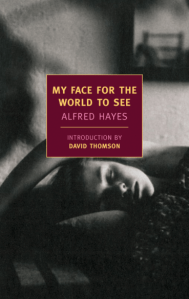
Alfred Hayes – My Face for the World to See (1958)

This wasn’t the best reading year for me. While I was very lucky with my nonfiction choices, more than one novel was a dud. Imagine how happy I was to see my faith in literature fully restored before the end of the year. Alfred Hayes’ novel My Face for the World to See is just marvelous. A perfect gem of a novel. I couldn’t fault a thing. I discovered it a few years ago on Guy’s blog here, but forgot all about it until Jacqui reviewed another of Hayes’ novels, The Girl on the Via Flaminia.

Alfred Hayes was born in London but moved to the US as a child. In 1943 he was drafted and spent time in the US army, in Italy. In Italy he contributed to some of the most famous scripts of Italian neo-realist cinema – Rosselini’s Paisà and de Sica’s Bicycle Thieves. The following ten years, he worked as a screen writer in Hollywood, writing  scripts for people like Fritz Lang, John Huston and many more.

While The Girl on the Via Flaminia, his earlier novel, is set in Italy, My Face for the World to See is set in Hollywood.

Before starting the review, I’d like to share the opening paragraphs, which set the tone and the mood of the novel.

It was a party that had lasted too long; and tired of the voices, a little too animated, and the liquor, a little too available, and thinking it would be nice to be alone, thinking I’d escape for a brief interval, those smiles which pinned you against the piano or those questions which trapped you wriggling in a chair, I went out to look at the ocean.

There it was, exactly as advertised, a dark and heavy swell, and far out the lights of some delayed ship moving slowly south. I stared at the water, across a frontier of a kind, while behind me, from the brightly lit room with its bamboo bar and its bamboo furniture, the voices, detailing a triumph or recounting a joke, of those people who were not entirely strangers and not exactly friends, continued. It seemed silly to stay, tired as I was and the party dying; it seemed silly to go, with nothing home but an empty house.

With hindsight, it’s amazing to see how perfect this beginning is. It captures the tone and the mood of the novel, as well as the narrator’s character. The narrator – he’s never named – is a successful, rich script writer, who spends some months of the year, in Hollywood, far from his wife and kid, who stay in New York. He’s successful but it doesn’t seem to mean much to him. He could be part of a crowd but he stays outside. There’s one person one could call a friend, the host, but other than that, he seems like the ship he watches – passing by, detached. At the same time, he’s the guy who is eternally watching, witnessing. A couple of moments after this short intro, he’s again a witness – this time to the near-suicide of a young, pretty wannabe actress. He saves her and this act is the beginning of a terrible mistake. While he may think he’s just being friendly when he contacts her again, it dawns on the reader that loneliness and boredom – also mentioned in the first paragraphs – might be the true reasons.

From that moment on, the reader gets to witness an awful Maelstrom of an affair. The beginning is somewhat sordid and the end disastrous.

I absolutely loved this novel because of the tone and the mood. And the writing style. It’s pared down and economical, not one superfluous word. It’s also chilling at times, because the narrator never fully engages with anything that happens. It’s almost as if he’s never really there. And the more he is withdrawn, the more the girl seems to sink deeper and deeper into her despair. I felt so sorry for this girl. A typical pretty small town girl who comes to Hollywood with big dreams, which a crushed instantly. She was hoping for “My Face for the World to See”, but what she gets instead is the wrong male attention. Almost all of her lovers seem to have been married and, invariably, it ends badly and she tries to console herself with alcohol. There’s a scene with a cat, who she loves dearly, that’s utterly heartbreaking.

I think one reason why I loved this so much is because it reminded me of Dorothy B. Hughes fantastic novel In a Lonely Place, which made my best of list in 2016. I’m sure Hayes knew the book and certainly knew the movie with Humphrey Bogart. Even though My Face for the World to See isn’t a crime novel, it has all the trademarks of a noir like In A Lonely Place. There’s the melancholy mood, the jaded, lonely people who try to connect but fail, love affairs that turn bitter within weeks.

Of course, Hollywood is the perfect setting for a story like this and one can easily see that Hayes knew what he was writing about.

I’m not entirely sure I will write a best of post this year, but if I do – My Face for the World to See will be on it.


A Tardy German Literature Month Wrap-up and Radetzky March Readalong Announcement

Does anyone else feel November went fast? I only just wrote a welcome post to German Literature Month and now it’s already over. That’s not why I’m late though. I caught a nasty cold.

I’d like to thank everyone who participated. It’s always wonderful to see all of your choices and your enthusiasm. So, thank you very much.

If you haven’t done so already, please add your posts to the German Literature Month Site. I’m still playing catch up and Lizzy’s collecting links for a final wrap-up post.

If you haven’t seen Lizzy’s post, you might not know that we are planning a Readalong of Joseph Roth’s Radetzky March early next year. The date hasn’t been fixed yet, so I’d like to know what would work for you.

We would like to extend this readalong over the course of one month, posting weekly on predefined portions of the novel. There will be questions, for those who’d like to use them, that will facilitate discussion.

I hope you’ll join us.

And thanks again for your participation.


A Long Blue Monday by Erhard von Büren – Swiss Week Readalong

Published in 2013, A Long Blue Monday, is Erhard von Büren’s third novel. His earlier novels Wasp Days and Epitaph for a Working Man were published in 1989 and 2000 respectively. He lives in Solothurn, Switzerland.

A Long Blue Monday tells the story of Paul Ganter, a retired school teacher who has temporarily left his wife and taken an apartment in the city to write a book about Sherwood Anderson. Very possibly he could have done that at home, but we soon learn that this time out is about much more than just writing a book. He uses the time alone to delve into his feelings and memories and relives vividly an unhappy love story that happened over forty years ago, in the summer of 1959. That year he fell in love with Claudia, a girl from a very rich family and, in a desperate attempt to impress her, takes weeks off from school to write a trilogy of plays in the vein of the great American playwrights of the time. Every day he slaves over his work that seems to be a series of soliloquies put on paper. Once it is finished, he gives the play to his crush, hoping it will impress her. Sadly, just like all his other attempts at wooing her, this barely gets a reaction. Clearly, she’s not into him. Looking back, Ganter can’t help but admire the stamina of his younger self. And he realizes that while the result of his writing wasn’t successful, locking himself away, writing daily, going for long walks and experience the changes in the weather and nature surrounding him, was one of the most intense experiences of his life.

The story is told going back and forth in time. In the present, Paul spends a lot of time writing and reminiscing, but he also has long conversations with his daughter who discovers sides of her father she never knew existed. While the love story is central, it isn’t the most important aspect of Paul’s delving into his past. He also remembers vividly what it was like to come from a poor family, in which the men were battling alcoholism. He remembers how difficult it was to know what he wanted to do with his life and to achieve it. Trying to overcome the shortcomings of his upbringing, he became a master student. Unfortunately, for the longest time, he thought that he could master life and love just like he mastered school. This set him up to failure. Being shy didn’t help him either. Love and life choices are explored, but there’s one other important thing—the narrator’s intense love of American culture that finally leads him to become an English teacher and is now one of the reasons for his time out.

I hope my review will have told you several things—this is a very complex, rich book, but it’s neither straightforward, nor plot-driven. Funnily, for a novel that talks so much about American culture, it’s very unlike most American literature I know. It’s introspective and very quiet. Far more analysis of thoughts and feelings, than scenes and action. One could say, more telling than showing. The story meanders, goes back and forth in time, returns to certain events, adds additional information. Just like it happens to all of us in real life. We rarely remember events in a straightforward way.

I liked A Long Blue Monday very much. It’s a quiet book about a quiet, shy man, who feels strongly, struggles and fails, struggles some more, and then succeeds and finds meaning in all sorts of things. My favourite parts were the nature descriptions and if I had read this in English, you’d find dozens of quotes. The descriptions are lyrical and beautifully crafted. They are the most eloquent sign of the narrator’s rich interior life.

While reading A Long Blue Monday, I couldn’t help but think of another Swiss author, who writes similar descriptions— Robert Walser. If you know me, you know this is high praise.

I hope some of you have read this as well. I’m looking forward to the discussion.

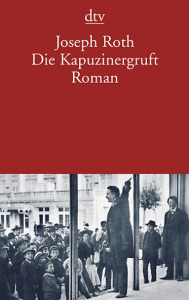
Some thoughts on Joseph Roth’s The Emperor’s Tomb – Die Kapuzinergruft

Published in 1938, Die KapuzinergruftThe Emperor’s Tomb, was one of Joseph Roth’s last novels and the last that was published during his lifetime. Roth died in 1939, in exile, of the complications of a double pneumonia, that was possibly aggravated due to the sudden withdrawal of alcohol.

The Emperor’s Tomb tells the story of Franz Ferdinand Trotta and begins shortly before the first world war and ends with Austria’s Anschluss, the annexation of Austria into Nazi Germany. In many ways the book can be seen as a sequel to The Radetzky March, Joseph Roth’s most famous novel. Usually I would write a brief summary but since this review is part of a readalong and since Emma has already posted an excellent summary of the book, I’ll skip this part and add a link to her post instead – here.

For this post, I’d like to focus on some topics I found of interest.

WWI

As many of the readers of this blog know/may remember, for many years, I hosted a Literature and War readalong. Roth had been a chosen author in the past, even though he doesn’t portray the war as such, as rather the mental state of war, or people during war time. I ususally like this approach but in this novel, it was puzzling for several reasons. As I said before, the book begins before WWI, in 1913, and ends in 1938. While Roth describes the time before and after the war years in great detail, things get blurry from 1914 to 1918, although, allegedly, Trotta spends his years in a Russian POW camp in Siberia. If you’d never read anything about any prisoner of war camps, reading this novel would make you think it was a bit of harsher version of a boy scout camp. There aren’t any details described. No fighting happens. This is puzzling, if not bizarre. My knowledge of war literature made me assume one thing – Roth spent his WWI years sheltered. Although I own a huge Roth biography, I haven’t read it yet, but I picked it up and overflew some passages that confirmed what I suspected. He was enlisted but since he was initially considered unfit for military service, he never saw any action, but spent the war years behind a desk. Apparently, to explain why he hadn’t seen any action during the war, he pretended that he had been in Russian captivity, which isn’t true. I think this shows clearly that he must have felt guilty. While I’m not familiar with his earlier years, I know a bit about his final years, and guilt has been a defining emotion for Roth. Once it’s clear that this is why the book is so unspecific when it comes to the actual war, one can move on and concentrate on other elements. As a portrayal of the end of an era and the end of a class system, this is absolutely brilliant and nuanced. And while Trotta’s war experience lacks realism, the way he feels when he comes home doesn’t, because the strong feeling of alienation and of being a stranger in one’s own country was something many Austrians felt at that time.

Women

Before going to war, Trotta marries a girl, Elisabeth, he’d been in love with for ages. Due to a sad story, involving a servant, the marriage isn’t consummated and his new wife flees, angry. When he returns from the war, she’s not exactly keen on seeing him. Like so many women back then, she’s learned to live a life according to her own choices. She certainly doesn’t want to abandon her freedom. And she is living with another woman with whom she clearly is in a physical relationship. Trotta isn’t happy about this but he’s not prejudiced. If it had been a man, it would have been the same to him. Only he might have felt more threatened as the only reason why his wife, in the end returns to him, is because she wants a child. Once the child is born, however, it doesn’t hold her back and she leaves it with his father. I found this surprisingly modern. I’m sure Roth was freethinking when it came to relationships, but I also think that Elisabeth is a character that was quite common at the time. It’s sad to think that so much of that freedom was lost again later.

Austrian pre-war diversity

I don’t think I’ve ever read an author that made me realize just how diverse the Austro-Hungarian Empire was. It was a multinational state, with people speaking different languages, following different religions. In this book Trotta, who is descendant of the non-aristocratic line of the “von Trottas”, feels a stronger connection with the peasant side of his family. While he’s called “Herr Baron”, he doesn’t identify with the aristocracy. When a cousin from Sipolje comes to claim a part of his inheritance, he also introduces Trotta to a friend. That friend invites Trotta to spend time with him in Galicia. Then the war breaks out. Trotta suddenly feel estranged from his former aristocratic friends and asks to be transferred to the regiment in which his cousin and the friend serve. Back in Vienna, after the war, Trotta mourns not only the past but the missed opportunity. He believes that Austria-Hungary could have been a really great state, especially due to its diversity, but instead, it only chose the German part.

Final thoughts

This is a flawed book. The structure is uneven and the war section is so far from realistic, it’s almost painful. Nonetheless, I loved this book. I love Roth’s writing, the mournful tone, his description, his humanity. And there’s also some gentle humour. Roth is outstanding at showing people’s quirks. The portrait of the mother in this book, is an excellent example. At first, she’s very rooted in her old ways, but once change has come, she embraces it and enjoys it because it means there’s new life, where there was only stuffiness before. Sadly, it’s all an illusion, but she’ll never really find out.

I’m glad, Lizzy chose this novel for her readalong. You can find her thoughts here.

This was my fifth Joseph Roth novel and so far, I’ve liked them all. If you’re interested, here are my reviews of Weights and MeasuresHotel Savoy and of Flight Without End.I’ve read The Radetzky March pre-blogging.

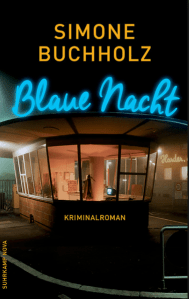
Simone Buchholz – Blue Night – Blaue Nacht – German Literature Month Crime Readalong

Blue NightBlaue Nacht is the sixth book in Simone Buchholz’ Chastity Riley series and the first to be translated into English. I discovered the book last year in a book shop, not realizing it was part of a series, or I would have started with book one. Oddly, the English translation has the subtitle “Chastity Riley book 1”. Be it as it may, I’m so glad I finally read it. I love noir and this is noir at its best.

State attorney Chastity Riley has done a few stupid things and so she’s not working in the state attorney’s department anymore but for the witness protection. This bores her no end. Feeling she needs some change, she takes her car and drives to the country. The car breaks down and Chastity is stranded somewhere on the road. Where other people would look for the beauty around them, all she sees is a lack of streets and people. And too much countryside. Yikes. Barely gone for a few minutes, she misses Hamburg, the Reeperbahn, the seedy haunts, her ex-gangster lover Klatsche, and the bars where she drinks until the early hours. This beginning sets the tone and introduces a character who is witty, sarcastic, laconic, lyrical, and always different.

Back in Hamburg, she’s assigned to look after a man who has almost been killed. He’s been beaten up severely and has lost one finger. It looks a lot like retribution. With cunning, kindness, and a lot of beer, Chastity manages to get his trust. While he doesn’t reveal his identity, he gives her enough information to begin investigating a crime ring.

The story is definitely interesting and offers a look into the drug problems big cities with large ports like Hamburg face these days. Cheap, dangerous drugs, produced in the East, are distributed in the West with maximum profit. The people in charge are able to wash their money and while everyone knows it, the law can’t touch them.

As interesting as the story is, it pales in comparison to the cast of characters and the style. Chastity Riley is a loner at heart but one with a crowd of friends. Some were formerly criminals, some are policemen, bar tenders, restaurant owners. A charming element of the book is that they all get a voice. In between the regular chapters are chapters in which each of the protagonists, including the nameless man, the criminals, Chastity and her friends get their say. In some books this type of approach doesn’t work, but here it lifts the book to another level.

I read a lot of crime novels this year, but this is the one I liked the most. The voice is so unique, the style so brilliant that it can keep up with a lot of literary fiction that is published these days. And the mood and tone are reminiscent of some of the best noir I’ve read in recent years.

I read this in German, that’s why there are no quotes. Please visit Pat’s blog (added below) to get an idea of the style

Other reviews:

Pat – South of Paris Books


Mechthild Gläser’s The Book Jumper – Die Buchspringer – German Literature Month Readalong

The Book Jumper is a children’s book by German author Mechthild Gläser.

Amy and her mother flee Bochum to take refuge on a forgotten Shetland island. Years ago, when she was pregnant with Amy, her mother left the island just as helter-skelter as they left Bochum now. Amy never knew why. She also never knew her dad. The island, the castle, and Amy’s grandmother are all very mysterious, but not as mysterious as learning that Amy is a book jumper, like everyone in her family. Book jumping is an important ability that gets lost once people get older. Together with two other young people Amy is taught in the art of book jumping. In the beginning book jumping novices have to stick to a favourite book. In Amy’s case that’s The Jungle Book. She is told that it’s important not to stray from the path of the story or to interfere with it. The book jumpers are vital for literature because they have to make sure that the stories remain exactly as they were originally written down.

Among other things, Amy is taught that she can only jump into a book from a specific spot and when she puts the open book on her face. She realizes soon, that this isn’t a necessity for her. She can jump into any book pretty much from wherever she wants. Already on her first jump into the jungle book, she strays from her path and meets Goethe’s Werther. Together with him, she travels in the no-man’s-land between different stories or enters other novels, like Alice in Wonderland. It doesn’t take long until she realizes that there’s something wrong in the land of literature. It seems that a thief is stealing ideas and important story lines get either jumbled or lost. Together with Werther and Will, another book jumper, Amy tries to catch the thief. Unfortunately, the thief is quite dangerous. He kills a beloved literary character and, in the end, even attempts to kill Amy and her grandmother. I can’t really tell much more without spoiling the story.

When Lizzy proposed to read this, I really liked the premise of the book. The idea to jump into your favourite novels, meet favourite characters was so appealing. Sadly, this didn’t work for me. I read it pretty quickly, it had some amusing moments and characters, especially Werther, but it felt quite lifeless. Even the love story between Will and Amy, did only work at first. The solution to the story felt forced. The only thing I liked, was Amy’s back story.

The book is initially amusing, but not exactly a must-read. Something was missing. It may sound weird, but it isn’t fantastical enough. I also didn’t like that Mechthild Gläser spoils a few classic stories by giving away the ending. On top of that, the German blurb is misleading. We’re led to believe Amy will become friends with Elizabeth Bennett, but she only sees her once and very briefly. I hope others enjoyed this more than I did.

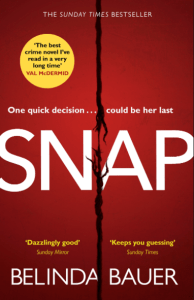
A Very Short Review – Belinda Bauer: Snap (2018)

I’ve wanted to read Belinda Bauer for ages because I’ve heard so many good things about her books. Even so, I was surprised to see her on the Man Booker longlist. I don’t think many crime novels are included usually. And so, even though Rubbernecker is on my piles, I went and got Snap. I finished it two days ago and am still baffled. Baffled it made the Booker longlist. Not only baffled – sad really – because if the typical Booker longlist reader usually doesn’t read crime and this is his introduction to the genre  . . . Not ideal. Baffled also because it’s such a weak book. There’s some nice writing there, good characterisations, but the story is unbelievable, relies heavily on coincidences – one after the other  – and the killer’s motive is so far-fetched that it’s painful.

The premise is interesting enough. A pregnant mother leaves her kids in the car to get petrol and never returns. Later, her body is found. She’s been murdered. There are no suspects and soon it’s a cold case. Three years later, the three kids are living on their own in the messiest place one could imagine. What happened? The dad couldn’t cope and left the three children to fend for themselves. The oldest, Jack, provides for them by breaking and entering into houses whose owners are on holidays. Unfortunately, (biggest coincidence) one house isn’t abandoned and inside Jack finds not only a pregnant woman, but an object he believes had something to do with his mother’s death.

If I didn’t already own Rubbernecker, I’m pretty certain, I would not return to Belinda Bauer. But since I do, I might give her another try. I’m not sure though. I’ve read many great crime novels this year and also a few mediocre ones, but none was as unbelievable as this.

Why did I finish it, you may wonder? For the longest time, I thought it might go into another direction. Sadly it didn’t. And there was zero atmosphere.