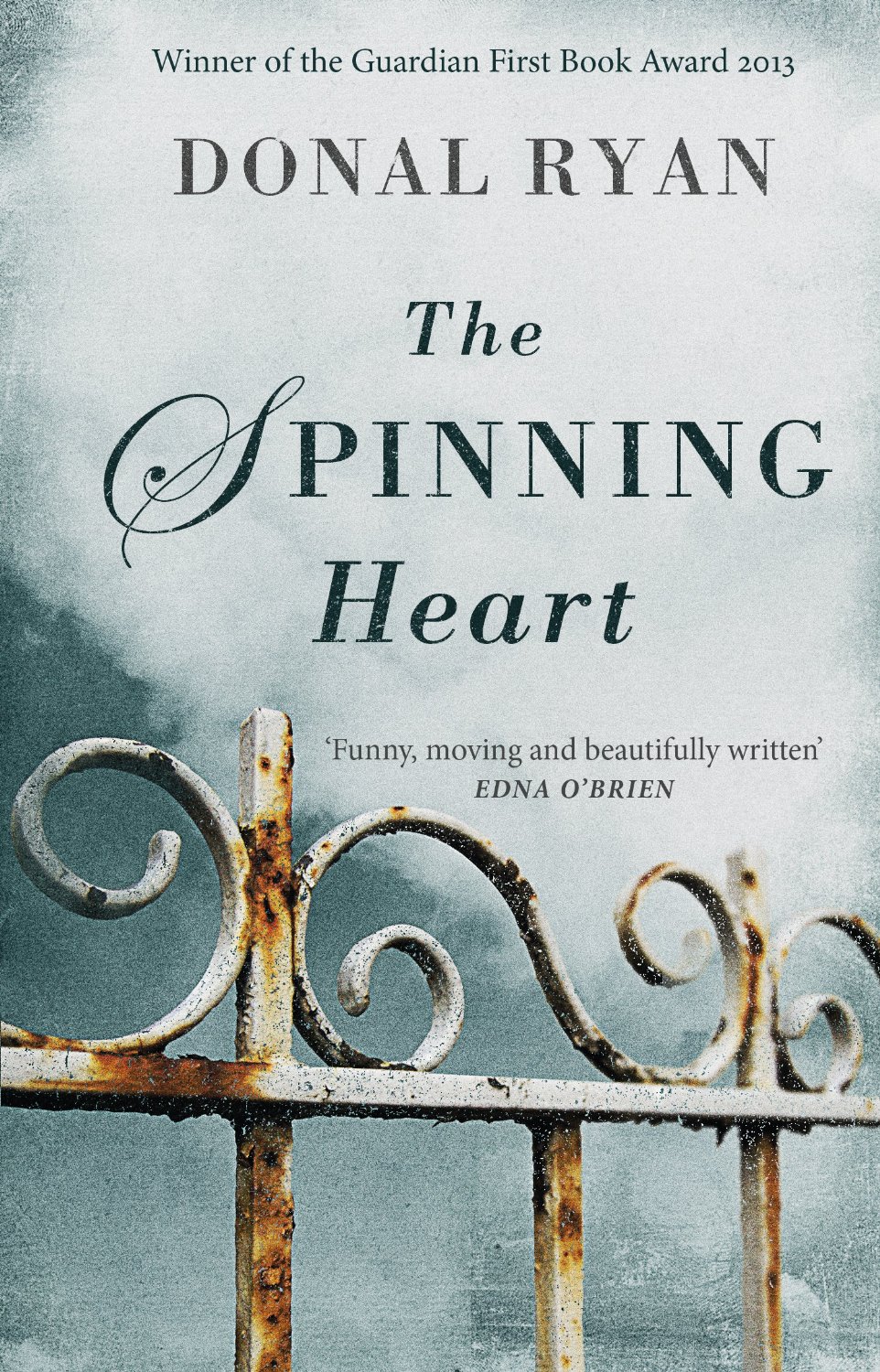
Donal Ryan: The Spinning Heart (2012)

The Spinning Heart

Irish writer Donal Ryan’s first book  The Spinning Heart is less a novel than a chorus. A chorus of 21 voices telling, stating, deploring, accusing and confessing things that are on their mind, things they want to commit or have committed, things they should have done or could have done. While each of them gives us a slice of individual life, in his or her unique voice, using their idiom or vernacular, they are linked because of the recession that has hit them hard. Most of the professional life in this small rural community was tied to the building firm of Pokey Burke who fled the country, leaving his former employees without pension or income. He’s also responsible for a ghost estate, in which one of the narrators, Réaltín, her little boy, and one elderly woman live. The other houses haven’t been finished and Réaltín’s house has a lot of shortcomings too.

The book opens with Bobby’s voice and closes with Triona, Bobby’s wife. In between are the 19 others. Former workers of Pokey, his father and many more. What struck me the most was that every chapter really sounded as if a person was talking to us. The voices are each so intimate and distinctive. Some focus on the present moment and the recession, some go way back. What we read paints an astounding portrait of Irish society, the things that have been the same for decades, like the weight of the Catholic Church, and those that have drastically changed, like the economy. Some voices are shocking, some are heartbreaking, some belong to very young children, some to old people, most to those who have been the most affected by the recession- people between 18 and 60+.

While all these lives have been marked by Pokey and his real estate fraud, there are also two thin plot lines which link all the people: the abduction of Réaltín’s boy and the murder of Bobby’s father. With these to plots the book transcends the economy theme and encompasses more universal topics like family and relationships.

The Spinning Heart is an amazing piece of writing and I’m not surprised Donal Ryan won the guardian First Book Award. Creating 21 distinctive voices is an achievement but to tell 21 touching life stories and to capture a whole country even more so.

Federico García Lorca: The House of Bernarda Alba – La casa de Bernarda Alba (1936) – A Play

The House of Bernarda Alba

I’ve read many French and German plays, some British, American, and Russian ones, but only one or two of Spanish origin. Richard and Stu‘s Spanish Literature Month seemed like a good opportunity to change this and I decided to read The House of Bernarda Alba – La casa de Bernarda Alba, Federico García Lorca’s last play, which he completed just before being murdered by Nationalists at the outbreak of the Spanish Civil War.

The House of Bernarda Alba – La casa de Bernarda Alba is set in a village in Spain in the house of the widow Bernarda Alba. Her second husband has just been buried and she decides to close down the house  and impose an eight-year-long mourning period. This means that her five unmarried daughters will lose their freedom and live a secluded life for the next eight years. Bernarda Alba is a joyless tyrant, a crushing, sadistic mother, who uses her Catholic faith as a means to domineer and abuse her daughters. The oldest, Angustias, is already 39 and still not married. She’s the only one from Bernarda’s first husband and has inherited a fortune, while the other four, ranging in age from 20 to 30, are left almost destitute. The two youngest, Adela and Martirio, are both in love with the same man, Pepe el Romano. Pepe seems to be in love with Adela, the only pretty one among the five  daughters. Martirio is jealous and full of hatred. Unfortunately the scheming Bernarda has arranged that Pepe will marry the rich Angustias. As is to be expected the play ends in tragedy.

It’s stifling hot in the play and the heat works as a brilliant metaphor for repressed anger, suppressed desires, sexual frustration, and passions running amok. It enhances the sense of oppression and suffocation the women experience. An eerie element comes from the fact that everyone spies on everyone else at all times and that they all envy each other for one reason or the other. It’s a play that can easily be read as a metaphor for a totalitarian regime. But it’s also an illustration of the crushing power of the Catholic faith and how it can be abused by a sadistic and frustrated person.

This is an amazing play. The dialog is concise and pithy, consisting mostly of short repartees. The only exceptions are the exchanges between Poncia – a servant/confidante – and a maid and between Poncia and Bernarda Alba.

Although men are so important, not one man appears on stage. They are only spoken about and referred to.Browsing on YouTube I saw that a few directors chose to include male actors, which I find very wrong. García Lorca wanted to express something by leaving them out. I wonder why some directors chose to include them? Out of Fear that nobody would want to watch a play with only female actors?

I prefer reading plays but this is one I’d love to see performed. It has been made into a British TV movie (1991), starring Joan Plowright as Poncia, the servant/confidante of Bernarda, who is tied to her mistress by some weird loyalty in which there’s as much obedience as hatred and rebellion. Quite an interesting relationship. I started watching it but this is such a prototypical Spanish play that seeing it performed by British actors was a bit strange. I’ll still watch it some day and  have attached it for those who are interested.

This is my second contribution to Stu‘s and Richard‘s Spanish Literature Month.

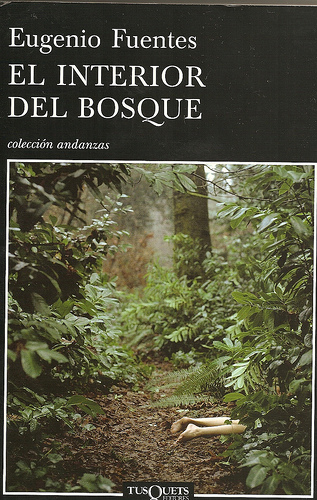
Eugenio Fuentes: The Depths of the Forest – El interior del bosque (1999)

El Interior del Bosque

In a guardian article on best crime fiction in English translation Ann Cleeves mentioned Eugenio Fuentes’ novel The Depths of the Forest – El interior del bosque. Since Stu‘s and Richard‘s Spanish Literature Month was upcoming and I’ve never read a Spanish crime novel before, I thought it would be an excellent choice.

The book starts chillingly with the POV of the first victim. Gloria, a beautiful painter, is hiking alone in Paternóster, a remote nature reserve, in Spain. She feels dread but since she’s all alone, there doesn’t seem to be any reason. A few minutes later she’s murdered brutally. This isn’t a spoiler. Her murder is revealed on the bokk cover and happens in the first few pages. The next POV is quite unusual. A rat finds Gloria’s body. The following paragraphs are written from the point of view of a group of young boys who torture scorpions and discover Gloria’s body. The POV switches again, this time we are in the head of Richard Cupido, the PI hired by Marcos, Gloria’s fiancé. Marcos is sure that the Guardia Civil, the local police, are not going to investigate thoroughly and hopes Cupido will find the murderer.

Most of the story is written from Cupido’s perspective but many chapters are told from the point of view of the many suspects. When a second woman is murdered there are even more suspects. In spite of these many different perspectives, the book didn’t feel disjointed.

Most of the men who came in contact with Gloria fell in love with her. And it seems that she had affairs with most of them. Was it a crime of passion? Or has it something to do with an ongoing lawsuit? El Paternóster used to belong to a rich widow who has been fighting to get it back for years. Did she take drastic measures to discourage the public from visiting?

Cupido turns in circles for a long time. He gathers information but it’s leading nowhere. And he becomes obsessed with Gloria himself.

Having finished the novel, I’m facing a huge dilemma. I want to be fair to a novel, which is clearly on the literary side of the crime spectrum, and would most certainly delight many readers, but at the same time I have to admit that this wasn’t for me. Not because it wasn’t good but because it contained a recurring scene of an act of cruelty against an animal (a deer) that made me sick. I skipped most of the parts but still read too much for my own liking. It wasn’t a gratuitous scene but nevertheless, I wonder why an author chooses to include scenes like this. I think this is too bad because if those scenes hadn’t been included I would have liked this book. I thought that all the aspects about nature and how people value it in different ways was thought-provoking and topical. From the nature theme we’re lead to think about human nature. Clearly, the cruelty is part of these explorations. Cupido is a complex character and most of the other character studies were quite fascinating too. The way Fuentes captured this nature reserve and its remoteness, was very well done. Fascinating and eerie at the same time. And I really wanted to find out who killed those women. But overall the novel was too pessimistic for my own liking. While I agree that humans are the most cruel animals in this world, I don’t want to read about it in this way. Or Nnot if illustrating this point includes scenes with cruelty against animals. If this doesn’t bother you and you like your crime novels unusual, literary and very bleak – don’t miss this.

This is my first contribution to Spanish Literature Month hosted by Stu and Richard.

The Depths of the Forest


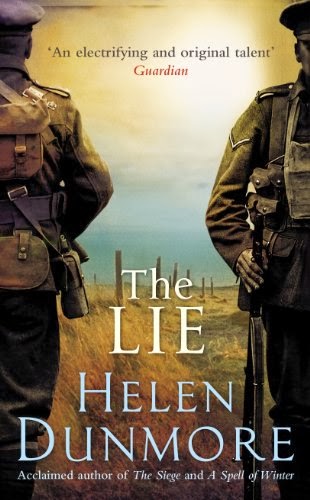
Literature and War Readalong July 28 2014: The Lie by Helen Dunmore

The Lie

Helen Dunmore has written several times about WWI. Back in 2012 we’ve read her earlier novel Zennor in Darkness, a book that made it on my Best of List that year. Naturally I’m looking forward to read her latest novel The Lie. I’ve seen a few reviews here and there but avoided to read them as I want to discover it for myself. What I like the most about Helen Dunmore is her beautiful prose. You can sense right away that she is also a poet.

If Rudyard Kipling’s epitaph at the beginning of the book is anything to go by, then it will be a heartbreaking novel.

If any question why we died

Tell them, because our fathers lied

This epitaph is doubly tragic as Kipling lost his son in WWI. Judging from the movie My Boy Jack, the boy would never have enlisted if it hadn’t been for his father. Here’s Kipling’s touching poem:

My Boy Jack

Have you news of my boy Jack?
Not this tide.
When d’you think that hell come back?
Not with this wind blowing, and this tide.

Has any one else had word of him?
Not this tide.
For what is sunk will hardly swim,
Not with this wind blowing, and this tide.

Oh, dear, what comfort can I find?
None this tide,
Nor any tide,
Except he did not shame his kind —
Not even with that wind blowing, and that tide.

Then hold your head up all the more,
This tide,
And every tide;
Because he was the son you bore,
And gave to that wind blowing and that tide!

Here are the first sentences of The Lie

He comes to me, clagged in mud from head to foot. A mud statue, but a breathing one. The breath whistles in and out of him. He stands at my be-end. Even when the wind is banging over the roof that I’ve bodged with corrugated iron, it’s very quiet. He doesn’t speak. Sometimes I wish he would break the silence, but then I’m afraid of what he might say. I can smell the mud.You never forget the reek of it. Thick, almost oily, full of shit and rotten flesh, cordite and chloride of lime. He has got himself coated all over with it. He’s camouflaged. He might be anything, but I know who he is.

And  some details and the blurb for those who want to join

The Lie by Helen Dunmore (UK 2014) WWI, Novel, 304 pages

Set during and just after the First World War, The Lie is an enthralling, heart-wrenching novel of love, memory and devastating loss by one of the UK’s most acclaimed storytellers. Cornwall, 1920, early spring.

A young man stands on a headland, looking out to sea. He is back from the war, homeless and without family.

Behind him lie the mud, barbed-wire entanglements and terror of the trenches. Behind him is also the most intense relationship of his life.

Daniel has survived, but the horror and passion of the past seem more real than the quiet fields around him.

He is about to step into the unknown. But will he ever be able to escape the terrible, unforeseen consequences of a lie?

*******

The discussion starts on Monday, 28 July 2014.

Further information on the Literature and War Readalong 2014, including all the book blurbs, can be found here.

Gabriel Chevallier: La Peur – Fear (1930) Literature and War Readalong June 2014

Fear

Most of the books we read for the Literature and War Readalong are historical novels, written by people who do not have any experience of war. But I always try to make sure to include at least one novel or memoir written by someone who had first-hand experience. Gabriel Chevallier’s Fear – La Peur is one of those. Like his narrator Jean Dartemont, Chevallier was a simple soldier during WWI. He served from 1914 to the end of the war. In 1915 he had a small break because he was wounded but was sent back to the front-line after his recovery. Reading his account it sounds like a miracle that anyone could survive this long under such circumstances. Given the title of this novel it may also come as a surprise that its author returned highly decorated. He was awarded the Croix de Guerre and the Chevalier de la Légion d’honneur.

Most of the time reading La Peur felt like reading a memoir and I suppose most of it is autobiographical. What drew me in from the beginning was the voice. I hope they were able to capture this unique and powerful voice in the English translation. A voice that mentions everything, denounces everything, and lets us get as close to the war in the trenches as possible without having been there.

The book hasn’t a plot as such, it’s more an episodic account of Dartemont’s experience of WWI and his thoughts. Not for one second does he think the war is noble, nor does he ever strive for glory. He sees right through most of the cowardly and sadistic officers and he speaks openly. Not always though. Sometimes he’s just too baffled to speak his mind like when an elderly man asks him on his leave whether they are having fun. Those at home think it’s all a great adventure, just like most of those who signed up early on.

Dartemont who was a student didn’t sign up for “gloire et patrie” (glory and homeland), he signed up because he wanted to see. He’s a very curious person, that’s probably why he never averts his eyes, no matter how scared he is. In the beginning he’s just like a participant observer. At first he’s far from the most intense fighting but once he’s seen his first battle, the first dead people and horribly wounded, fear is his constant companion.

I don’t think I’ve ever read anything quite like this. Not for one second are we led to believe that going to war is heroic. It might very well be one of the most openly anti-war books I’ve ever read. Free of any sentimentality, free of any attempt to make us swallow the bitter pill by telling some touching story. It’s just one man’s account of the most horrible things one can experience.

The parts that shocked me the most are not the gruesome descriptions of the wounded and the dead but those that show how utterly ill prepared most of the attacks were. And how incapable and idiotic most of the high command was. How can you expect to win a battle when the enemy is dug in and your soldiers are just running into open fire? No wonder there were some battles in which there were 50,000 to a 100,000 dead and wounded within two hours. All this led to the mutinies of 1917. Of course it wasn’t much better on the British side. Unfortunately many officers were not only useless but petty and sadistic, mean-spirited and small-minded, and managed to turn even times of rest into nightmares.

Seeing how scared Dartemont was all through the war, and how long he stayed in the trenches, I was wondering why he wasn’t shell-shocked. I think he must have had an extremely strong character. Unlike so many, he never looks away, not even when he’s scared. He’s always aware that any moment could be his last, that he could end up maimed for life from one second to the other. This extreme awareness, paired with a strong character, seems to have helped him stay sane through the madness.

As awful and detailed as many of the description were, I liked reading this, because I liked the narrator’s voice so much. Staying this matter of fact in such mayhem is admirable.

I’m not surprised this book went out of print in France when WWII broke out. It’s as powerful as it is subversive. Chevallier rips off the masks of all those who pretend war is noble.


Other reviews

 Guy (His Futile Preoccupations)

Judith (Reader in the Wilderness)

*******

Fear – La Peur is the sixth book in the Literature and War Readalong 2014. The next book is the WWI novel The Lie by Helen Dunmore. Discussion starts on Monday 28 July, 2014. Further information on the Literature and War Readalong 2014, including the book blurbs can be found here.

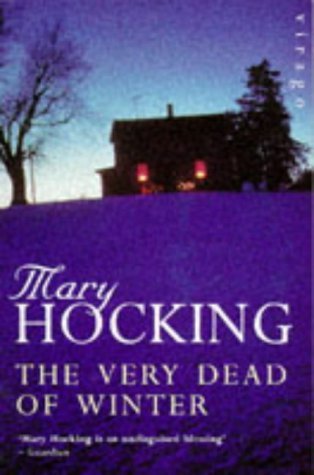
Mary Hocking: The Very Dead of Winter (1993)

The Very Dead of Winter

I’m so glad I came upon Heavenali’s Mary Hocking Month and discovered the brittle beauty of the novel The Very Dead of Winter and its cast of eccentric characters.With her wry humor and sharp eye for social comedy Mary Hocking can be firmly placed in the tradition of British women writers like Elizabeth Taylor, Barbara Pym, Susan Townsend Warner, Beryl Bainbridge and Muriel Spark.

Take a dysfunctional family, put them in a snowed in cottage at Christmas, with one of them slowly dying, and watch what will happen. I can guarantee you it will never be boring. The sisters Florence and Sophia used to spend their childhood holidays at the cottage. Now, in their sixties, they have come here for a special family reunion. Sophia is the owner of the cottage; Sophia’s sister Florence, her dying husband Konrad and their grown-up children Nicholas and Anita are guests.

What would be a testing moment for any family turns into a sometimes tragic, sometimes hilarious adventure. With the exception of Sophia and Konrad, these are some of the most selfish, narcissistic people I’ve ever come across in a novel. Florence is a master manipulator but she’s not very subtle, which leads to hilarious moments. Anita, her daughter, a child psychologist who doesn’t like children, has been under her thumb her whole life. Being with her mother is like being on a battle field when both parties are too tired to strike. They say the nastiest things in the world to each other but they can’t really fight openly.

“My mother is too big for me: She dwarfs everyone around her – except my father,” Anita shouted in to the wind. “There’s never any peace where she is, nowhere I can feel I am me. All my childhood I had to stay clenched tight, ready to parry thrusts from my mother.”

Nicholas isn’t any less dysfunctional he just handles it differently and doesn’t really communicate with any of them.

The book offers wonderful character portraits and an abundance of scenes I’m not likely to forget. In one instance, Florence decides to go to church in the middle of the night, right through the snowed in forest. What would be challenging during the day in summer turns into a dangerous expedition. Anita, although she’s terribly annoyed with her mother, feels obliged to go with her. Of course, it’s far too exhausting and Florence collapses in the middle of the woods. She’s a heavy woman and slender Anita isn’t capable of carrying her. Luckily they stumble over a half-frozen pony, and because she has no means to guide the animal, Anita takes drastic measures. I’m not going to reveal what she does. It’s nothing tragic, just wildly crazy.

Florence is a great character, she’s scheming and manipulative, driven by fear of abandonment, which makes her do foolish things. She lives in constant disappointment with everyone around her, always expecting them to serve her narcissistic purposes. She’s only interested in what people can be or do for her, but takes no interest in their personalities. She has no idea for example who her husband is, where he came from – he is German – or what his dreams and hopes are. Once it’s obvious he will die, filled with the horror of future loneliness, she clumsily tries to capture a widower who lives near by. The ensuing scenes are some of the funniest. Desperate as she is, she even thinks she can manipulate her grown-up children to come back to live with her. One of her favourite techniques is finding her own faults in everyone else.

“Dear God,” Florence said. “What has happened to me?”

Standing there, in the center of the room, it was as if she had come on stage to find herself in an unfamiliar play. She was, above all else, a performer, and to find that she had got the performance wrong was deeply disquieting.

I really liked The Very Dead of Winter are great deal. Not only for its wry humour and psychological insight, but also for some lovely descriptions. It’s not a flawless novel, there are a few instances of shifty point of view, but that didn’t diminish the experience one bit. I’ll certainly read more of Mary Hocking, might even re-read The Very Dead of Winter.

I leave you with two final quotes, one from the beginning of the novel, the other can be found towards the end:

The beginning of the journey had been enchanting. Porcelain blue sky and the sparkling white canopy transformed dingy streets into fantasies of unimaginable purity and, passing out of town, they came to broad fields where sunlight reflected the trellis of branches like veins across the snow.

She stood there a long time while the shadows crept towards her, deeps of blue from which a tree stump rose like the funnel of a sunken steamer. On the other side of the hedge, and between the bars of the gate, the sharpness of outline blurred into a mist of pink and grey shot through here and there with a shee of palest turquoise.

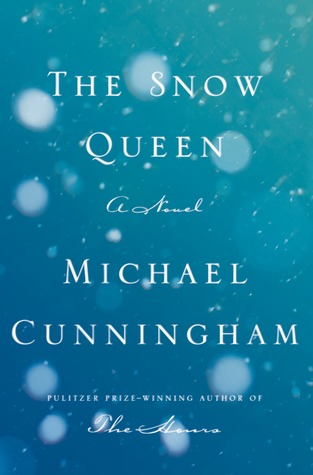
Michael Cunningham: The Snow Queen (2014)

The Snow Queen

Michael Cunningham’s luminous, compassionate new novel begins with a vision.

It’s November 2004. Barrett Meeks, having lost love yet again, is walking through Central Park when he is suddenly and inexplicably inspired to look up at the sky, where he sees a pale, translucent light that seems to regard him in a distinctly godlike way. Although Barrett doesn’t believe in visions – or in god, for that matter – he can’t deny what he’s seen.

At the same time, in the not-quite-gentrified Bushwick neighborhood of Brooklyn, Beth, who’s engaged to Barrett’s older brother ,Tyler, is dying of colon cancer. Beth, Tyler, and Barrett have cobbled together a more or less happy home. Tyler, a struggling musician with a drug problem, is trying and failing to write a wedding song for his wife-to-be – something that will be not merely a sentimental ballad but an enduring expression of eternal love.

Barrett, haunted by the light, turns unexpectedly to religion. Tyler grows increasingly convinced that only drugs can release his deepest creative powers. Beth tries to face mortality with as much courage and stoicism as she can summon.

One night, after having been dumped by his boyfriend via text message, Barrett is walking through Central Park when he sees a light. He’s pretty sure it’s of divine origin and looking down on him. He’s not the only one in his entourage who would benefit from divine intervention. He shares an apartment with his older bother Tyler, an unsuccessful musician with a drug problem, and his soon-to-be sister-in law Beth who has colon cancer. Both could do with some divine assistance.

The Snow Queen starts shortly before Christmas. It snows constantly and the images Cunningham creates are lovely and haunting. Tyler standing at the open window, while the snow swirls into the room full of old broken objects. Beth who wears only white and goes for a solitary walk. Liz and Andrew who do drugs until the early morning and stand on the top of the roof talking.

Barrett was once a wunderkind, someone who promised to be great one day. A scholar, a writer, someone who would leave a mark. Nowadays he’s happy to be a shop assistant in Beth’s and Liz’s vintage clothes shop. He doesn’t see himself as a failure when it comes to his career but he definitely sees himself as failure when it comes to love.

Tyler, the addict, struggles hard to write the perfect song for his wedding. He’s sure that a small bit of cocaine occasionally will help him. But occasionally is just an addict’s way of saying “I’ll stop soon”. And he always stops – until the next time, which comes invariably.

Liz is the oldest of the group of friends. She’s over fifty and still dating young men in their twenties. When they leave her for younger women she doesn’t care. It’s part of the plan, part of never settling.

We follow the four characters over the course of four years and see each of them come to terms with their life choices. They are drifters who have to learn that what they wanted in life might not have been the thing that would really make them happy.

I’m not sure what to think of this novel. I’ve read it in one sitting and some of the images are still vivid but it was also quite lame. I’ve read two of Cunningham’s novels A Home at the End of the World and The Hours. I loved both but this one left me puzzled. The writing is airy and precise, the images he creates are haunting but overall it’s so fluffy. And most of the time I felt like I’ve read something similar somewhere before. I even had a shock moment while working out, watching TV, and an episode of Sex and the City came on. A lot in this episode resembled The Snow Queen. I must say I like him better when he recycles Virginia Woolf. I also have no idea why he chose the title. Tyler get’s a snow splinter in his eye at the beginning but apart from that and the snow-heavy first chapters, there’s no link. Another possible inspiration might have been Jonathan Lethem’s Fortress of Solitude, with which it has more than one element in common.

With the exception of one critic most were raving about this book. I agree that the writing is lovely and the descriptions of addiction are extremely well done. Nonetheless, I need a bit more than a person seeing a light which is never explained and a couple of drifters accepting that life isn’t as grand as they thought it would be. Read it if you want to read an ode to resignation in a snowy setting.