Some Thoughts on Charlotte Wood’s The Natural Way of Things or Should There Be Trigger Warnings on Books?

I finished Charlotte Wood’s The Natural Way of Things a couple of days ago and wasn’t sure whether I should review it or not. But then I thought of the many glowing reviews in newspapers and on blogs that made me pick this up and so I decided, while I won’t review it, I will write about my reactions to this book because they are so different from any one else’s. While most people loved it and even put it on their “Best of the Year” list, I truly hated it and wish I hadn’t read it. And, frankly, if I had known what to expect, I wouldn’t have picked it up. But before I write more, I have to emphasize – this isn’t a bad book. It just has elements in it, I wish I’d been made aware of.

I’ve read another Charlotte Wood novel, a few years ago, which made my end of year best of list. It’s a marvelous book and very different from this one. It’s one of the reasons why I continued reading The Natural Way of Things although I disliked it from the beginning. And since I’m bad at putting away books, once I’m halfway through, I finished it. It gave me nightmares and has planted some images in my head, I have a hard time getting rid of.

If you’ve read other reviews, you might be puzzled that it upset me so much and I can tell you, I get it, because nobody mentioned those elements.

The Natural Way of Things is a story about a group of girls who were each involved in a sex scandal. While the men aren’t punished, the girls are sent to a remote place, stripped of their clothes, shaven, barely fed and guarded by two brutal men who hit them and force them to work like slaves. It’s a lot like a concentration camp. Every review I read, mentioned this and how this is a feminist look at the way the media sees women and how women are still mostly the ones blamed when there’s a scandal. I didn’t have a problem with that, I had a problem with what follows. In the middle of the book, the captives and their captors realize they have been abandoned by the outside world. They run out of food and other basic supplies. And that’s when it started to get horrible for me because one of the girls decides to set traps and catch rabbits. Anyone knows that catching animals with traps, especially certain traps, is barbaric. Reading about this made me sick. Reading about the detailed ways the animals were taken apart, skinned, their fur prepared  . . . You get the picture. And there’s a scene towards the end, when a larger animal gets trapped . . . I’m not going to forget that.

I’m not sure why nobody mentioned the traps or those awful scenes linked to that. I wish they had because, as I said, I would have stayed away from this book. It would have worked as a trigger warning.

I suppose, you get why I still had to write about this because I know there are other people who are highly sensitive to anything involving animals.

That said, I don’t think Charlotte Wood should have written this any other way. I guess it works. One of the themes in her book is that of predator and prey and the trapped rabbits are linked to that theme. It’s not a bad book, but I was the wrong reader. If you’re like me and anything harming animals upsets you, you might want to stay away from this book.

The above may give you the impression that there isn’t any explicit violence against women in this book, but there is. I found that hard to stomach as well but I could handle it better.

This brings me to the topic of trigger warnings. I’ve seen debates, where people said that there should be trigger warnings on books. For all sorts of things. Cruelty against animals, kids and women, swearing, explicit sex, violence  . . . The list is as endless as people’s sensibilities. I don’t think that there should be trigger warnings because there’s always the risk that those could, in some countries, lead to the banning of certain books. I’m against book bans and I think that trigger warnings are also problematic because they simplify a complex theme. Let’s take The Natural Way of Things as an example. What should the warning have looked like “Violence against women” – that would have been possible, but the animal topic couldn’t have been covered by a similar concise warning. There’s no gratuitous violence, like in the case of the women. There’s killing, trapping, skinning and slow death. “Warning – animal trapping”. Weird. Some readers who are sensitive to cruelty against animals in books, might not even have found the instances here problematic because they are not gratuitous. You see, it’s tricky.

While I don’t think trigger warnings are the way to go, I still would have wished the one or the other review had made me aware that some of the content could be problematic for me. Nonetheless, it’s my fault I didn’t stop reading. I wish I will finally be able to abandon books that aren’t good for me, even when I’m halfway through.

How do you feel about this? Trigger warning or no trigger warning?

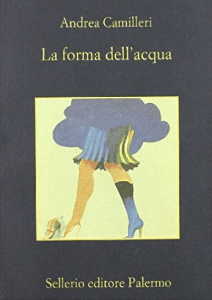
Andrea Camilleri: The Shape of Water – La forma dell’aqua ( 1994) Inspector Montalbano 1

Andrea Camilleri is an Italian crime writer, famous for his long-standing Inspector Montalbano series. Camilleri was born in 1925 in Sicily, where the series is set. I’ve been aware of him for ages, but for some reason, I never felt tempted to read his books. I thought this was a cozy crime series and while I occasionally enjoy them, I’m rarely willing to read a whole series. After reading a few reviews recently, I realized, I was wrong and that this wasn’t a cozy series at all.

Thanks to Stu, who dedicated March to Italian literature, I finally picked up the first in the series,  The Shape of Water – La forma dell’acqua.

The Shape of Water, like all the other novels in the series, is set in the fictional small-town Vigàta, in Sicily, which was inspired by Camilleri’s hometown Porto Empedocle, near Agrigento. On the outskirts of Vigàta, there’s the Mannàra, an open-air brothel. And it’s exactly here that the body of the dead engineer Luparello is found. The verdict is – natural causes – something that’s almost unheard of, in a region where the mafia drops body after body. Luparello was a prominent political figure and a lot of people profit not only from his death but from its unsavoury circumstances. Montalbano who is anything but obedient, demands to conduct an investigation. There are too many things that do not add up. Why would someone like Luparello go to a place like the Mannàra? Who is the woman who lost an incredibly expensive bracelet close to where the body was found? Who did Luparello meet with at his love nest?

Montalbano’s investigation introduces us to many striking and colourful characters. We get to know him, his girlfriend, his boss, his subordinates and friends very well. The book also introduces us to a place where corruption and violence are all too common. A place, where the mafia reigns and the police have a hard time keeping up with the crimes that are committed daily.

In his unorthodox way, Montalbano discovers more than one criminal act. And he decides to “play God” as his girlfriend calls it.

I’m so glad I finally read Camilleri because I enjoyed it so much that I have already started book two. This is such a perfect series for so many reasons. It paints an accurate, if somewhat embellished and exaggerated, picture of Sicily, its people, and customs. And its food. Montalbano enjoys good food, and for many readers, discovering all the dishes he eats in the books, is part of the appeal. While the descriptions of the place and its mores is part of the success of the series, the biggest reasons for loving it, is the character of Montalbano. He’s unorthodox, funny, dry, doesn’t suffer fools but has a big heart when it comes to “little people”. Montalbano’s name is an homage to Manuel Vázquez Montalbán. It’s no surprise then, that the inspector reads one of Montalban’s detective novels in this book.

Another aspect that won me over is that this isn’t the kind of police procedural, that most UK or US authors write. The police in this book are chaotic, a bit useless and the investigation isn’t conducted very rigorously. At times it reads like a satire, which I enjoyed very much.

People often wonder, why an author chooses a fictional town. In an interview Camilleri gave a very good reason. While he used his hometown and its surroundings to make the descriptions in the books more authentic, they aren’t particularly violent places and definitely not places where so many people get killed.

I’m not at my most eloquent today. Possibly because I loved this so much. I often find it difficult to write about favourite books. I’m very fond of Sicily and this brought back memories, but even if this hadn’t been the case, I would still have loved it. It’s so colorful and original and Montalbano is one of the greatest fictional inspectors I know.

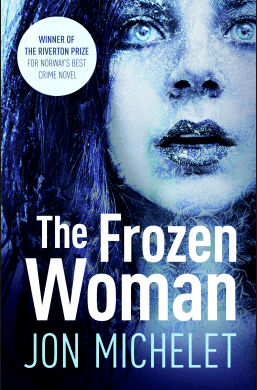
The Frozen Woman by Jon Michelet

I found The Frozen Woman at a local book shop and because I was in the mood for crime in translation, I got it. I’d never heard of Norwegian crime writer Jon Michelet before. He seems to be highly popular in Scandinavia, where he’s been publishing for five decades. We all know that this doesn’t guarantee a translation and so it’s not surprising that this is one of the first of his novels that has been translated into English. It’s part of a series and has won the Riverton Prize for best Norwegian crime.

The story can be summarized very quickly. A murdered woman is found frozen in the garden of a notorious lawyer. The police suspect him immediately, although it seems highly unlikely that he killed her. But why was she found in his garden, since she wasn’t killed there but somewhere else? Retribution? It complicates matters that the police can’t find the woman’s identity. Nobody is missing her. She looks foreign, so possibly she’s an illegal immigrant?

That’s as much as I can say about this book without giving away too much.

What a peculiar reading experience. I don’t think that this has happened to me very often. At first I really liked this novel. Then I didn’t. Then I liked it again . . .  And so on and so forth. Funny enough, once I read the last page I thought – hmm . . . I might read another one of his novels after all.

Looking back it’s easy to say why I reacted like this. The plot is rather thin and not very suspenseful. While it starts like an ordinary police procedural, with the point of view of the police, it then suddenly shifts to the POV of possible suspects and from there to a business man, who is somehow linked as well. This made the book uneven but at the same time, it’s also its strength because the characters are so well done. They are complex and quirky, each with a distinctive voice. I especially liked the detectives Stribolt and Vaage. Stribolt is a very cultured, laconic man. A bit sarcastic, very dry but not too hardened. His thoughts made me smile quite often. Vaage, his partner, is equally unusual. The book ends with her and Thygesen getting to know each other better. Since this is a series, these three characters will return in other books or have already been in other books.

If you’re not looking for a crime novel whose main appeal is suspense and if you like crime writing duo Sjöwall and Wahlöö, and your crime to be on the political/social commentary side, this book, or another one of the series, might be for you. 

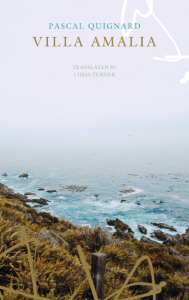
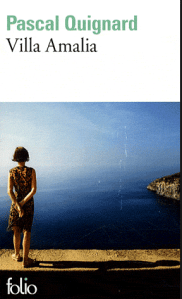
Pascal Quignard: Villa Amalia (2006)

I’ve heard so many good things about Pascal Quignard that I finally had to read him. I had two of his books on my piles, Tous les matins du mondeAll the World’s Monrnings and Villa Amalia, which will be published in English later this month. I finally decided to read Villa Amalia because I wasn’t in the mood for historical fiction.

At the beginning of the novel, the musician and composer Ann Hidden follows her boyfriend because she suspects he’s being unfaithful. She’s right and it hurts her terribly. While she does confront him, she’s not really interested in hearing what he has to say. Her mind is made up, she will leave her house, and everything else behind. She sells her house and all of her belongings, telling nobody but an old childhood friend who helps her to disappear. At first, she wants to tell her mother when she visits her in Brittany but their relationship is so tense, she only tells her she will travel.

Even though her childhood friend Georges knows what she’s doing, she also lies to him about her voyage. He thinks she’s in Africa, but she’s actually travelling first to Switzerland, where she stays in the Alps for a while, and then settles on the seaside in Southern Italy, on the island of Ischia. Here, she takes long baths and walks and begins to compose again. Ann has long abandoned giving concerts, she now dedicates her time solely to her own music and the transcription and reinterpretation of old masters, whose music she simplifies.

One day, on one of her walks, she sees a house high up on a hill and falls in love with the place. It’s a love and a longing so intense it seems strange that she feels this for a place and not a person. Villa Amalia has been abandoned for years and it’s not easy to track down the owners. She finds them eventually and is allowed to rent the house and renovate it. For the first time in her life, Ann Hidden is not only happy but has a sense of belonging somewhere. Later, she finds friends, a lover, and lives with a woman and a small child in great harmony until something terrible happens and she begins her wanderings again.

Villa Amalia is an astonishingly beautiful book. Ann Hidden is unlike any character I’ve come across in any book recently. If anything, she reminded me a bit of the one or the other character in Japanese fiction. She’s cold and distant but with a depth of feeling and a sense of beauty that makes her appealing. She carries wounds from her childhood that run very deep and explain why she’s cold and why she abandoned everything to try to find freedom.

The book beautifully explores several themes. The most obvious is how we deal with loss and abandonment. Another theme is life outside of what is considered conventional/normal. Ann finds nontraditional ways to interact and live with people. Every choice Ann makes is surprising because it’s a free choice. Most of us do or have to consider consequences, other people’s feelings, the future etc. Ann never does. She chooses the way that feels right to her at a given time. Another theme that is extremely important is creation. Or, more precisely, the creation of music. Where does music come from? Ann is a taciturn person who loves silence, yet she seems to have a well in her from which one melody after the other pours out.

I liked this book very much but it took me ages to finally review it because it’s so difficult to put into words why this is so beautiful or why I liked it so much. It’s a bit like with an elusive scent. It’s hard to describe it to someone else and explain why you like it.

I would have liked to share quotes but I’ve read this in French and the translation will only be out at the end of the month. I always find it a bit futile to do my own translations, when there is or will be an English version available.

Like All the World’s Mornings, Villa Amalia has been made into a movie starring Isabelle Huppert and one of my favourite actors Jean-Hughes Anglade. I hope to watch it soon.

Elina Hirvonen: When Time Runs Out (2017) – Kun aika loppuu (2015) Finnish Crime

I’m glad I stumbled across this book on Raven Crime’s blog at the end of last year because I liked it so much. One could say it’s less a crime novel than a novel about a crime and a study of the ways we deal with the many global problems we’re facing. Ultimately, it’s also an exploration of family dynamics and responsibility.

The story is set in contemporary Helsinki and Mogadishu and told from several different points of view. Laura, an expert in climate change, Erik, her husband, and their son Aslak live in Helsinki. Their daughter, Aava, is a doctor in Mogadishu, where she’s helping the poorest of the poor.

Right from the beginning we know that something’s wrong with Aslak. He hardly talks to his parents, doesn’t always show up when he’s invited, doesn’t seem to work. He’s drifting. While it worries his mother, it doesn’t come as a surprise as he’s always been difficult. Laura isn’t sure, where that comes from and in several chapters, telling the back story, she tries to analyze why Aslak is the way he is. Should she have stayed a single woman and not had children, like she originally intended? Was Aslak born different? Or is his character the result of a traumatic experience? As a young boy, he vanished for several hours and nobody ever found out what happened to him.

When a young man begins to open fire on passers by, in the center of Helsinki, there’s no doubt who the shooter is.

While the book is about the reasons for such a drastic act, it’s also about more than that. Each of the three major narrators – Laura, Aslak, and Aava – respond to the world around them, to consumerism, overpopulation, animal abuse, climate change and many other global problems in a very specific way. I absolutely loved the way Elina Hirvonen explored the very different ways to find solutions to global crises.

The character I found most interesting was Aava. In an attempt to help the poorest people of Somalia, she risks her life and health. Very often with very little success. At times, she manages to save a child, only to see it die a few weeks later of some ailment that wouldn’t be of any consequence in Europe. The struggle and futility of it all often lets her lose faith. According to a short biographical notice I found online, Elina Hirvonen has travelled a lot and knows Africa very well. One can sense that. The parts set in Africa felt just as authentic as those set in Finland.

As I said before, the book is about a crime. About why a young person would commit it and how this will end for him and his family. One of the central themes is responsibility, responsibility for children, other people, animals, the planet. It shows the many contradictions we face, how, even when we try to do well, we might still fail on some level. And, it also shows that it’s often easier to help strangers than your own family members, easier to communicate with someone one hardly knows than with a brother, mother, sister or husband.

When Time Runs Out is an engaging, thought-provoking book that tackles major themes of our time and looks at them from different points of view. And it’s also an analysis of the struggles of family life, missed communications, missed opportunities. It’s biggest strength however, is that it allows us to understand people whose choices are very far from those we make. Another reason this was so engaging and readable is the structure and the narrative techniques. It’s so well constructed and balanced.

It’s not often that a crime novel would make an excellent choice for a discussion group – this one certainly would.


Best Books I Read 2017

The year’s not over and it is possible I might still read something I love, but I don’t want to wrap up in January. I want to leave this year behind. It was a difficult year. It started good and then went downhill from February on. I wrote about my eyes because that affected my reading/blogging the most but I had so many other unpleasant, weird, and other ailments. That’s why I was hardly present during German Literature Month and why I didn’t blog/visit in June/July, and most of November/December. Even so, I’ve read a lot of books I absolutely loved. Most of them during the first months of the year. Those are also the books I didn’t only like while reading, but still remember vividly. I’ve also read a number of books I didn’t review and while some were good, I would have forgotten all about them, if I hadn’t written down the titles in a notebook. I’m not sure why they were gone so completely, as some, like Elizabeth von Arnim’s The Pastor’s Wife, made an impression. I probably had too much on my mind.

Be it as it may, here are my “best books” of the year, including the links to my reviews and short excerpts from the reviews:

Moshi Moshi by Banana Yoshimoto

From my review:

Banana Yoshimoto has a knack for capturing fleeting beauty, for using unusual, eccentric characters and situations. She’s also known for writing about death and the influence of the dead on the living. This book contains all of that and more. Because it is longer than most of her other books, the reader has time to get fully immersed in this world. I was sad when I finished the book. It reminded me of a time when I was twenty and, like Yotchan, knew that many of the people and places I loved would possibly not stay in my life forever. It’s peculiar to look back and remember this odd clarity. Maybe this happens to most people at that age. Like Yotchan, I enjoyed the company of some people and at the same time I knew, I would move on.
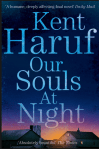
Our Souls At Night by Kent Haruf

From my review:

I loved the story, which is first sweet then bittersweet, but what I loved even more was the beautiful, luminous writing. In most of his sentences Kent Haruf uses the conjunction “and”. Not only once but often two, three, even four times. This gives his sentences a leisurely pace, a gentle, tone that works so well with the peaceful fictional small town, Holt, his favourite setting. I don’t think he would get away with the overuse of the conjunction, if he didn’t pair it with a very precise vocabulary. All of these elements are present in the first sentences already. That’s why I quoted them. If you like the opening paragraphs, there’s a good chance you’ll like the rest as well. He maintains this pace, the use of descriptions, the gentle tone and mood until the last paragraph. It looks so simple, but it’s very skilful writing.
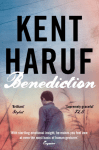
Benediction by Kent Haruf

I didn’t review this. I read it right after Our Souls at Night and was surprised to find out I loved it even more. So much, in fact, that I wasn’t even able to write a review. That happens sometimes.
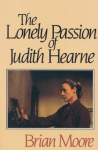
The Lonely Passion of Judith Hearne by Brian Moore

From my review:

It’s not often that a title is so well-chosen or that it does double duty like in the case of Moore’s eponymous title. Yes, the book is about loneliness, and it’s about the last hope to find love. But it’s also a description of utter despair and suffering and that’s alluded to in the title as well. After all, “passion” is also a reference to the “passion of the Christ” or his final suffering and martyrdom. We find in this book the same doubts, the same “why have you forsaken me feeling”, only Judith Hearne, being human, has another fate awaiting her.

Magnus  by Sylvie Germain

From my review:

I’m afraid, I could only scrape the surface of this beautiful and complex novel. I’d say it’s one of the best books on war and memory and the importance to remember our own story and the history of our society. For such a sophisticated novel, Magnus is surprisingly captivating and suspenseful. There are two powerful twists that I didn’t see coming. Truly a tour de force.
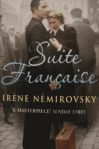
Suite Française by Irène Némirovsky

From my review:

Obviously, this novel spoke to me because it shed light on some questions I had about my family’s history, but even without that, I would have loved this book for its minute details and because it focused on  aspects of the war that are often just briefly mentioned. I can’t think of any other novel that focuses on the invasion of Paris and the early occupation. Most other books either focus on the fighting or on the resistance. I also liked how critical she seems of human behaviour. All too often historical WWII novels or period movies choose to show how people grow under the circumstances, how they overcome their pettiness and selfishness, turn into heroes. The shared tragedy brings out the best in them. While I’m sure, this is true for some, for many it isn’t. Since Némirovsky experienced what she described, I’m pretty sure, her description is more realistic than the idealized versions we usually see. In her book, the Michauds are the only people who seem to grow morally under the circumstances.
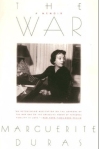
The War by Marguerite Duras

From my review:

I wasn’t sure what to expect from this book. I’m familiar with Marguerite Duras and love her writing but I still thought this would be just another WWII memoir. It isn’t. Most memoirs fous either on the war – on the battle field or the home front – or on the camps. I don’t think I’ve ever read a memoir by someone who was waiting for someone and about the challenges of the return. There’s so much going on in these pages. Every day, there’s a new anxiety regarding her husband and every day the people in France find out more details about the war. The French sent 600,000 Jews to the camps. One in 100 came back. They didn’t know any details about the camps until the end of the war. Other arresting details capture that for France the end of the war also meant the end of the occupation. Or what it was like to see Paris at night illuminated again.
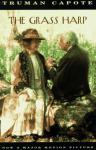
The Grass Harp by Truman Capote

From my review:

I remember how I surprised I was, years ago, when I read that Harper Lee and Truman Capote had been friends since childhood and that she helped him with his book In Cold Blood. While I haven’t read Breakfast at Tiffany’s, thinking of that novella and other elements of Capote’s life, made me assume he was from New York. I realized then, that I had been mistaken. Reading The Grass Harp, makes it obvious where Capote comes from and, given the close friendship with Harper Lee, it’s not surprising that this slim book has a lot in common with To Kill a Mockingbird. Maybe it inspired Harper Lee. The stories and the writing are different, but there are many similar themes; childhood, friendship, authority, love, justice, money, society, death, outsiders, life in a small town, the South, the role of women and African-Americans . . .
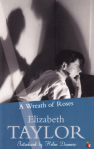
A Wreath of Roses by Elizabeth Taylor

From my review:

A Wreath of Roses caught me by surprise for many reasons. I didn’t expect to like it as much as I did and certainly wasn’t prepared for something as sinister. But there was also a small disappointment. I didn’t appreciate the somewhat circular structure and the way it ended. Those who have read it will now what I’m talking about. But don’t get me wrong, it’s a minor reservation. Otherwise, this is one of Elizabeth Taylor’s richest and most nuanced novels. It combines a wonderful cast of characters with a tone and mood that is at times acerbic but mostly bitter-sweet and melancholic. An interesting combination, for sure. In spite of the somewhat puzzling ending, A Wreath of Roses has become one of my favourites, together with Mrs Palfrey at the Claremont and A Game of Hide and Seek.

Crime Fiction
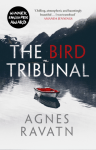
The Bird Tribunal by Agnes Ravatn

From my review:

This book is so eerie. It made me feel uncomfortable from the beginning. The last thing I would want, is to share an isolated house with a brooding, taciturn stranger. Not even the descriptions of the beautiful fjord made me ever forget what this would be like. And in Allis’ situation at that. She’s really done herself a huge disservice in doing what she did back home. Her life is shattered and the things she did has left her very vulnerable. While she hopes things can only get better, the reader senses from the beginning that the house on the fjord might not be a safe haven. There are too many sinister indications that something’s wrong, and that Sigur might be hiding a secret of his own.
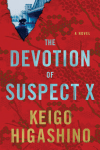
The Devotion of Suspect X by Keigo Higashino

From my review:

The Devotion of Suspect X is a very clever novel. It’s as subtle as it is complex, told in a cool tone and infused with a gentle, melancholic mood. I absolutely loved it.
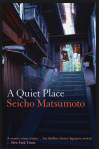
A Quiet Place by Seicho Matsumoto

From my review:

I followed this character with great fascination and astonishment, but for the longest time I didn’t understand why this was called a crime novel. It’s clear from the beginning that Asai’s wife wasn’t killed. So why was this labelled crime? I can assure you, it’s labelled correctly but I won’t tell you why.
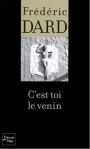
C’est toi le venin (not translated yet) by Frédéric Dard

From my review:

I absolutely loved this novel. Some of it is predictable but there are still enough surprising twists and the end is chilling.

Like Simenon, Dard relies heavily on dialogue. There are just a few descriptions here and there to create a mood and atmosphere. That’s why reading the book feels a lot like watching a movie. It has immediacy and a pretty brisk pace.

Non-fiction

I read a lot of nonfiction and some of the books I read were great (to name but a few – The Lonely City, The Things You Can see Only When You Slow Down, Pema Chödron’s books, The Curated Closet, The Cool Factor) but I didn’t review them, that’s why there’s only one title in this category.
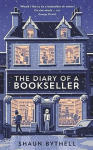
The Diary of a Bookseller by Shaun Bythell

From my review:

I never thought I would love The Diary of a Bookseller so much. I discovered Shaun Bythell ‘s book on Jen Campbell’s YouTube channel. She knew him because she interviewed him way back when she wrote The Bookshop Book. Possibly he was also a contributor to her Weird Things Customers Say in Bookshops. Shaun Bythell is the owner of Scotland’s largest secondhand bookstore. His shop has over 100,000 titles. He’s famous for being more than a little cranky, a bit like Dylan Moran’s character in the TV series Black Books (if you haven’t watched that yet, do yourself a favour and watch it. It’s so, so funny). If you read the diary, you’ll agree, that he has reasons for being cranky. My goodness. It’s unbelievable what some customers do or say.

While 2017 was a bit of catastrophe for me, it wasn’t such a bad year reading wise.


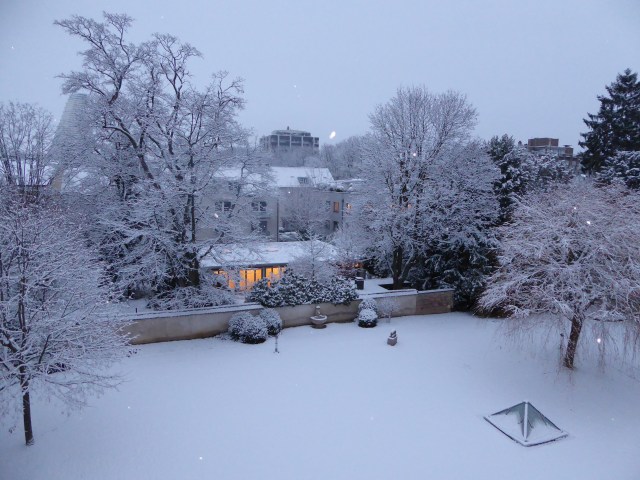
Should anyone wonder about the photo – it’s a view from my bedroom window and a total one-off as we hardly ever get snow, which surprises most people as they think snow is common in Switzerland, but unless you live near/in the mountains, it’s not that common. We get a day or two but not even every year. I took this picture early in the morning, one week before Christmas. I woke up to this view but a couple of hours later, it was already gone. The movie enthusiasts among my readers might enjoy knowing that the film producer Arthur Cohn lives in the high building you can see in the back in the middle of the photo. 

Friend Request by Laura Marshall (2017)

Would you believe it – there’s finally a psychological crime novel whose premise is so original that it isn’t constantly compared to Girl on a Train/Gone Girl  . . . The book in question is Laura Marshall’s début Friend Request. I’d been aware of the novel since last year when it was shortlisted for the Lucy Cavendish Fiction Prize 2016, and was runner-up in the Bath Novel Award 2016. The premise sounded so great, I knew had to read it as soon as it was out, even though I’m a bit tired of psychological crime with a major twist. I’m certainly glad that didn’t keep me from reading it because I thoroughly enjoyed Friend Request. The premise, which you see summarized on the cover, is pretty simple but arresting—Louise gets a friend request on Facebook, from a former classmate, Maria. But Maria has been dead for over twenty years. Or hasn’t she? Fact is, nobody really knows. All they know is that she disappeared at the end of the leavers party and was never seen again.

Louise is shaken by this request. Not only because Maria is said to be dead but because Louise has done something very bad, something that seems to be linked to Maria.

As the novel unfolds, more requests are sent and Louise even feels that she’s followed. We learn who Louise is and who Louise used to be and why she’s so guilt-ridden. In 2016, Louise is a self-employed interior designer. She’s divorced from her highschool crush, Sam, and has a little boy of four. Back in 1989 Louise was an insecure schoolgirl who desperately wanted to be friends with the cool kids. So much in fact, that she wouldn’t shy away from letting others down or even betray them.

After Maria receives the friend request, she receives an invitation to a school reunion. Scared and intrigued, she contacts a former friend, who was the center of the group of cool kids, Sophie. She too has received a friend request and an invitation to the reunion. I’m not going to say much more or the book would be spoilt.

Friend Request is told in chapters that alternate between 2016 and 1989. A lot of the suspense comes from the first person narrator’s withholding information. That’s a narrative device I’m not too keen on and it annoyed me here as well. It just feels a bit artificial and not always believable psychologically. That said, the novel still works and feels realistic. Anyone who has gone to school was either part of the cool crowd, despised by them or just a neutral bystander/observer. In any case, we’ve all experienced or witnessed similar things – bullying, shunning, shaming -, so this was very relatable. Louise is a likeable, interesting character and to some degree I could understand, why she kept what she did a secret.

The final twist was surprising but not far-fetched. It really worked for me. Yes, I would have wished that the writing had been a bit less manipulative, but overall it was gripping and so entertaining that I was sad when it was finished.

Laura Marshall’s certainly an author to watch and while her début has a few flaws, it also has a killer premise, a lot of suspense and a very satisfying ending. That’s more than one can say about most contemporary psychological thrillers.