I’m so pleased that I can finally announce that German Literature Month is returning. Mark November in your calendar and join Lizzy and me for the occasion.
While we focused on countries last year, this year we are structuring the month around genres and literary formats.
Week 1 (November 1-7) Novellas, plays and poems Week 2 (November 8-14) Literary Novels Week 3 (November 15-21) Genre Fiction – Crime, Fantasy, Horror, Romance Week 4 (November 22-30) Read as you please
We chose that sequence so that Judith’s previously announced Bernhard Schlink Week (November 11-17) would span both literary novels and genre week. So if you read something by Schlink this month, you can partake in two blogging events for the price of one. Cunning, don’t you think?
2012 is also the bi-centennial of the birth of the Brothers Grimm. We can’t let it pass without a Brothers Grimm Readathon. So we’ve put that in the calendar from 22-26 November.
My Literature and War Readalong of Gert Ledig’s The Stalin Front will bring the month to a close on the 30th.
I’m looking forward to another wonderful month with lots to read, discuss and discover. Please join us.
Looking for inspiration? Why don’t you browse through last year’s discussion or the German Literature Month 2011 page. You never know what you’ll be inspired to pick up.
Like last year there will be giveaways. Additionally I’m planning on doing a series of introductory posts during October.
A few years ago I was on a trip through Spain and stopped in Sevilla. It was the beginning of August and incredibly hot. Most Spanish cities have rivers but you wouldn’t know that if you visit in summer because they are dry. A very peculiar sight for someone from central Europe. The heat was scorching and I was out sitting in a park, it was only 9 a.m. The park’s sprinklers were on and the moment the water hit the asphalt, it turned into mist. So not only was it hot but quite humid. I had not specific plans but just wandered the city and stopped in parks, bars, restaurants and spoke to people. I haven’t done a similar trip in two years but when I started reading Tabucchi’s Requiem. A Hallucination it was exactly like being on my own, without specific plans and just immersing myself in a new place. The place in this case wasn’t Sevilla or any other Spanish city but the capital of Portugal, Lisbon. It’s equally hot in the book as it was on my trip and this catapulted me back in time. I realize I’m writing a lot about myself instead of writing about Tabucchi but there is a reason. I’m trying to put into words why this author means so much to me, why I love his books although they often, like in this case, are rather descriptions of a quest than a real story. There is just something I can relate to on a deeper level than with most other authors.
Since I’ve just read more than one Tabucchi in a very short time, I was reminded of one of the major themes of his work – the quest. His characters,be it in Indian Nocturne or in Requiem, are always looking for someone. Sometimes the person is real, sometimes the person is just some sort of magnet which attracts the narrator but what he really is looking for is himself.
In Requiem the nameless narrator finds himself aimlessly wandering through the sweltering city of Lisbon. He thought he had an appointment with someone at midday but the person didn’t show up and so he’s left on his own for another twelve hours as the meeting will take place at midnight instead. The person the narrator will meet is the famous writer Fernando Pessoa.
The narrator seems to be dreaming with open eyes, no wonder, after all the book is subtitled “A Hallucination” and we follow him from the park to a bar, to the cemetery, to a restaurant, a hotel, an abandoned villa and finally to another restaurant where he will dine with Pessoa. On his meanderings through the hot summer city he will meet people who are dead already, people from his past, people who still exist and some who never existed.
While this may sound confusing, it isn’t because Tabucchi is a very descriptive writer and the book is more than anything else an homage to Lisbon and everything the city represents for Tabucchi. This includes the people, the food, the music, the atmosphere. As dreamlike as the story may be, it is on the other hand described in an amazingly realistic way and you have the feeling to be there and explore the city through the eyes and the other senses of the narrator. It is an atmospherical and sensual account at the same time.
It seems that one of the things Tabucchi must have liked the most about Portugal was the cuisine. He mentions numerous dishes and recipes in the book. It’s interesting because most of the dishes are poor people’s dishes. Things they cook with leftovers. A frequent ingredient is bread. I have never eaten Portuguese cuisine and to be entirely honest it’s not likely I will as they include a lot of ingredients which I do not eat but it’ still interesting and the way the food is described you can almost taste and smell it.
Requiem is a complex book and can be read in many different ways. To fully appreciate it, I would have to read it once more. There were a few things that struck me during a first reading. The love for Portugal and Lisbon, the quest-like search. The admiration for Pessoa. The mysteries and complexities of life. Memories, dreams, illusions.
What I liked best is that reading Requiem felt so much like exploring a city as a traveller not so much as a tourist. When I’m a tourist I might visit all the places you “have to see” but when I travel, I let the city guide me. The city and it’s people. There will always be someone in a foreign city who will show you something which is worth discovering. A hidden street, a secret corner, a bar to which only the natives go. It’s this type of exploration you will encounter in Requiem. It’s a book for those who do not mind getting lost, knowing very well that they find a world worth discovering on their way.
Tabucchi’s love of Portugal and Lisbon was so intense that he wrote this novel in Portuguese stating in the foreword that no other language, other than maybe Latin which he didn’t master, seemed appropriate.
Tabucchi mentions Portuguese music and this reminded me of the wonderful singer Misia and her fados. Her videos are all visually compelling. This one was directed by John Turturro.
While finishing the book I discovered that the book has been made into a movie by Swiss filmmaker Alain Tanner. The movie is in French/Portuguese. I’ve attached it. You can watch the whole of it on YouTube. I’m not sure it exists with English subtitles but it’s possible.
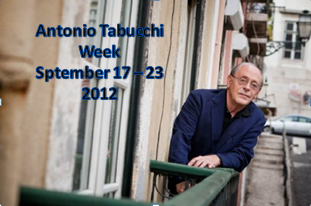
Antonio Tabucchi Week is finally approaching. It’s starting tomorrow and this is really just a very quick introduction to the week and some info for those who participate. I’m going to post two reviews, one on Tuesday and one either Friday or Saturday and will wrap up on Monday in a week.
I spent the last week reading Tabucchi and was quite captivated by my choices. I wanted to read Pereira Maintains but then I dipped into another two of his books and one of them hooked me right away.
Tabucchi has written quite a few very short books, so if you haven’t started yet, there is still time until Sunday.
If you are participating and have reviewed something, please, leave a link in the comment section of this post. I’ll add it to this post. Once the week is over you can still access the links either via this post or via the page I will set up.
Last year I read Taichi Yamada’s Strangers and it was one of the best books I’ve read that year. It haunted me for weeks. The mood, the atmosphere, it was beautiful and sad at the same time. I knew that it wasn’t his first book but the first to be translated into English. There are two other of his novels available in English one of which is In Search of a Distant Voice.
Just like Strangers, Yamada’s older novel In Search of a Distant Voice is a ghost story. But what a peculiar ghost story. Tsuneo works as an immigration officer in Tokyo. This means he chases illegal immigrants, takes part in raids, arrests people and sends them back to their country. Early on in the novel we learn that he has complex emotions which he fights and tries to repress. Some of them are linked to his professional life, some to his personal, very lonely life and another part has something to do with an incident which lies back ten years and took place in Portland, Oregon.
At the opening of the novel, Tsuneo has to get up in the middle of the night and take part in a raid to arrest Bangladeshi immigrants on the outskirts of Tokyo near a cemetery.
First he was overcome by a sense of foreboding. A second self would realize this back-and-forth was just part of the program. And the he would notice that even this realization itself was part of a ritual he had performed many hundreds of times. He was used to holding back moods. Keeping his feelings suppressed. Today, too, everything was happening as it always did.
When he runs after one of the immigrants and wants to arrest the man in the cemetery he is suddenly overwhelmed by an intense feeling which he cannot define at first but seems to be of an intense sexual nature. Tsuneo is delighted and shocked at the same time about the intensity of this experience. Something, a ghost, he thinks has flooded him with his or her emotions. When he returns home that day, he starts to hear the voice of a woman who speaks to him. At first he thinks he is going mad but then he is sure the voice is outside and not inside of his head. And although nobody else hears her, she seems real. It’s like having a phone conversation, only with a ghost.
Tsuneo’s has a lot on his mind these days. He feels pity for those people he arrests and he is wary of the arranged marriage he has agreed to. He is not in love with the woman but she isn’t a bad choice. But the more the book progresses, the more Tsuneo talks to the invisible woman, the more absurd the arranged marriage seems to be. He has a hard time to suppress his feelings and during the engagement ceremony when everyone is performing meaningless gestures and speaking empty words he starts to laugh uncontrollably and in the end breaks down and cries.
There is too much, Tsuneo has never told anyone. What happened in Portland for example or why he even went there. He cannot talk to his fiancée about that nor about the voice but he opens up to that invisible woman and tells her everything, the whole tragic episode that happened in Portland.
More than a ghost story, this is the portrait of a man who, at only 29, has given up on his hopes and dreams, who has repressed all of his feelings but cannot cope anymore. It’s the story of a breakdown, an analysis of guilt, suppressed sexuality, loneliness and search for meaning. There is a moving scene in which Tsuneo tells his friend that his life is completely meaningless. The friend is quite affected and answers that if this was the case, then his life would be meaningless as well.
It’s a flawed book as the end of the ghost story is not as satisfying as in Strangers – and the book is certainly pale in comparison to Strangers – but it’s still a very interesting book. There are many beautiful scenes and reflections and I don’t think I’ve read a lot of novels which dealt as powerfully with the two complementary themes “strangers” and “immigrants” as this book. I didn’t love it as much as Strangers but I liked it too.
I really like Nicci French or I wouldn’t have picked the third book in such a short time. The last two I have read were the first two installments of the new series, Blue Monday and Tuesday’s Gone. Both were really good books. Unfortunately that’s not exactly the case here. Secret Smile has a lot of what I truly like about Nicci French but it’s painfully unbelievable. Still, call me weird, I liked it.
The story, if one doesn’t want to spoil the book, is told in a few sentences. Miranda has been dating Brendan for three weeks when she catches him reading her diary. She immediately ends the relationship. In a way she is relieved because he annoyed her. He was far too obtrusive and possessive. Brendan takes the break up very badly, still she manges to get rid of him. Or so she thinks. A few weeks later he is introduced to her as her sister’s new boyfriend. She is quite shocked and the idea to have to see him regularly really bothers her but on top of that Brendan pretends that he ended the relationship.
What follows is at first manipulation, then pure psychological terror. This premise as such isn’t unbelievable but what is unbelievable is the fact that Miranda doesn’t try to clarify right away who broke up with whom and when she does, nobody believes her anymore.
I always find it annoying when a whole plot relies on one person’s silence, a silence at that which isn’t realistic but has to be maintained in order to get the plot moving. If you can forgive this major flaw or if it is in character with you – let’s say you’re the type who always speaks up too late – then you might not find this unbelievable and would enjoy the book because I think there are a lot of really appealing elements in it. Nicci French is really good at creating atmosphere. The change of seasons is captured well and there are a lot of scenes in which Miranda is on her own and they are all nicely created. Plus she is an interesting character. She is independent, attractive, makes a living as a decorator, all things which work quite well.
Despite the fact that there are unrealistic elements, Secret Smile was a page turner and I really wanted to find out how it would end. Surprisingly the end is different from what I expected which was a pleasant surprise.
As you can see, a mixed bag, but still an enjoyable, quick read.
This is my first contribution to Carl’s R.I.P. VII. Here are the links to the posts of the other participants.
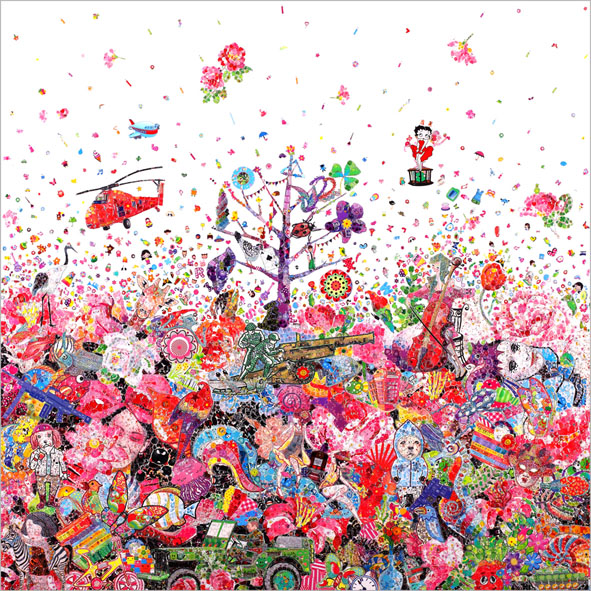
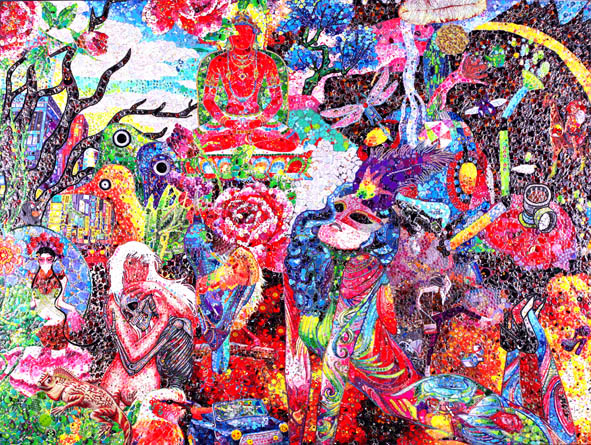
As you may remember, this summer I went to the ART fair in Basel where I discovered the work of Chinese artist Ye Hongxing. She was one of those artists who stunned me not only because of the art she created but also because of the technique she used. Her art is very colorful, some pictures are Mandalas, like the one above, others are depictions of colorful gardens or dreamlike landscapes.
You may like this or not but once you stand in front of her work you’re in for a major surprise. This is art you need to see close up to appreciate how amazing it is as only when you stand quite close will you see that the individual pieces are collages made of hundreds of stickers. The result is stunning and surprising. A mass-product, something we might all have collected as children, creates powerful images which represent religious symbolism, fantastic landscapes and modern technology alike.
I’m glad Lee Sharrock PR informed me of her upcoming exhibition in London. Ye Hongxing is based in Bejing and this is her first UK exhibition. At the same time this is Scream’s opening of their new gallery space on 27 – 28 Eastcastle Street, London W1.
I will not be able to see the exhibition as I will not be in London during that time but for all those who live in London or the UK, don’t miss it. It’s really amazing what she does.
Ye Hongxing is considered to be one of the Top 20 rising Chinese artists. The exhibition is called The Modern Utopia and runs from 13 September to 20 October. As the press release states
The title of the exhibition references the 1905 novel ‘A Modern Utopia’ by H.G Wells and is suggestive of the artist’s investigation into society and modern life.
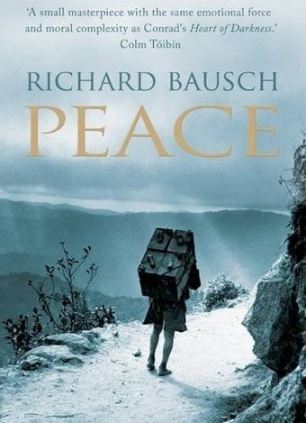
This year’s readalong is a chance for me to read some of the great novelists and authors I hadn’t had an opportunity to read before. Since I’ve first read something about Richard Bausch he was on my list of authors I must read. He is quite famous as a short story writer, his work has appeared in numerous collections and magazines. Peace (2008) is set in Italy during WWII. This isn’t a tale of the home front but from the point of view of American soldiers. It is towards the end of the war, in 1944. Critics called it one of the best books they’ve ever read. A.L. Kennedy called it, lean, compact, layered, darkly humorous, unflinching and lyrical.
Here are the first sentences
They went on anyway, putting one foot in front of the other, holding their carbines barrel down to keep the water out, trying, in their misery and confusion – and their exhaustion – to remain watchful. This was the fourth straight day of rain – a windless, freezing downpour without any slight variation of itself.
*******
The discussion starts on Friday, 28 September 2012.
Further information on the Literature and War Readalong 2012, including all the book blurbs, can be found here.





 Beauty is a Sleeping Cat