Contemporary Chinese Artist Ye Hongxing in London – 13 September – 20 October 2012

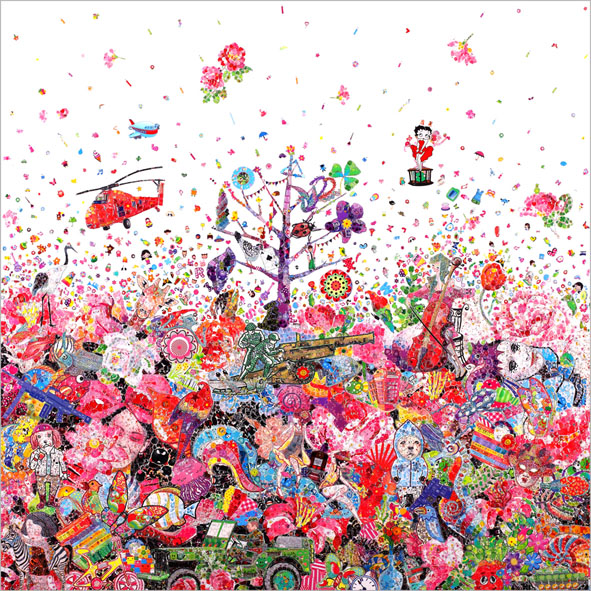
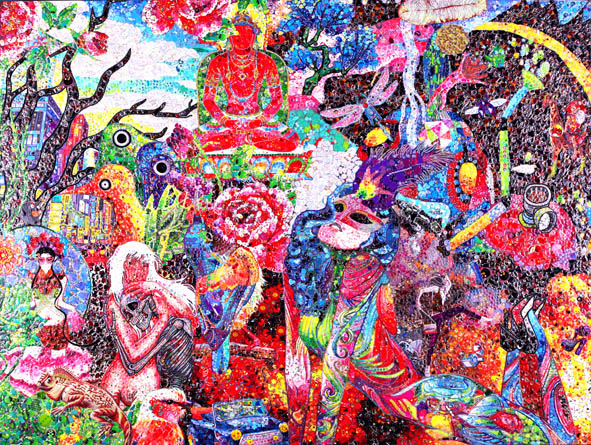
As you may remember, this summer I went to the ART fair in Basel where I discovered the work of Chinese artist Ye Hongxing. She was one of those artists who stunned me not only because of the art she created but also because of the technique she used. Her art is very colorful, some pictures are Mandalas, like the one above, others are depictions of colorful gardens or dreamlike landscapes.

You may like this or not but once you stand in front of her work you’re in for a major surprise. This is art you need to see close up to appreciate how amazing it is as only when you stand quite close will you see that the individual pieces are collages made of hundreds of stickers. The result is stunning and surprising. A mass-product, something we might all have collected as children, creates powerful images which represent religious symbolism, fantastic landscapes and modern technology alike.

I’m glad Lee Sharrock PR informed me of her upcoming exhibition in London. Ye Hongxing is based in Bejing and this is her first UK exhibition. At the same time this is Scream’s opening of their new gallery space on 27 – 28 Eastcastle Street, London W1.

I will not be able to see the exhibition as I will not be in London during that time but for all those who live in London or the UK, don’t miss it. It’s really amazing what she does.

Ye Hongxing is considered to be one of the Top 20 rising Chinese artists. The exhibition is called The Modern Utopia and runs from 13 September to 20 October. As the press release states

 The title of the exhibition references the 1905 novel ‘A Modern Utopia’ by H.G Wells and is suggestive of the artist’s investigation into society and modern life.

Here is a bit more about Ye Hongxing.

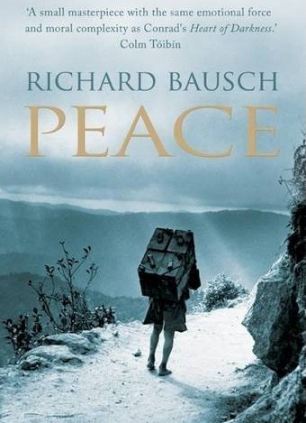
Literature and War Readalong September 2012: Peace by Richard Bausch

This year’s readalong is a chance for me to read some of the great novelists and authors I hadn’t had an opportunity to read before. Since I’ve first read something about Richard Bausch he was on my list of authors I must read. He is quite famous as a short story writer, his work has appeared in numerous collections and magazines. Peace (2008) is set in Italy during WWII. This isn’t a tale of the home front but from the point of view of American soldiers. It is towards the end of the war, in 1944. Critics called it one of the best books they’ve ever read. A.L. Kennedy called it, lean, compact, layered, darkly humorous, unflinching and lyrical.

Here are the first sentences

They went on anyway, putting one foot in front of the other, holding their carbines barrel down to keep the water out, trying, in their misery and confusion – and their exhaustion – to remain watchful. This was the fourth straight day of rain – a windless, freezing downpour without any slight variation of itself.

*******

The discussion starts on Friday, 28 September 2012.

Further information on the Literature and War Readalong 2012, including all the book blurbs, can be found here.

Guy de Maupassant: Bel-Ami (1885)

When I used to think of Maupassant, I used to think of short stories. That was all I had read by him so far and because he is so excellent at it – probably one of the very best short story writers you can read – I thought that his novels might be pale in comparison. I was wrong. After having read Bel-Ami, I think that he might very well be one of the best writers in any genre. It’s one of the most perfect books I’ve ever read. I couldn’t name one single flaw. As much as I like Balzac there is always this and that, minor things, sure, but still, some imperfections. Not with Maupassant. What also surprised me is that this book could have been written nowadays. The society has changed, the world has changed but the way he writes about love, sex, power, money, careers… It’s outspoken and modern.

More than anything Bel-Ami is a character portrait paired with the portrait of a society, the Parisian high society. Georges Duroy, who receives the nick name Bel-Ami from the daughter of his lover Mme Marelle, is one of the most unlikable characters of French literature. An arriviste who has only one striking feature, his good looks, and one talent, the talent to know how to use people or, to be more precise, women.

At the beginning of the  novel he is working as a clerk and hardly knows how to pay his meals. He was a sergeant in the colonial army and served in Algeria. One evening, strolling down the boulevards of Paris and debating with himself how to use his last francs, he bumps into Forrestier, a former comrade. Forrestier has become a journalist in a new and not very respected newspaper which belongs to a Jewish man, Mr Walter. Forrestier is married to a beautiful and very intelligent woman and lives a cushy life. It wasn’t entirely clear to me why he chose to help Bel-Ami but he does and in doing so sets in motion the spectacular ascension of Georges Duroy. Forrestier opens the door to his house and helps him to a position as assistant journalist. Although, just like Forrrestier himself, he isn’t capable of writing one coherent piece, he will become a famous journalist. I’m not going to tell you how, you have to read it to find out.

One trait I found interesting in the novel is to see why people invite other people into their houses. Women invite Bel-Ami because they want him close, they are in love with him. Men on the other hand invite him because he doesn’t have a lot and they all love to display their riches. The women in this society are all easily seduced and the men become victims of their vanity.

While he is still somewhat naive but envious at the beginning of the novel, once he has understood how easily he gets access to the high society and can achieve almost anything through these two weaknesses, the easy seduction of women and the vanity of their men, he turns into a manipulative and calculating machine. Using one woman after the other, duping one husband after the other, he ascends the social ladder with dizzying speed.

While Bel-Ami is the central character, the women and their husbands are not less well-drawn. One perfect little scene after the other shows Bel-Ami “at work”. It’s amazing that he becomes a famous journalist although he isn’t capable of writing. And later he even becomes a politician despite the fact that he is clueless and knows nothing about politics. He is just clever enough to know who does and to get to their knowledge via the one or the other woman.

Bel-Ami is vain, he is self-centered and cares only about his own pleasure, power and money. He seduces people and uses them and when they are no longer of any value he discards them which leads to some fantastic scenes. While he is unlikable, one has to be fair, he doesn’t force women, he seduces them and it’s ultimately their weakness which leads him to success. Men like Bel-Ami still exist and things have not changed much in our society in that regard. I still see women falling for this type of guy who has nothing to offer but looks and sweet talk. And an erotic appeal. Let’s face it, without that erotic appeal not even Bel-Ami would have gotten that far. It’s obvious in the novel, and quite explicit too, that the women  do not fall for him because he is bright or because they want to spend hours gazing into his eyes. They want to go to bed with him. Even the very young ones like Mme Marelle’s daughter who invented the nickname Bel-Ami, cannot hold back and want physical contact.

Maupassant’s novel is one of those that should be read by people who think 19th Century literature is old-fashioned and has nothing to offer to contemporary readers. It could open a door to a whole new reading experience. 

Bel-Ami is an entirely captivating and well-told story, combining descriptions of opulent interiors and detailed character portraits with the analysis of a society addicted to power and fame and one man who knows how to exploit it all.

Aharon Applefeld: The Story of a Life – Sippur chajim (1999) Literature and War Readalong August 2012

In his memoir The Story of a Life acclaimed author Aharon Applefeld tells the story of his childhood and how he came to be a writer. He starts by describing his earliest memories, the beauty he experienced, the love he received from his parents and grandparents. Most prominent in his memories is his last summer holiday as a child of five when he and his parents visited the grand parents in the Carpathians. Little Aharon’s parents are quiet people. They don’t talk a lot and Aharon learns early just to observe, be in the moment and absorb everything around him, the light, the scents, nature. These sensory memories will haunt him all his life. But this idyllic summer is the last peaceful moment of his childhood. Hitler comes to power, war breaks out. At first the family lives in a ghetto, later on they are transported to the camps. Both his parents are killed, his mother right at the beginning of the war. After having lost his father as well, Aharon escapes into the forest where he lives for years until he joins others. Together they first walk from the Ukraine to Italy and from there to Palestine, their new home.

The memoir is a book of a rare beauty. It taps into the deepest recesses of the soul where vague and sensory memories are stored. Because he was a child and a taciturn child at that, he is lacking words for what has happened to him. This makes this memoir so amazing, it’s like watching someone feel around, probe and slowly approach the right words to convey what it was like. Fleeting memories and strong impressions are mixed. Some people, some stories stand out but a lot is just like shadows on the wall.

The loss of his mother tongue leads to further fragmentation. In his family they spoke three different languages, on his long escape to Italy and from there to Palestine, there are more languages spoken and when he finally arrives in Palestine he has to let go of all of them and learn a new one, Hebrew. This is all painful.

I’ve read all sorts of WWII accounts and novels but they never focussed on orphaned children. It’s hard to imagine what it means to lose your parents, your home, your mother tongue. And Palestine wasn’t as welcoming as one would think. Especially not when you felt you wanted to talk about what happened and later to write about it.

Applefeld had to overcome an incredible amount of obstacles before becoming the writer he is today. He had to dig out his memories from where they were buried, find the right words, find the right language. He had to fight hostility too. Every single one of his books is an attempt to capture what happened to him and how it felt.

The Story of a Life is in part exactly that, the story of one man’s life, but more than that it’s a meditation on language and how to put into words, make palpable what is just a fleeting sensory impression. No wonder the cold, the wind, the rain are things which catapult him back to the war years. The war, he writes, is stored in his body, his bones. Because he was so little at the time, lacking the ability to fully comprehend and put into words what happened, the memoir and most of his novels, it seems, are more like a search, a quest almost for what once was, an attempt at conjuring up what was lost.

This is a book I can highly recommend even to those who are tired of reading about WWII and the Holocaust. It is a rich, inspiring and very meditative book about life and how to tell one’s story.

Other reviews

Danielle (A Work in Progress)

Judith (Reader in the Wilderness)


*******

The Story of A Life was the eighth book in the Literature and War Readalong 2012. The next one will be Richard Bausch: Peace. Discussion starts on Friday 28 September, 2012.

R.I.P. VII

Thanks to Grace (Books Without Any Pictures) I discovered that Carl from Stainless Steel Droppings has finally announced R.eaders I.mbibing P.eril VII.

There are different levels of participation. You can read as many books as you like or just one, stick to short stories or watch a movie.

And here are the genres you can choose from:

Mystery
Suspense
Thriller
Dark Fantasy
Gothic
Horror
Supernatural
Or anything sufficiently moody that shares a kinship with the above

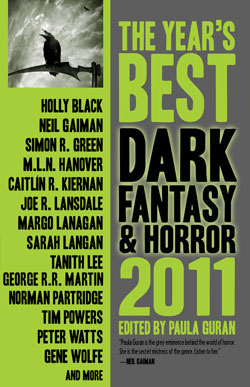
I’m in the mood for ghost stories right now and will certainly read the one or the other. I also just bought The Year’s Best Dark Fantasy and Horror.

There are also two extremely tempting readalongs.

Sarah Water’s The Little Stranger

Neil Gaiman’s The Graveyard Book

Details and sign up can be found here R.eaders I.mbibing. P.eril VII

The reviews can be posted here R.I.P. VII Review Site

Will you join? What are you going to read?

How Gruesome Does A Realisic Account Have To Be? – On Jeanette Winterson’s The Daylight Gate (2012)

A visit to a book shop on Friday evening led me to Jeannette Winterson’s latest book The Daylight Gate. It was in the fantasy section and from the description I gathered it was a book on the trial of the Lancashire Witches in 1612, the most famous of the English witch trials. Why this book was in the fantasy section wasn’t entirely clear to me as witch trials are a historical fact and hardly fantastic. Maybe it was because of the way it was written?

I’ve always been interested in the topic of the trials of witches. Interested and horrified. And I often pick up novels on the subject. In the past I’ve read Eveline Hasler’s amazing but untranslated Anna Göldin. Letzte Hexe (Anna Göldin. Last Witch) on the last witch trial in Switzerland, in 1782. The way the book was told is amazing because it reads like an old trial report. It’s sober and very impersonal which created an eerie feeling of realism. Maryse Condé chose an entirely different approach for her I, Tituba, Black Witch of Salem – Moi Tituba, sorcière noire de Salem. That’s a novel I didn’t only find fascinating but really loved. It’s tragic but beautiful as well. A third novel which many people like but I found dry and unappealing was Erika Mailman’s The Witch’s Trinity.

I was keen to find out how Jeanette Winterson would treat this subject. It seems that content-wise The Daylight Gate is very close to Robert Neill’s Mist Over Pendle. Pendle Hill in Lancashire was said to be the home of witches. While there may be a similarity content-wise, there certainly is none in the execution.

Maybe the fact that it was in the fantasy section misled me. While I didn’t expect a fantasy novel as such, I most certainly wasn’t prepared for something this gruesome. This was by far the most gruesome book I’ve ever read. It’s really not for the faint of heart and it literally made me sick. For someone who is used to read accounts on war this is an intense reaction and it really made me wonder if the book had to be this gruesome to be realistic? Witches are frequent figures in fantasy novels and fairy tales. They can be black or white but some romantic ideas may often be tied to them. Maybe Jeanette Winterson wanted to prevent any idealization or romantic notions. While there are a few instances of magic in the novel – mostly linked to the figures of John Dee and Edward Kelley – the focus is on fanaticism. There is nothing romantic in women and men being persecuted by zealots. Women and Catholics alike were hunted by King James’ henchmen. King James, a fervent  and fanatic protestant, who believed he was attacked by witches, hunted and executed numerous men and women. And had them tortured. And this is the gruesome part, as the torture scenes are described in great detail.

Not only are we served detailed descriptions of torture but of incest and rape as well. Children are sold to their own father. Many a poor woman’s only chance at survival is to sell her body. Often they received not only food but many negative things in exchange. They got pregnant or contracted a disease. The scenes in the dungeons are hard to take as well. The dirt, the festering and oozing wounds, the stink…

To call the world of The Daylight Gate bleak would be an understatement. This is a dark, very dark and disturbing book. Finishing it felt like coming up for air after having been under water and deprived of oxygen.

Was there anything to like in this book?  Yes, I liked the story of Alice Nutter, a rich woman who acquired her fortune through the invention of a magenta dye. An independent and strong woman. Beautiful and free. She was convicted together with 12 other women and men. She seems to serve as proof that it wasn’t about witchcraft but that at the core of those trials was hatred. Hatred against poor people and women.

While I see why Jeannette Winterson chose this approach, I’m not sure it had to be this gruesome. A little less show but tell would have been my preference here. If we had read “He was emasculated” would we not have gotten the picture? Did we need to read how it was done in a page long, detailed description? We get a full blow. No room for romantic notions here, fanaticism and ugliness are laid bare.

To be honest, I could have done without reading this. As well written as it was, as much as I was fascinated by the story of Alice Nutter, I cannot understand how a writer can let loose such utter ugliness. If you know and like Jeanette Winterson, just bear in mind, this might be her most disturbing work.

What do you think? How gruesome should a realistic account of torture and pain be?

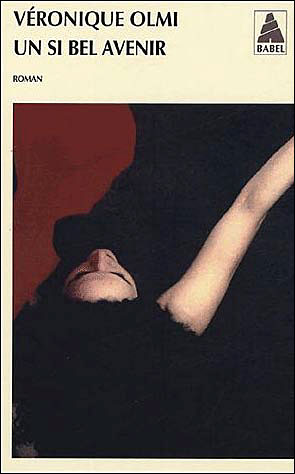
There is More to Véronique Olmi Than “Beside the Sea” or Un si bel avenir (Such a beautiful future)

Un si bel avenir

Lucky Pereine Press decided to publish Véronique Olmi’s prize-winning novel Bord the Mer – Beside the Sea or she may still be waiting for an English translation. I’ve read the book when it came out in France in 2001. It’s an excellent but bleak account of a highly depressed mother.

Olmi has written several novels and theater plays. The one that interested me the most was Un si bel avenir which you could translate by Such a beautiful future. Set in the theater world, it tells the story of two women who meet at a time when their lives start to unravel. Elizabeth is an actress, married with two little girls. Her husband is a failed stage director. Clara is a radio journalist who is in a relationship with Boris, an actor as well. The women first meet at the premiere of one of Pascal’s plays which is a total failure. They meet again by coincidence, just after having found out that their marriages and relationships are about to end.

The friendship she describes is very rare in it’s intensity and loyalty. Two people meet when they need someone the most and open up in a way unknown to both of them. Family secrets, disappointments, dreams and fears are shared with great trust and openness.

Some of the scenes in this novel are incredibly  beautiful, some even in their absurdity like when Elizabeth and Pascal are stuck at midnight on the péripherique or when Elizabeth sits up in the middle of the night, the family is sleeping and she enjoys the peacefulness and security it means. Little does she know this is one of the last moments like this.  Another scene in which she starts to see her husband for what he really is, a failed aging guy, with a sagging ass and a secret mistress, is tragic and hilarious. She swears like a sailor using the most expressive language.

The book is an exploration of what it means to be a woman, a mother, a wife, of the different possibilities, the choices, the difficulties and pitfalls modern life has in stall.

The poignancy and immediacy with which this is written, the dialogue and interior monologue, so close to everyday language, bears the sign of a novelist who is also a successful playwright.  This dialogue and interior monologue is so authentic. At the same time there is an airiness in this writing that can describe the dark night of the soul and still let a light shine in. What I missed most in Bord de mer, the chance for transformation and hope, is present here.

I always felt that French women writers have a capacity to touch on every single detail of everyday life, from the most mundane to the most sublime and render it in a meaningful way, show us how we live now with a all the complexity there is.

As I wrote before, Un si bel avenir is about all the facets of the life of a woman, as a daughter, a wife, a lover, a mother and a friend. It is this last part that is the most accentuated. The book’s characters’ hope lies in the friendship with another woman. Romantic relationships are scrutinized, taken apart and discarded together with family ties.

I do not have such a pessimistic view of the couple, not at all. I think a lot of what is called love has not much to do with real love and that is the core problem. It seems, as if these two women show that it can be easier to live this type of love with another woman or the children, in relationships that are free of physical attraction.

I hope this books will be translated too. It isn’t flawless, there are a few breaks in the narrative towards the end which are abrupt but it has a lot of qualities, a lot to offer.

There is much more to Véronique Olmi than Beside the Sea. Although better constructed, Beside the Sea is awfully bleak. If you ever read anything else you will notice how nunaced her writing really is.

Un si bel avenir has been translated into German Eine so schöne Zukunft.

Coincidentally Emma has just reviewed Bord de mer – Beside the Sea. You can find her review here.