Simone Buchholz – Blue Night – Blaue Nacht – German Literature Month Crime Readalong

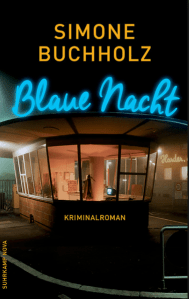
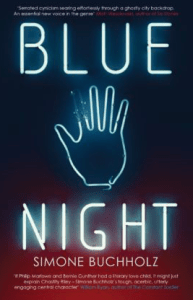
Blue NightBlaue Nacht is the sixth book in Simone Buchholz’ Chastity Riley series and the first to be translated into English. I discovered the book last year in a book shop, not realizing it was part of a series, or I would have started with book one. Oddly, the English translation has the subtitle “Chastity Riley book 1”. Be it as it may, I’m so glad I finally read it. I love noir and this is noir at its best.

State attorney Chastity Riley has done a few stupid things and so she’s not working in the state attorney’s department anymore but for the witness protection. This bores her no end. Feeling she needs some change, she takes her car and drives to the country. The car breaks down and Chastity is stranded somewhere on the road. Where other people would look for the beauty around them, all she sees is a lack of streets and people. And too much countryside. Yikes. Barely gone for a few minutes, she misses Hamburg, the Reeperbahn, the seedy haunts, her ex-gangster lover Klatsche, and the bars where she drinks until the early hours. This beginning sets the tone and introduces a character who is witty, sarcastic, laconic, lyrical, and always different.

Back in Hamburg, she’s assigned to look after a man who has almost been killed. He’s been beaten up severely and has lost one finger. It looks a lot like retribution. With cunning, kindness, and a lot of beer, Chastity manages to get his trust. While he doesn’t reveal his identity, he gives her enough information to begin investigating a crime ring.

The story is definitely interesting and offers a look into the drug problems big cities with large ports like Hamburg face these days. Cheap, dangerous drugs, produced in the East, are distributed in the West with maximum profit. The people in charge are able to wash their money and while everyone knows it, the law can’t touch them.

As interesting as the story is, it pales in comparison to the cast of characters and the style. Chastity Riley is a loner at heart but one with a crowd of friends. Some were formerly criminals, some are policemen, bar tenders, restaurant owners. A charming element of the book is that they all get a voice. In between the regular chapters are chapters in which each of the protagonists, including the nameless man, the criminals, Chastity and her friends get their say. In some books this type of approach doesn’t work, but here it lifts the book to another level.

I read a lot of crime novels this year, but this is the one I liked the most. The voice is so unique, the style so brilliant that it can keep up with a lot of literary fiction that is published these days. And the mood and tone are reminiscent of some of the best noir I’ve read in recent years.

I read this in German, that’s why there are no quotes. Please visit Pat’s blog (added below) to get an idea of the style

Other reviews:

Pat – South of Paris Books


Mechthild Gläser’s The Book Jumper – Die Buchspringer – German Literature Month Readalong

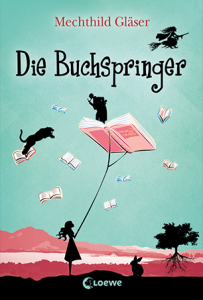
The Book Jumper is a children’s book by German author Mechthild Gläser.

Amy and her mother flee Bochum to take refuge on a forgotten Shetland island. Years ago, when she was pregnant with Amy, her mother left the island just as helter-skelter as they left Bochum now. Amy never knew why. She also never knew her dad. The island, the castle, and Amy’s grandmother are all very mysterious, but not as mysterious as learning that Amy is a book jumper, like everyone in her family. Book jumping is an important ability that gets lost once people get older. Together with two other young people Amy is taught in the art of book jumping. In the beginning book jumping novices have to stick to a favourite book. In Amy’s case that’s The Jungle Book. She is told that it’s important not to stray from the path of the story or to interfere with it. The book jumpers are vital for literature because they have to make sure that the stories remain exactly as they were originally written down.

Among other things, Amy is taught that she can only jump into a book from a specific spot and when she puts the open book on her face. She realizes soon, that this isn’t a necessity for her. She can jump into any book pretty much from wherever she wants. Already on her first jump into the jungle book, she strays from her path and meets Goethe’s Werther. Together with him, she travels in the no-man’s-land between different stories or enters other novels, like Alice in Wonderland. It doesn’t take long until she realizes that there’s something wrong in the land of literature. It seems that a thief is stealing ideas and important story lines get either jumbled or lost. Together with Werther and Will, another book jumper, Amy tries to catch the thief. Unfortunately, the thief is quite dangerous. He kills a beloved literary character and, in the end, even attempts to kill Amy and her grandmother. I can’t really tell much more without spoiling the story.

When Lizzy proposed to read this, I really liked the premise of the book. The idea to jump into your favourite novels, meet favourite characters was so appealing. Sadly, this didn’t work for me. I read it pretty quickly, it had some amusing moments and characters, especially Werther, but it felt quite lifeless. Even the love story between Will and Amy, did only work at first. The solution to the story felt forced. The only thing I liked, was Amy’s back story.

The book is initially amusing, but not exactly a must-read. Something was missing. It may sound weird, but it isn’t fantastical enough. I also didn’t like that Mechthild Gläser spoils a few classic stories by giving away the ending. On top of that, the German blurb is misleading. We’re led to believe Amy will become friends with Elizabeth Bennett, but she only sees her once and very briefly. I hope others enjoyed this more than I did.

Welcome to German Literature Month 2018

November is here and German Literature Month begins.

Normally I do share my plans with you at this stage, not so this year. I will be focussing on our readalong titles. If I manage something else, wonderful, if not, that’s OK as well.

Just to remind you – here’s our program again:

Week 1: Children and Young Adult Fiction (November 1-7)

November 7 – Readalong with Lizzy: The Book Jumper – Mechthild Glaser

Amy Lennox doesn’t know quite what to expect when she and her mother pick up and leave Germany for Scotland, heading to her mother’s childhood home of Lennox House on the island of Stormsay. Amy’s grandmother, Lady Mairead, insists that Amy must read while she resides at Lennox House – but not in the usual way. It turns out that Amy is a book jumper, able to leap into a story and interact with the world inside. As exciting as Amy’s new power is, it also brings danger – someone is stealing from the books she visits, and that person may be after her life. Teaming up with fellow book jumper Will, Amy vows to get to the bottom of the thefts – at whatever cost.

Week 2: Crime Week (November 8-14)

November 14 – Readalong with Caroline: Blue Night – Simone Buchholz

The hair stands up on the back of my neck and I get an age-old feeling in my belly. Like there’s a fight ahead. Like something’s really about to go off…

After convicting a superior for corruption and shooting off a gangster’s crown jewels, the career of Hamburg’s most hard-bitten state prosecutor, Chastity Riley, has taken a nose dive: she has been transferred to the tedium of witness protection to prevent her making any more trouble. However, when she is assigned to the case of an anonymous man lying under police guard in hospital – almost every bone in his body broken, a finger cut off, and refusing to speak in anything other than riddles – Chastity’s instinct for the big, exciting case kicks in.

Fresh, fiendishly fast-paced and full of devious twists and all the hard-boiled poetry and acerbic wit of the best noir, Blue Night marks the stunning start of a brilliant new crime series, from one of Germany’s bestselling authors.

Week 3: 1918 Week (November 15-21)

November 21 – Readalong with Lizzy: The Emperor’s Tomb – Joseph Roth

The Emperor’s Tomb is a magically evocative, haunting elegy to the vanished world of the Austro-Hungarian Empire, and to the passing of time and the loss of youth and friends. Prophetic and regretful, intuitive and exact, Roth’s acclaimed novel is the tale of one man’s struggle to come to terms with the uncongenial society of post-First World War Vienna and the first intimations of Nazi barbarities.

Week 4: Swiss Literature Week (November 22-28)

November 28 – Readalong with Caroline: A Long Blue Monday – Erhard von Büren

The novel portrays, with dry humour, delicate irony and a touch of nostalgia, the lives and feelings of young people in the late 1950s.

“Erhard von Büren pours out memories of love affairs, of family life, of student experiences or incidents from his readings… His style is spiced with waywardness and wit.” – Award of the Canton Solothurn Prize for Literature.

In A Long Blue Monday, the narrator, who is temporarily away from home working on a book about Sherwood Anderson, remembers his unrequited love affair with Claudia, whom he met at college during rehearsals for a play.

How could he, the village lad, the son of a working-class family, aspire to gain the affection of Claudia, a sophisticated town girl, who lives with her wealthy family in a spacious house by the river? Worlds seem to separate the two. But he is convinced that where there’s a will there’s a way. As a young boy, he had tried, by being a model pupil and a model son, to repair his family’s damaged reputation. But now, in spite of all his attempts, his love remains unreciprocated. Finally he decides to take several weeks off college to write a play – a trilogy, no less – to gain Claudia’s esteem.

Week 5: Read as you please (November 29-30)

*******

Please do not forget to enter your posts on the German Literature Month site, so everybody knows what’s happening and can visit your blogs.

Happy reading!

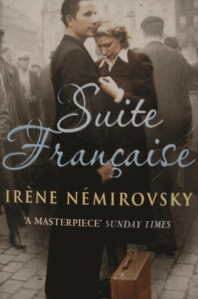
Irène Némirovsky: Suite Française (2004) Literature and War Readalong October 2017

Suite Française, Irène Némirovsky’s posthumously published novel was written in 1942, rediscovered in 1998 and published in 2004. Originally it was planned as a sequence of five novels, but Némirovksy was deported and murdered in Auschwitz before she could complete it.

The two novels included in Suite FrançaiseTempête en juin and Dolce – can be read individually. There are a few characters that are mentioned in both but that does not affect the plot. Judging from the notes Némirovsky left, part three, would have reintroduced a number of the characters from the first books. We can assume, that all five books together would have worked a bit like Balzac’s Comédie Humaine.

Part one, Tempête en juin, which is much more episodic than part two, begins in Paris, in 1941 when the Germans arrive. Thousands of people flee in panic. The book follows several groups of people who all flee the town. Gabriel Corte, a famous writer, flees with his mistress. Some members of the Péricand family flee to Nîmes, where they have family. One of the sons is in the army, another one runs aways to join the army and a third, a priest, is guiding orphans out of the town. Charles Langelet, an aesthete and collector of art and porcelain, flees in a car. The Michaud’s, two bank employees, try to join the staff of the bank in Troyes. Their son Jean-Marie, who has been wounded, is recovering in Bussy.

The narrative moves back and forth between these people, yet the result is anything but disjointed because the tone is so similar and the descriptions so astute. At times it feels like a documentary. The reader is there all the time. We can see, hear and smell the chaos, the fear, the panic. But we also see people at their worst. Most of those Némirovsky chose to describe, with the exception of the Michauds, are rich people. Rich people with a lot of possessions that they don’t want to lose and cling to. People who think that even under dire circumstances, when there’s no food, no shelter, they should still be able to get what they want because they can pay for it. Most of these people are shown as materialistic, ruthless and selfish. They cling to their things in a way that’s absurd. The best example for this is the collector Langelet. He tricks a young couple and steals their petrol, just to save himself and his possessions. In the end, he has nowhere to go and returns to Paris. We see him unwrapping his collection, dine in expensive restaurants and return to his life as a socialite, until he has the most absurd accident.

Part one ends with the armistice and the Germans occupying large parts of France.

Part two begins right after the armistice and is set in the province, in Bussy. It shows how the French dealt with the German occupation and ends when Germany begins the invasion of Russia and the troops stationed in Bussy are sent to the Eastern Front.

Part two has two main story lines. One centers on Lucile Angellier whose husband is a prisoner of war. The Angelliers are one of the richest families of Bussy that’s why a Oberleutnant of the Wehrmacht is billeted at their house. Lucile and the Oberleutnant both seem unhappy in their respective marriages. After long shared walks and endless discussions about music and art, they fall in love but don’t engage in an affair.

The second story line follows a French farmer who was a prisoner of war and escaped. He’s one of those who has the hardest time accepting the new masters. While things look peaceful, under the surface it’s boiling. The French resent the Germans, resent that they eat their food, flirt with their women, live in their houses and make the rules. Who disobeys is shot.

Both parts are very good but I loved the first one more. The descriptions, the choice of details, the characterisations were so captivating that I could hardly put it down. I could also relate to it far more as my father’s family was among those who fled Paris when the Germans arrived. Nobody spoke about it. My dad had just been born, so he didn’t experience it and other members of the family didn’t talk about it. I know they fled to Brittany where my grandmother was from. Brittany was among the parts occupied by the Germans and they spoke about that. Just like in Dolce, they described the Germans as mostly very polite and even kind, but, like in Dolce, they found that even harder to take. Psychologically, an occupation is an extremely difficult experience. So many conflicting emotions play into it. Irène Némirovsky excels at describing this.

Obviously, this novel spoke to me because it shed light on some questions I had about my family’s history, but even without that, I would have loved this book for its minute details and because it focused on  aspects of the war that are often just briefly mentioned. I can’t think of any other novel that focuses on the invasion of Paris and the early occupation. Most other books either focus on the fighting or on the resistance. I also liked how critical she seems of human behaviour. All too often historical WWII novels or period movies choose to show how people grow under the circumstances, how they overcome their pettiness and selfishness, turn into heroes. The shared tragedy brings out the best in them. While I’m sure, this is true for some, for many it isn’t. Since Némirovsky experienced what she described, I’m pretty sure, her description is more realistic than the idealized versions we usually see. In her book, the Michauds are the only people who seem to grow morally under the circumstances.

One could write endlessly about this book. I only scratched the surface. Suite Française is more than just an outstanding novel, it’s an invaluable document. What a terrible shame it wasn’t finished. That said, it doesn’t feel unfinished.

Other Review

TJ (My Book Strings)


*******

Suite Française is the sixth book in the Literature and War Readalong 2017. The next book is the German pre-war novel The Oppermanns  – Die Geschwister Oppermann by Lion Feuchtwanger. Discussion starts on Wednesday, November 29, 2017. You can  find further information on the Literature and War Readalong 2017, including the book blurbs here.

Literature and War Readalong October 2017: Suite Française by Irène Némirovsky


Irène Némirovsky’s posthumously published book Suite Française has been on my pile for ages. I bought the French edition when it came out in 2004. The book consists of two fifths of a novel that was planned to have five parts. Irène Némirovsky wasn’t able to finish her work.  The author, who was of Ukrainian Jewish origin, was deported by the Nazis and killed in 1942.

Usually I start my readalong books later in the month but given that this one is over 500 pages long, I started early. That’s why I can do something, I usually can’t do— urge you to pick this up. I haven’t finished yet but I can already tell – this is fantastic and will make my end of year list.

Most WWII novels we’ve read for the readalong were written either with hindsight or as contemporary historical novels. Not this one. It was written while things happened, which gives it a poignancy, many other books lack. In that it reminds me of Duras’ La douleur.

Here are the first sentences:

Hot, thought the Parisians. The warm air of spring. It was night, they were at war and there was an air raid. But dawn was near and the war far away. The first to hear the hum of the siren were those who couldn’t sleep—the ill and bedridden, mothers with sons at the front, women crying for the men they loved. To them it began as a long breath, like air being forced into a deep sigh. It wasn’t long before its wailing filled the sky. It came from afar, from beyond the horizon, slowly, almost lazily. Those still asleep dreamt of waves breaking over pebbles, a March storm whipping the woods, a herd of cows trampling the ground with their hooves, until finally sleep was shaken off and they struggled to open their eyes, murmuring. “Is it an air raid?”

And some details and the blurb for those who want to join

Suite Française by Irène Nemirovsky, 432 pages, France 1942, WWII

Set during the year that France fell to the Nazis, Suite Française falls into two parts. The first is a brilliant depiction of a group of Parisians as they flee the Nazi invasion; the second follows the inhabitants of a small rural community under occupation. Suite Française is a novel that teems with wonderful characters struggling with the new regime. However, amidst the mess of defeat, and all the hypocrisy and compromise, there is hope. True nobility and love exist, but often in surprising places.

Irène Némirovsky began writing Suite Française in 1940, but her death in Auschwitz prevented her from seeing the day, sixty-five years later, that the novel would be discovered by her daughter and hailed worldwide as a masterpiece.

*******

The discussion starts on Tuesday, 31 October 2017.

Further information on the Literature and War Readalong 2017, including all the book blurbs, can be found here.

Leslie Marmon Silko: Ceremony (1977) Literature and War Readalong September 2017

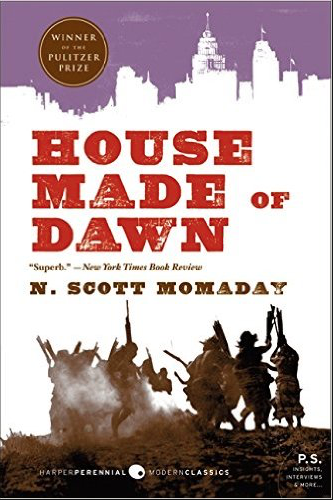
The good news first—I got along better with Leslie Marmon Silko’s Ceremony than with N. Scott Momaday’s House Made of Dawn. I found the writing evocative; the descriptions of the landscape are stunning and it’s a very rich, multi-layered book. The bad news—it was still hard work. There’s not much of a plot, the story isn’t told chronologically, there’s a mix between prose and poems, and without some research, a lot of it would have gone over my head. And that even though I studied cultural anthropology and have at least some idea of Native American mythology.

Given its complexity and that I did only very little research after finishing it, I can’t write an exhaustive review. But I can give you a brief summary and focus on some of the elements that stood out for me.

Tayo, who is half Laguna and half White, suffers from PTSD. He’s a veteran of the war in the Pacific. But not only that, he was also a prisoner of war and one of only a few to survive the notorious Bataan Death March. He’s haunted by the atrocities of war, like the killing of Japanese prisoners, and the things he saw during the march, especially the death of his best friend Rocky. After his captivity, after the war, Tayo spends time at an army hospital but back at the reservation, it’s clear, he’s not cured. He hallucinates, hears voices, drinks too much and gets violent. His family feels that only a medicine man can help but the first ceremony doesn’t change anything because the medicine man is stuck in the past. Only when Tayo finds another medicine man, who incorporates the changes the world has undergone, does he have a chance to heal.

The book explores many themes. Change and identity, the way white people destroy nature and other humans, war, spirituality, the landscape and nature. One could pick any of these themes and write endlessly about it. Since I read this for the readalong, I’ll focus on  a few of the war elements.

There are several things that stood out. First, Tayo, Rocky, and their friends sign up because they hope that fighting for the US, will help them to be accepted. To become “real Americans” one could say. Once back, they soon learn that nothing has changed. They don’t receive any recognition and are pretty much where they were before, only worse off because now they have to deal with contradictions and trauma. Tayo discovers one of the biggest contradictions once he realizes that the Japanese look similar and that the faces of his friends and the soldiers merge in his hallucinations. That’s when he understands he has been instrumentalized by the whites. But not only that – they value him and his people as little as the Japanese. The atomic bomb was tested near the Indian reservations and then used to bomb people, who look a lot like the Indians. The sequence below illustrates this very well.

He had been so close to it, caught up in it for so long that its simplicity struck him deep inside his chest: Trinity Site, where they exploded the first atomic bomb, was only three hundred miles to the southeast, at White Sands. And the top-secret laboratories where the bomb had been created were deep in the Jemez Mountains, on land the Government took from Cochiti Pueblo: Los Alamos, only a hundred miles northeast of him now, still surrounded by high electric fences and the ponderosa pine and tawny sand rock of the Jemez mountain canyon where the shrine of the twin mountain lions had always been. There was no end to it; it knew no boundaries; and he had arrived at the point of convergence where the fate of all living things, and even the earth had been laid. From the jungles of his dreaming he recognised why the Japanese voices had merged with Laguna voices, with Josiah’s voice and Rocky’s voice; the lines of cultures and world were drawn in flat dark lines on fine light sand, converging in the middle of witchery’s final ceremonial sand painting. From that time on, human beings were one clan again, united by the fate the destroyers planned for all of them, for all living things; united by a circle of death that devoured people in cities twelve thousand miles away, victims who had never known these mesas, who had never seen the delicate color of the rocks which boiled up their slaughter.

Needless to say, that the book is to a large extent a criticism of white society and the way White people destroy everything – other people, animals, and nature. In the ceremony, Tayo learns that there are forces, called destroyers, who brought witchery, or dark witchcraft into the world to destroy it. The whites seem to have been the most infected and now act according to the destroyers’ will.

I know I’m not doing this book justice. It’s extremely complex and poetic. To properly review and analyse it, it would need, at least, a second reading.

I didn’t fully warm to Ceremony. I liked the descriptions of the landscape best. And the parts where Tayo’s on a quest to find his uncle’s cattle. Tayo’s a keen observer and the harsh beauty of the land, the precariousness of life in a dry, desert like place, where livestock is constantly threatened to die of thirst, is powerfully rendered. On the other hand, when I look at our world today, the way climate change affects us all, when I think of the 6th extinction that’s currently underway, and how “he who shall not be named” uses a rhetoric of total destruction, I can’t help but notice that Ceremony is an important book. Many of the themes are as actual today as they were when Leslie Marmon Silko wrote it.

I hope I could give a bit of an idea of the book. Its’ definitely ideal for students of American and/or Native American Literature, as it’s so rich and offers so many topics for analysis and discussion. 

Here’s one of my favourite quotes:

The buzzing of grasshopper wings came from the weeds in the yard, and the sound made his backbone loose. He lay back in the red dust on the old mattress and closed his eyes. The dreams had been terror at loss, at something lost forever; but nothing was lost; all was retained between the sky and the earth, and within himself. He had lost nothing. The snow-covered mountain remained, without regard to titles of ownership or the white ranchers who thought they possessed it. They logged the trees, they killed the deer, bear and mountain lions, they built their fences high; but the mountain was far greater than any or all of these things. The mountain outdistanced their destruction, just as love had outdistanced death. The mountain could not be lost to them, because it was in their bones; Josiah and Rocky were not far away. They were close; they had always been close. And he loved them then as he had always loved them, the feeling pushing over him as strong as it had ever been. They loved him that way; he could still feel the love they had for him. The damage that had been done had never reached his feeling. This feeling was their life, vitality locked deep in blood memory, and the people were strong, and the fifth world endured, and nothing was ever lost as long as the love remained.

Other Reviews

TJ (My Book Strings)


*******

Ceremony is the fifth book in the Literature and War Readalong 2017. The next book is the French WWII novel Suite Française by Irène Nemirovsky. Discussion starts on Tuesday 31 October, 2017. You can  find further information on the Literature and War Readalong 2017, including the book blurbs here.
Announcing German Literature Month VII

Doesn’t time fly?  It seems like only two minutes ago since we were celebrating GLM VI.

Just like in previous years, I will co-host this event with Lizzy’s Literary Life. During the month of November, both our blogs will be dedicated to literature written in German.

Will you be dusting down some neglected tomes from your bookshelves? Reading more from a favourite author or treating yourself to some newly translated works?  There’s a lot to celebrate in German Literature this year: the Theodor Storm bi-centennial, the Heinrich Böll centennial, or the three German titles on the longlist of the Warwick Prize for Women in Translation.

It’s hard to know where to start, and impossible to fit it all in. So Lizzy and I have decided to let you meander through the trails of German literature wherever and in whatever fashion you may wish (and perhaps, between us, we’ll cover it all.)

The whole month will be read as you please, with two readalongs for those who enjoy social reading.

On 15th November, the date of the Warwick Prize award, Lizzy will be discussing Yoko Tawada’s Memoirs of A Polar Bear.

On 29th November, I will discuss Lion Feuchtwanger’s The Oppermanns as part of her War and Literature series.

There is no obligation to participate in the readalongs.  As ever,  the only rule for German Literature Month is to simply enjoy reading something originally written in German.  A novel, a play, a poem. Literary non-fiction, even.  Blog about it. Tweet about it. Review on goodreads or any other review site of your choice.  Just let the world know about the treasures to be found in German Literature (and let us know about it also on a special link that will be made available on November 1st).

In years past support for German Literature Month has been phenomenal, and the event is now a true highlight of our reading calendar.  Will GLM VII match its predecessors? It will if you join us. Will you?