Berlin Alexanderplatz Readalong – Part 1

Due to some time constraints this and next week, my post is very short.

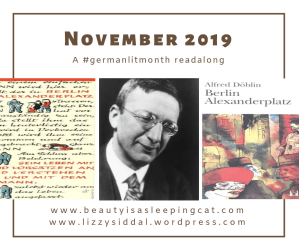
Welcome to the #germanlitmonth readalong of Alfred Döblin’s Berlin Alexanderplatz.  What enticed you to readalong with us?

When I buy a book in a bookshop, I sometimes keep the receipt. I did so in this case and that’s how I know that the book has been on my shelves for 19 years. I bought it in September 2000. I know that when I bought it, I was extremely keen on reading it. But for some reason I didn’t and because I always felt it was a book that had to be read during autumn – possibly because I visited Berlin in autumn – I postponed it from year to year. When Lizzy mentioned she wanted to read it during this GLM, I decided that the time had finally come.

Summarise your initial expectations.  Are they being met?

It’s pretty much how I expected it. Highly readable in some places, and more experimental in others. I struggled more reading the first book than I thought I would. I wasn’t in the right frame of mind, but once I made more time for reading it and saw certain patterns in the storytelling emerge, I was captivated.

Which edition/translation are you using and how is it reading? If you’re reading the original German, is there anything noteworthy about Döblin’s language?

I’m reading the German original and am constantly thinking that it’s almost impossible to translate this adequately because of the extensive use of Berlin vernacular. But since Döblin uses a collage/montage technique there are other challenges. He uses bits from songs, slogans, poetry, and many other sources. Occasionally he uses them verbatim, quite often though, he changes words. Of course, you can translate them, but they won’t mean the same to a foreign reader. With the changes, they might even be more unrecognizable. I was also wondering, if the translators really caught all the allusions and quotes. They would have to be extremely knowledgeable about German culture and literature

The more descriptive passages, especially those in which the narrator/author are present are very beautiful. There’s a rhythm and sound to his sentences that’s unique. The choice of words is very careful.

What are your first impressions of Berlin and Franz Biberkopf?

Because of the way Döblin chose to tell this story, I think of Franz as a guinea pig or a marionette. I feel like I see the threads, the author is using to make him move. I can’t think of him as a real person at all. Interestingly, I feel very differently about Berlin. The city comes across as more of person than Franz. The city comes to life. One has the feeling of experiencing a particular moment in a very particular place.

Welcome to German Literature Month IX 2019

Welcome all! It’s that glorious time of the year again – a full month of Germanic literary indulgence! This is just a quick admin post as there may be newcomers who wonder how this event works.

1. Read anything you want in any language you want … as long as the material was originally written in German.

2. You can follow the themed reading schedule, or ignore it completely by reading as you please for the entire month.

3. If you’re joining in the Berlin Alexanderplatz readalong, please leave an email address to receive the readalong discussion questions.

4. Share what you are reading and what you felt about it by using the tag #germanlitmonth on your blog posts, tweets, instagram shots or booktube videos.

5. Please add a link to each review on the linky at www.germanlitmonth.blogspot.com. (This is an invaluable help when pulling together the author index at the end of the event. Check out the indices from previous years if you’re looking for something to read.)

6. Have fun!

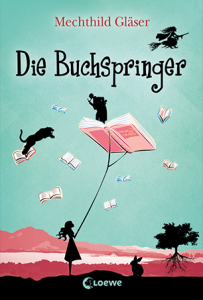
Mechthild Gläser’s The Book Jumper – Die Buchspringer – German Literature Month Readalong

The Book Jumper is a children’s book by German author Mechthild Gläser.

Amy and her mother flee Bochum to take refuge on a forgotten Shetland island. Years ago, when she was pregnant with Amy, her mother left the island just as helter-skelter as they left Bochum now. Amy never knew why. She also never knew her dad. The island, the castle, and Amy’s grandmother are all very mysterious, but not as mysterious as learning that Amy is a book jumper, like everyone in her family. Book jumping is an important ability that gets lost once people get older. Together with two other young people Amy is taught in the art of book jumping. In the beginning book jumping novices have to stick to a favourite book. In Amy’s case that’s The Jungle Book. She is told that it’s important not to stray from the path of the story or to interfere with it. The book jumpers are vital for literature because they have to make sure that the stories remain exactly as they were originally written down.

Among other things, Amy is taught that she can only jump into a book from a specific spot and when she puts the open book on her face. She realizes soon, that this isn’t a necessity for her. She can jump into any book pretty much from wherever she wants. Already on her first jump into the jungle book, she strays from her path and meets Goethe’s Werther. Together with him, she travels in the no-man’s-land between different stories or enters other novels, like Alice in Wonderland. It doesn’t take long until she realizes that there’s something wrong in the land of literature. It seems that a thief is stealing ideas and important story lines get either jumbled or lost. Together with Werther and Will, another book jumper, Amy tries to catch the thief. Unfortunately, the thief is quite dangerous. He kills a beloved literary character and, in the end, even attempts to kill Amy and her grandmother. I can’t really tell much more without spoiling the story.

When Lizzy proposed to read this, I really liked the premise of the book. The idea to jump into your favourite novels, meet favourite characters was so appealing. Sadly, this didn’t work for me. I read it pretty quickly, it had some amusing moments and characters, especially Werther, but it felt quite lifeless. Even the love story between Will and Amy, did only work at first. The solution to the story felt forced. The only thing I liked, was Amy’s back story.

The book is initially amusing, but not exactly a must-read. Something was missing. It may sound weird, but it isn’t fantastical enough. I also didn’t like that Mechthild Gläser spoils a few classic stories by giving away the ending. On top of that, the German blurb is misleading. We’re led to believe Amy will become friends with Elizabeth Bennett, but she only sees her once and very briefly. I hope others enjoyed this more than I did.

Welcome to German Literature Month 2018

November is here and German Literature Month begins.

Normally I do share my plans with you at this stage, not so this year. I will be focussing on our readalong titles. If I manage something else, wonderful, if not, that’s OK as well.

Just to remind you – here’s our program again:

Week 1: Children and Young Adult Fiction (November 1-7)

November 7 – Readalong with Lizzy: The Book Jumper – Mechthild Glaser

Amy Lennox doesn’t know quite what to expect when she and her mother pick up and leave Germany for Scotland, heading to her mother’s childhood home of Lennox House on the island of Stormsay. Amy’s grandmother, Lady Mairead, insists that Amy must read while she resides at Lennox House – but not in the usual way. It turns out that Amy is a book jumper, able to leap into a story and interact with the world inside. As exciting as Amy’s new power is, it also brings danger – someone is stealing from the books she visits, and that person may be after her life. Teaming up with fellow book jumper Will, Amy vows to get to the bottom of the thefts – at whatever cost.

Week 2: Crime Week (November 8-14)

November 14 – Readalong with Caroline: Blue Night – Simone Buchholz

The hair stands up on the back of my neck and I get an age-old feeling in my belly. Like there’s a fight ahead. Like something’s really about to go off…

After convicting a superior for corruption and shooting off a gangster’s crown jewels, the career of Hamburg’s most hard-bitten state prosecutor, Chastity Riley, has taken a nose dive: she has been transferred to the tedium of witness protection to prevent her making any more trouble. However, when she is assigned to the case of an anonymous man lying under police guard in hospital – almost every bone in his body broken, a finger cut off, and refusing to speak in anything other than riddles – Chastity’s instinct for the big, exciting case kicks in.

Fresh, fiendishly fast-paced and full of devious twists and all the hard-boiled poetry and acerbic wit of the best noir, Blue Night marks the stunning start of a brilliant new crime series, from one of Germany’s bestselling authors.

Week 3: 1918 Week (November 15-21)

November 21 – Readalong with Lizzy: The Emperor’s Tomb – Joseph Roth

The Emperor’s Tomb is a magically evocative, haunting elegy to the vanished world of the Austro-Hungarian Empire, and to the passing of time and the loss of youth and friends. Prophetic and regretful, intuitive and exact, Roth’s acclaimed novel is the tale of one man’s struggle to come to terms with the uncongenial society of post-First World War Vienna and the first intimations of Nazi barbarities.

Week 4: Swiss Literature Week (November 22-28)

November 28 – Readalong with Caroline: A Long Blue Monday – Erhard von Büren

The novel portrays, with dry humour, delicate irony and a touch of nostalgia, the lives and feelings of young people in the late 1950s.

“Erhard von Büren pours out memories of love affairs, of family life, of student experiences or incidents from his readings… His style is spiced with waywardness and wit.” – Award of the Canton Solothurn Prize for Literature.

In A Long Blue Monday, the narrator, who is temporarily away from home working on a book about Sherwood Anderson, remembers his unrequited love affair with Claudia, whom he met at college during rehearsals for a play.

How could he, the village lad, the son of a working-class family, aspire to gain the affection of Claudia, a sophisticated town girl, who lives with her wealthy family in a spacious house by the river? Worlds seem to separate the two. But he is convinced that where there’s a will there’s a way. As a young boy, he had tried, by being a model pupil and a model son, to repair his family’s damaged reputation. But now, in spite of all his attempts, his love remains unreciprocated. Finally he decides to take several weeks off college to write a play – a trilogy, no less – to gain Claudia’s esteem.

Week 5: Read as you please (November 29-30)

*******

Please do not forget to enter your posts on the German Literature Month site, so everybody knows what’s happening and can visit your blogs.

Happy reading!

Announcing German Literature Month VIII – November 2018

German Literature Month is eight years old this year, and part of the literary calendar. Lizzy and I know that because of the chatter that continues throughout the year about books purchased and set aside for the event. And that makes us very happy.  We’re even happier when you read them during November.

For those though who are wondering what this is all about, and may wish to join us for the first time, November is the month for reading works originally written in German: fiction, non-fiction, poetry, plays, essays, comics, graphic novels.  Anything you fancy really, in any language you fancy, as long as the original language was German. Then tell the world about it: on your blog, facebook, twitter, instagram, goodreads, amazon, wherever. It all adds up to one great banquet of Austrian, German and Swiss literary goodness. This, for example, was last year’s menu. https://lizzysiddal.wordpress.com/2017/12/05/german-literature-month-vii-author-index/

The last couple of years have been entirely read as you please, but this year Lizzy and I wanted to introduce new themes and add in more social reading opportunities. So we’ve devised the following plan.

Week 1: Children and Young Adult Fiction (November 1-7)

November 7 – Readalong with Lizzy: The Book Jumper – Mechthild Glaser

Week 2: Crime Week (November 8-14)

November 14 – Readalong with Caroline: Blue Night – Simone Buchholz

Week 3: 1918 Week (November 15-21)

November 21 – Readalong with Lizzy: The Emperor’s Tomb – Joseph Roth

Week 4: Swiss Literature Week (November 22-28)

November 28 – Readalong with Caroline: A Long Blue Monday – Erhard von Büren

Week 5: Read as you please (November 29-30)

As always, you may read as you please for the month, or you may choose to join in any (or all) of the specific themes and readalongs.  It’s entirely up to you.  The main thing is to enjoy yourself!  Will you join us?

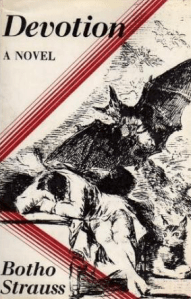
Devotion – Die Widmung by Botho Strauss – A 1977 Club Review

I’m notoriously bad these days when it comes to participating in blogging events, but I always try to read at least one book for Karen and Simon’s “Club” – no matter what year they choose. This week was dedicated to 1977. It was a particularly good year and I could have chosen many books from my piles. I picked Botho Strauss’ novella DevotionDie Widmung because I’ve had it for ages and because it was said to be a stellar piece of writing.

Botho Strauss was first known as a playwright before he started to write fiction. DevotionDie Widmung is considered one of his best works. It tells the story of Richard Schroubek who has been abandoned by his girlfriend Hannah and can just not get over it. It’s 1976, a brutally hot summer in Berlin. In an attempt to fully immerse himself in his feelings of loss and abandonment, he takes leave from his work as a bookseller and stays at home where he spends endless days exploring every facet of his grief and writes it down. The bookseller has turned writer. While writing and tormenting himself, he hopes Hannah will return eventually. Latest, when he gives her his writing.

This is a stunning short novel. It’s neither plot- nor character- but mostly language-driven. It might be the best piece of writing, style-wise, I’ve read in quite some time. The book is in many ways a rant. The rant of a man who has been left and doesn’t understand why. But also of  man who is very different from most people and very isolated. This may sound a bit like Goethe’s Leiden des jungen Werther but it’s not like that at all. Here, the tragedy always veers towards the satirical and the book is often funny. Especially during the rare moments when Richard interacts with someone else. Richard is an astute, sharp observer. He dissects people’s behaviour, their opinions, things he reads or watches on TV and his feelings of loss and grief. While not as lyrical as Swann in Proust’s work, he’s just as analytical.

The longer the story progresses, the more his feelings vanish and that is a new source of sorrow. Celebrating his despair filled the void that the loss of dialogue and companionship left.

Richard is a character-type that I’ve come across several times in literature. He is one of those, like Melville’s Bartleby, who refuse to take part. Naysayers who don’t want to participate in our society. In Richard’s case it’s the loss that catapults him out of his normal life and makes him look at the world around him and at himself with critical eyes. Only Hannah is perfect. In his memory that is.

Because this is so language-driven and because I’ve read it in German, it’s hard to convey how brilliant it is. I can only say, I don’t envy the translator. This must have been extremely difficult to translate.

I’m not sure why this book is called Devotion in English. The German title means “Dedication” and I don’t see why it wasn’t kept. There’s an instance, in which Richard writes about his devotion, but I don’t think it justifies the change of title.

I found a lot to admire in this book and the observations, expressions, figures of speech, are all brilliant, but it was not an entirely accessible book. Not because of the lack of plot or because it’s language-driven but because it very often changes from first to third person and it’s not always clear why and who is the narrator. I should have read it more closely to avoid this type of confusion. I mention this, so future readers know, this needs very attentive, close reading.

Here’s a photo of Botho Strauss and Cate Blanchett. She played Lotte in his play Big and Small.

Lion Feuchtwanger: The Oppermanns – Die Geschwister Oppermann (1933) Literature and War Readalong November 2017

When Lion Feuchtwanger left Germany in 1933 for a trip to the UK and the US, he didn’t think that he would never return to his home country. While abroad, he said to people that “Hitler is over”. When Hitler then became Chancellor – Reichskanzler – in 1933, Feuchtwanger’s opinion changed considerably. “Hitler means war” he said to a journalist, a statement that was widely quoted in the American press. Soon after the Reichstags fire – Reichstagsbrand – Feuchtwanger’s house was searched, his possessions destroyed or confiscated. He knew he could never go back. The events shocked him, but what shocked him even more was that he, like so many other Jews and other Germans, had believed for so long that anything this barbarous would never be possible in the country of Goethe and Schiller. The realization of how wrong he was led him to write The Oppermanns, a book in which we find a lot of his own experience. What struck me, while reading this, was how prescient it seemed. I rechecked my edition twice, to see whether it was really published in 1933. Yet, Feuchtwanger was very had on himself for not having seen the whole thing coming sooner. I found that so interesting. I think we are so focused on the war that we tend to forget that Hitler’s ascent, his totalitarian regime, the horrors against the Jews, the communists and the intellectuals started so much earlier. Long before the war.

The Oppermanns tells the story of a rich Jewish family. There are three brothers and a sister. Martin is the head of the family company, a furniture house, Gustav who works with his brother, is also a publicist and does research on Lessing. Edgar, is a brilliant surgeon. The sister, Klara, stays in the background. It’s her American husband, Jacques Lavendel, who is another major character. Three of the Oppermanns have children. Martin’s son Berthold, Edgars’ daughter Ruth, and Klara’s son Heinrich.

There are many minor characters that are just as important. Teachers at Berthold’s and Heinrich’s school, people who work for the Oppermann’s in their furniture store and many more.

The story starts in 1932 with Gustav’s 50th birthday. It should have been a day of triumph but their company is in danger and this overshadows Gustav’s big day. Until now, Gustav wasn’t a political man. He was more interested in Germany’s culture, its literature and, like many, he believed that someone who produced something as badly written as Mein Kampf couldn’t be taken seriously. Surely, the Germans would see through this and shake it off. His brothers Martin and Edgar were slightly more aware of what was going on. The Nazi’s were gaining ground and Jewish businesses and Jewish people were more and more threatened. In order to save the furniture business, Martin suggests to collaborate with an Aryan business partner. That someone this rooted in tradition and family values would go this way, wakes up Gustav.

Edgar on his side is threatened to leave his hospital. Although he has invented a famous cure, the Nazis’ pretend he’s killing his Aryan patients.

The saddest stories focus on Berthold, whose new teacher is a fanatic Nazi and determined to humiliate Berthold, and the story of one of the Oppermanns’ employees who, like so many, is arrested and tortured.

Towards the end of the novel, after Hitler has become Chancellor, those Oppermanns, who survived, flee the country.

An omniscient narrator tells us the many stories, switching back and forth between the characters. A bit like in Irène Némirovsky’s Suite Française, we get the feeling of being there, of reading a documentary, but the result is a more traditional novel with a plot.

Feuchtwanger deplored later that he wrote this without taking a step back. He felt this documentary aspect was a weakness of the novel. I don’t agree with him. I think this is exactly the reason why this book is so outstanding. It’s the first novel in which the Nazis and their ascent is criticized, in which the manipulations, the lies, the atrocities, the confiscations, the torture, the concentration camps are described in detail.

What I found particularly fascinating is how Feuchtwanger explores the different reactions to the Nazi’s rise. Many, especially cultured people, just couldn’t believe that someone who wrote a book that was as badly written as Mein Kampf could become Chancellor. Others just didn’t take the movement seriously because they thought they wouldn’t get in the line of fire, either because they were from old, rich and influential families or because they thought they were not important enough. Others, especially religious Jews, were planning on leaving for Palestine. I often wondered why not more left but I had no clue that not everyone was allowed in. Only those who could pay a certain amount, which wasn’t possible for everyone.

Another interesting aspect is the difference between race and religion. Reading this book, one becomes fully ware, that it was never really about religion but about race. Most of the characters in this book, probably like Feuchtwanger himself, were not religious. And they certainly didn’t see themselves as belonging to another race. They felt they were Germans just like anyone else. Germans first and then Jewish. Not the other way around. In a way, you could say that this self-image clouded their perception. They didn’t identify with being Jewish and therefore didn’t feel threatened.

At the beginning of this post, I wrote how prescient this book felt. But that is the perception of someone who reads this now and the longer I think about it, the more I feel, Feuchtwanger wasn’t so much prescient as just aware. Reading this, I really wonder why not more people saw it coming.

The Oppermanns is a very readable, entertaining book. The characterisations are wonderful. Feuchtwanger brings even minor characters to life and makes the reader care for them. The strength of the book however lies in its immediacy and documentary character. Reading it, one feels transported in time. And, for the first time, I understood, not only how early it all began, but why people didn’t or couldn’t react the way they should have. Some embraced Nazism, but many just couldn’t believe it. Not even when they saw or heard about the atrocities. Only when they or their loved ones experienced them first-hand did it fully sink in.

If you’re interested in the rise of Nazism or like a well-told family story, then you shouldn’t miss this. It’s outstanding.

Other reviews

TJ (My Book Strings)