Wednesdays are wunderbar – It’s Swiss Crime Time – Friedrich Glauser Giveaway

It’s Wednesday again, time for our weekly giveaway. Today’s books by Swiss author Friedrich Glauser have been kindly offered by Bitter Lemon Press.

We can give away 2 copies of his classic crime novel In Matto’s Realm. I know it’s somewhat shameful but I haven’t read Glauser yet that’s why I included the description of the Bitter Lemon Press Glauser Page for you.
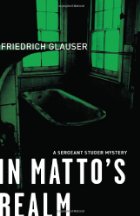
Finalist for the 2005 CWA Gold Dagger Award.

A child murderer escapes from an insane asylum in Bern. The stakes get higher when Sergeant Studer discovers the director’s body, neck broken, in the boiler room of the madhouse. The intuitive Studer is drawn into the workings of an institution that darkly mirrors the world outside. Even he cannot escape the pull of the no-man’s-land between reason and madness where Matto, the spirit of insanity, reigns.

Translated into four languages, In Matto’s Realm was originally published in 1936. This European crime classic, now available for the first time in English, is the second in the Sergeant Studer series from Bitter Lemon Press.

Author Information
Friedrich Glauser was born in Vienna in 1896. Often referred to as the Swiss Simenon, he died aged forty-two a few days before he was due to be married. Diagnosed a schizophrenic, addicted to morphine…

The Translator
Mike Mitchell has translated some thirty books, including ‘Simplicissimus’ by Grimmelshausen and all the novels of Gustav Meyrink. He won the 1998 Schlegel-Tieck German translation prize.

If you would like to win one of the books, please leave a comment. The only condition is that you have been participating in German Literature Month, either with comments, posts or reading along. No need to have your own blog.

The giveaway is open internationally, the books will be shipped by the editor. The winner will be announced on Sunday November 20 at 18.00 – European – (Zürich) time.
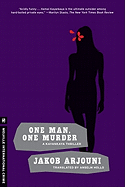
Wednesdays are wunderbar – It’s Crime Time – Jakob Arjouni Giveaway

Today we have another special treat for you, courtesy of Melville House Press we give away one set of Jakob Arjouni’s Kayankaya series to one lucky winner.

This is a great series and anyone who will win it will surely like it.

The giveaway is part of German Literature Month and  is open internationally but if you would like to enter you have to hop over to Lizzy’s blog where the giveaway is taking place.

Good luck!

Nicci French: Blue Monday (2011)

I have read a few novels by Nicci French in the past and always thought they were very entertaining. Not the height of the psychological thriller realm but nicely paced and interesting. All of their (Nicci French is the pseudonym of a married couple writing together) novels are stand-alone thrillers. When I read that they had written the first book in a new series I was very interested to read it.

Blue Monday introduces psychotherapist Frieda Klein and Detective Chief Inspector Karlsson. I suppose we will see both of them again in the next novel but Frieda Klein is the more important character of the two.

One of the problems I have with a lot of the mainstream thrillers and crime novels is what I call “dodgy psychology”. You could also call it pseudo-psychology. This type of psychological explanation was the reason why I did not like Nesbø’s The Snowman. With Blue Monday we are on the same terrain but, funny enough, I liked it anyway. This is as much a thriller as a novel about London. The descriptions of the city are very well done. Another reason why I didn’t mind reading the book was that Frieda Klein is an appealing character. At the beginning of the novel she is just breaking up with someone because he will move to the States and she doesn’t want to follow him. She is deeply rooted in London and in her little house that feels like a den to her. Frieda  is a solitary person and likes to spend a lot of time on her own. Sometimes, plagued by insomnia, she will roam the silent streets of the big city at night. I liked these parts. She used to work in a clininc but has now her own practice.

A little boy is abducted in a way that reminds Detective Karlsson of another abduction twenty years ago. At the same time a man is seeing Frieda because he is suffering of panic attacks and nightmares. The nightmares circle around a little boy whose description reminds Frieda of the one who has been abducted. Frieda cannot put her finger on it but she has a feeling that there is a connection. She reports what she has found out to the police who do not belive her in the beginning.

I’m not going to write anything more about the story, the reader knows soon enough in what direction it goes (another weakness of the book, by the way). Frieda and Karlsson will work very closely together from then on. If you want to find out who abducted the little boy and whether they will find him alive, you will have to read the book.

As I said, despite it’s flaws I found Blue Monday readable because I liked Frieda and the descriptions of London. I’m often not interested in the mystery or the solution to it and enjoy all sorts of other aspects in crime novels and thrillers but if you are someone who loves a mystery, stay away from this book. The solution is very lame, to say the least, and the explanations are far from convincing. The end however is surprising.

This was my fourth and last book contribution to  Carl’s R.I.P. VI challenge. I’m still joining the group read and have planned on doing a post for Peril on the Screen. If you want to visit the review site, you can find it here.

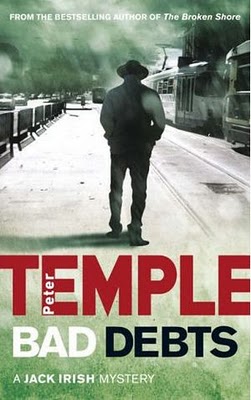
Peter Temple: Bad Debts (1996) A Jack Irish Mystery

Meet Jack Irish: some-time lawyer, part-time private eye, spare-time cabinet maker and full-time lover of strong coffee, swift horses and spirited women.

Bad Debts is the first in Australian crime writer Peter Temple’s Jack Irish series. Temple has won a lot of Australian prizes for his crime and thriller writing. I think it is the first time I read an Australian crime writer. I was very curious and looking forward to the novel and for a total of 50 pages I really enjoyed it.

It’s starts off well enough, quite sarcastic and humorous. Jack Irish seems a typical hardboiled private eye and debt collector. He used to be a lawyer but when his wife is killed he starts drinking and spends a year in total limbo. Sometime during that year he has to defend Danny McKillop, a drunk-driver, who killed a woman. The woman he killed, Anne Jeppeson, was an activist and pain in the neck for many people. The driver had no memory of either driving a car or hitting someone.

Ten years have gone by and all of a sudden Danny McKillop leaves messages on Jack’s answering machine. By the time Jack hears them McKillop has been shot by the police. Jack feels guilty. It seems to him as if he had let down McKillop a second time and he starts to investigate not only his death but also Anne Jeppeson’s death.

After interviewing a few people he finds out that there were and are a lot of strange things going on. People in high places are doing things they don’t want anyone to find out about. His investigation leads Jack deep into corruption and conspiracy and the farther he gets into these things, the more he endangers himself. The last third of the novel is very action-packed.

The beginning of the novel was humorous and I thought it might be one of the series I would like to explore further but after 20-50 pages, there were far too many things I didn’t like. Jack isn’t a lawyer anymore, he tries to make a living collecting debts, betting on horses and doing cabinets. All these different occupations take up time and pages which is very disruptive. On top of that I hate horse-racing stories. Not only do I despise horse-racing I also find it outrageously boring to read about it.

Another problem I had was the language. A large part of the novel consists of dialogue. Australian spoken language seems much closer to British English than to American English. I certainly didn’t mind that. But I did mind that most of the dialogue was composed of swearing and foul language. It was somewhat tiring after a while. And there is the love story. Maybe Jack has been mourning for ten years, but for us, who just got to know him, it’s odd to see him mourn on one page and jump at full speed into a love affair on the next one. And how do I have to picture a woman who is not good-looking but handsome?

I realized that I have a few first and occasionally second books in series at hand and decided to start to read my way through them. Peter Temple’s book was one of them. I’m sure the Jack Irish series has its merits, only I couldn’t find them.

Does anyone know the series? Or any other Australian crime novels/series?

Anne Perry – Interiors (2009) A Documentary

A while back I reviewed Heavenly Creatures (see my review) the movie based on the true story of two young girls who murdered the mother of one of them. One of the girls is the famous crime writer Anne Perry.

The movie was excellent although very disturbing. Last week I discovered on Sam’s blog Book Chase that there is a documentary on the story called Anne Perry – Interiors. If anyone is interested to dig deeper, Sam’s post contains other info and a long discussion.

I haven’t had a chance to watch it yet but will try to do so.

Here is the original site Anne Perry – Interiors

Louise Welsh: Tamburlaine Must Die (2004)

It’s 1593 and London is a city on edge. Under threat from plague and war, it’s a desperate place where strangers are unwelcome and severed heads grin from spikes on Tower Bridge. Playwright, poet, spy, Christopher Marlowe has three days to live. Three days in which he confronts dangerous government factions, double agents, necromancy, betrayal and revenge in his search for the murderous Tamburlaine, a killer who has escaped from between the pages of Marlowe’s most violent play. The Final Testament of Christopher Marlowe is a swashbuckling adventure story of a man who dares to defy God and state and who discovers that there are worse fates than damnation.

I really enjoyed Tamburlaine Must Die. I liked Louise Welsh’s latest novel Naming the Bones (here’s the review) and wanted to read another one and I wasn’t disappointed. However I know the book got very mixed reviews and this mainly because of the language. Clearly Welsh tried to write 16th century English and might not have been 100% successful. I didn’t care or – because I’m not a native speaker – didn’t notice. I thought the language was beautiful.

In her novella Louise Welsh lets Christopher Marlowe, the famous playwright, tell his final ten days. Someone has written a libel in his name, imitating his writing, signing with the name of the main-protagonist of one of his plays, Tamburlaine. Welsh imgines how and why he must have been killed, how he spent his last days, sleeping with men and women, drinking too much, picking fights, putting himself in danger through his blasphemies.

I think Christopher Marlowe is one of the most fascinating figures of literature. An immensely gifted writer, a rake, a debauchee, a spy, a rough neck, a ruffian, an innovator and subversive man  and many other things. The book is atmospheric and evocative, you see the streets of London, the intrigue, the danger of a city afflicted by the plague, the violence of the times. Any sign of not following the Church, not being loyal to the Queen, being a homosexual were highly dangerous.

We know Marlowe escaped the dungeon but only to face death through an unknown enemy. His murder has never been solved and to this day there are many speculations.

I think I start to realize what type of historical novels I like. I like it when a writer manages to give a voice to historical figures, makes them come alive, imagines how they thought and felt.

One thing that has been criticized is that she didn’t depict a fear-ridden Marlowe although he knew he was going to be killed. I think from what I know of the man, he wasn’t too anxious, he threw himself into life until his last moment. He would have gladly gone on living, writing more plays but if this wasn’t to be, then it wasn’t. As simple as that.

The best about the book is that it sparked my imagination. I’m in the mood to read Marlowe’s Tamburlaine, The Great and Doctor Faustus which influenced Goethe and Thomas Mann and I would also be interested in reading about him.

Louise Welsh based her book to a large part on Charles Nicholl’s The Reckoning: The Murder of Christopher Marlowe but David Rigg’s The World of Christopher Marlowe sounds equally interesting.

Has anyone read any of these or other books about Tudor England?

Jenn Ashworth: Cold Light (2011) Crime and Social Realism

An unsettling, darkly humorous tale of teenage girls in a predatory adult world, and a cocktail of lies, jealousy and unworldliness that leads to tragedy.

I have been looking forward to Jenn Ashworth’s new novel since I read A Kind of Intimacy at the beginning of the year (here’s the review). I had a bit of a problem not comparing the two books but once I let go of that I really liked this novel, it’s disturbing and chilling and you only find out at the very end what really happened.

Cold Light is a very appropriate title for this novel, although – as will be explained towards the end – it refers to bioluminescence.  It is a cold world in which today’s girls move and a predatory one. But is this really all that new? There is a lot that reminded me of my own coming of age. Not for anything in the world would I want to be 14 again. The competitions, the jealousy, the insecurity and the constant fighting off of boys or hoping to be noticed by them – depending on where on the good-looking scale you were positioned – was by far too upsetting. It’s all very horrible and can damage you for life. But there are other things young girls have to cope with nowadays that were not even thinkable 10-20 years ago. And today’s Britain (I’m just finishing Kat Banyard’s book The Equality Illusion and it echoes Cold Light) seems to be even worse than many other places.

Chloe is dead. Chloe will be 14 forever, 14, pretty and romantic. Since her presumed suicide 10 years ago she has become something like a cult figure. A symbol for young love and innocence. Now, ten years later, her former best friend Laura sits in front of her TV in a shabby little apartment and watches the groundbreaking ceremony for her memorial. The ceremony comes to an abrupt and macabre end when human bones are found in the damp soil. Laura nows whose bones they are and from this very first scene in the novel we know that some things must have gone seriously wrong ten years ago and we also know that there is a lot to be found out about Chloe, her ex-boyfriend who died with her and everyone else who was involved.

Laura will be watching TV all night, later joined by Emma with whom she is still in contact. They will be smoking and drinking until the early morning. Through flash backs and parts of their discussion the truth is slowly revealed. It’s the story of three friends who are jealous of one another, an older boyfriend who seems weird, a town in a state of alarm as a flasher who is getting more and more violent is chasing young girls. The three girls are only 14 yet they smoke, drink and have sex. We also hear a lot about innocent Chloe, how she exploited the obsessive best friend feelings of the others, how narcissistic and bullying she was, her delinquency and how she always got away with everything just because she was so pretty. Reading the story from Laura’s point of view we discover a lot about her family, the sadness of her childhood, about her father who seems to suffer from some kind of mental illness, her controlling mother and her obsession with Chloe that turns her into a stalker.

It’s an excellent book, disturbing and accurate and reminded me a great deal of the movie Fish Tank. I also thought of Harry Brown. Both movies paint a bleak picture of British youth. The first one also focusing on young girls being as well prey, victims and perpetrators.

Thanks again to Hodder and Stoughton who send me a review copy.