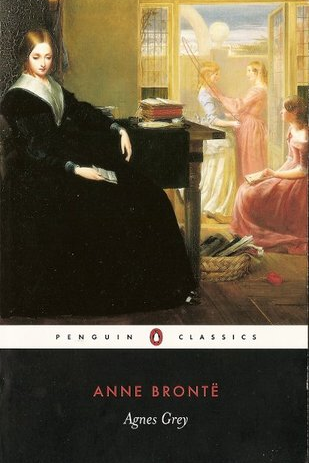
Anne Brontë: Agnes Grey (1847)

Screen Shot 2014-10-05 at 15.33.49

Last year I read all the Jane Austen novels I hadn’t read yet. This year I wanted to do the same with the Brontë novels. Agnes Grey was one of those I hadn’t read yet. Unfortunately starting my project with this book wasn’t a good choice. I found it so dark, I don’t think I’ll pick up The Tenant of Wildfell Hall any day soon, nor Villette or Shirley. Don’t get me wrong, I did expect a bleak story as I knew the book was based on Anne Brontës experience as a governess; an experience that was so negative that it led to her writing of Agnes Grey, hoping it would raise awareness and maybe help change a few things for future governesses. The description of the loneliness and social isolation of a governess were bound to be depressing but what really got to me are the many instances of cruelty against animals. I didn’t see that coming and really struggled through this novel. All the negative characters in this book—children and grownups alike— share a common trait— they see themselves as superior. If they think they are superior to other human beings, how much more must they feel superior to animals? Descriptions of torturing birds, hitting and kicking cats and dogs abound, and turned reading this novel into a nightmare. There’s even an instance in which Agnes, who loves animals, crushes a bird’s nest, to save the small birds from being tortured. Awful!

The book begins with the description of Agnes Grey’s childhood. Unlike most other Brontë heroines, she has a happy childhood and loving parents. They are not very rich but live comfortably until the day when her father loses everything due to an unfortunate investment. There is no urgent need for the two Grey girls to work, but Agnes would like to help her parents financially and decides to become a governess. Thanks to a reference from an acquaintance, she soon finds employment, although she’s only 19 years old and doesn’t have a lot of qualifications.

Her first employment is with the Bloomfields. Agnes knows it will be hard to live far away from her family and that she won’t be able to see them more than once a year. She is sure that her time away will not be easy but she didn’t expect she would be so miserable. Not only is she treated like a servant, but the children of the family are monstrous. They kick and scream and rebel. They are so badly behaved, only a very strong hand would be able to tame them. At the same time they are spoilt and Agnes isn’t even allowed to raise her voice, let alone punish them. She is shocked. She didn’t even knew that children could be like this. One boy in particular is very nasty and enjoys torturing small animals.

After a year she leaves the Bloomfield family and finds new employment with the Murrays. The children are slightly better behaved. There are four of them, two boys and two girls. Luckily the boys are sent away and Agnes does only have to teach the two girls. They are not interested in learning anything and treat Agnes just like their parents: condescending and as if she was a slave. One of the girls is a nasty piece of work. She’s very beautiful and uses her looks to manipulate and flirt. It’s her biggest joy to refuse and humiliate the men who fall in love with her. When she becomes aware that Agnes is interested in the curate Mr Weston, she tries to seduce him as well.

I can understand that people at the time were shocked when they read the book. I wasn’t shocked about Agnes’ treatment, because I knew that governesses had a hard life, due to their awkward situation. They come from the same class as their employers but they have no money and are forced to work. Because they have to work they are seen as inferior, at the same time they are not accepted by the servants because their social class and education places them above. It’s hard to imagine how lonely and helpless these women must have felt.

What shocked me as a modern reader is not so much that they didn’t accept Agnes as one of their own, but how mean and nasty those children were. How spoilt and misbehaved. They were as cruel and mean to Agnes as they were to their animals. They made her suffer on purpose, played tricks on her, disobeyed constantly, had no interest in anything.

If this was what poor Anne Brontë had to endure it’s quite appalling. I don’t know why any parents would have put up with such behaviour. These children have not the tiniest feeling for good and bad, no morals at all. They know what’s socially acceptable, and act accordingly, but only as long as it brings them some benefit or other.

What I found  most disturbing are the scenes among the destitute and the poor. Many rich girls and women did (and still do) charity work. The Murray girls are no exception. They visit the poor, bring things and money but they are never good or kind. They have been taught to give but they do so condescendingly, while Agnes spends time with them, reads for them or just sits and chats with them.

The end felt a bit like wish fulfilment. In a way you could say that the good are rewarded and the bad are punished.

I can see why Agnes Grey isn’t as famous as Wuthering Heights or Jane Eyre. Nor why it is not as well-known as Villette and The Tenant of Wildfell Hall. I found it interesting but dry and shocking. It’s not very descriptive and the character’s voice lacked life. I suspect, should I go on with my Brontë project, that this will remain my least favourite of their novels.

Have you read Agnes Grey? What did you think of it?
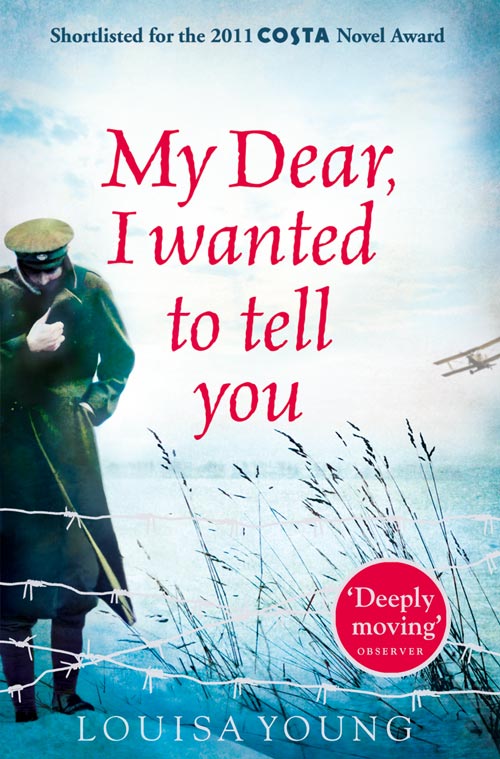
Louisa Young: My Dear, I Wanted to Tell You (2011) Literature and War Readalong September 2014

My Dear I Wanted To Tell You

Louisa Young’s novel My Dear, I Wanted to Tell You is one of the most surprising reads for me this year. After having been disappointed in Pat Barker’s Toby’s Room and Helen Dunmore’s The Lie, I was a little worried this would be the third in a series of underwhelming contemporary WWI novels. Well, it wasn’t. I loved this book and could hardly put it down. Not only because the story was so engaging and the characters so likable but because Louisa Young is a skillful storyteller with a very unique style. It’s not easy to tell a WWI story, including all the common themes, and manage to do that in a fresh and original way, but that’s just what Louisa Young did.

Riley Purefoy and Nadine Waveney meet when they are still small children. Although from very different backgrounds – he’s a poor working-class boy, she’s from a rich upper-class family – they become friends and their friendship turns into love eventually. They both share a passion for art and both want to become artists. Just before the war breaks out, Riley works as an assistant to an artist. He sees Nadine regularly and they know they are in love. However, when her parents find out, they are not thrilled and make Riley understand that he isn’t welcome in the Waveney’s home anymore. Feeling hurt and insulted, Riley impulsively joins the army and within a few weeks is sent to the trenches. Nadine on her side, becomes a nurse. They keep in contact and write to each other regularly, even meet during one of Riley’s leaves.

Thanks to influential people at home and thanks to Peter Locke, Riley’s commanding officer, who understands that Riley is very cultured and intelligent, Riley becomes an officer in spite of his background.

Peter Locke and his wife, Julia, are the second important couple in this novel. The book moves back and forth between these four characters.

The first half of the book is intense and beautiful and drew me in so much that when tragedy strikes it made me gasp. What followed wasn’t an easy read. It was tragic but so well done. There are numerous ways to write about facial mutilation and the way Louisa Young did it was outstanding. She combines the themes of body image, art, and beauty, and weaves them together in way that I found extremely thought-provoking. Peter’s wife, Julia, is obsessed with her beauty. She thinks she has nothing else to offer and, although not yet 30, already wants to undergo plastic surgery. Her thoughts and her anguish mirror the thoughts and the anguish of the mutilated men. I also liked that Louisa Young set the book in an artists’ milieu at the beginning because it underlines that we humans are extremely visual beings and while we might not all feel the same about beauty, we all feel the same about looks and mutilation. Making beauty, even more than mutilation, a main theme was a unique choice and even daring. Daring, because Louisa Young doesn’t spare us. She shows us what those mutilations looked like, what they did to a soldier. And how the society reacted. Even mothers screamed and fled at the sight of their disfigured sons.

The second part of the novel focusses almost entirely on the surgeries and the despair of the mutilated men and on the toll the war takes on the minds of those who survive intact.

One of the strengths of the book is its accuracy, another one is that Louisa Young makes us care about her characters. Not only about the main characters but about the minor characters as well. She captures a society and an event, and thus achieves what the best historical fiction should achieve— make us we feel we’ve been there too.

Although My Dear I Wanted to Tell You tells a horrific story, it’s an amazingly beautiful book, full of sentiment and rich descriptions. Louisa Young has already published the sequel (The Heroe’s Welcome) and more books centering on the same characters are still to come. As she said in an interview: “I think I may be writing the twentieth century, through these characters.” I’m eager to read more of her novels.

Other reviews

 Anna (Diary of an Eccentric)

Danielle (A Work in Progress)

My Book Strings

*******

My Dear, I Wanted to Tell You is the ninth book in the Literature and War Readalong 2014. The next book is the Fantasy novel Phoenix and Ashes by Mercedes Lackey. Discussion starts on Friday 31 October, 2014. Further information on the Literature and War Readalong 2014, including the book blurbs can be found here.

Helen Dunmore: The Lie (2014) Literature and War Readalong July 2014

The Lie

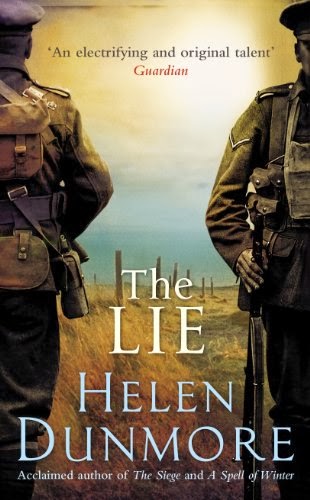
The Lie is not the first WWI novel Helen Dunmore has written. Nor is it her first book about war. While you certainly don’t have to read Zennor in Darkness, or The Siege, or her ghost story The Greatcoat, before you read The Lie, it’s interesting to see how she approaches war from different angles. The Lie is foremost about the aftermath of war. About the scarring, the wounds, in the souls, the bodies, the land.

The Lie is set after WWI in Cornwall. The narrator, Daniel, lives on a forlorn piece of land, overlooking the sea. He’s shell-shocked, but unlike so many other soldiers with post-traumatic stress disorder, who populate literature, he’s taciturn and withdrawn. Even people who know him, like his childhood friend Felicia, would not be able to tell what is going on inside of his head.

I’ve been quiet a long time, I know that. It happens. I go back in my mind. It’s not the same thing as remembering, because it has colour and smell and taste.

The land on which Daniel lives belongs to Mary Pascoe, an old woman, almost blind and frail, who lived outside of society, far from the town, all of her life. WhenDaniel returns from the war, she let’s him seek shelter on her land. When she becomes very ill and blind, Daniel takes care of her and moves into her cottage with her. She makes him promise not to fetch a doctor and to stay on her land once she’s dead.

He takes care of her until her last moment and buries her on her land. Daniel is an able gardener and can live of the land, whose soil is rich. There’s a goat and hens as well. When people start to inquire about Mary, he tell’s them she’s still alive.  The lie will be his undoing.

The story moves back and forth in time, is interwoven with flashbacks of his childhood during which he was friends with Frederick and Felicia, and flashbacks of the war.

I was green as grass. And there was first aid drill, which was like no first aid I ever saw in France. We had a dummy which kept still and didn’t scream, bleed, or stink of shit because its insides were falling out. They taught us to tie a tourniquet, and apply field dressings, and that gas lies in pockets close to the ground long after you think it’s cleared.

You’d think selfishness would be the stronger force, but it turns out that it’s not so. Tell a man to unwrap his puttees, take off his boots, dry each toe individually, examine his feet for sores and rub them all over with whale oil, and tell him if he doesn’t he’ll get trench foot which will cause his feet to go black and stink and maybe even have to cut off — well, you’d think he’d do it. But he doesn’t. He’s cold and wet and dead beat and all he wants is to get some kip. Tell him he’s responsible for the feet of the man next to him, and he does it.

Daniel fights on his own at first and later, with Frederick. Frederick and Felicia come from money, while Daniel is the son of a poor housekeeper. Frederick’s and Daniel’s friendship is tested often due to these class differences; it ultimately survives, because the attachment is so profound.

During the war the class difference almost splits them up, but their friendship survives even this test. It even survives death. We know from the beginning that Frederick is killed in France. We just don’t know how, but assume that Daniel must have witnessed it and feels guilty, as he’s haunted by his death. And by Frederick’s ghost. I thought it was strange that she chose to write another ghost story, right after The Greatcoat, but this isn’t a ghost story. I read the ghost as a symbol for how deeply rooted the trauma of war is.

All at once I know he’s going to come. The dead aren’t tied to one place. He’s as fearful as I am, more maybe. He knows what’s coming to him, and he can’t get away from it. Something’s gone wrong. Thing’s out to stop, once they’re finished, but this won’t stop. They say the war is over, but they are wrong. It went too deep for that. It opened up a crack in time, a crater maybe. Once you fall into it, you can’t get out again. The mud is too deep and it holds you.

Daniel isn’t the only one grieving. Felicia has lost her husband and her brother in the war. When they meet again for the first time, they are both wary. They have changed and are not sure  whether there is more than their connection with Frederick that brings them together, or if there is a possibility of friendship, even love.

The Lie is a poetical story. The flashbacks are so tightly woven into the progressing story that they become part of it. Nothing that Daniel does, doesn’t remind him of the war. When he repairs Felicia’s furnace, he’s transported back to the trenches. When he cultivates the land, and digs in the soil, he’s reminded of the mud in France.

The most beautiful parts are the descriptions of this forlorn country, covered in furze and bracken, smelling of salty sea air and the richness of its soil. But in spite of these beautiful passages, I found the novel and its tragic ending, extremely depressing. And I didn’t get why the lie had such tragic consequences.


Other reviews

Danielle (A Work in Progress)

TJ (My Book Strings)

Violet (Still Life With Books)


*******

The Lie is the seventh book in the Literature and War Readalong 2014. The next book is the WWI memoir Undertones of War by Edmund Blunden. Discussion starts on Friday 29 August, 2014. Further information on the Literature and War Readalong 2014, including the book blurbs can be found here.

Angela Carter: The Magic Toyshop (1967)

The Magic Toyshop

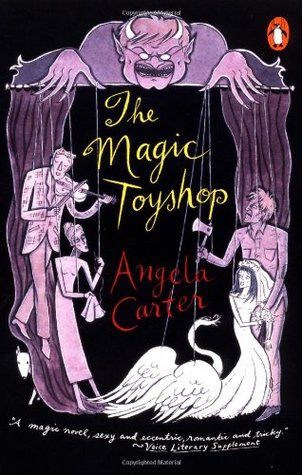
I’m often tempted to skip the summary when reviewing a book, because, most of the time, the story as such doesn’t tell you a lot about a book. This is especially true in the case of Angela Carter. Her second novel The Magic Toyshop is no exception. It tells the story of a young girl, 15 year-old Melanie, who loses her parents the day after exploring the nightly parental garden in her mother’s wedding dress. She and her two siblings are then sent to her maternal Uncle Philip, a toy maker. At her uncle’s house she meets her Aunt Margaret and her aunt’s two brothers Finn and Francie. One is a painter, the other one a fiddler. It’s a very strange household. Creepy, joyless and fearful when her uncle is around; excentric and exuberant when he’s out. There’s a strange attraction between Finn and Melanie and one night, in the ruin of a magical garden, he kisses her. Melanie is confused by this because she doesn’t really fancy Finn. Additionally they have to hide their attraction because their uncle hates affection and emotions; he only lives for and through his toys and puppets. The grand finale is set in motion when Melanie has to play Leda in a cruel version of Leda and the Swan. Finn not only refuses to play along, but he takes revenge. Will the inhabitants of the sinister uncle’s house be able to free themselves or will they continue to be puppets in his hands?

A summary like this doesn’t tell you anything about the lush richness of the writing or what it feels like to enter an Angela Carter novel. Reading The Magic Toyshop is like entering an antiques shop or a shop with vintage clothes. You move from one beautiful garment to the next, from one arresting object to the following, only instead of objects and clothes you find sentences and images, allusions to fairy tales and myths, all woven into a shimmering tapestry. I felt like walking around in a stuffy room; in one corner I saw Bluebeard, in the next Red Riding Hood, and, over there, in a corridor, I spotted Dickens. Uncle Philip is like Bluebeard but he’s also a counter piece to the many bad stepmothers in fairy tales. He decidedly plays the role of a very bad step-father.  He’s an illustration of Carter’s play with gender clichés and tropes. Why does it always have to be the step mother who is vicious and vitriolic? In The Magic Toyshop the older women are positive, maternal figures. The older man is wicked and the younger are dreamy and wild.

The amazing thing in Carter’s writing is, that in spite of its complexity, it is very accessible and even entertaining. You can read The Magic Toyshop without being aware of the subtext, the allusions and references and still enjoy it. But, of course, she’s an author who makes you want to pick up books on her writing. It makes it so much richer, when you know what she is referring to or what she deconstructs.

Before I end this somewhat disjointed review (we have a heat wave currently and it’s hard to concentrate) I’d like to mention two more elements and maybe someone else can tell me how to interpret them:

Dirt – Dirt plays an important role in this novel. Melanie comes from a rich, elegant environment and everyone is clean at all times. Not so in Uncle Philip’s household where it’s hard to find warm water or soap and the people and their clothes are filthy. I remember from other stories that dirt is important but I’m not sure what meaning it has.

Incest – There’s open incest and incestuous moments in the novel. This is also a recurring theme.

The Magic Toyshop has been made into a movie which you can watch on YouTube. Angela Carter was fascinated by cinema and has twice contributed to the scripts of her own stories. This may be one of the reasons why anyone can enjoy her work – it’s always very visual.

This is my first review for Angela Carter week, co-hosted with Delia (Postcards from Asia).

PLEASE ADD YOUR OWN REVIEWS TO THE MR LINKY HERE

ACW badge 2-2

Welcome to Angela Carter Week

ACW badge 2-2

Today marks the beginning of Angela Carter Week.  We have over twenty people who would like to participate. I saw quite a few intro posts, links and announcements. Thanks everyone for that. I’m really thrilled to see so much enthusiasm.

Delia has made a list of the participants and I’ve added everyone to my bloglovin account – still, it’s possible we might not see every contribution, therefore we’d be glad if you could use the Linky below.

It’s not as sophisticated as a blogspot Linky but it does work. You just have to click on the widget to see all the entries.

I’ll be visiting and posting all through the week. Next Sunday we’ll wrap up and hopefully we’ll be able to share a list with all the links.

I wish all the participants a great Angela Carter Week!

Michael Morpurgo: Private Peaceful (2003) Literature and War Readalong May 2014

Private Peaceful

British author Michael Morpurgo is one of the most appreciated writers for Children. He was the UK Children’s Laureate from 2003 to 2005 and Writer in Residence at the Savoy Hotel in 2007. He won many prizes for his fiction.

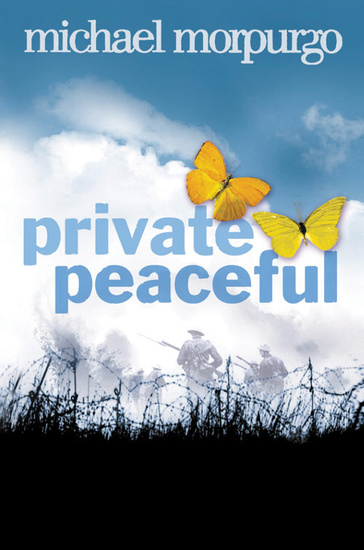
Tommo Peaceful is the narrator of Private Peaceful. He begins his story at five past ten in the evening, after everyone else has left him. He awaits the next day with anxiety but he doesn’t want any company or distraction. He wants to spend the night thinking about his life. The chapters are all given a specific time and each intro to the chapter describes briefly Tommo’s surroundings and his state of mind. After the intro Tommo tells us in flashbacks his story, from the idyllic childhood in the English countryside to the trenches of WWI.

Tommo is one of three boys. At the age of nine his father dies in an accident and Tommo feels responsible for his death. Although he and his older brother Charlie are very close, he never mentions what happened in the woods, the day their father dies. They have an older brother Big Joe who had Meningitis as a child. He can’t go to school and is easily agitated but they are still very fond of him.

Their father’s death marks a transition from a carefree life to a life of some hardship. They are at the mercy of the Colonel in whose cottage they live. The cottage is tied to a function and after the death of the father, who was the forester, they would have to leave. The Colonel’s estate is big and many people and families work for him and so Tommo’s mother is offered a position at the big house, and they can stay in the cottage.

The years go by and there is happiness and heartache in equal measures. When WWI breaks out, they don’t think they are affected. Tommo is only 16 and Charlie, who is two years older, doesn’t think of volunteering but in the end they are forced. Although Tommo is too young, he doesn’t want to abandon Charlie and pretends he’s older. Finally they are shipped to France together. From there they move on to Belgium and stay near Ypres for the following months.

They don’t see any action at first but eventually they come under heavy fire. From then on we get an impression of everything that was typical or important during WWI: trench warfare, mustard gas, rats, rain, mud, high numbers of casualties among men and horses, arbitrariness of orders, sadism of the high command, absurdity of it all . . . While it’s usually key to show but not tell, Morpurgo often tells but doesn’t show. He stays away from graphic descriptions or anything that you could call gruesome. We still get the horror because we see how it affects Tommo. Most of the time, we just don’t get to see what he sees. I think that’s a great way to go in a Children’s book.

What works particularly well in the book is the contrast between the childhood and teenage years and the war scenes. Morpurgo takes a lot of time to introduce us to his characters and to make us care for them. While some of the secondary characters are a bit stereotypical, the main characters Charlie and Tommo are well-developed. Their relationship is very close and they would give everything for each other.

As I wrote in the introduction to this month, I was particularly interested to see how a Children’s author would handle a WWI book from the point of view of a soldier. I think Michael Morpurgo did an admirable job. I’m sure, children will get a good impression for the particularities of WWI. And they will care for the characters and feel deeply about the end. For an adult reader who has read some very similar books for adults – Strange Meeting and How Many Miles to Babylon come to mind – it was not exactly a huge revelation, but in spite of that, I found the twist at the end harrowing.

Other reviews

Danielle (A Work in Progress)

 Judith (Reader in the Wilderness)

*******

Private Peaceful is the fifth book in the Literature and War Readalong 2014. The next book is the WWI novel Fear – La Peur by Gabriel Chevallier. Discussion starts on Friday 27 June, 2014. Further information on the Literature and War Readalong 2014, including the book blurbs can be found here.

Sarah Moss: Bodies of Light (2014)

Bodies of Light

In January I read Sarah Moss’ first novel Cold Earth (here is the review). I liked it but had some minor reservations. I wasn’t sure how good a writer she really was. After having read her latest book, Bodies of Light, I think it’s safe to say that she’s evolved from a promising writer to an accomplished one.

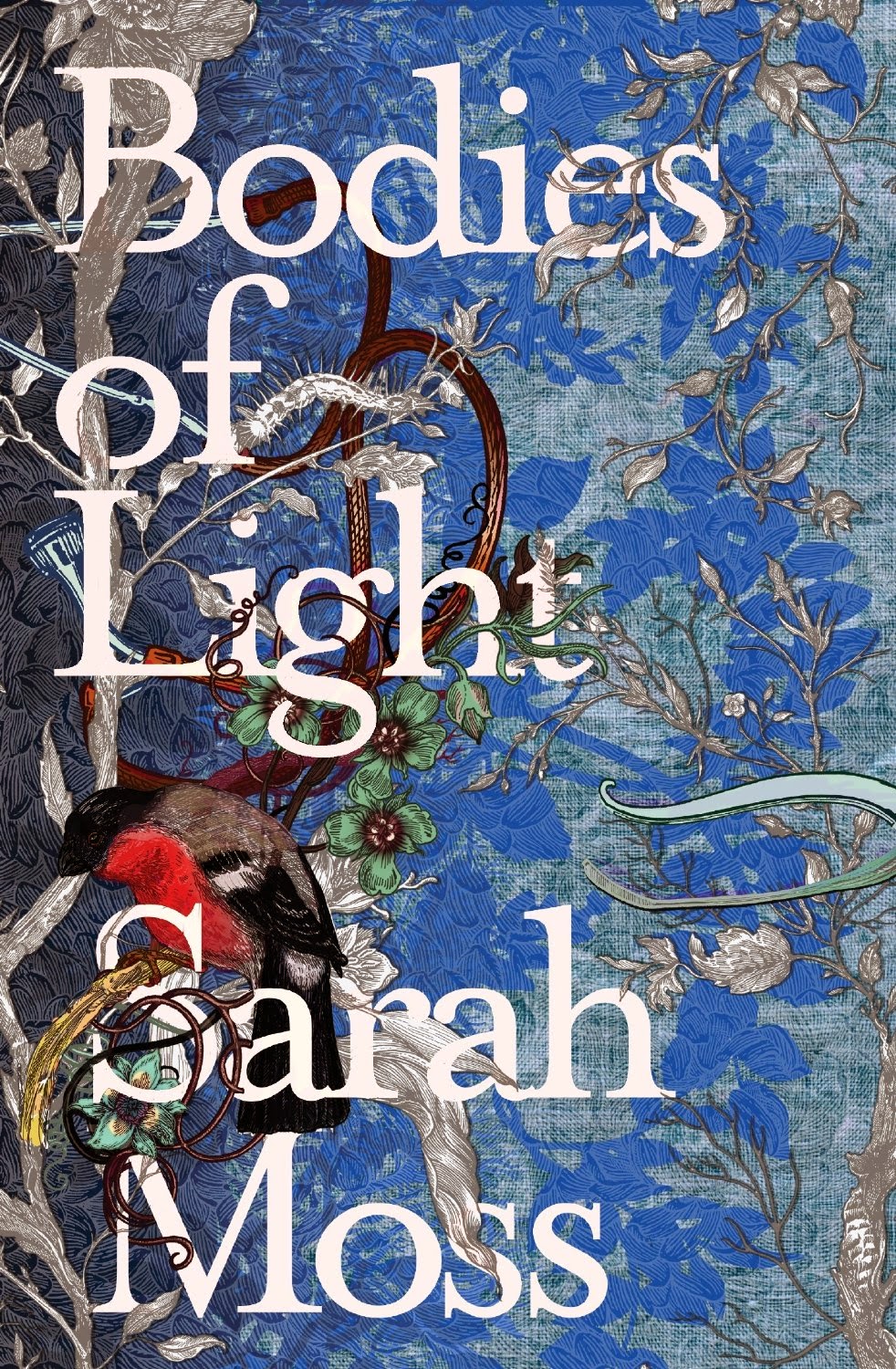
I didn’t look at the author’s name when I saw the book at the book shop the other day. What caught my attention was the beautiful cover that reminded me of a Victorian wallpaper. As soon as I opened it, I discovered that they had used the same endpaper inside. When I read the blurb, I saw how fitting this was, as Sarah Moss has set her third novel in Victorian Manchester and London. This might not have been enough for me to buy the book, but I started browsing and what struck me was how often colors and light were mentioned. I did something I don’t do that often; I bought the book and started reading it right away.

The novel did keep its promise; it has a lot of a William Morris wallpaper. The descriptions and the writing are gorgeous. But what is really arresting is the combination and range of topics.

Bodies of Light tells the story of two generations of women. Elizabeth is married to the designer and painter Alfred Moberley. Beauty is most important to him. He pays attention to color and light, to fabrics and interior decoration, to every single detail in a furniture, wallpaper or painting. Elizabeth is quite different. She likes it sober. She doesn’t want to wear expensive, colorful clothes. Her mother taught her that she has to be modest at all times because there are so many poor women who have nothing. This strict, severe upbringing, in which every single minute is dedicated to helping the poor, has turned Elizabeth into a joyless creature. And she’s ill-equipped for motherhood. She hates being pregnant and once the girl is born she hates her and can hardly be forced to take care of her. On the other hand, her mother taught her to despise the ways of the rich. A nanny is out of the question. Whenever her husband, who is a kind man, wants to take care of Ally and pampers the child, Elizabeth tells him off. It’s easy to understand why this marriage isn’t a happy one.

May is born after Ally. While she will be treated in very strict ways as well, she will not be abused. Abuse is the ugly secret in the Moberly household. Ally is her mother’s mirror and instrument. Her mother mishandles and punishes her and forces her to become successful. What she calls strict is nothing bud thinly veiled sadism.

In spite of this – or because of this – Ally will become one of the first women doctors. When it’s time for her to study, she will leave Manchester and go to live in London. She’s learned from an early age that others have less, that women are mistreated and it seems natural for her to dedicate her life to the cause of women. But her family, especially her mother, looms like a dark shadow over her head. The question is – will she be able to free herself and find happiness?

The summary may seem gloomy and the parts dedicated to Ally’s upbringing, the many cruelties she had to endure on a daily basis, made me choke, but the book contains so much beauty. I liked how complex all the characters are. Even Ally’s mother, Elizabeth. She’s doing a lot of good, helping the poor selflessly, at the same time, she unleashes her sadistic impulses on her daughter. It’s something that we hear occasionally. A person famous for his/her altruism, is a tyrant, bully or even a sadist at home.

A major topic is women’s fight for the right to higher education, their fight to become doctors. The scenes at the hospital are quite drastic. Ally specializes in gynaecology at first but then discovers her interest in psychiatry.

At times it was shocking to see that, while we’ve come a long way, women still fight for many of the things they fought for in the 19th Century. Conflicting emotions about motherhood, for example, are still more or less taboo.

Bodies of Light is a remarkable book. The writing is taut and stylish and full of luminous descriptions. The topics range from art to motherhood, from medicine to women’s history, from psychiatry to abuse and, finally, to healing. The greatest accomplishment however, is that the opposing themes and characters of the novel are mirrored in the writing. The writing is at times pithy, at times lavish. It’s a fascinating, thought-provoking book from a very assured writer. We can look forward to her next books.