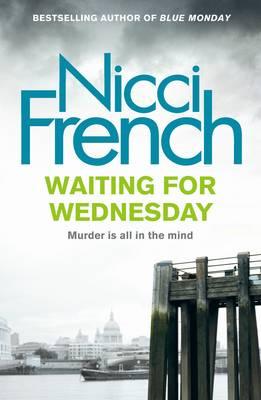
Nicci French: Waiting for Wednesday (2013)

Waiting for Wednesday

If you follow this blog you know I’m a fan of crime writing duo Nicci French. Having read the first two in the Frieda Klein series and spotting number four on the shelves of a local bookshop, I had to finally read Waiting for Wednesday. I really like this series, despite the fact that this is the weakest of the three. It’s an in-between book, a warm up for what will come next. That doesn’t mean it’s not gripping, it’s just that there are two plot-lines, which run parallel, and Frieda isn’t really part of the main plot, but investigating something else.

The book starts strong. Ruth Lennox, a middle-aged housewife with an untarnished reputation and a slightly perfectionist streak when it comes to housekeeping, is found brutally murdered. Her smallest daughter, Dora, finds her when she comes back from school. Why would anyone want to kill a perfect mother and wife, a model neighbour? Maybe she isn’t as exemplary as everyone believes? DCI Karlsson investigates this murder, unfortunately not with the help of psychotherapist Frieda Klein, but with another therapist, Hal Bradshaw,  who hates Frieda’s guts. Although Karlsson is told not to use Frieda’s help, he goes to see her anyway, as he senses the assigned therapist is pompous and useless.

Like in the other books of the series, Frieda’s private life takes a lot of space. Her last case with Karlsson has left her wounded and somewhat traumatized. I can’t reveal too much because that would spoil book number two. In any case, she’s not safe. Or will not always be safe and she knows that.

Her home is Frieda’s refuge. She loves her small house in London, but in this book she hardly ever has it to herself, as it’s invaded by friends and family and finally even by the family of the murdered woman because her niece, Chloë, is friends with the oldest boy.

While Karlsson and his team feverishly investigate the murder, Frieda’s rival, psychotherapist Hal Bradshaw, plays a dirty trick on her, trying to discredit her and some other therapists. A minor thing someone mentions in this charade, makes Frieda look for a girl who has gone missing a while ago. During her investigation, her path crosses with that of a journalist who has spent his whole life investigating the cases of missing girls.

It’s typical for Frieda that she puts herself at risk, so, once again, she makes a narrow escape – that’s not a spoiler as book 4 is already out and we know she’ll survive. Frieda’s love life has gained more importance as well, although her boyfriend Sandy lives in New York.

The book switches from the Ruth Lennox case to Frieda’s investigations and her life. Since Nicci French are excellent at what they do, the book felt seamless. It may not have been as gripping as the last, but it sure put me in the mood to grab the next one right away.

I would recommend this book if you like the series, but I’m not so sure how well it works when you haven’t read the first two. Starting with this one isn’t a good option as book two would be seriously spoilt.

Here’s Guy’s take on the novel. 

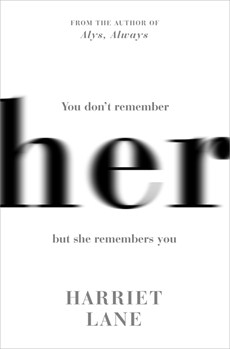
Harriet Lane: Her (2014)

Her

Last year I read Harriet Lane’s Alys, Always and loved it so much that I had to read her new novel Her as soon as it came out. Amanda Craig calls it “Thriller of the Year” and while I might not have read enough of the books that came out in 2014 to confirm this, it’s certainly the best thriller I’ve read so far this year. Take Lucie Whitehouse’s Before We Met and one of Ruth Rendell’s psychological thrillers and you’ll end up with something like Her.

Her has a split narrative. Nina tells one half of the chapters, while Emma narrates the other half. Do you ever wonder what people truly think of you? What they might say about you behind your back? Whether they truly like you or just pretend they do? If you have, and I’m pretty sure, we’ve all wondered at some time, this book will resonate deeply with you as Nina is not so much an unreliable narrator as an unreliable character. She does tell us the truth, albeit in small doses, but she’s anything but truthful to Emma.

At the beginning of the book Nina sees Emma in the street, in London. She hasn’t seen her in years, decades even, and is pretty sure that Emma will not remember her. However, Nina remembers Emma because, all those years ago, Emma did something that Nina could never forgive.

At first Nina doesn’t do anything. She just relishes seeing Emma in a bad place, with one small demanding child and a second on the way. She’s not a young mother and the sleepless nights, the demands of motherhood, have taken their toll. She’s not as gorgeous as she once was. And she’s neither rich nor does she have a career, unlike Nina who lives a life of elegance and wealth and is a succesful painter.

Their paths cross again. This time Nina makes contact. What follows is extremely chilling. Nina befriends Emma, is helpful and kind, but we know what she really feels. Unbeknownst to Emma she manipulates, stages disasters that are just small at first but become more menacing every time.

Reading what Nina thinks and does, followed by Emma’s interpretation of the events, made me feel so uncomfortable. I couldn’t help putting myself into Emma’s place and tried to imagine what it would be like being duped like this. Creepy.

The book is extremely gripping because we constantly ask two questions: What did Emma do all those years ago? and How far will Nina go?

What makes this book even more readable is Harriet Lane’s writing. Her descriptions are fresh and elegant. The only thing that bothered me was the depiction of motherhood. I’m sure it’s stressful to have small children but to the extent this is described here?

The end wasn’t exactly what I had expected but I thought it made sense and it shed another, even darker light on Nina.

If you liked Notes on a Scandal or Ruth Rendell’s psychological thrillers, you’ll enjoy this and appreciate Harriet Lane’s lovely, elegant writing.

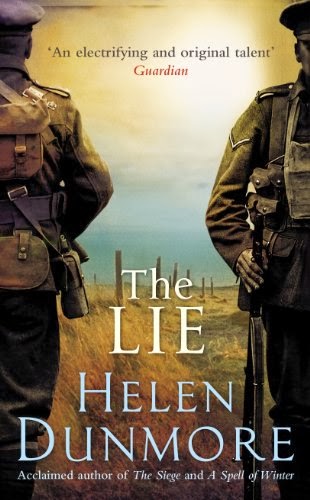
Literature and War Readalong July 28 2014: The Lie by Helen Dunmore

The Lie

Helen Dunmore has written several times about WWI. Back in 2012 we’ve read her earlier novel Zennor in Darkness, a book that made it on my Best of List that year. Naturally I’m looking forward to read her latest novel The Lie. I’ve seen a few reviews here and there but avoided to read them as I want to discover it for myself. What I like the most about Helen Dunmore is her beautiful prose. You can sense right away that she is also a poet.

If Rudyard Kipling’s epitaph at the beginning of the book is anything to go by, then it will be a heartbreaking novel.

If any question why we died

Tell them, because our fathers lied

This epitaph is doubly tragic as Kipling lost his son in WWI. Judging from the movie My Boy Jack, the boy would never have enlisted if it hadn’t been for his father. Here’s Kipling’s touching poem:

My Boy Jack

Have you news of my boy Jack?
Not this tide.
When d’you think that hell come back?
Not with this wind blowing, and this tide.

Has any one else had word of him?
Not this tide.
For what is sunk will hardly swim,
Not with this wind blowing, and this tide.

Oh, dear, what comfort can I find?
None this tide,
Nor any tide,
Except he did not shame his kind —
Not even with that wind blowing, and that tide.

Then hold your head up all the more,
This tide,
And every tide;
Because he was the son you bore,
And gave to that wind blowing and that tide!

Here are the first sentences of The Lie

He comes to me, clagged in mud from head to foot. A mud statue, but a breathing one. The breath whistles in and out of him. He stands at my be-end. Even when the wind is banging over the roof that I’ve bodged with corrugated iron, it’s very quiet. He doesn’t speak. Sometimes I wish he would break the silence, but then I’m afraid of what he might say. I can smell the mud.You never forget the reek of it. Thick, almost oily, full of shit and rotten flesh, cordite and chloride of lime. He has got himself coated all over with it. He’s camouflaged. He might be anything, but I know who he is.

And  some details and the blurb for those who want to join

The Lie by Helen Dunmore (UK 2014) WWI, Novel, 304 pages

Set during and just after the First World War, The Lie is an enthralling, heart-wrenching novel of love, memory and devastating loss by one of the UK’s most acclaimed storytellers. Cornwall, 1920, early spring.

A young man stands on a headland, looking out to sea. He is back from the war, homeless and without family.

Behind him lie the mud, barbed-wire entanglements and terror of the trenches. Behind him is also the most intense relationship of his life.

Daniel has survived, but the horror and passion of the past seem more real than the quiet fields around him.

He is about to step into the unknown. But will he ever be able to escape the terrible, unforeseen consequences of a lie?

*******

The discussion starts on Monday, 28 July 2014.

Further information on the Literature and War Readalong 2014, including all the book blurbs, can be found here.

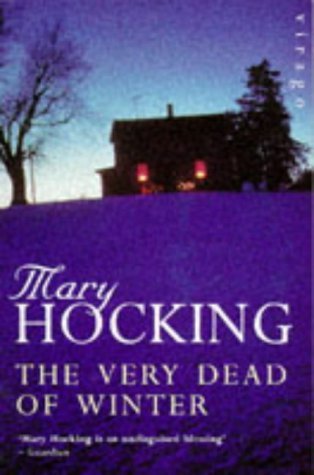
Mary Hocking: The Very Dead of Winter (1993)

The Very Dead of Winter

I’m so glad I came upon Heavenali’s Mary Hocking Month and discovered the brittle beauty of the novel The Very Dead of Winter and its cast of eccentric characters.With her wry humor and sharp eye for social comedy Mary Hocking can be firmly placed in the tradition of British women writers like Elizabeth Taylor, Barbara Pym, Susan Townsend Warner, Beryl Bainbridge and Muriel Spark.

Take a dysfunctional family, put them in a snowed in cottage at Christmas, with one of them slowly dying, and watch what will happen. I can guarantee you it will never be boring. The sisters Florence and Sophia used to spend their childhood holidays at the cottage. Now, in their sixties, they have come here for a special family reunion. Sophia is the owner of the cottage; Sophia’s sister Florence, her dying husband Konrad and their grown-up children Nicholas and Anita are guests.

What would be a testing moment for any family turns into a sometimes tragic, sometimes hilarious adventure. With the exception of Sophia and Konrad, these are some of the most selfish, narcissistic people I’ve ever come across in a novel. Florence is a master manipulator but she’s not very subtle, which leads to hilarious moments. Anita, her daughter, a child psychologist who doesn’t like children, has been under her thumb her whole life. Being with her mother is like being on a battle field when both parties are too tired to strike. They say the nastiest things in the world to each other but they can’t really fight openly.

“My mother is too big for me: She dwarfs everyone around her – except my father,” Anita shouted in to the wind. “There’s never any peace where she is, nowhere I can feel I am me. All my childhood I had to stay clenched tight, ready to parry thrusts from my mother.”

Nicholas isn’t any less dysfunctional he just handles it differently and doesn’t really communicate with any of them.

The book offers wonderful character portraits and an abundance of scenes I’m not likely to forget. In one instance, Florence decides to go to church in the middle of the night, right through the snowed in forest. What would be challenging during the day in summer turns into a dangerous expedition. Anita, although she’s terribly annoyed with her mother, feels obliged to go with her. Of course, it’s far too exhausting and Florence collapses in the middle of the woods. She’s a heavy woman and slender Anita isn’t capable of carrying her. Luckily they stumble over a half-frozen pony, and because she has no means to guide the animal, Anita takes drastic measures. I’m not going to reveal what she does. It’s nothing tragic, just wildly crazy.

Florence is a great character, she’s scheming and manipulative, driven by fear of abandonment, which makes her do foolish things. She lives in constant disappointment with everyone around her, always expecting them to serve her narcissistic purposes. She’s only interested in what people can be or do for her, but takes no interest in their personalities. She has no idea for example who her husband is, where he came from – he is German – or what his dreams and hopes are. Once it’s obvious he will die, filled with the horror of future loneliness, she clumsily tries to capture a widower who lives near by. The ensuing scenes are some of the funniest. Desperate as she is, she even thinks she can manipulate her grown-up children to come back to live with her. One of her favourite techniques is finding her own faults in everyone else.

“Dear God,” Florence said. “What has happened to me?”

Standing there, in the center of the room, it was as if she had come on stage to find herself in an unfamiliar play. She was, above all else, a performer, and to find that she had got the performance wrong was deeply disquieting.

I really liked The Very Dead of Winter are great deal. Not only for its wry humour and psychological insight, but also for some lovely descriptions. It’s not a flawless novel, there are a few instances of shifty point of view, but that didn’t diminish the experience one bit. I’ll certainly read more of Mary Hocking, might even re-read The Very Dead of Winter.

I leave you with two final quotes, one from the beginning of the novel, the other can be found towards the end:

The beginning of the journey had been enchanting. Porcelain blue sky and the sparkling white canopy transformed dingy streets into fantasies of unimaginable purity and, passing out of town, they came to broad fields where sunlight reflected the trellis of branches like veins across the snow.

She stood there a long time while the shadows crept towards her, deeps of blue from which a tree stump rose like the funnel of a sunken steamer. On the other side of the hedge, and between the bars of the gate, the sharpness of outline blurred into a mist of pink and grey shot through here and there with a shee of palest turquoise.

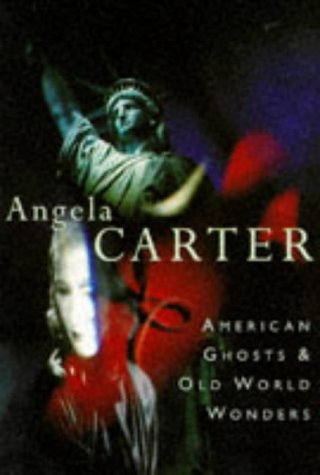
Angela Carter: American Ghosts and Old World Wonders (1993)

American Ghosts

I’m sure we all read because we like a good story but aren’t we equally keen on writing which ignites our imagination? Writing that connects us with our subconscious, our emotions and dreams? Angela Carter knows how to tell a story but more than that, she inspires. She makes us think, explore, dream, fantasize, question. Sometimes it’s not even important to understand every aspect of her short fiction but just to read one of her wonderful sentences, discover one of her splendid images is enough.

The short story collection American Ghosts and Old World Wonders is such a treasure trunk. It’s full of retellings, deconstruction, parodies, reimagining of old myths, fables and fairy tales. It wasn’t always a breezy read. I had to hunt for a few academic papers in order to fully understand the one or the other of the pieces in this book. Like in all of her collections, there were a few stories that stood out and I’ve even found a new favourite.

In this collection Angela Carter mixes myths and elements of the American Dream and/or of America as the land of dreams, the country of  one of the biggest movie industries, the country of serial killers and westerns, of endless possibilities, and juxtaposes these elements with stories from the old world – fairy tales and history. The result is stunning.

The book is divided in two parts. I’d call the first the “American” part and the second the “Old World” part.

Part I

Lizzie’s Tiger is the second Lizzie Borden story she wrote. It shows us a young fearless Lizzie who discovers the magical world of a circus and a tiger who’s living in it. It’s as much an allusion to Blake’s famous poem as it is an imagination of a time when Lizzie was still small and had options to become someone else.

John Ford’s ‘Tis Pity She’s a Whore is a pretty tongue-in-cheek and cheeky piece. What if the film director John Ford made British playwright John Ford’s drama ‘Tis Pity She’s a Whore into a movie? Well – read her story and you’ll find out what that would be like.

Gun for the Devil is another Western type story set near the Mexican border. Johnny get’s a gun and frees a girl. Sort of. The story contains an allusion to the movie Johnny Got His Gun.

The Merchant of Shadows is my favourite story in the book and has become one of my all-time favourites. A story of decay, exuberance, mystery, set in a decadent Hollywood setting, reminiscent of Sunset Boulevard (one of my favourite movies btw). A young academic comes to interview the widow of the famous film director von Mannheim (he seems inspired by von Sternheim). His widow was once a femme fatale but now she’s in a wheelchair, living with her sister who looks like a cowboy.

Here are is a sample of this deliciously lush and weird story, which contains a lot of Angela Carter’s magic, including metafiction, allusions, cultural references and a lot more:

A flight of rough-cut stone steps led up to a pool surrounded by clumps of sweet-smelling weeds; I recognised lavender. A tree or two dropped late summer leaves on scummy water and, when I saw that pool, I couldn’t help it, I started to shiver; I’ll tell you why in a minute. That untended pool, in which a pair of dark glasses with one cracked lense rested on an emerald carpet of algae, along with an empty gin bottle.

On the terrace a couple of rusty, white-enamelled chairs, a lopsided table. Then, fringed  by a clump of cryptomeria, the house von Mannheim caused to be erected for his bride.

That house made the Bauhaus look baroque. An austere cube of pure glass, it exhibited the geometry of transparency at its most severe. Yet, just at that moment, it took all the red light of the setting sun into itself and flashed like a ruby slipper. I knew the wall of the vast glittering lounge gaped open to admit me, and only me, but I thought, well, if nobody has any objections, I’ll just stick around on the terrace for a while, keep well away from that glass box that looks like nothing so much as the coffin for a classical modernist Snow White; let the lady come out to me.

No sound but the deep, distant bass of the sea; a gull or two; pines, hushing one another.

So I waited. And waited. And I found myself wondering just what it was the scent of jasmine reminded me of, in order to take my mind off what I knew damn well the swimming pool reminded me off – Sunset Boulevard, of course. And I knew damn well, of course I knew, that this was indeed the very pool in which my man Hank Mann succumbed back in 1940, so very long ago, when not even I nor my blessed mother, yet, was around to so much as piss upon the floor.

I waited until I found myself growing impatient. How does one invoke the Spirit of Cinema? Burn a little offering of popcorn and old fan magazines? Offer a libation of Jeyes’ Fluid mixed with Kia Ora orange?

This passage shows something else that strikes me every time when I read Angela Carter – how she is at the same time irreverent and full of admiration for her themes.

I liked the stories in part II a little less.

The Ghost Ships – A Chritsmas Story, I didn’t really get it but it had a few great moments. This opening for example:

‘Twas the night before Christmas. Silent night, holy night. The snow lay deep and crisp and even. Etc. etc. etc.; let these familiar words conjure up the traditional anticipatory magic of Christmas Eve, and then – forget it.

Then In Pantoland – a parody of the way fairy tales have become a pure commodity, robbed of their deeper meaning and sometimes violent aspects due to the way Disney has used them.

Ashputtle or The Mother’s Ghost contains three ways to deconstruct Ashputtle. Very different from Disnye’s Cinderalla.

Alice in Prague or The Curious Room is an homage to a Czech filmmaker. It combines Dr Dee and Alice in Wonderland. Edward Kelly is called Ned Kelly. I didn’t really understand what this figure of Australian history got to do in this text. I really love this passage:

Night was. Widow Night, an old woman in mourning, with big, black wings, came beating against the window; they kept her out with lamps and candles.

Impressions: The Wrightmans Magdalene is the reimagining of the story of Mary Magdalene. It references two artists’ representation: Georges de La Tour’s Mary Magdalene and Donatello’s Mary Magdalene. One a painting, the other a sculpture.

This collection was a wild ride, at times challenging, but mostly really captivating and enchanting.

This is the second review for Angela Carter week, co-hosted with Delia (Postcards from Asia).

PLEASE ADD YOUR OWN REVIEWS TO THE MR LINKY HERE
ACW badge 2-2


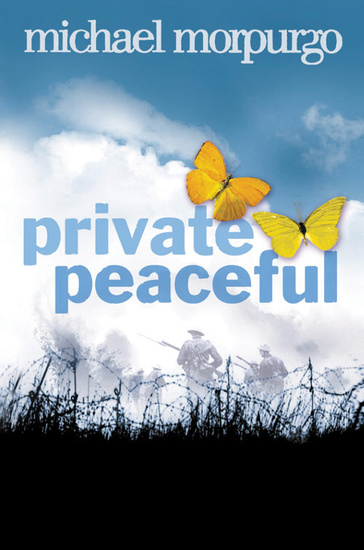
Literature and War Readalong May 30 2014: Private Peaceful by Michael Morpurgo

Private Peaceful

Michael Morpurgo is a famous British Children’s author. Some of you may know him from the Spielberg movie War Horse, which was based on one of his novels. I’ve had Private Peaceful on my piles for a while and I’m really keen on reading it finally. I’ve always wondered how you write about war for children. Especially from the point of view of a soldier. We’ve read the Dutch novel Winter in Wartime last year, but that was set among civilians. So I’m curious to find out how explicit the book will be and where Morpurgo draws the line.

I’m glad that CarolineD made me aware that Private Peaceful and My Dear I Wanted to Tell You (our choice for September) have been chosen by CityRead London 2014. CItyRead London is a project to promote reading across the UK capital.

Here are the first sentences

They’ve gone now, and I’m alone at last. I have the whole night ahead of me, and I won’t waste a single moment of it. I shan’t sleep it away. I won’t dream it away either. I mustn’t, because every moment of it will be far too precious.

And some details and the blurb for those who want to join

Private Peaceful by Michael Morpurgo (UK 2003)  WWI, Children’s Book, 192 pages

Heroism or cowardice? A stunning story of the First World War from a master storyteller.

Told in the voice of a young soldier, the story follows 24 hours in his life at the front during WW1, and captures his memories as he looks back over his life. Full of stunningly researched detail and engrossing atmosphere, the book leads to a dramatic and moving conclusion.

Both a love story and a deeply moving account of the horrors of the First World War, this book will reach everyone from 9 to 90.


*******

The discussion starts on Friday, 30 May 2014.

Further information on the Literature and War Readalong 2014, including all the book blurbs, can be found here.

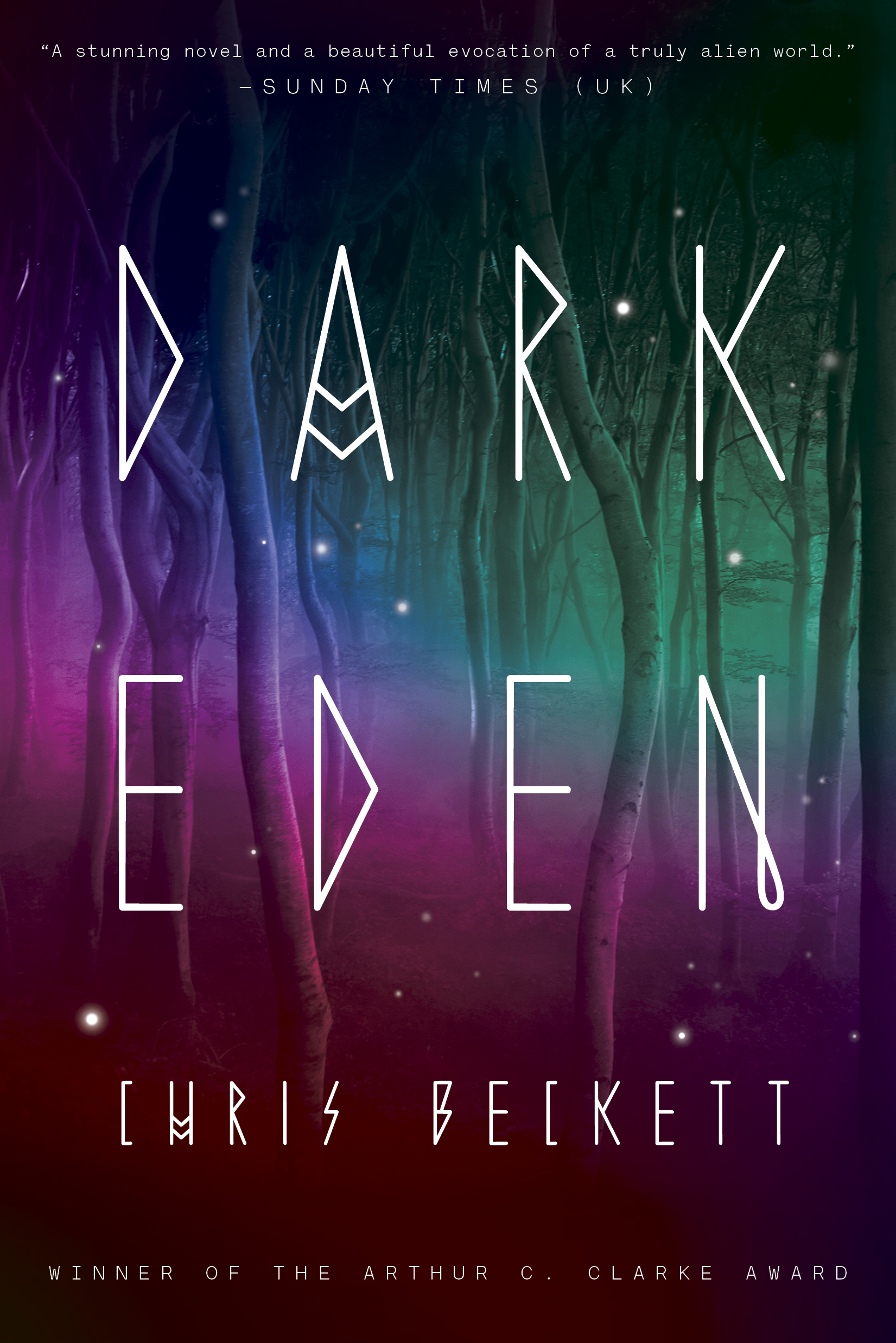
Chris Beckett: Dark Eden (2012)

DARK_EDEN

Chris Beckett’s novel Dark Eden was last year’s Arthur C. Clarke Award winner, which usually guarantees that a book is at the more literary end of the Sci-Fi spectrum. For once I can understand why a novel received an award. Dark Eden is nothing if not a tour de force. It’s as original as it is philosophical; in its themes as much as in its execution. Reading it wasn’t only a brainy experience, it was quite visceral as well. Beckett’s world felt so realistic, the everyday life of the people is described in all its strangeness and boring repetition, that I felt sucked in.

As a linguist and cultural anthropologist, I found the civilisation Beckett created extremely fascinating and thought-provoking. What would happen if a part of our high culture, a tiny fragment of our civilisation – two people to be precise – were abandoned on an alien planet, with nothing but their clothes, some paraphernalia and nothing else? This is what happens to Thommy and Angela, the ancestor’s of the people we meet in Dark Eden. The world they encounter is strange and dark. Light and warmth come from the lantern trees. Food abounds at first. The two humans can eat fruit and hunt the strange six-limbed animals of Dark Eden. Angela and Thommy procreate and once the story begins, the population of Dark Eden has risen to 532 people. Food is scarce by now. The perpetual darkness is hard on them. They have not ventured further because their creation myth traps them. After 160 years, or wombtimes as they call it, they are still waiting for a “veekle” from Earth to return and bring them back to their planet of origin. A planet that sounds like paradise to them. A planet where there is “lecky trickity” and daylight coming from a giant star.

Cultural anthropology studies – among other things – the development of civilisations from hunter-gatherers to (nomadic) herders to agriculturalists and more advanced civilisation. In Dark Eden this evolution is reversed at first and then starts to move through the aforementioned stages. The descendants of Angela and Thommy are hunter-gatherers, on the verge of becoming herders. And they have an oral tradition again; writing and schools have been abandoned a long time ago. Many of the words are written phonetically to illustrate that. “Rayed Yo”, “Veekle”, “Secret Ree”, “Wind Oh”. The sentence structure is simple and words like “very” don’t exist but instead of them, the narrators repeat words. “Very sad” becomes “sad sad” or even “sad sad sad”. I thought this was ingenious but – in all honesty – it got a bit on my nerves as well.

As we all know, a story needs conflict and the conflict arises in the form of a “newhair”. John Redlantern is only 20, but he questions the traditions who keep them trapped in this one place, waiting forever for an air ship that never comes. He dares the unspeakable. He challenges the elders and is finally cast out. What the elders didn’t expect – he’s struck a chord with many. Staying in one place means that food is getting scarcer and people are afraid of starving. When he leaves, a group of newhairs joins him.

John’s frustration has a lot to do with survival but is about something else als well. John’s suggestion to leave their dwelling place has something to do with leaving behind the past. Everything they do or think revolves around a distant time and place. They hope to be saved and brought back one day. They re-enact the story of Thommy and Angela again and again and, while waiting to be saved, they don’t really enjoy life or live freely.

What false hope can do to people is only one thought-provoking element, which is part of a profound analysis of meangless rituals and religion.

The structure of the novel is interesting as well. It has two main first person narrators and at least six minor narrators. That breaks up the monotony and gives Beckett the opportunity to show more than one view of the same story. The multiplicity of stories is another important theme in the book:

There are lots of different stories branching away all the time from every single thing that happens. As soon as a moment has gone, different versions of it start to be remembered and told about. And some of them carry on, and some die out, and you can’t know in advance which version will last and which won’t.

Dark Eden  describes a world in which sexuality is lived freely, in which nobody has ever murdered anyone and in which even the crippled and disfigured are treated like everyone else. But it’s not a peaceful society. Hatred and aggression simmer under the surface and can only be contained as long as absolutely nothing in the daily or yearly routine is changed. Once John questions tradition and sets in motion change, violence erupts.

The end is well done and logical. Pretty much what I had expected but that wasn’t disappointing. However, closing the book was a relief. The world Dark Eden describes is a wondrous place, filled with abundant vegetation and a strange and haunting fauna, but it’s bathed in perpetual darkness, and very suffocating.

Dark Eden is a novel that touches on many different topics – religion, family, tradition, overpopulation, hope, creation myths, languages etc. –  it’s philosophical and anthropological in scope and certainly testifies that Sci-Fi can still contribute a fresh and thought-provoking exploration of the human condition and our culture.

Thanks to Broadway Books for the review copy.