Bernice L. McFadden: Glorious (2010)

Glorious is set against the backdrops of the Jim Crow South, the Harlem Renaissance, and the Civil Rights era. Blending fact and fiction, Glorious is the story of Easter Venetta Bartlett, a fictional Harlem Renaissance writer whose tumultuous path to success, ruin, and ultimately revival offers a candid and true portrait of the American experience in all its beauty and cruelty.

What an entertaining and well written book! I always say that I don’t like historical novels but I really liked this one a great deal. I had a feeling I had only just started when it was already finished.

Glorious tells the story of the fictitious Harlem Renaissance writer E.V. Gibbs whose maiden name was Easter Venetta Bartlett.

Easter’s story is a blend of fact and fiction and from what I can judge McFadden put a lot of effort into the research of her topic and manages to weave it artfully into the story.

I was drawn into the book from the first pages on. In the prologue we read about the tragic beginning of Easter’s story. I liked the way McFadden did this in adding a long list of sentences  and paragraphs all starting with “If….” It exemplifies something that is on my mind a lot, namely the one single instance or occurrence in which a fatal or happy series of events is triggered, the one crucial point that determines the course a life will take.

If her father hadn’t won a boxing match, Easter’s sister wouldn’t have been raped. If that hadn’t happened her father wouldn’t have had an affair and her mother wouldn’t have died. If her mother hadn’t died, Easter wouldn’t have left her hometown and if….

But it did happen and Easter leaves. First she stays with relatives in the Jim Crow South until she witnesses a lynching.  She escapes and joins a travelling circus where she meets the charismatic, lesbian Rain. Easter will not stay very long with the circus and moves on. After some more trials and tribulations she arrives in New York.

She settles down in New York, finds a job that pays he bills, meets a man from the Caribbean and gets married.

Since her early days Easter has always written stories. In New York, after having met Rain again and been introduced to Meredith Tomas, the rich wife of a Cuban plantation owner, she is discovered as the great hidden talent she is. All the prominent people of the Harlem  Renaissance like her writing and she is very influential.

Chance however is not on her side. Her husband who attempts to murder Marcus Garvey, dies soon after her talent has been discovered and Meredith, consumed by envy of her talent, steals Easter’s novel.

The last chapters fast forward some 4o years and we see what has become of  Easter who is now an elderly woman working as a maid in her hometown.

As I said, this book is based on a lot of facts and I’m pretty sure, that it is to a large extent inspired by Nella Larsen’s biography whose career did also end with an accusation of plagiarism.

The beginning in the Jim Crow South is maybe the best part of the novel. The descriptions are very powerful and almost cinematographic. What a monstrosity the South of those days was. It made me think of the song Strange Fruit. I have been collecting versions of it for years now.

Glorious will not be my last Bernice McFadden novel. She really is a very talented writer and it was a highly entertaining read. I already got her first novel Sugar here.

I’m amazed that she hasn’t been translated into German. If there is one market for which her novel would be perfect, it is the German one.

I wouldn’t have read this book if it hadn’t been for a comment by Anna (Diary of an Eccentric) who mentioned it on my first Nella Larsen post.

Here is the link to Anna’s review and to my first Nella Larsen post on Quicksand and to the second on Passing.

Last but not least here is the link to Bernice McFadden’s Blog.

I couldn’t resist and have attached one of my favourite Strange Fruit versions sung by Nina Simone. The video is worth watching as well. It’s very shocking.

The Fiction of Nella Larsen Part II: Passing (1929) A Classic of Harlem Renaissance

Passing (1929) tackles the sensitive issue of black people who ‘pass’ for white. It also explores the desire of one woman for another – a new and daring theme for the writing of the time.

I just reviewed Nella Larsen’s Quicksand and since I liked it great deal I thought I will read and review her second novel Passing right away as well. Some details on her life can be found on the review of Quicksand.

As said, I liked Quicksand, the main character is so fascinating, still I was surprised how powerful Passing is. It’s an extraordinary story. I was hooked from the first sentence and found it extremely captivating, almost as gripping as a thriller.

Irene, a woman of mixed origins, gets a letter from another woman, Clare, with whom she grew up. The woman has a similar back ground only she has no parents. She isn’t only very light-skinned but her father was white. The two women had met in Chicago, a few years back, after having lost contact for twelve years. They met in an expensive tea room to which black people aren’t allowed. Irene is often ‘passing’ as she is very light-skinned. While she is sitting in the tea-room, enjoying her tea and the elegant surroundings, she notices another woman staring at her. The beautiful and elegant blond woman has alabaster toned skin and Irene is scared she might have found out until she realizes, she knows the woman. Irene always assumed that Clare has become a prostitute but as it seems she got married to a white man and is obviously “passing” for good. Clare invites Irene to her place to meet her husband and family and also invites another girl who also “passes” frequently.

What could have been a pleasant get-together turns into something that is hardly imaginable. Clare’s husband starts to talk about “niggers” and how much he despises them, that he would immediately leave his wife if he found out that she is “a nigger.” Picture this: there sits this condescending man, married to a woman of mixed origins, talking to her two friends of equally mixed origins and he doesn’t get. Not only does he not get, he would still leave her, if he found out although there seems to be nothing that indicates her being different in any way.

Irene doesn’t want to see Clare anymore after this. She is deeply humiliated and outraged. But Clare cannot let go. She wants to see her again. She wants to frequent “her people”. From a story about race, Passing develops into a novel of gender roles, jealousy, attraction and hatred. I don’t want to go into too much detail, but the development and the ending are quite unexpected and cruel.

Passing illustrates the complexity of notions of race even better than Quicksand.

“Yes, I understand what you mean. Yet lots of people ‘pass’ all the time.”

“Not on our side, Hugh. It’s easy for a Negro to ‘pass’ for white. But I don’t think it would be simple for a white person to ‘pass’ for colored.”

This is a highly interesting aspect and seems to indicate that African-American people are far more sensitive to race than white people, which makes the racism of white people all the more absurd. If they don’t get the difference, unless it is really obvious, what is the prejudice based on? The perception of African-Americans is much more nuanced. From my studies (I have an unfinished interdisciplinary Ph.D. on Haitian literature in my drawers) I know that in Haiti, for example, there are at least ten different expressions for skin-tones. Only a very few Haitians are just called “black”. Each skin-tone is linked to a specific social status. The lighter the better. (You could say that the suppressor’s or colonialist’s belief system has been fully internalized).

If I have to compare the novels, I think I liked Quicksand more as I found Helga Crane such a moving character.

It is sad that Nella Larsen didn’t write any other novels and I would like to know what really spurred that decision. Maybe she wanted to turn her back on her past. She had a troubled marriage and was writing during that marriage. Sometimes we cut off something that we really like just because it is tied to something unpleasant in our past.

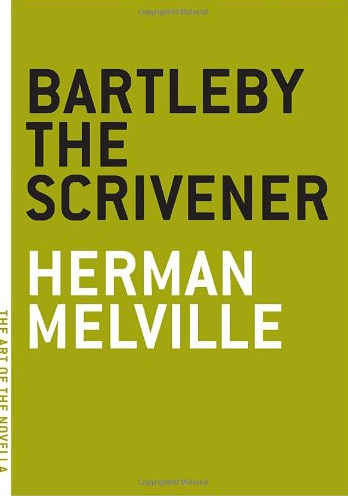
Herman Melville: Bartleby the Scrivener. A Story of Wall Street (1853)

bartleby

Academics hail it as the beginning of modernism, but to readers around the world—even those daunted by Moby-Dick—BARTLEBY THE SCRIVENER is simply one of the most absorbing and moving novellas ever. Set in the mid-19th century on New York City’s Wall Street, it was also, perhaps, Herman Melville’s most prescient story: what if a young man caught up in the rat race of commerce finally just said, “I would prefer not to”?

There is a specific reason, why I read Melville’s novella Bartleby. I have just read and reviewed Delerm’s novel Quelque chose en lui de Bartleby and since it was obviously inspired by Melville’s story, I had to read it.

I was never tempted to read Moby Dick although my parents had a copy with beautiful etchings. I can’t tell you why but some books just do not sound like you would like them.

Reading Bartleby I was very surprised how humorous it is. The characters are very eccentric and so is the story. It is basically the story of a young man called Bartleby who just doesn’t want to comply. Like the raven, in Poe’s eponymous poem, he has his stereotypical sentence which is “I would prefer not to.” Whatever it is he is asked to do, Bartleby invariably refuses it uttering the sentence I just quoted.

Bartleby is told in the first person peripheral, by a lawyer who has his office on the Wall Street. He once hired Bartleby as a copyist or scrivener. He already had three different copyists, each one of them with his own eccentricities, that’s why at first he didn’t pay too much attention when Bartleby declares that “he would prefer not to” read the copies together with anyone else.

The lawyer thinks at first that this is just a whim but soon enough it is obvious that there is more to it. While in the beginning he doesn’t want to read with the others, never goes out or seems to eat, after a certain time Bartleby stops working altogether. On a Sunday morning the lawyer makes another discovery which leaves him quite fazed. Bartleby never leaves the office. He stays there over night and during the weekends.

As much as he threatens him, offers him money, tries to negotiate, Bartleby doesn’t work anymore and he doesn’t leave either. If he wants to get rid of him, the lawyer has to take extreme measures. After some time and many frustrations, he decides to change the office and move away from Wall Street.

Not long after he has moved, he hears complaints by the new lawyer about Bartleby. The man is still there and haunts the building.

I’m not going to tell you the end in all its details, it should just suffice to say that the narrator tells the reader, that he thinks he might have found out what drove Bartleby to this extreme behavior. Bartleby used to work for another lawyer handling “Dead Letters”. I must admit I had no idea what “dead letters” are. It reminded me vaguely of Gogol’s Dead Souls and it proved that the association wasn’t totally wrong. “Dead letters” are letters that never reach their recipient because he has died or disappeared or left without leaving an address.

While reading this novella I was reminded of many other books. Not only Poe’s The Raven came to mind but some of Poe’s other writings. He didn’t only write Tales of Mystery and Imagination but a fair amount of absurd tales like we find them again in Kafka’s work. The already mentioned Gogol came to mind as well. I was also reminded of the first scene in Balzac’s Le Colonel Chabert (see my review in which the clerks bicker and quarrel.

Bartleby is the tale of someone who gives up on life, who stops participating and contributing. He is tired of it all. I often wonder when I see beggars in the streets how many chose to live like that. I met Clochards in Paris who told me that the hassle of a job, an apartment, a wife and children was just too much for them and they found it easier to live on the street. At first this may seem absurd but thinking of it for a while, it may make sense.

If it hadn’t been for Delerm, I wouldn’t have read this novella but I’m glad I did. It’s surprisingly modern. It is interesting to discover its intertextuality and a  more thorough analysis would be fascinating. I’m sure Kafka read it, as sure as I am that Melville was influenced by Poe, Gogol and maybe Balzac. However, I must say, I don’t think that Delerm’s Spitzweg and Bartleby have much in common.

Hop a long, Git a long, Read a long Western Reading Challenge

Have you ever read a Western? Well, I haven’t. It is just not a genre I ever really felt tempted to explore but one evening, watching TCM, a couple of years ago, I saw a made for TV movie  that really stunned me, namely Riders of the Purple Sage. It was a melancholic tale of a gunslinger looking for the guy who drove his sister to commit suicide. It showed Ed Harris, in what I would say, one of his best roles. It was such a moody and atmospheric movie. I found out later that it was based on a novel by Zane Grey, Riders of the Purple Sage. I bought it, wanted to read it and forgot all about it. When I stumbled upon this Western challenge/readalong in which you can participate reading only one book, I thought, now is the time .

My thanks go to Gavin from Page247 who presented this effortless challenge on her blog a while ago. The challenge itself is hosted by Ready When You Are, C.B.. Here is the link to the challenge that takes place in May.

It’s worth having a look at the definition of Westerns on C.B. James’s page and also at the list of possible books. People who love Willa Cather could read along as well as those who always wanted to read Jim Harrison.

For me this is a good opportunity to broaden my horizon. I wouldn’t call it get out of my comfort zone as that is a concept I don’t have. I can’t think of any genre or type of book I don’t feel comfortable with (but maybe I get the idea of comfort zone in this context wrong?).

Dashiell Hammett: The Glass Key (1931) and Heisler’s The Glass Key (1942)

Ned Beaumont is a tall, thin, moustache-wearing, TB-ridden, drinking, gambling, hanger-on to the political boss of a corrupt Eastern city. Nevertheless, like every Hammett hero (and like Hammett himself), he has an unbreakable, if idiosyncratic moral code. Ned’s boss wants to better himself with a thoroughbred senator’s daughter; but does he want it badly enough to commit murder? If he’s innocent, who wants him in the frame? Beaumont must find out.

I have read everything Raymond Chandler has written. He used to be one my favourite authors. This might be the reason why I neglected Hammett for so long. Maybe I thought he would be too similar and that this would influence my reading.

The Glass Key was my introduction to Dashiell Hammett and although it did remind me a bit of Chandler, they are still quite different. Hammett is at the same time sparser and coarser.

At the heart of The Glass Key lies the question “Who has killed Taylor Henry?”. Taylor Henry is the son of the influential politician Ralph Henry. In an attempt to appear cleaner than he is, the corrupt politician Paul Madvig tries to associate himself with Henry. And he is in love with Henry’s daughter Janet. When Taylor is found dead, rumors start to circulate that he might have been killed by Paul. None of these people are really main characters, the central figure and exemplary tough-guy, is Ned Beaumont. He is a sort of assistant to Paul Madvig and tries, like a PI, to investigate the murder. He visits bars and clubs and people. Gets beaten up and is held captive. Women literally throw themselves at him. This all leaves him quite unfazed. No matter how much you beat that guy up, how often you threaten him, how many times you flatter him or try to seduce him, you will not get much of a reaction but a very short reply. This is as tough as tough-guys go.

The interest, at least for me, did not lie in the solving of the murder. I couldn’t care less. The appeal of this book, is the character of Ned Beaumont, this monosyllabic guy who doesn’t even flinch when he is beaten to a pulp. The other appeal is the world and the atmosphere this novel depicts.

The world of The Glass Key is a world of corruption, prohibition, easy women, hard men, bars and secret joints, bribery and violence.

And of course one has to mention the dialogue. You couldn’t find any more sparse and caustic dialogue in any novel.

Ned Beaumont advanced into the room where Lee and the Kid were.

The Kid asked: “How’s the belly?”

Ned Beaumont did not say anything.

Bernie Despain exclaimed: “Jesus! For a guy that says he came up here to talk you’ve done less of it than anybody I’ve ever heard of.”

“I want to talk to you,” Ned Beaumont said. “Do we have to have all these people around?”

“I do,” Despain replied. “You don’t. You can get away from them just by walking out and going about your own business.”

“I’ve got business here. “

After having finished the book I realized that I had the movie. It is part of a collection of Film noir movies that I had ordered before Christmas. I immediately watched it and liked it a lot.

The story is told differently. More chronological and Janet Henry’s (Veronica Lake) role is much more important. A few names have been changed. There is a club owner who is Irish in the book. He is Italian in the movie which was probably more in line with the depiction of wise guys as they populated the film noir. What I truly liked about the movie is Veronica Lake. Since I have seen L.A. Confidential (one of my favourite movies) in which Kim Basinger is compared to Veronica Lake I always wanted to see the real one. I think she is really special.

Don’t ask me whether I prefer the novel or the movie. I enjoyed reading and watching at the almost same time. It was as if the characters had stepped out of the pages at the end of the book and come alive.

I am really pleased I found the trailer which is not usual for every old movie.

Anne Tyler: Back When We Were Grownups (2001)

The first sentence of Anne Tyler’s 15th novel, Back When We Were Grown Ups, sounds like something out of a fairy tale: “Once upon a time, there was a woman who discovered she had turned into the wrong person.” Alas, this discovery has less to do with magic than with a late-middle-age crisis, which is visited upon Rebecca Davitch in the opening pages of the book. At 53, this perpetually agreeable widow is “wide and soft and dimpled, with two short wings of dry, fair hair flaring almost horizontally from a centre part”. Given her role as the matriarch of a large family–and the proprietress of a party-and-catering concern, The Open Arms–Rebecca is both personally and professionally inclined towards jollity. But at an engagement bash for one of her multiple stepdaughters, she finds herself questioning everything about her life: “How on earth did I get like this? How? How did I ever become this person who’s not really me?”

Did you ever have the feeling you are living the wrong life? You should be somewhere else and someone else? I think this did happen to me in the past a few times and this may be one of the reasons why I could relate so well to Rebecca, the main character of this novel. This was my first Anne Tyler novel and I liked it a great deal. It’s a marvelous novel. Warm, rich, touching. It’s not a novel in which there is a lot of action, not at all, there are a few intense scenes the rest are flashbacks, thoughts, feelings. Back When We Were Grownups explores if there are signs that we live the right life, if there are signs that we could read before things happen, “Prophetic Moments”, as Rebecca calls them.

Or is it just like Poppy, her late husband’s great-uncle states:

“And that’s where he and I differed,”  Poppy said. “Because I was always telling him, ‘Look,’ I said. ‘Face it,’ I said. ‘There is no true life. Your true life is the one you end up with, whatever it may be. You just do the best you can with what you’ve got,’ I said.”

During a picnic with her family Rebecca all of a sudden has this strong feeling of being at the wrong place. She is a fifty something widow, mother and grandmother and professional hostess. The house she has inherited from her husband, a grand old mansion, is used as a place where people can celebrate parties, weddings, birthdays. One of her daughters is a chef and does the cooking.

Rebecca looks back on her life and the turning point, the one moment that made her embark on this life that she has suddenly become so unsure of. When she was still a young woman, studying for a degree, dating a fellow student, Will, she was invited to a party at the mansion she is now living in and meets the older son of the family. He sees her and chooses her immediately, as his companion and as the mother for his three little daughters. His wife abandoned him for a dubious career as a singer and the poor man struggles to keep his girls happy. When he sees Rebecca she strikes him as someone very cheerful, which she wasn’t, as she thinks looking back. Two weeks later they are married. She has left her highschool sweetheart and moves in with this older man and the three little girls. They have a daughter of their own and organize parties at their house. Six years later he dies suddenly.

Rebecca wonders if she shouldn’t have stayed with Will, pursued her studies. At present she lives with her husbands 99-year-old great-uncle. The old man is somewhat demented but still appears very intelligent and articulate, just very forgetful. His wish is a birthday party for his hundredth birthday. Rebecca is afraid of all the effort this will require and doubts he will even remember it the next day but someone says that he will still enjoy it while it lasts and so she gives in.

The birthday party is really the culmination point of the novel. It’s a wonderful final scene, very rich and full of life. The old man enjoys every moment of it and describes to those gathered around him with great minutiae every instant of this memorable day.

He must be nearing the finishing line now; he was dressing for the party (“…the crackly  feel of starched shirtsleeves when yu slither your arms inside them…”) And anyhow Rebecca was enjoying this. It was sort of like a report on what it was like to be alive., she decided. let’s say you had to report back to heaven at the end of your time on earth, tell them what your personal allotment of experience had been: wouldn’t is sound like Poppy’s speech? The smell of radiator dust on a winter morning, the taste of hot maple syrup…

This is one of the best and most touching scenes in a novel that is full of wonderful moments.

But before we arrive at Poppy’s birthday, we follow Rebecca as she tests the possibilities she might have missed. She contacts Will after all these years, gets some books from the university.

This is a novel about possibilities, lost dreams, second chances, family and love and ultimately about chosing the right path and belonging. I really loved this book. I liked Rebecca and many of the other characters, especially Poppy, the great-uncle. I liked how it shows that choosing a partner also means choosing a life and that maybe sometimes when we feel we are just drifting we are actually just sliding along because we are on the right path. Back When we Were Grownups also takes a very close look at parenting and step parenting. Rebecca never makes a difference between any of her girls.

I always like novels that explore alternative life styles or unusual families and big old houses. Rebecca lives with her late husbands great-uncle, every Thursday the whole family gathers at her place, every evening she is on the phone with her best friend, her brother-in-law. She is surrounded by people and life, still there are these moments for which I loved the book even more:

And anyone would agree that “Stardust” was a melancholy song. So that was probably why, in the middle of “How Old Are You?” she felt an ache of homesickness in her own house.

Did you read any novels by Anne Tyler? I got Dinner at the Homesick Restaurant (said to be her best) and The Amateur Marriage that I would like to read next.

If I had to compare her, there are some recent authors who came to my mind, Rachel Cusk and Ayelet Waldman and maybe Rebecca Miller.

Edith Wharton: Madame de Treymes (1907) Novella with Parisian Setting

Madame de Treymes (Penguin 60s)

Set in Paris, Wharton’s 1907 novel explores the theme she and Henry James so often examined; the conflict between American innocence and corrupt Europe.

Even a short novel like Madame de Treymes (just 80 pages long) shows you what a masterful writer Edith Wharton was. This is the oldest of her novels that I have read so far. It came out after her enormous success The House of Mirth (1917) which I want to read very soon as well. The Age of Innocence (1920) and Ethan Frome (1911), both books that I have read, are later ones. Another one that I have found in my hopelessly overstuffed book shelves is Summer (1917).

Madame de Treymes has a Parisian setting which always appeals to me, as sentimental as this may be. It is a cruel little book and a very surprising one. All in all there is not a lot of description of the city itself, the novel rather offers an analysis of the society. It is interesting to see how Americans perceived the Parisian society and the differences in their respective values.

John Durham knew Mme de Malrive when she was still called Fanny Frisbee. Once a lively young American woman, she has become but a mere shadow of herself. She married into the Faubourg St Germain society, meaning Parisian upper-class. Stuffy, traditional and very unwelcoming to outsiders. She lives separated from her husband as he has cheated on her. She would like a divorce but is afraid to lose her son and doesn’t want to move him from Paris. Durham always liked Fanny and intends to marry her and, if needed, stay with her in Paris.

The only person Fanny trusts is Mme de Treymes, her sister-in-law, who disapproves as much of her brother as Fanny herself. Durham turns to her for help and what follows is a tragedy of manners, if I may say so.

This little story, as beautifully written as it is, made feel quite chilly. I am surprised to see that the Parisian upper-classes (to which I never belonged but am fairly familiar with) haven’t changed that much.

The differences between the American and the Parisian way of life is nowhere to be seen so well as when Durham and his sister visit Fanny at her house. The house, a rundown old mansion in a poky street, causes the follow exclamation from his sister:

“Well, if this is all she got by marrying a Marquis”.

Wealth meets status and it is funny to see how those down-to-earth rich Americans are absolutely not impressed with the shabby elegance they encounter. On the other hand, they were not aware of the power of ancestry and heritage which reignes in the society into which Fanny has married.

Durham felt, as he observed them, that he had never before known what “society” meant; nor understood that, in an organized and inherited system, it exists full-fledged where two or three of is members assembled.

But Wharton doesn’t only dissect the French society she also lays bare the lack of culture of some of the Americans.

To Mrs Durham, with her gentle tourist’s view of the European continent, as a vast museum in which the human multitudes simply furnished the element of costume, the Boykins seemed abysmally instructed, and darkly expert in forbidden things (…)

As the title indicates, Mme de Treymes is the central figure, the most complex character, much more than you can deduce from this post. She is also married to the wrong man and lives a scandalous life, having a  lover, yet she would never even think about leaving her husband. This would be too open a rebellion against the society of which she is a much more integral part than Durham and Fanny realize.

Mme de Treymes is a wonderful example of what an adept writer can achieve even in such a short form as the novella.

The topic of the American in Paris is interesting and would certainly be worth exploring further. Hemingway, Gertrude Stein and many more come to mind who wrote about it.

I think that to this day Paris is the city Americans are mostly likely to visit if they have to make a choice. At least that is what I have been told lately by different Americans. Maybe we could call this the “mythical Europe”.

Should you like to read another review of one of Edith Wharton’s books, Guy Savage just reviewed The Old Maid which rekindled my interest in Wharton that had unfortunately been dormant for a while. As soon as I get a chance I will continue with Summer and The House of Mirth. She is such a wonderful writer and one of a few where I could imagine reading everything she has written.

Which is your favourite Edith Wharton novel? I remember I liked The Age of Innocence a great deal.