Literature and War Readalong December 30 2013: The Sorrow of War aka Thân phận của tình yêu by Bao Ninh

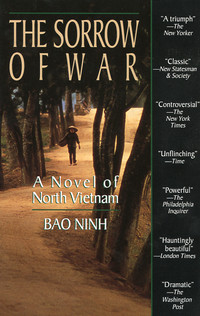
The Sorrow of War

We’ve all seen movies or read books on the war in Vietnam from an American perspective. Bao Ninh’s The Sorrow of War aka Thân phận của tình yêu is told from the other side. The author was a North Vietnamese soldier and the book is based on his experiences.  The majority of the books we’ve read this year were set far away from the frontline. With this last novel of this year’s readalong, we return to the territory of the soldier.

Here’s the blurb

Kien’s job is to search the Jungle of Screaming Souls for corpses. He knows the area well – this was where, in the dry season of 1969, his battalion was obliterated by American napalm and helicopter gunfire. Kien was one of only ten survivors. This book is his attempt to understand the eleven years of his life he gave to a senseless war.

And the first sentences

On the banks of the Ya Crong Poco, on the northern flank of the 3B battlefield in the Central Highlands, the Missing In Action body-collecting team awaits the dry season of 1976.

The mountains an jungles ae water-soaked and dull. Wet trees. Quiet jungles. All day and all night the water steams. A sea of greenish vapour over the jungle’s carpet of rotting leaves.

*******

The discussion starts on Monday, 3o December 2013.

Further information on the Literature and War Readalong 2013, including all the book blurbs, can be found here.

Looking Back on German Literature Month 2013

image

German Literature Month 2013 is over. It’s time to thank everyone for participating. Some have shown extraordinary enthusiasm. I’m not sure about the statistics of the last years but I’d say with 127 posts, this year was a success.

If you’d like to get an overview, visit our special German Litertaure Month page, which will guide you to all the contributions.

While the month ends on my blog, there is still something going to happen on Lizzy’s. A generous editor has provided a set of books for a lucky winner, who will be announced on Wednesday. Don’t miss visiting her blog then.

I was a bit afraid that there wouldn’t be as much interest this year but that was clearly not the case. Thanks again to all of you.

Hans Keilson: The Death of the Adversary – Der Tod des Widersachers (1959) Literature and War Readalong November 2013

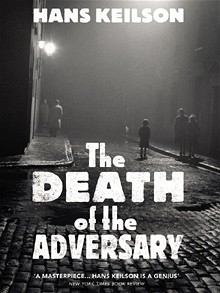
Death of the Adversary

I wish it hadn’t happened but it did. I couldn’t finish Hans Keilson’s novel The Death of the AdversaryDer Tod des Widersachers. Not because I ran out of time but because – frankly – I hated it. I hate parables and books that whiff of Kafka (and are not Kafka) and  . . . If  you want to write about Nazism and the rise of Hitler, why don’t you mention it. Why does Hitler have to be referred to as “B”? Why is it never stated that the narrator is Jewish . . . It’s obvious, of course, but the way this is handled is just annoying.  Ilse Aichinger does a similar thing in her novel Herod’s ChildrenDie grössere Hoffnung, but it never feels like mannerism, it’s powerful, expressive and chilling.

I’ve read about 2/3 of The Death of the Adversary and there were passages I thought masterful but they had nothing to do with Nazism and/or oppression but were mainly taken from either childhood or young adult memories. There is a story in which the narrator tells how he forged stamps. This was psychologically subtle. There are other instances in which we see that Keilson’s observations are the result of his being a psychiatrist.

The book’s central story tells how a young Jewish boy first learns about his adversary “B”, a man who slowly rises to political power. His power can be felt in the growing number of followers and how they accept his theories and apply his laws and rules, which first lead to exclusion of the Jews, and then to their persecution. I don’t see what is gained in calling Hitler “B”. Did he want to show the universality of evil? He wanted to show the banality of it, which becomes obvious when he sees the man. And the way he treats the adversary as a recurring motif, showing that he is  s much on the inside as on the outside  . . .  Most of the time, I agree, things are not black or white but I don’t want this concept applied to Hitler and Nazism.

There is also a parable-in-the-parable – the story of the elks and the wolves, which I found particularly ambiguous. Elks were living under the best conditions, however they were not striving but dying. Why? Because there were no wolves. In order to live they would have needed adversaries.

I almost always finish books because some stories need every single passage to become a whole. Given that The Death of the Adversary is not only a parable but a disjointed book – I wouldn’t really call it a novel -,  I’m pretty sure, the end wouldn’t have made me think differently. From what I’ve seen so far, Keilson might be a good writer but he’s not a novelist.

I know that I’m one of a very few who didn’t like this book. But I really didn’t and although I’m sure that Comedy in a Minor Key is different – I’m not going anywhere near Keilson’s fictional work  for a while.

Other (favorable) reviews

Lizzy (Lizzy’s Literary Life)

Mel u (The Reading Life)

*******

The Death of the Adversary was the eleventh book in the Literature and War Readalong 2013. The next is the Vietnamese novel The Sorrow of War aka Thân phận của tình yêu by Bao Ninh. Discussion starts on Monday 30 December, 2013. Further information on the Literature and War Readalong, including the book blurbs can be found here.

Barbara Honigmann: A Love Made Out of Nothing – Eine Liebe aus nichts (1991)

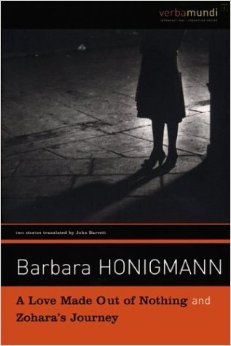
A Love Made Out of Nothing

Barbara Honigmann’s A Love Made Out of Nothing tells the story of a young expatriate’s journey back to Weimar to attend her father’s funeral. As the narrator remembers her father’s life, she explores her own past and relates her struggle to establish new roots following her emigration from Berlin to Paris. In its portrayal of a young woman’s complex relationship with her father, the novella offers a rich account of German-Jewish history and of the search for identity in the shadow of World War II.

This is my first book by German author Barbara Honigmann but it’s not going to be my last. I loved this novella. A Love Made Out of Nothing  – Eine Liebe aus nichts is written in a very intimate style, almost like a memoir. Honigmann usually weaves her own life into the narrative, blending fact and fiction.

The narrator, who lives in Paris, starts her story with the funeral of her father. He has died in Weimar and she wanted to attend. It’s the first time in years that she goes back to Germany. She’s born in East-Berlin after the war to Jewish parents who had spent WWII in England. After the war the father decides to live in the Russian sector.

Her father has been married four times, her mother was wife number two. She’s returned to her home country Bulgaria years ago and even lost the German language. There is no possibility for the narrator to communicate with her as she doesn’t speak Bulgarian.

During her childhood she spent all of her weekends with her father and stayed in contact with him ever since. A couple of years before his death, she leaves the DDR and moves to Paris, hoping that a new city, a new language would not only bring a new life but her own transformation.

Much of her emotional life is full of shadows and muted grief over the impossibility to live with the man she loves. All they have is a “Love Made Out of Nothing” as it proves to be impossible for them to live together. When she meets someone else that love can’t be lived either because the man returns to the US.

Memory, identity, languages, exile and emigration are the themes this small poetic book explores. The reasons why someone leaves his or her home country are complex. Political reasons, danger, a lack of freedom are triggers, but they are not the only motive. There is always also the wish to become another person and when that isn’t possible what remains is a feeling of loss and unfulfilled yearning. The narrator wishes to be rootless, but, paradoxically, in trying to run away from her home and her parents she imitates their life.

Barbara Honigmann is a Jewish author but she transcends the Jewish experience and captures the universality of her themes, making it easy for non-Jewish readers to identify. I have read the German edition of this book that’s why I can’t tell you anything about the second novella, which is contained in the English edition.

Literature and War Readalong November 29 2013 Meets German Literature Month: Death of the Adversary – Der Tod des Widersachers by Hans Keilson

Death of the Adversary

This months readalong title Death of the Adversary aka Der Tod des Widersachers by Hans Keilson is also part of German Literature Month. Keilson was an interesting figure. A German/Dutch novelist and psychiatrist who is most famous for his WWII novels. Born in 1909 in Germany, Keilson, who was Jewish, emigrated in 1936 to the Netherlands where he stayed until his death in 2011. During the war he was part of the Dutch Resistance. In his work he tried to analyse and illustrate the psychological, political and cultural aftermath of WWII.

Here is the book blurb

1930s Germany; the shadow of Nazism looms. Pictures of the new dictator, ‘B.’, fill magazines and newspapers. Our hero is ten when his world begins to change dramatically. Suddenly, the other children won’t let him join in their games. Later, he is refused a job on a shop-floor. Later still, he hears youths boasting of an attack on a Jewish cemetery. Both hypnotised and horrified by his enemy, our hero chronicles the fear, anger and defiance of everyday life under tyranny.

Written while Hans Keilson was in hiding during World War II, this novel is a powerful account of what he outlived. Painful, trenchant and streaked with dark humour The Death of the Adversary is a rediscovered masterpiece.

And the first sentences

For days and weeks now I have thought of nothhing but death. Though I am normally a late riser, I get up early every morning now, calm and uplifted, after a night of drealess sleep. I feel all my powers string and ready within me, as they have not been for a long time. I welcome the day which brings me once again the thought of death.

*******

The discussion starts on Friday, 29 November 2013.

Further information on the Literature and War Readalong 2013, including all the book blurbs, can be found here.

Welcome to German Literature Month

image

Lizzy and I are happy to announce the official beginning of German Literature Month. A few introduction posts and lists have cropped up here and there already, which tells us, the event will be running strong once more.

Since google reader doesn’t exist anymore and a really great alternative hasn’t been found, we’ve decided to set up a German Literature Month site on Blogger which allows you to use Mr. Linky.

Please sign up and leave your links here: German Literature Month Blog

You can find the link to the review site on my sidebar.

I’ve already started a couple of books and hope to be able to post the first reviews soon.

My plans are, as usual. over-enthusiastic.

I’m currently reading or planning on reading the following books

Allissa Walser Mesmerized – Am Anfang war die Nacht Musik

W.G Sebald The Emigrants – Die Ausgewanderten

Ferdinand von Schirach – Tabu (not translated yet)

Eduard von Keyserling – Schwüle Tage (not translated)

Elke Schwitters Mrs Sartoris – Frau Sartoris

Stefan Zweig – Beware of Pity – Ungeduld des Herzens

Please sign up and leave your links here: German Literature Month Blog

Vasily Grossman: Everything Flows (1961) Literature and War Readalong October 2013

Everything Flows

Would you inform on people to save your own life? Sign papers knowing very well it will send people to the Gulag? Would you? If you are like me, you are unable to answer this question. You will hope that you wouldn’t but how can you be sure. It didn’t take a lot for people to be sent to the camps. Anything would make the state suspect subversiveness.Some were sent because others signed a paper, some were sent because they didn’t sign papers. According to the afterword Grossman did precisely that, he signed a paper which served to arrest a group of doctors. He must have felt guilty all of his life, resented his own weakness. Exploring why people would do such a thing, is one of the themes in Everything Flows. It’s not always out of fear or cowardice.

A friend of Ivan Grigoryevich is responsible that he is sent to the Gulag for thirty years. He is released after Stalin’s death in 1953. At first he visits his cousin Nikolay, in Moscow. Nikolay is a scientist who has made a remarkable career, due to some extent to his betrayal of others. When he sees Ivan again, he’s incapable of showing compassion of listening to Ivan’s story. All he does is talk about his own hardships. How very cynical. No deprivations endured outside can be compared with what those in the camps had to go through. These are poignant scenes, which show the selfishness and faulty thinking of so many, the struggle between a bad conscience and the aim to refuse any responsibility. Ivan then moves on to Leningrad where he hopes to meet a former lover. He meets Anna Sergeyevna instead and shares a room with her and her little son. Her husband has been sent to a camp. She blames herself for having taken part in the Terror famine of 1932-3.

The story of Ivan is the only coherent storyline. It is interrupted by stories of other people and many non-fiction parts – on the terror against the Ukrainians, on Lenin and Stalin, on their terror regimes, on the way the Soviet Union worked. This made me wonder often whether Everything Flows can really be called a novel. Where is the borderline? How much non-fiction elements can a book contain and still be called fiction? Grossman didn’t see the publication of Everything Flows and it is possible he would have altered it, still, according to the afterword, it’s finished the way it is. He would not have removed the nonfiction parts, although it seems obvious that they were added to the manuscript later.

Until WWII Grossman was loyal to the Soviet state but after having witnessed the war, having been in Stalingrad, that changed completely. From then on he was focussing in his work on writing about everything as truthfully as possible, on not embellishing and buying into the state’s way of distorting the truth. This cost him almost everything and I’m surprised he was never sent to the Gulag himself. One of his most traumatic experiences was when his novel Life and Fate was confiscated. What further contributed to his critical view of the Soviet state was Stalin’s antisemitism.

In his best parts Everything Flows is an amazing testimony of compassion and humanity. In other parts it is a masterful depiction of the human condition and an open criticism of totalitarianism. Some of the non-fiction parts were a bit heavy going, as I was not familiar with many of the names and with Soviet history in general. I think he rendered the atmosphere of being unfree and the paranoia very well.

I’d like to read a biography of Grossman. He served 1000 days during WWII, was present in Stalingrad and his The Hell of Treblinka was the first eyewitness account and was used during the Nuremberg trials. Has anyone read the Gerrard’s biography The Life and Fate of Vasily Grossman or Grossman’s The Writer at War?

Other reviews

Andrew Blackman

Danielle (A Work in Progress)

Silver Seasons (Silver Threads)

*******

Everything Flows was the tenth book in the Literature and War Readalong 2013. The next is the WWII novel Death of the Adversary aka Der Tod des Widersachers by German writer Hans Keilson. Discussion starts on Friday 29 November, 2013. Further information on the Literature and War Readalong, including the book blurbs can be found here.