Jo Walton: Among Others (2010)

With a deft hand and a blazing imagination, fantasy writer Walton mixes genres to great effect. Elements of fantasy, science fiction, and coming-of-age novels combine into one superlative literary package that will appeal to a variety of readers across age levels. After engaging in a classic good-magic-versus-bad-magic battle with her mother that fatally wounds her twin sister, 15-year-old Morwenna leaves Wales and attempts to reconnect with her estranged father. She was sent to boarding school in England, and her riveting backstory unfolds gradually as she records her thoughts, feelings, and experiences in a series of journal entries.

Jo Walton’s Among Others is an absolutely charming book. Despite the fact that there are some magical things happening this isn’t a fantasy novel.  It is a novel about fantasy and SF and, if anything, I would call it magical realism. What is charming about this book is not the magic, which is raw, wild and dangerous but Morwenna’s voice and her love of books, reading and libraries.

Morwenna’s story unfolds in a series of diary entries. The year is 1979 and Morwenna has just arrived at and English boarding school. She is a 15-year-old girl from Wales whose twin sister has died in an accident. The very same accident has left her injured and crippled. As we learn in the novel the accident was the result of their evil mother’s doing. The girls tried to stop her from getting more power through magic and that’s how the accident happened.

Morwenna is an outsider at her new school. She is crippled and the only one from Wales. But that isn’t the only thing that makes her an outsider. She knows that she is different. Her mother is a witch. Morwanna only just met her father whose sisters are witches as well, she sees and talks to faeries and she is addicted to reading SF novels. Novels are her consolation.

“It doesn’t matter. I have books, new books, and I can bear anything as long as there are books.”

Books are her escape route but also her way to make sense of the world. Her enthusiasm and love for books is one of the most important elements in this novel. At the boarding school she discovers what libraries have to offer, is introduced to inter library loan which opens the world for her even more and finally she is invited to a SF book club. Once a week she will discuss all her favourite SF and fantasy writers and learn about new books and authors and go on reading her new discoveries in her spare time.

I sat on the bench by the willows and ate my honey bun and read Triton. There are some awful things in the world, it’s true, but there also some great books. When I grow up I would like to write something that someone could read sitting on a bench on a day that isn’t all that warm and they could sit reading it and totally forget where they were or what time it was so that they were more inside of the book than inside their own head. I’d like to write like Delany or Heinlein or Le Guin.

At the book club she meets Tim a gorgeously beautiful boy with a bad reputation. It’s for her to discover whether it is founded or not.

I haven’t read a lot of SF and although I knew the names, I hardly knew any of the books still it was captivating to read about them, to see what elements she picked for her life, what themes, questions and speculations fascinated her.

The voice of Morwenna is very well rendered. This sounds like a young girl discovering the world and new books. We follow her thoughts and see how they develop, how wrong assumptions are corrected, how new things are learned.

The magical parts can be read in many different ways. A sceptical reader could just assume that it is all in Morwenna’s imagination. That grief, sadness and the constant pain she is in lead her to fantasize. It would make sense as well. If you are less sceptical you can just accept the fact, that, yes, she does see fairies and has an evil witch mother. The fairies are very interesting beings and she also mentions that they have nothing in common with Tolkien’s elves. Some of them look like gnomes, others are very beautiful. They are tied to places and seem like some sort of condensed energy.

A part that spoke to me is, the description of Morwenna’s pain. The descrptions were very realistic. The way chronic pain changes, how she tries to handle it, the cures that are provided, the wrong therapy she gets from conventional doctors and how she finally gets better through acupuncture.

Jo Walton lives in Canada but she is from Wales. The differnce between Wales and England is emphasized all through the novel. Half of the French side of my family is from Brittany. The difference to the rest of France is very similar. And you also find a lot of magical beliefs in Brittany. I grew up believing in loup-garous (werewolves) and nobody would have made me go out during a full moon when we were on holidays in Morlaix.

Amon Others is a very unusual coming of age story and I’m glad I read about it on Gavin’s blog (here is her post). I can’t imagine that anyone who loves books wouldn’t be able to relate to the intense love of reading that is capured in this book.

Jenn Ashworth: Cold Light (2011) Crime and Social Realism

An unsettling, darkly humorous tale of teenage girls in a predatory adult world, and a cocktail of lies, jealousy and unworldliness that leads to tragedy.

I have been looking forward to Jenn Ashworth’s new novel since I read A Kind of Intimacy at the beginning of the year (here’s the review). I had a bit of a problem not comparing the two books but once I let go of that I really liked this novel, it’s disturbing and chilling and you only find out at the very end what really happened.

Cold Light is a very appropriate title for this novel, although – as will be explained towards the end – it refers to bioluminescence.  It is a cold world in which today’s girls move and a predatory one. But is this really all that new? There is a lot that reminded me of my own coming of age. Not for anything in the world would I want to be 14 again. The competitions, the jealousy, the insecurity and the constant fighting off of boys or hoping to be noticed by them – depending on where on the good-looking scale you were positioned – was by far too upsetting. It’s all very horrible and can damage you for life. But there are other things young girls have to cope with nowadays that were not even thinkable 10-20 years ago. And today’s Britain (I’m just finishing Kat Banyard’s book The Equality Illusion and it echoes Cold Light) seems to be even worse than many other places.

Chloe is dead. Chloe will be 14 forever, 14, pretty and romantic. Since her presumed suicide 10 years ago she has become something like a cult figure. A symbol for young love and innocence. Now, ten years later, her former best friend Laura sits in front of her TV in a shabby little apartment and watches the groundbreaking ceremony for her memorial. The ceremony comes to an abrupt and macabre end when human bones are found in the damp soil. Laura nows whose bones they are and from this very first scene in the novel we know that some things must have gone seriously wrong ten years ago and we also know that there is a lot to be found out about Chloe, her ex-boyfriend who died with her and everyone else who was involved.

Laura will be watching TV all night, later joined by Emma with whom she is still in contact. They will be smoking and drinking until the early morning. Through flash backs and parts of their discussion the truth is slowly revealed. It’s the story of three friends who are jealous of one another, an older boyfriend who seems weird, a town in a state of alarm as a flasher who is getting more and more violent is chasing young girls. The three girls are only 14 yet they smoke, drink and have sex. We also hear a lot about innocent Chloe, how she exploited the obsessive best friend feelings of the others, how narcissistic and bullying she was, her delinquency and how she always got away with everything just because she was so pretty. Reading the story from Laura’s point of view we discover a lot about her family, the sadness of her childhood, about her father who seems to suffer from some kind of mental illness, her controlling mother and her obsession with Chloe that turns her into a stalker.

It’s an excellent book, disturbing and accurate and reminded me a great deal of the movie Fish Tank. I also thought of Harry Brown. Both movies paint a bleak picture of British youth. The first one also focusing on young girls being as well prey, victims and perpetrators.

Thanks again to Hodder and Stoughton who send me a review copy.

Georges Simenon: Maigret et les Vieillards aka Maigret in Society (1960)

Last year I felt the urge to read some Maigret and got four books. I reviewed the first Un Noël de Maigret aka Maigret’s Christmas. I liked quite a few things about it and since they are all short, under 200 pages, I thought I might try another one.

I’m not sufficiently familiar with Simenon’s Maigret novels to know which of the two that I have read is the more typical one. All I can say is that I liked the first but I’m completely underwhelmed by the second.

In Maigret et les Vieillard aka Maigret in Society Maigret has to solve the murder of an aristocratic ex-ambassador. He has been shot four times, in his own apartment, in the middle of the night. His old servant found him towards the morning and reports the murder at the Ministry of Foreign Affairs.

Maigret has the pleasure to interview people belonging to the Parisian High Society. A breed he isn’t exactly fond of. Although – typical for Maigret – he never judges people, we still understand how much he disapproves of them and thinks they are all a bit odd.

The Count had a “lover”, a princess, who was married to someone else. For over fifty years he wrote a daily letter to the princess which she would promptly answer. They had intended to get married after the death of her husband which had just occurred before the murder.

Despite the strange habits and a few questionable things he discovers, Maigret doesn’t see a motif or find a suspect.

I’m not sure whether this is a trait of Simenon or the Maigret novels but 80% of the book consists of dialogue. The lack of description and scenes was not to my liking. I love good dialogue but it was a bit average. He got the different talking styles of the people very well but the exchange wasn’t very interesting.

All in all I cannot recommend this novel. I’m also not keen on a detective who smokes a pipe and whose homey wife stays at home waiting for him with the dinner and his slippers …

The thing that I found most interesting is the fact how the books are rooted in their time. The mentioning of the death penalty startled me at first and then I vaguely remembered that the Capital punishment existed in France until the 80s. Should you, for one reason or the other, feel nostalgic about the 60s in France, you might like this.

Since I still have two other books sitting here, my final verdict is outstanding… I already have a feeling that I will have to look somewhere else for a detective series that is really to my liking or stick to those I already know. I think I need to get back to Simenon’s romans durs. They are definitely worth reading.

Literature and War Readalong May Wrap up: The Sea and Poison


Shusaku Endo’s novel The Sea and Poison proved to be a challenging read which is also reflected in the fact that some reviews will still be posted. I will of course link to them once they are done. For the time being you can always read Novroz’ review which complements my own very well.

For the time being thanks a lot for those who already participated. I know that the idea of reading about vivisection held some readers back but it isn’t a graphic book at all. Nevertheless it is a depressing book that seems to center on two major themes, one of which hospitals and their staff, the other war crimes.

What depressed me was the description of the hospital and the doctors. My late mother spent more time in hospitals than outside, so I have had my fair share of contact with doctors and most of them were not like Suguro but rather like Toda or Hashimoto. Doctors in hospitals that is. I’d like to emphasize this. Doctors who stay in hospitals after having been interns follow another agenda. A hospital in many cases isn’t much different from a Corporate Company. It’s all about results and money and hierarchy. What I didn’t know at the time of my reading is the fact that Endo suffered all his life. He was very ill, had tuberculosis and some of the treatments described in the novel in great detail were treatments he had to undergo regularly. For anyone interested in this background here is an interesting analysis.

Thanks to Kevin who did some research and added them in his comments, it became clear that the book was based on facts and that there had indeed been American POW on whom they performed vivisections. Here is the link he added to the comments section.

This leads us to the biggest problem of this book, as Kevin and Anna (Diary of an Eccentric) pointed out and which was probably the base for my doubting the incident. Why did Endo chose to describe the vivisection as if it had been performed under anesthesia when it is apparently well-known, that like in Germany, the vivisections were performed without the prisoners being anesthetized? I have no answer to this question and don’t want to start speculating.

Does anyone have an idea?

Jenn Ashworth: Cold Light (2011) Giveaway

This is the tale of three fourteen-year-old girls and a volatile combination of lies, jealousy and perversion that ends in tragedy. Except the tragedy is even darker and more tangled than their tight-knit community has been persuaded to believe.
Blackly funny and with a surreal edge to its portrait of a northern English town, Jenn Ashworth’s gripping novel captures the intensity of girls’ friendships and the dangers they face in a predatory adult world they think they can handle. And it shows just how far that world is willing to let sentiment get in the way of the truth.

Anyone who follows this blog knows how much I loved Jenn Ashworth’s novel A Kind of Intimacy (here is my review). That’s why I am especially pleased to be able to giveaway 2 copies of her new book Cold Light courtesy of Hodder.co.uk.

The giveaway is open internationally. All you need to do is leave a comment and tell me if you would like one of the books. If there is a lot of interest, I will determine the winners with the help of random.org. They will be announced next Monday.

I started reading my review copy and so far I’m enjoying it a lot. It’s different from A Kind of Intimacy but quite captivating as well.

The giveaway ends Sunday June 5 2011.

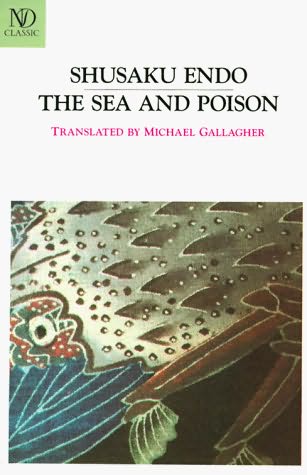
Shusaku Endo: The Sea and Poison aka Umi to dokuyaku (1958) Literature and War Readalong May

Against the backdrop of World War II, Japanese writer Endo ( Scandal ) explores the nature of morality. In this novel, originally published in Japan in 1958, the author examines the inner lives of three characters in the central drama, a grisly vivisection of an American prisoner of war, in an attempt to understand what conscience, or lack of conscience, allowed them to participate in such an atrocity.

The Sea and Poison is the first novel in this readalong that truly upset me. It’s an excellent book but so depressing and bleak, it reminded me of Kafka’s In the Penal Colony which was so far one of the most disturbing books I have ever read. I was afraid that the part on the vivisection might be too graphic but Endo is far to subtle a writer to be too explicit. The horror lies somewhere else.

The Sea and Poison is divided in three parts plus a prologue. Each part is told from another point of view, part 2 from different points of view. It is set during WWII in a hospital outside of the city of Fukuoka. Before we even hear about the planned vivisection on American prisoners of war we get to see the doctors at work. What we see is highly depressing. They do not seem guided by the love of their fellow human beings but purely because they are careerists and love power. Seldom have I read such an utterly negative depiction of doctors. This is best shown in the way they treat poor patients. They are unfriendly and heartless, whether they die or not, it doesn’t matter. It seems as if they did try to excuse this with the war as Suguro thinks:

No doubt it was a time when everybody was on the way out. If a man didn’t breathe his last in the hospital, he might well die that night in an air raid.

The central story is the vivisection which isn’t described in great detail. What is at the core is the study of the people who take part in it. “The old man”, chief surgeon Dr. Hashimoto and Dr. Asai are in charge. Dr. Toda and Dr. Suguro, two young interns, will assist, and two nurses will help as well. We do not hear much about Hashimoto’s motivations or only what Toda explains to Suguro:

“Doctors aren’t saints. They want to be successful. They want to become full professors. And when they want to try out new techniques, they don’t limit their experiments to monkeys and dogs. Suguro, this is the world and you ought to take a closer look at it. “

However we get to know Toda, the nurse and Suguro’s motivations and their stories. What is important is to underline that they could have refused. All three of them were asked whether they were willing to particpate and none of them refused.

Suguro is the only one with a conscience, still he accepts because the proposal comes at a moment of utter disillusionment. He has lost a patient and has seen how “The Old Man” lied about a patient he lost. He sees how many people are killed in air raids, how hopeless it is to help. When he is asked he doesn’t really say yes but he can’t refuse. Only at the last moment does he back off and doesn’t want to touch the patient.

The nurse has a complicated and sad life story. It seems as if there is nothing in this world for her anymore after her personal tragedy. It looks as if she was thinking “If I am miserable, why shouldn’t the others be?”

And Toda? Toda is a being without any feelings. Since his early childhood he is aware that he doesn’t care about other people, that he cannot connect. He has no empathy, no compassion. Occasionally he wonders if there is something wrong with him but at the end of the day he thinks that most people are like him.

I would like to ask you. Aren’t you too, deep down, unmoved by the death and sufferings of others? Aren’t we brothers under the skin perhaps? Haven’t you, too, lived your life up to now without excessive self-recrimination and shame? And then someday doesn’t there stir in you, too, the thought that you are a bit strange?

The questions the novel poses are manyfold and extremely interesting. One could ask whether those who do not directly kill the prisoners are as guilty as those who kill them. Is Suguro who can’t say no and watches but doesn’t touch the patient less guilty than the chief surgeon who performs the surgery?

And what about the chief surgeon? He is a man who is responsible for the death of many people. He performs a surgery and it goes wrong. He makes mistakes, people die. Is he less guilty of those deaths than of those of the American prisoners?

The type of questions this novel poses are the same that were asked in Germany after the war as well. Were those who watched and let things happen less guilty than those who took an active part? This made me think of Macbeth. Who is guiltier? Macbeth who did the killing or Lady Macbeth who had the idea?

I know it is said that this novel explores individual responsibility in wartime. I’m sure that is an important topic but I think two other things were far more important. I think this book criticises doctors and health care professionals in general, showing them as too keen on success and power, as heartless and inhuman. And it also wants to illustrate that people are selfish and mean.

I cannot say I “liked” this book but I did find it extremely thought-provoking, the writing is captivating and the character studies interesting.

I’m really looking forward to read what you thought of it.

Please read also what others wrote:

Anna (Diary of an Eccentric)

Danielle (A Work in Progress)

Gary (The Parrish Lantern)

Mytwostotinki

Novroz (Polychrome Interest)

*****

The Sea and Poison was the fifth book in the Literature and War Readalong. The next one will be Primo Levi’s If This is a Man aka Se questo è un uomo. Discussion starts on Friday June 24, 2011 .


Dutch Reading Month in June

I just wanted to raise awareness for the upcoming Dutch reading month that will be organized by Iris on Books. She already hosted the read along for Harry Mulisch’s The Discovery of Heaven and now, all through June, we will be reading Dutch books. There are already quite a lot of people who want to participate. I did a post a while back with Dutch reading recommendations. If you would like to participate, have a look at my Dutch Book Recommendations or at those Iris is giving on her Blog.

I’m not sure what I will read but I enjoy the fact that I don’t have to decide in advance.  I have two new books on my TBR pile, one is Tommy Wieringa’s Caesarion, the other one Willem Frederik Herman’s The Darkroom of Damocles. Both have been recommended by Lizzy (Lizzy’s Literary Life) and by Iris.

You can also find recommendations on The Dutch Foundation For Literature.