Walter Kempowski: All for Nothing – Alles umsonst (2006) Literature and War Readalong November 2016

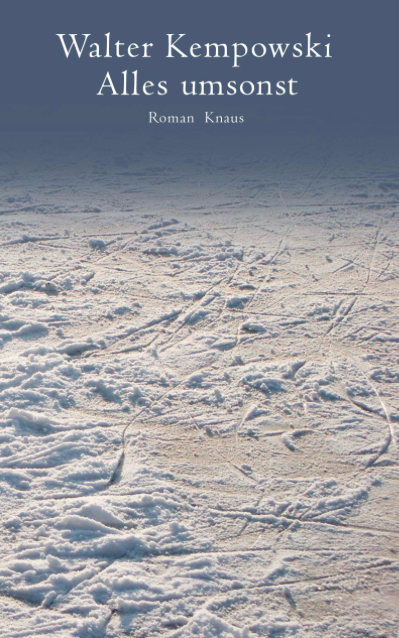
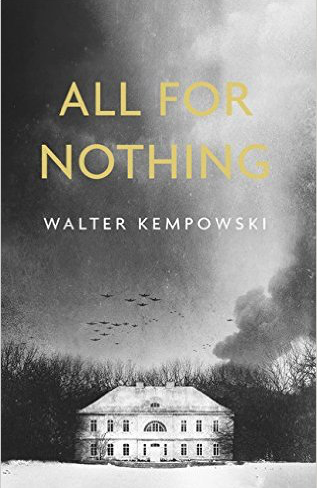
alles-umsonstAll For Nothing

Until not too long ago, even Germans thought it was in bad taste to write about German suffering during WWII. The feeling of guilt ran too deep. I still remember the discussion when the movie Anonyma came out in 2008. It’s based on the diary of a German woman who was in Berlin when the Russian army arrived. She was one of 2,000,000 German women who were raped many times by the Russian troops. We may look at the war any which way we want, there’s no denying that the Germans suffered too. We just have to think of the bombing of Dresden, the mass rapes of German women by Russian troops and – of course – the huge number of people who were forced to flee from the East towards the West, when the war was lost. Many of these Germans would never be able to return because the place they came from wouldn’t be part of Germany anymore.

This may seem a lengthy introduction but it’s essential to understand not only the importance but the scope of Walter Kempowskis’ powerful and chilling novel All For Nothing – Alles umsonst .

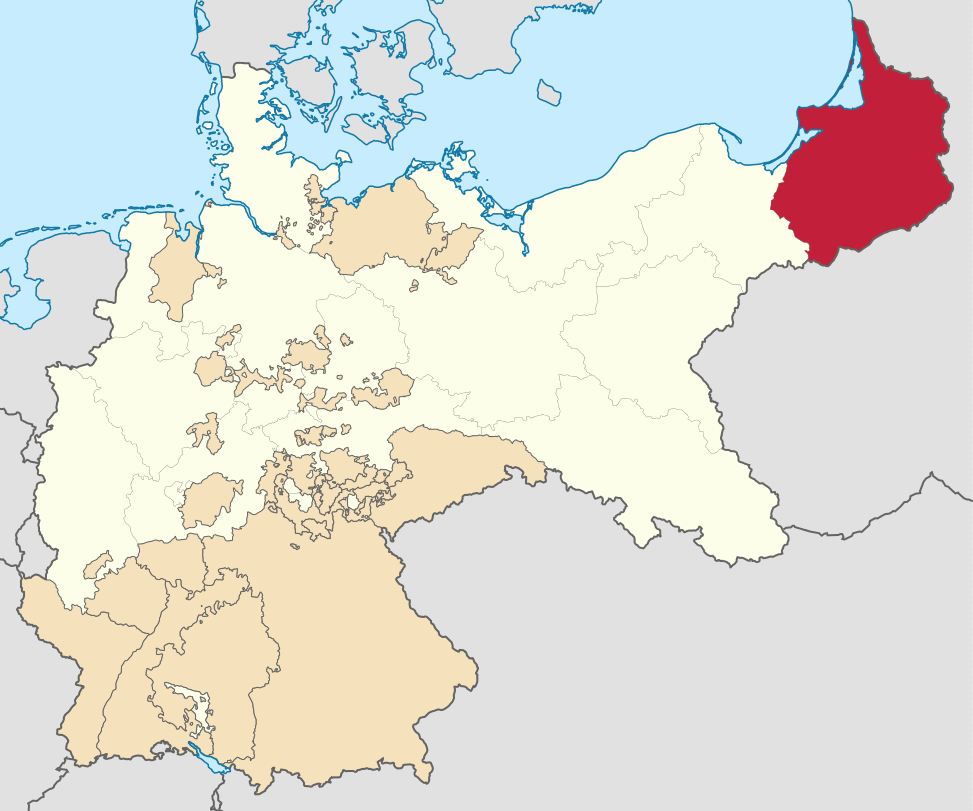
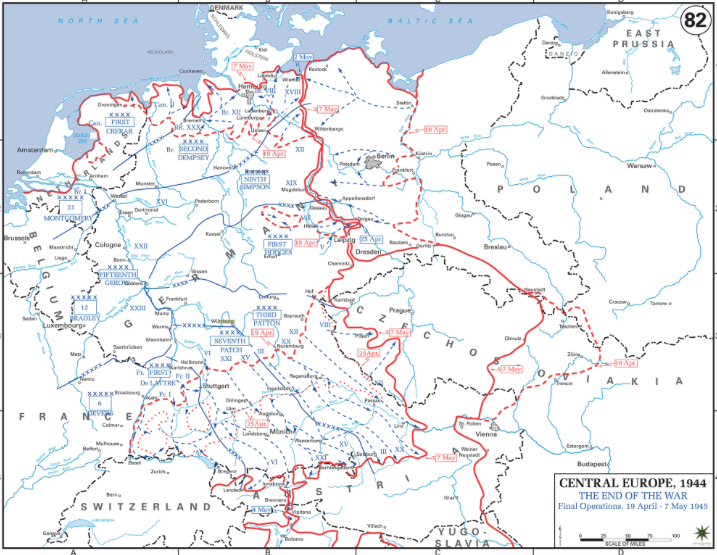
All for Nothing is set in East Prussia, in the winter of 45. In January, to be precise. The story mostly takes place on the Georgenhof estate, located near Mitkau, not too far from Königsberg. Königsberg which was once famous was almost completely destroyed and is now called Kaliningrad. For further understanding, I’ve added two maps.
east-prussia

The map above shows East Prussia in red. The other one below, is a map from 1945. It is more detailed and shows other territories. It’s easy to understand when you look at the maps, how precarious the situation was for the civilians in East Prussia when the Russians started to advance.
germany-1945

At the beginning of the novel, people already start to flee in the direction of Berlin, only the people on Georgenhof, the von Globig’s, behave as if nothing was happening. This is mostly due to Katharina von Globig’s character. She’s the wife of the estate owner who is serving in Italy. Together with her twelve-year-old son, her husband’s elderly aunt and Polish and Ukrainian servants, she lives a life of carefree ease. She’s someone who likes to withdraw from the world, into her own realm. She lives in an apartment inside of the large estate where nobody is allowed to enter. Here she reads, dreams, smokes, cuts out silhouettes, and thinks of an affair she had some years ago. Possibly the only time in her life in which she was really happy.

The aunt is a typical old maid. In the absence of her nephew, and knowing how little Katharina cares, she is in charge of the estate. Peter, the son, who should be with the Hitler Youth, pretends he’s got a cold and, like his mother, flees to other realms in his imagination.

When the first refugees arrive, the small household welcomes them. They feed and entertain them, just as if they were ordinary guests. Katharina may be distracted but she’s kind and generous. Even though her husband calls her occasionally and urges her to leave, she stays put.

But some of the refugees tell horror stories and even Katharina and the aunt realize that falling into the hands of the Russians might prove fatal. Only their life is so comfortable, so enjoyable, how can they leave everything behind? This is an incredible dilemma, and one can easily understand how so many waited far too long before they finally fled.

In the case of the von Globig’s it needs a tragedy that finally pushes them to make a decision.

The first half of the book tells the story before they flee, the second half, tells the story of the flight.

It was so strange, but reading the first almost peaceful part was really stressful. The reader knows what’s coming but the character’s don’t. It takes so long until it sinks in that all is lost.

The descriptions of the flight, those long, endless treks of refugees is harrowing. Not only are the Russians pushing forward, but the refugees are bombed and dead people and horses are piled up to the left and the right of the roads.

Kempowski did a great job at describing in a poignant way how this must have been without traumatizing the reader. We read, breathlessly, but it’s not too graphic and the characters are held at arm’s length. That doesn’t mean the book left me cold. Not at all but it never felt like it was manipulative and trying to shock and disgust.

People often say “Why didn’t they leave earlier?” when speaking of people who are trapped in a war zone. When you read this, you get a good feeling for the reasons. Not only do they have to abandon everything, but they have no idea whether it will be better where they are going. Besides, back then, all they had was accounts of a few other refugees and British radio. Their own radio told them that it was negative propaganda, that all was well, the frontline still secure. How would you have known for sure?

The luckiest thing may have been that they fled back to their own homeland and could stay on territory in which their own language was spoke. While many didn’t make it and many had a very uncertain future, they had at least that. Unlike the refugees that come to Europe from the war zones in the Middle East.

Before ending, I’d like to say a few things about the characters and Kempowski’s style. He does something I’ve never seen before. Almost every other sentence ends in a question mark. It’s really bizarre and I’m surprised it didn’t annoy me. Interestingly, it felt like we hear the characters question themselves all the time. I read a few reviews and apparently he tried to show the general confusion. I’d say he was very successful but it takes some getting used to. His characters are very well drawn. Even minor characters come to life. Most of the time he uses indirect speech but you can still hear the different mannerisms. People repeat the same stories again and again. Just like in real life. Sometimes that’s quite funny. People can be so absurd. Petty. Self-absorbed. Ridiculous. Under the circumstances it’s tragically comic. As I said, Kempowski keeps the reader at arm’s length, that’s why there isn’t a character I loved but there were two I genuinely disliked. One of them was Peter. I would love to know if anyone who read this had a similar reaction. The more I approached the end, the more I disliked this kid. Such a cold fish.

I’m so glad that I chose this novel for the readalong because it’s not only powerful but important. It tells a story that needed to be told and does so masterfully. Raising awareness for a tragedy, making characters  come to life on the page, but not bang your readers over the head or traumatize them – that’s no mean feat.

Other reviews


*******

All For Nothing is the fifth book in the Literature and War Readalong 2016. The list for next year’s Literature and War Readalong will be published in December. Further information on the Literature and War Readalong 2016, including the book blurbs can be found here.
Gil North: Sergeant Cluff Stands Firm (1960)

sergeant-cluff-stands-firm

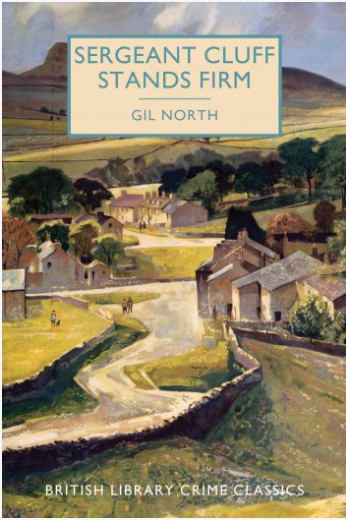
Sergeant Cluff Stands Firm is the first in Gil North’s Sgt. Cluff crime series, one of the titles in the British Library Crime Classics series. In the 60s, North’s series was very successful and was even made into a TV series, but it’s long been forgotten and out of print. Luckily North’s first two novels, along with a variety of other forgotten British crime classics, are available again. I’ve been following Guy’s (His Futile Preoccupations) progress through the British Library Crime Classics series in the last couple of months and was keen on finally trying them for myself. Reading his review of North’s second Cluff novel finally made me pick up one of the books. I liked what he wrote about book two The Methods of Sergeant Cluff, so much, that I thought it was worthwhile to start the series at the beginning. (Of course, he reviewed book one too (here’s the review) but for some reason I never saw that review.)

The series is set in Yorkshire. Descriptions of the bleak landscape, the rough weather, the lonely moors are part of the appeal. And the main character Sergeant Cluff, of course. Cluff is one of those silent, loner type detectives. He mostly keeps to himself, lives outside of the small village, gets in trouble with his superiors. That might not sound all that likable but as soon as I found out that, like Hamish Macbeth, he’s a lover of animals and owns a cat and a dog, I was won over. Sometimes an animal loving character can be depicted as a misanthrope, but while Cluff is wary of fellow humans, he’s a very empathic, compassionate man. And it takes a man like that, someone who observes people, feels compassion, to detect that something’s fishy, when they find the body of Amy Wright.

Amy Wright is found dead, in her bed, in her gas-filled house. She’s a woman in her forties, who, after a life of taking care of her mother, got married to a much younger man. A useless man with the reputation of being a womanizer. It seems obvious that Amy committed suicide. While Sgt. Cluff can’t find proof that it isn’t a suicide, he still thinks she might have been murdered and finds it odd that her husband has disappeared.

When his superior doesn’t want him to pursue the case, Cluff takes a vacation, investigates on his own, uncovers some very dark secrets, and puts himself in danger.

I was so surprised by this book. It starts a bit like a cozy mystery but then quickly turns into a realistic, bleak tale of disappointment and greed. I liked that not the whole book was told from Cluff’s point of view. The points of view of other characters were included which gave the impression the book was far more substantial than it is (it has only 155 pages). The descriptions of the landscape, and the time, Yorkshire in the 60s, was something else I appreciated. This is a old-fashioned, but changing world. Another surprise was that the book which initially felt quite pensive, picked up speed and turned into a real page-turner towards the end.

As soon as I had finished, I ordered book two in the series. I think that tells you how much I liked it. Cluff reminded me of M. C. Beaton’s Hamish Macbeth. I’m pretty sure, she knew North’s series. Her series is more on the cozy side and Hamish is less of a loner. Nonetheless, there are parallels— the love for animals, the compassion and the strong sense of place. And I will definitely read more of the British Library Crime Classics.

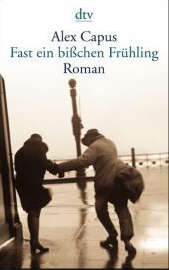
Alex Capus: Almost Like Spring – Fast ein bisschen Frühling (2002)

almost-like-springfast-ein-bisschen-fruhling

I wanted to post every other day during German Literature Month as I’ve read so many books in advance but last week was such an awful week. First the shocker election, then Leonard Cohen’s death, then the death of the brilliant Austrian writer Ilse Aichinger. So depressing. I’m sure many people feel the same way. Despondency may not be helpful but sometimes it needs room and needs to be acknowledge before we can move on.

cohenaichinger

I’ve not read any books by Alex Capus so far. I thought I wouldn’t like his writing but I’m glad to say, he’s so much better than I expected. I picked Almost Like Spring – Fast ein bisschen Frühling because it’s set in Basel, Switzerland. As many of you know, I live in Basel. There aren’t a lot of books set in this city, so I was curious because of that too.

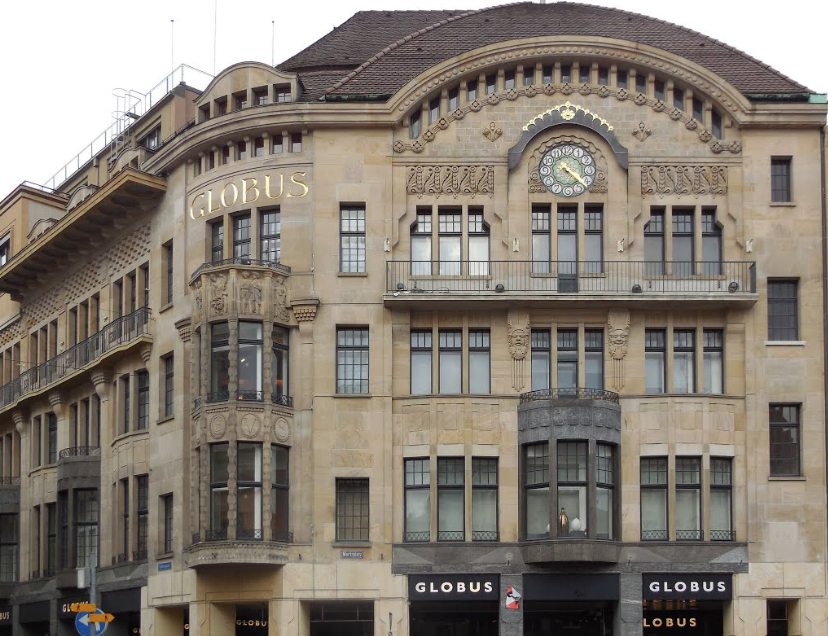
As Capus writes at the beginning of his novel, Almost Like Spring tells the true story of the German bank robbers Kurt Sandweg and Waldemar Velte. Fleeing from Wuppertal, Germany after having robbed a bank and killed someone, they arrived in Basel in the winter of 33/34. The plan was to flee to India but one of them fell in love with a shop girl, Dorly Schupp, who was working in the record department where the two robbers bought Tango records. Dorly worked at Globus, a department store that still exists and is known because it’s one of the rare Jugendstil buildings in Basel.

globus

Sandweg and Velte are depicted like two rebels and compared to Bonnie and Clyde. At any other time, one would have simply called them anti-social, but the way Capus depicts them, they were victims too. They robbed a bank because they were desperate, without a job and seeing no future in a Germany where the Nazis were taking over power. Sandweg and Velte are a peculiar pair; they are so close that people think they might be lovers but what they share is rather a bit like a folie à deux. In their heads, they’re on a mission – fighting poverty and injustice. One of them falls in love with Dorly, the other one with one of her colleagues— Alex Capus own grandmother. While the pair is in Basel, they buy a Tango record every day and go for long walks through the old town and along the Rhine, accompanied by the two young women.

The descriptions of these walks are lovely. The way Capus describes the weather, the cold winds from Siberia, and how it can get warm again, all of a sudden, in the middle of winter, because those winds change course and warm winds from the south arrive, is so spot on. The four young people don’t do much on these walks, but all four of them feel free. Dorly lives with her elderly mother, while Capus’ grandmother is engaged and will soon marry a man she never really liked. The two women don’t know that the men are criminals and when they finally leave Basel, they are disappointed.

Unfortunately, the plan to take a ship to India doesn’t work and a couple of weeks later, after having stayed in Spain, the two men are back in Basel and the real tragedy begins. They rob another bank, kill people, and are hunted down.

Most critics haven’t found anything good to say about this novel. I’m not sure why. Is it the tone? Capus mixes fact and fiction. He stays outside of his character’s heads, which makes it sound like a report at times, but the book is rich in mood and atmosphere. He captures the times and women’s fates so well. What choices did they have back then? Dorly’s actually living a relatively independent life, but Capus’ grandmother, who isn’t from Basel, is expected to return home soon and get married. While the storytelling is a bit dry, the mood is anything but.

I’m not sure about the descriptions though. Readers who haven’t been to Basel may be able to picture the department store Globus but the city? I don’t think so because he mentions street names but doesn’t really describe them.

Be it as it may, sometimes I agree with critics, sometimes I don’t. In this case I don’t agree. Almost Like Spring is a lovely book. It’s a rounded, historically accurate, atmospheric book that mixes fact and fiction to great effect.

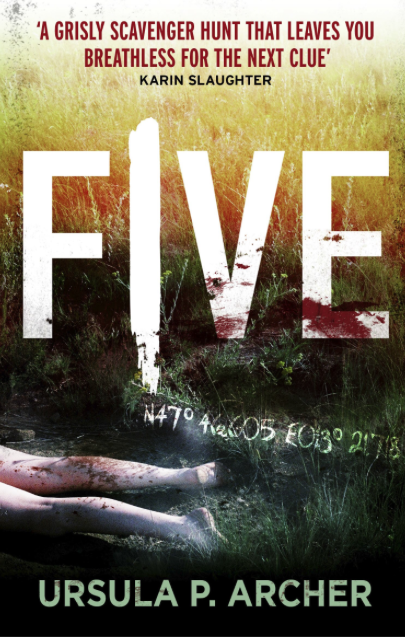
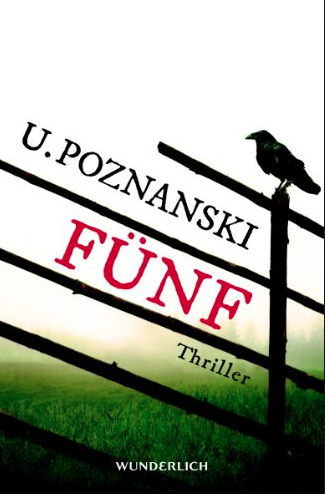
Ursula P. Archer aka Ursula Poznanski: Five – Fünf (2013)

fivefunf

Last year I read Ursula Poznanski’s YA thriller Erebos and liked it a great deal. When Lizzy mentioned that one of Poznanski’s crime novels for adults had been translated, I knew I had to read it. Not that I read it in English, of course not, but it’s always nicer to review books that have been translated.

Five – Fünf, the first in a series, introduces detectives Bea Kaspary and Florin Weininger of the Landeskriminalamt in Salzburg, Austria. They have been called to an unusual crime scene – a cow pasture. A woman has been found dead. Her hands tied in the back. She has been thrown from a small mountain overlooking the pasture. On the soles of her feet, they find a tatoo of strange numbers, which turn out to be coordinates. Those will lead them to a severed hand and more co-ordinates, which lead to another body part and other coordinates. The second set of coordinates aren’t added in the same straightforward manner as the first. They can only be found after the detectives solve a riddle for which they need to find someone. As if finding body parts wasn’t bad enough, the people who are the clues to solve the riddles, get killed as soon as they have been found by the police.

Five is very well done. It’s extremely suspenseful and, like in her YA novels, Ursula Poznanski/Archer uses a type of game or hobby – in this instance geocaching. I’d never heard of it but it seems that the author herself is a dedicated geocacher. Geocaching uses coordinates and hiding places. On a website you find coordinates and can then hunt a hidden object. The objects are often hidden in beautiful places. So it’s a bit of a mix between hiking and some sort of treasure hunt. It’s a trademark of Poznanski’s writing to use such modern-day games/technology as a base—computer games, live role-playing, drones . . .

I can’t say too much but although this sounds like a serial killer story, it’s not. Nonetheless, it’s quite gruesome in places.

Since this is the beginning of a series, the characters are very important. The detectives are very likable and well drawn. Bea is a mom of two, newly divorced from a bullying husband and still deeply traumatized by something that happened in her past. Florin is single but just started to date someone. That’s important because Bea clearly has a bit of crush on him. They work very well together, are almost friends. Bea is rather unconventional and gets into trouble with her superiors while Florin looks out for her and defends her.

One could call Five a crime novel with thriller elements. It’s very suspenseful and should appeal to many different crime readers – those who prefer thrillers, those who like a mystery, and those who love police procedurals. It has Poznanksi’s trademark mix of likable characters, impeccable pacing and contemporary feel. None of her novels could have been set at another time. I like that. She explores many themes in this book but they are tied so closely into the motive for the murder that I cannot say too much. If you’re looking for a suspenseful page-turner and love crime series, give this one a try.

If you’d like to find out more about geocaching – here’s a link.

Literature and War Readalong November 2016 Meets German Literature Month: All For Nothing – Alles umsonst by Walter Kempowski

All For Nothing

The last title of this year’s Literature and War Readalong is Walter Kempowski’s All For Nothing – Alles umsonst. It was Kempowski’s last novel. Walter Kempowski was born in 1929 in Rostock and died in 2007 in Rotenburg. He was famous for his autobiographical novels, one of which Tadellöser & Wolff, was made into a mini-series, and his huge project Echo Soundings – Echolot, subtitled “A collective diary”. In this project he collected and juxtaposed excerpts of diaries, letters ,and documents to illustrate and capture history.

Here is the first sentence of All for Nothing

The Georgenhof estate was not far from Mitkau, a small town in East Prussia, and now, in winter, the Georgenhof, surrounded by old oaks, lay in the landscape like a black island in a white sea.

And some details and the blurb for those who want to join

All For Nothing – Alles umsonst by Walter Kempowski, 352 pages, Germany 2006, WWII

Here’s the blurb:

Winter, January 1945. It is cold and dark, and the German army is retreating from the Russian advance. Germans are fleeing the occupied territories in their thousands, in cars and carts and on foot. But in a rural East Prussian manor house, the wealthy von Globig family tries to seal itself off from the world. Peter von Globig is twelve, and feigns a cough to get out of his Hitler Youth duties, preferring to sledge behind the house and look at snowflakes through his microscope. His father Eberhard is stationed in Italy – a desk job safe from the front – and his bookish and musical mother Katharina has withdrawn into herself. Instead the house is run by a conservative, frugal aunt, helped by two Ukrainian maids and an energetic Pole. Protected by their privileged lifestyle from the deprivation and chaos around them, and caught in the grip of indecision, they make no preparations to leave, until Katharina’s decision to harbour a stranger for the night begins their undoing. Superbly expressive and strikingly vivid, sympathetic yet painfully honest about the motivations of its characters, All for Nothing is a devastating portrait of the self-delusions, complicities and denials of the German people as the Third Reich comes to an end.

*******

The discussion starts on Friday, 25 November 2016.

Further information on the Literature and War Readalong 2016, including all the book blurbs, can be found here.

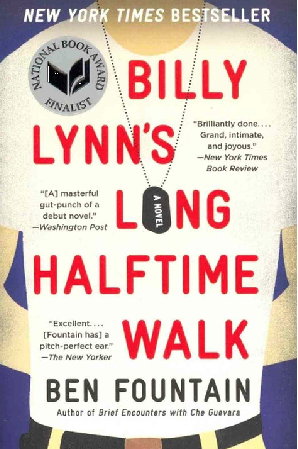
Ben Fountain: Billy Lynn’s Long Halftime Walk (2012) Literature and War Readalong September 2016

Billy Lynn's Halftime Walk

Luckily Billy Lynn’s Long Halftime Walk was one of my readalong titles or I might have given up after fifty pages. I found it hard to get into but once I passed the fifty page mark, I was so engrossed, I could hardly put it down. What a terrific, poignant, witty, and sarcastic book.

The novel is set on the last days of Bravo company’s victory tour. Billy Lynn and his comrades are heroes. They survived a firefight in Iraq, during which they overthrew a group of insurgents. One of the Bravos died in the fight, another one came back disabled. Nonetheless, this “sacrifice” might have passed unnoticed if it hadn’t been filmed by an embedded journalist. As a reward they receive medals and are sent home on a propaganda tour.

This does it; they throw back their heads and roar. In a way it’s so easy, all he has to do is say what they want to hear and they’re happy, they love him, everybody gets along. Sometimes he has to remind himself there’s no dishonor in it. He hasn’t told any lies, he doesn’t exaggerate, yet so often he comes away from these encounters with the sleazy, gamey aftertaste of having lied.

The last day is meant not only as a special tribute but as a special treat. The Bravos assist and participate in a game of the Dallas Cowboys. They are allowed to go back stage and to talk to the players, their manager and their rich Texan supporters. At halftime, they are on the field, right next to the musical attraction – Destiny’s Child. And during every break, the footage of their fight is shown on a giant screen.

During this tour, and especially on this last day, people force themselves on the young men, telling them how much they admire them, asking them questions about the war “Are we winning?” – “Did you kill many?” – “It’s a god war we’re fighting, right?”

Billy who’s done the most heroic thing, is the 3rd person narrator of this story. Like Holden Caufield he is equally precocious and naïve and such a terrific character. One of the central plot lines is his falling in love with a cheerleader. While his testosterone-fuelled feelings might not be love, as he thinks, hers are even further from the feeling as all she wants is “a hero” – “a soldier”, as Destiny’s Child sing. She wants the idea of a man, not the man himself.

“Hi, you’ve reached Faison! I’m not able to take your call right now…”

It makes for an odd sensation, watching her real-time person in the middle distance while holding her disembodied voice to his ear. It puts a frame around the situation, gives it focus, perspective. It makes him aware of himself being aware of himself, and here is a mystery that seems worth thinking about, why this stacking of awareness should even matter. Ant the moment all he knows is that there’s structure in it, a pleasing sense of poise or mental ordering. A kind of knowledge, or maybe a bridge thereto–as if existence didn’t necessarily have to be a moron’s progress of lurching from one damn this to another? As if you might aspire to some sort of context in your life, a condition he associates with adultness. Then comes the beep, and he has to talk.

It’s a very difficult book to review as it’s not very plot-driven. It’s the exuberant style that’s important, the descriptions of the absurdities, the frenzy with wich football and war are celebrated by the very rich, as if both only served one purpose – to make them feel good about themselves and about being Americans.

Where else but America could football flourish, America with its millions of fertile acres of corn, soy, and wheat, its lakes of dairy, its year-round gushers of fruits and vegetables, and such meats, that extraordinary pipline of beef, poultry, seafood, and pork, feedlot gorged, vitamin enriched, and hypodermically immunized, humming factories of high-velocity protein production, all of which culminate after several generations of epic nutrition in this strain of industrial-sized humans? Only America could produce such giants.


No matter their age or station in life, Billy can’t help but regard his fellow Americans as children. They are bold and proud and certain in the way of clever children blessed with too much self-esteem, and no amount of lecturing will enlighten them as to the state of pure sin toward which war inclines. He pities them, scorns them, loves them, hates them, these children. These boys and girls. These toddlers, these infants. Americans are children who must go somewhere else to grow up, and sometimes die.


All the fakeness just rolls right off them, maybe because the nonstop sales job of American life has instilled in them exceptionally high thresholds for sham, puff, spin, bullshit, and outright lies, in other words for advertising in all its forms.

I don’t think I’ve ever come across a contemporary book that was so astute and harsh in its criticism of the negative aspects of American culture. It shows that most things are about money and consumption. And even when people pretend they care about something, they ultimately only care about what it can bring them.

Somewhere along the way America became a giant mall with a country attached.

The book is written in a frantic, quick-paced style, with long sentences and paragraphs that reminded me of listening to a frenzied sports commentator.

Billy tries to imagine the vast systems that support these athletes. They are among the best-cared for creatures in the history of the planet, beneficiaries of the best nutrition, the latest technologies, the finest medical care, they live at the very pinnacle of American innovation and abundance, which inspires an extraordinary thought – send them to fight the war! Send them just as they are this moment, well rested, suited up, psyched for brutal combat, send the entire NFL! Attack with all our bears and raiders, our ferocious redskins, our jets, eagles, falcons, chiefs, patriots, cowboys – how could a bunch of skinny hajjis in man-skits and sandals stand a chance against these all-Americans? Resistance is futile, oh Arab foes. Surrender now and save yourself a world of hurt, for our mighty football players cannot be stopped, they are so huge, so strong, so fearsomely ripped that mere bombs and bullets bounce off their bones of steel. Submit, lest our awesome NFL show you straight to the flaming gates of hell!

Sometimes, when I watch a war movie or read a book about war, I have my doubts. I wonder whether or not it’s really anti-war – as it should. I never wondered for one second while reading this book. It’s not only against war but against the justification, the fake heroism, the phony concern and gratefulness. But it’s kind to the soldiers. They are shown as victims who very often only joined up because they were too poor to do anything else.

I was thinking, if Salinger had written Catcher in the Rye right after 9/11, it might have been a lot like Billy Lynn. I loved the Catcher in the Rye. Needless to say, I loved Billy Lynn.

Since the writing is the most important thing in this book, I’ll leave you with some more quotes:

Don’t talk about shit you don’t know, Billy thinks, and therein lies the dynamic of all such encounters, the Bravos speak from the high ground of experience. They are authentic. They are the Real. They have dealt much death and received much death and smelled it and held it and slopped through it in their boots, had it spattered on their clothes and tasted it in their mouths. That is their advantage, and given the masculine standard America has set for itself it is interesting how few actually qualify. Why we fight, yo, who is this we? Here in the chicken-hawk nation of blowhards and bluffers, Bravo always has the ace of bloods up its sleeve.


Fear is the mother of all emotion. Before love, hate, spite, grief, rage, and all the rest, there was fear, and fear gave birth to them all.


It’s going to be a long, lonesome eleven months in Iraq, long and lonesome being the best-case scenario.


Everybody supports the troops,” Dime woofs, “support the troops, support the troops, hell yeah we’re so fucking PROUD of our troops, but when it comes to actual money? Like somebody might have to come out of pocket for the troops? Then all the sudden we’re on everybody’s tight-ass budget. Talk is cheap, I got that, but gimme a break. Talk is cheap but money screams, this is our country, guys. And I fear for it. I think we should all fear for it.


Other reviews


*******

Billy Lynn’s Long Halftime Walk is the fourth book in the Literature and War Readalong 2016. The next book is the German WWII novel All For Nothing – Alles umsonst by Walter Kempowski. Discussion starts on Friday 25 November, 2016. Further information on the Literature and War Readalong 2016, including the book blurbs can be found here.
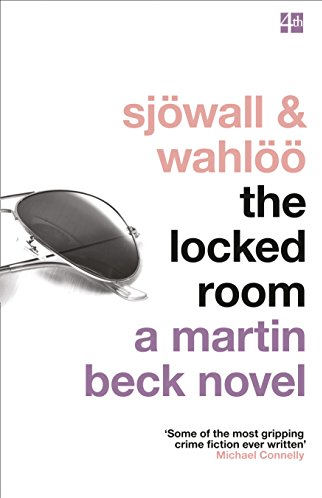
Sjöwall & Wahlöö: The Locked Room (1972) Martin Beck Series

the-locked-room

One could say that Sjöwall and Wahlöö are the grandfathers of Swedish crime. They wrote long before Nordic crime was the thing it has become. Their Martin Beck series is said to be one of the best around. A true classic. While the books have been around for as long as I can think, I never picked one up, although I have always been curious. Now, finally, because I was looking for a locked room mystery, I came across the eight title in the Martin Beck series, The Locked Room, and thought I’ll give it a try. I know it’s not ideal to start with book eight in a series but it was OK. I never felt liked I was missing a ton of information. According to Michael Connelly, who wrote the introduction to this book, it’s one of their best.

This book was not what I’ve expected. It was so much better. So good in fact that I immediately downloaded the first in the series.

Detective Inspector Martin Beck isn’t the central character in this book because he’s been shot and only just returned to work after an eighteen month break. To help him get back into the routine, he’s been assigned a minor case. A man has shot himself and Beck has to wrap up the case.

Parallel to this case, we follow the police investigating a bank robbery that has gone terribly wrong. One of the customers was shot. For years, the police have tried to catch a group of bank robbers, but they always escaped. The police are pretty sure that the robbers they are chasing, robbed this bank as well, even though they never shot anyone before.

The readers know from the beginning that someone else has robbed the bank. We also learn that the suicide Beck investigates was a murder. The man was found dead, shot, in a locked room and no weapon could be found.

These are two very different cases. The one Beck investigates is more suspenseful as we only know as much as Beck knows. The other case is rather hilarious. And this is exactly why this series surprised me so much and why I loved this book. Very obviously Sjöwall and Wahlöö were very fond of their character Beck. Beck, who is a bit of a loner, is very intelligent, a thinker, slightly sarcastic and disillusioned but not bitter. His colleagues aren’t too keen on him, they find him bizarre and too unconventional. He’s definitely an outsider. While we can feel how much the authors like Beck, we also notice quickly, how little they think of the police in general. They make fun of the bank robbery squad wherever they can. More than one of their missions turns into a farce. Some of these characters are very likeable too but dorky. Others, especially those higher up in the ranks are just clueless.

I really enjoyed the mix of such different cases. The quiet, introspective case Beck was on and the big bank robbery investigation that took surprising turns and had many funny moments.

Another aspect I liked was that the book was full of social criticism. It’s really quite harsh in places. The authors excoriate Swedish society and politics.

I know that Beck is more prominent in the earlier books, so I can’t wait to read a novel in which he gets more room. He’s a great character.

All in all, a very pleasant surprise. Sharp, pithy writing, combined with dry humour, appealing characters, a realistic setting, and two interesting cases. What more could you want?