Siri Hustvedt: The Shaking Woman or A History of My Nerves (2010)

While speaking at a memorial event for her father, the novelist Siri Hustvedt suffered a violent seizure from the neck down. Was it triggered by nerves, emotion – or something else entirely? In this profoundly thought-provoking and revealing book, Hustvedt takes the reader on her journey through psychiatry, philosophy, neuroscience and medical history in search of a diagnosis. Conveying the often frightening mysteries of illness, she illuminates the perenially mysterious connection between mind and body and what we mean by ‘I’

Siri Hustvedt is one of my favourite writers. Whenever she has a new novel out I’m likely to buy and read it. I’m a bit behind as I haven’t read Sorrows of an American and The Summer Without Men yet. Until now I haven’t read any of her essays but was planning on doing it and when I saw The Shaking Woman or The History of my Nerves in a bookshop I bought and read it immediately.

Whether someone likes this book or not depends a lot on the expectations. Many readers where disappointed to find a blend. The Shaking Woman is halfway between essay and memoir, very dense, hardly anecdotal but highly informative and thought-provoking.

“Nerves” is such an interesting term and topic. I recently watched the movie Housewife, 49 based on the diaries that a 49-year-old housewife wrote during WWII. She is  depressed and, as she says, “nervous” or has problems with her “nerves”. I also seem to remember distinctly Mrs Bennett in Pride and Prejudice exclaiming on and on “My poor nerves”. By using the word we may mean quite a lot of things and this is precisely what Siri Hustvedt hints at too.

During a speech for her late father Siri Hustvedt started to shake violently from chin down. She continued to speak and the shaking wasn’t in any way audible, it didn’t affect her capability to speak in any way. She says she didn’t even feel nervous or anxious before the speech. If this had happened only once she might not have felt tempted to undergo so many tests and read such a lot about various topics. But it did happen again and from what I understood still happens to this day.

Everybody with a chronic disease can feel with Siri Hustvedt and her struggle to make sense of what happens. It’s the nature of many chronic diseases that are somewhere on the borderline between physical and psychological to be hard to diagnose and even harder to treat.  These are some of the topics she writes about. But she doesn’t only write about the different tests and treatments she undergoes, she looks for a deeper meaning. What does it mean when you say “I’m ill”? Who is this “I”? What does it mean when you say you are physically ill? Is your mind not part of your body?

Who are we anyway? What do I actually know about myself? My symptom has taken me from the Greeks to the present day, in and out of theories and thoughts that are built on various ways of seeing the world. What is body and what is mind? Is each of us a singular being or a plural one? How do we remember things and how do we forget them? Tracking my pathology turns out to be an adventure in the history of experience and perception.

She thinks for a long time that what she has is a convulsion disorder and therefore we hear a lot about the history of hysteria, its early treatment and what has become of it now. She parallels hysteria and shell-shock and wonders why both terms are now out of fashion.

One of the doctors she consults tells her she has a panic disorder and she also reads a lot about this.

But it wouldn’t be Siri Hustvedt if she stopped there. She goes far beyond her illness and so, in the end, this book is less about a symptom than about the mind as a whole. She also writes at length about migraine and different ways of perceiving the world. About memory and imagination.

When I read a novel, I see it, and later, I remember the images I invented for the book. Some of these images are borrowed from intimate places in my own life. Others, I suspect, are taken from movies or pictures in books and paintings I’ve seen.

She also writes about mysticism, Merleau-Ponty, Simone de Beauvoir, Freud and mixes all kind of views and theories.

At the end she has explored numerous things but still doesn’t know what she really has.

The Shaking Woman describes one woman’s intellectual journey that starts with a symptom and ends with an exploration of all sorts of disciplines, theories and views on consciousness. It seems as if the inconspicuous sounding word “nerves” was a little door that Hustvedt opened to enter a huge, huge landscape. I’m glad I took the journey with her.

Stéphane Hessel: Indignez-Vous! /Time for Outrage!/Empört Euch!

Indignez-Vous!

Indignez-Vous!

Bookaroundthecorner reviewed this tiny little booklet a few days ago and since I had bought it last October when it came out and am one of the happy few to own a first edition, I thought I might as well read it. Besides it is only 13 pages long + an additional 14 of introduction and afterword.

Since the French original came out the essay has been translated into many different languages and is a success pretty much everywhere. There is always a very good indicator whether a book is spoken of in Germany when you look at the number of reviews and the number of comments the reviews get on amazon and whether there are articles and TV programs on Swiss TV as well.

Reviews of Indignez-vous! generated up to 200 comments on amazon.de. One could say that Stéphane Hessel hit a nerve.

In France alone it sold far over 600’000 copies, in Germany I think it hit the 1’000’000 mark a while back already.

Hessel, a German Jew,  is a charismatic man and  looks back on a life story that isn’t shared by many. Hero of the Resistance, member of de Gaulle’s Free French organisation in London, he was captured upon returning to France in 1944, tortured and sent to two different concentration camps which he both escaped. He helped to draft the UN’s Universal Declaration of Human Rights in 1948 and became a famous French advocate for Human Rights.

With this background and credibility it isn’t surprising that he would make people listen.

Time for Outrage!

Time for Outrage!

Hessel wants to incite a sense of outrage in his readers. Outrage is the fuel for resistance and the only way to stop things as he says. Our world is drifting away from democratic principles with the supremacy of money over everything else.

The worst attitude facing social injustice and exploitation is indifference. There are numerous things that outrage Hessel, one of the most important ones – and source of a lot of controversy – is his take on the situation in Palestine and his statements against the Israeli government. Despite being of Jewish origins he was promptly accused of anti-Semitism. Silly, really as there is a long tradition of Jewish intellectuals,  starting with Hannah Arendt, who criticized Israel.

Empört Euch!

Empört Euch!

It may come as a surprise but his answer to all the problems and conflicts is non-violence. Be outraged, do not stay indifferent and change things in a nonviolent way, is his core message.

That this book is such a success in France where the current politics give a lot of reason for outrage isn’t surprising. That it is an equal success in Germany isn’t any more astonishing. You cannot write anything and name Jews, Resistance, Nazism, concentration camps and Israel and not be read in Germany. To overlook this book would seem to many a German intellectual almost a sign of anti-Semitism. But there is more to it. His call for non-violence is something that strikes a chord in Germany more than anywhere else. The last time people were really outraged, they ended up killing people (RAF) and this cannot be a solution.

Still, why is it such a success? I think because it is so unflinching. There isn’t any superfluous word in this slim book, no adornment, no digression.

It is short and to the point and tells you without any ambiguities what his author considers to be right and wrong.

I am one of those who is against all sorts of relativism that seems to me just a means to avoid clear thinking and taking responsibility. The most outrageous things are just explained away by people who do not want to take position. There isn’t an excuse for everything, no matter how much some would like this. I particularly abhor cultural relativism and can still remember how I was ostracized as a young student because I dared criticizing the practice of female genital mutilation practiced in many African countries. One female fellow student dared telling me that I was “showing all the sings of the deluded belief of Western and Judeo-Christian supremacy” in criticising an African custom. Now I may be naive but I think whenever something harms someone it can not be right, whether this may be rooted in someone’s culture or not.

Another point in which I agree with Hessel is when he makes clear that outrage that leads to terror is not a solution.

Hessel would like to reach young people but I have my doubts whether his essay is read by the very young. I think those under 30 are getting more and more apolitical. I’m not even sure that growing insecurity will wake them up. Still, one should always try.

Hessel is a “phenomenon” that our world needs. A world that tends to pay attention to the young and good-looking rather than to the elderly. Although strong in numbers they seem to be treated more and more like a minority.  We need positive role models in every age group. Hessel demonstartes that you can be 93 years old and your thinking can still be fresh, your engagement intense and your ideas important enough to create an interest in a lot of people.

I attached a great interview for German-speaking readers.

Once Upon A Time Challenge

No matter what I said about challenges at the beginning of the year, forget it. Of course I’m joining the Once Upon A Time Challenge. I loved last year’s R.I.P. hosted by Carl and this is the lighter springtime side to R.I.P’s autumnal darkness. And I love fairy tales, folklore, fantasy and mythology.

There are different levels in the Once Upon A Time Challenge, please go there and find out all about it.

I decided to sign up for the Journey which leaves everything open from reading only one book to as many as I want, fiction and nonfiction.

I’m just about to finish a few fairy tale retellings, so this is timely in any case. I have a few ideas for other books I might read but I’m not sure it’s wise to tell it yet as I have seen in the last few weeks a few projects being left behind due to time constraints. The only book I am sure to review is Red Riding Hood and a few other retellings of the Little Red Riding Hood fairytale.

Brené Brown: The Gifts of Imperfection (2010)

Human-behavior researcher and author of I Thought It Was Just Me (2007), Brown has made a career out of studying difficult emotions such as fear and shame. In this latest book, she emphasizes that above all other ingredients of living an emotionally healthy life is the importance of loving ourselves. In the grips of what she took to be a breakdown, or midlife crisis, Brown came to understand she was experiencing a “spiritual awakening” and worked to explore its significance and the interaction of knowing and understanding yourself and loving yourself. She intersperses her own personal journey with research and clinical observations of others of the work of living a “wholehearted” life, or “engaging in our lives from a place of worthiness.” The point is to embrace life and oneself with all the imperfections, releasing the stress of overdoing and overworking. Brown offers exercises for readers to plumb their own emotions and begin to develop the kind of resilience needed to stand up to unrealistic expectations of others and ourselves.


I’m so glad I came upon Brené Brown’s Homepage and from there to her book The Gifts of Imperfection. This is her second book, the first was called I Thought It Was Just Me (But It Isn’t): Telling the Truth about Perfectionism, Inadequacy and Power.

Brené Brown is a researcher, specialized in topics like shame and perfectionism and analyzing how they are linked and keep us from living wholeheartedly. She is an incredibly honest and open person who is able to show her vulnerability.

Wouldn’t it be better if we could be kinder but firmer? How would our lives be different if there were less anger and more accountability?  (p. 17)

The source of this book was a major breakdown that forced her to look at herself and her life. What she found out and shares with her readers is truly invigorating.

Before the breakdown, I was sweeter – judgmental, resentful and angry on the inside – but sweeter on the outside. Today, I think I’m genuinely more compassionate, less judgmental, and resentful, and way more serious about boundaries. (p.16)

The book has two parts. The first is a more theoretical one in which she introduces us to the concept of living a wholehearted life. The key factors are: Courage, Compassion and Connection. Further she emphasizes the importance of Love, Belonging and Being Enough. But what is much more important is that she identifies that there is always something that gets in the way when we try to change. We need guideposts to overcome the hurdle and she provides them. Every guidepost is linked to something that gets in the way and is described in detail.

The Wholehearted journey is not the path of least resistance. It’s a path of consciousness and choice. And to be honest, it’s a little counter-culture. The willingness to tell our stories, feel the pain of others, and stay genuinely connected in this disconnected world is not something we can do halfheartedly. (p.21)

The second part offers a more practical approach and consists of ten very different guideposts: Authenticity, Self-Compassion, Resilience, Gratitude and Joy, Intuition and Trusting Faith, Creativity, Play and Rest, Calm and Stillness, Meaningful Work, Laughter. In the guideposts she provides her own insights, case stories from other people, research data and quotes from a variety of books. She also indicates titles for further reading. Especially those reading suggestions are very valuable and I compiled quite a list of interesting titles.

One of the best and most honest chapters is the guidepost on addiction or numbing as she calls it (Guidepost Resilience). Brené herself was an alcoholic and was also addicted to a great number of other things like over-eating and also the overuse of Facebook and the like.

Another chapter that I appreciated a lot was the one called ” Cultivating Creativity. Letting go of Comparison.”

Comparison is all about conformity and competition. At first it seems like conforming and competing are mutually exclusive, but they are not. (p.94)

The comparison mandate becomes this crushing paradox of “fit in and stand out!” It is not cultivate self-acceptance, belonging and authenticity; it’s be just like everyone else, but better (p.95)

If you like you can visit Brené Brown’s Homepage where you will find her blog as well as a lot of other resources.

Best and Worst Books 2010

After debating with myself for at least one week, whether or not I should do a Best of 2010, I finally gave in. Since I only started blogging in August many books are not reviewed here. Unfortunately some haven’t or will never be translated either. I did also add the worst books of this year. Not very nice, I know…

Most engrossing reads

These were the books where I never checked how many pages were left because I had finished them before even getting the chance to do so.

Francesc Miralles Amor en minúscula. Please find here his Spanish website. This writer needs to be translated!

Ulli Olvedi Über den Rand der Welt. Olvedi is a German Buddhist, teacher of Qi Gong and novelist.

M.C. Beaton Death of a Witch. Cozy crime in a Scottish setting with cat.

Ayelet Waldman Love and Other Impossible Pursuits. She has a style that just swipes you away and all her themes are so interesting.

Elizabeth Lupton Sister. Great thriller.

Ruth Rendell A Judgment in Stone. Fascinating psychological study of a criminal mind.

Most beautiful

You want to live in the world created by a beautiful book, jump right into it and stay there.

Harper Lee To Kill a Mockingbird. Atticus, where have you been all my life?

Rosamond Lehmann Dusty Answer. I love Rosamond Lehmann. This moved me and it is beautiful and thanks to this book I started blogging because it made me discover A Work in Progress and….

Elizabeth Taylor Mrs Palfrey at the Claremont. Just perfect.

Niccolò Ammaniti I am not scared. Childhood memories, intense pictures, such a beautiful, beautiful book.

Meg Rosoff What I Was. This has a truly dreamlike quality. Something very, very special.

Most fascinating

Books that were different, thought-provoking, engaging, not easy but worthwhile.

Sheri S. Tepper The Gate to Women’s Country. That’s what I call original. Feminist SciFi.

Audrey Nyffenegger Her Fearful Symmetry. The setting (Highgate Cemetery), the topic (ghosts), the writing. Marvelous.

Sjón The Blue Fox. Fairytale, historical, poetical.

John O’Hara Appointment in Samarra. This is a must read for aspiring writers. His writing teaches you a lot.

Most interesting

Occasionnaly you want to learn something when you read a novel. These two teach you something, are entertaining and really surprisingly good reads.

Lisa Genova Still Alice. What if you had early onset Alzheimer’s? Who would you be without your memory, without your intellectual faculties and how would others react?

Allegra Goodman Intuition. Did you ever wonder what scientists do in a lab, how researchers live? Intuition tells you this and a lot more. She kept me interested in a topic I am normally not interested in. Plus the style is limpid.

Most accomplished

This is the category of the stylists. Two of the books mentioned have been written by poets.

Jennie Walker 24 for 3. The work of a poet. I hardly found a book in which more parts were quotable than in this one.

Gerard Donovan Julius Winsome. Beautifully crafted. Sad and touching story. If you ever really loved an animal you know what he is talking about…

Jennifer Johnston The Gingerbread Woman. How to survive a tragedy? Told in compelling prose.

Andrew Sean Greer The Story of a Marriage. Puzzling, nice construction, short and efficient.

Most touching

Books that speak to you, your soul or something you experienced. In these cases everything spoke to me.

Susan Breen The Fiction Class. A teacher of creative writing, a difficult mother, a possible love story.

Maria Nurowska Jenseits ist der Tod. Death of a mother and how to bury her. Raw emotions. Incredible. I read the German translation of this book. The original is Polish.

Best Short Story

Lauren Groff Blythe (from her collection Delicate Edible Birds). If someone took the pieces of Anne Sexton’s life and wrote a short story about it, that is what would come out.

Would I have wanted to be the author?

I always ask myself this question. Occasionally I say yes.

These are this years’ choices:

Francesc Miralles Amor en minúscula

Maria Nurowska Jenseits ist der Tod

Niccolò Ammaniti I am not scared

Harper Lee To Kill a Mockingbird (why be modest?)

Non Fiction

Deepak Chopra’s The Book of Secrets. Chopra is famous but I don’t necessarily like his books. This one was different. It is one of the best introductions to Hinduism and the different yogas you can find. It combines theory with exercises. A truly great book and recommended by Ken Wilber whom I admire loads.

Paul Leyhausen Cat Behaviour: Predatory and Social Behaviour of Domestic and Wild Cats. One of the most interesting books on cats.

Georg Diez Der Tod meiner Mutter. Unfortunately this hasn’t been translated. It is an outstanding memoir about the death of a mother, the love of a son and saying goodbye.

Steven Pressfield The War of Art. You want to write or be otherwise creative? Why don’t you? Procrastination. Pressfield’s book is like dynamite…

Isabel Gillies Happens Everyday. Also a memoir. The style is simple not very engaging but I enjoyed it a lot. It is the story of the end of a marriage. But that is not the engrossing part, the engrossing part was the description of Oberlin College. Campus life in the States, something we do not have here.

The worst reads this year

Sebastian Barry’s The Secret Scripture. I hate this type of coincidence and Maggie O’Farrells’ The Vanishing Act of Esme Lennox tells a similar story only in a more appealing way.

Jo Nesbos The Snowman. Did he want to kill me through boredom? He almost achieved. Predictable and boring.

Alice Sebold The Lovely Bones. This is a bit difficult. Why did I not like it? I just didn’t. Period.

Maria Nurowska

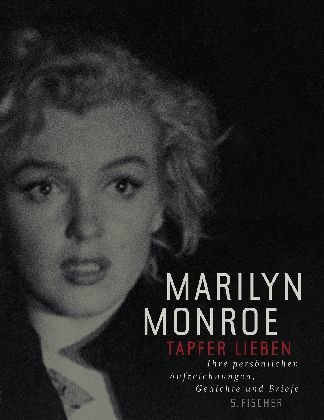
Marilyn Monroe: TAPFER LIEBEN. Ihre persönlichen Aufzeichnungen, Gedichte und Briefe (2010) Marilyn Monroe´s diaries, poems and letters

What a find. After all these years Marilyn Monroe’s diaries, poems and letters have been found. The German market is the first to publish this sensational book. I am really enthusiastic about is as I am a great admirer of Marilyn Monroe and have always been. The book contains diary entries, poems and letters in English and German translation. None other than one of my most beloved writers the Italian Antonio Tabucchi has written the foreword. We can discover how sensitive, vulnerable and intelligent the tragic actress was.

There are many photos in this book and pictures of the original pages on which she wrote and scribbled or drew. Some of the notes have been taken on random bits of paper like bills and the like.

Apparently the photo below was her own favourite one.

amazon.de