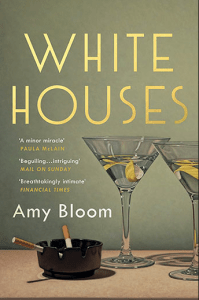
Amy Bloom: White Houses (2018)

I’m not that familiar with most of the pre-Reagan American presidents and even less with their respective wives, but Eleanor Roosevelt was someone who had piqued my curiosity, years ago, as a teenager. I read a terrific book by Gloria Steinem, called a Book of Self Esteem and she made a comparison between Eleanor Roosevelt and Margaret Mead. Both women were highly intelligent and successful, but not exactly known for their conventional beauty. As Steinem showed, Mead couldn’t have cared less, while Roosevelt, when asked by an interviewer, whether she had any regrets looking back on her life said: “Just one. I wish I had been prettier.” This struck me as incredibly sad and touched me because it was so frank. I also wondered, what kind of life she thinks she’d have had if she had been prettier. After all, she was married to one of the most popular US presidents. When I came across Amy Bloom’s latest novel White Houses and saw it was about her relationship with Lorena Hickock, I remembered the Steinem book and picked it up. I wasn’t surprised to find out that Eleanor Roosevelt’s looks were also an important topic in this novel.

Of course, White Houses, is a novel, not a nonfiction book, so we have to assume Bloom took some liberties, nonetheless it was fascinating for many reasons. I had an idea of president Roosevelt, like many do, and while I still believe he was one of the better presidents, I don’t think he was that good a man. At least not, judging by this novel. Not only was he a philanderer but quite cruel to his mistresses. When they had served their purpose, he dropped them like a hot potato. But this is only a tiny part of what this book is about.

He was the greatest president of my life-time and he was a son of a bitch every day. His charm and cheer blinded you, made you deaf to your own thoughts, until all you could do was nod and smile, while the frost came down, killing you were you stood. He broke hearts and ambitions across his knee like bits of kindling and then he dusted off his hands and said, Who’s for cocktails? If Missy’s stroke hadn’t killed her, Franklin’s cold heart would have.

White Houses is told by Lorena Hickock, a journalist and writer who seems to have had a love affair with Eleanor Roosevelt. Quite a passionate affair, as it seems. They were drawn to each other physically, emotionally, and intellectually.

While she may not have been a great beauty, Eleanor was very attentive and caring, which endeared her to people.

We love the attentiveness of powerful people, because it’s such a pleasant, gratifying surprise, but Eleanor was not a grand light shining briefly on the lucky little people. She reached for the soul of everyone who spoke to her, every day. She bowed her head towards yours, as if there was nothing but the time and necessary space for two people to briefly love each other.

For many years, Hickock lived with the Roosevelts at the White House. Just like Eleanor accepted her husbands affairs, he seems to have accepted that his wife had hers.

We learn a lot about Lorena Hickock who came from a dirt poor family, was abused by her father and later, during the depression, abandoned. It’s remarkable that she was able, in spite of her hardships, to get a good education and become one of the first female journalists who covered important cases, like that of the Lindbergh baby.

Eleanor came from a totally different background but there’s still a lot of tragedy there. Even though she had six children, she was only really attached to one and he died shortly after his birth. The other kids were brought up by Franklin’s mother, the bossy clan matriarch with whom Eleanor didn’t get along too well. It seems to have been clear for everyone that motherhood was never Eleanor’s calling. And she hated having sex with her husband. It’s sad to think that she still had to go through so many pregnancies.

Since they were public figures, it’s easy to imagine how difficult the relationship between Lorena and Eleanor was. Maybe it was because of that or because of other reasons, but they slowly drifted apart. The book begins right after Franklin D. Roosevelt’s death and then moves back and forth in time. The short period after her husband’s death, marks also the end of the love story between Eleanor and Lorena. Why? We don’t know.

White Houses is a elegantly written novel. It’s fascinating and has some wonderful scenes that I enjoyed a lot. The relationship between the women is very affectionate.

We drove to a cabin overlooking the ocean at dusk and unpacked before dark. We shared a brandy and the last of the pretzels and stood in our nightclothes on the little porch, the big quilt around us. The mottled, bright white moon pulled the tide like a silver rug, onto the dark pebbled beach. It should have been a starry sky, but it was deep indigo, like the sea below, with nothing in it but the one North Star.

What I found very well done was the way Bloom described the White House. It is, after all, not only a famous house, but a place where a family, their friends, and entourage live, in other words, it is someone’s home. And that aspect of home, is well captured.

While the novel had many interesting elements, I was a little disappointed. I was left with too many questions and felt I would have done better to pick up a biography. But maybe that’s unfair, as I didn’t regret reading it. Both women are so fascinating and the book manages to show what a complex person the president was.

They loved him. History should show him to be a great man, a great leader, a silver-tongued con man and a devil with women, but if it doesn’t show that they adored him, it’s not telling the truth.

And it does its title justice. It evokes both sides of the White House – the public place and the home of a family.

César Aira – El Tilo – The Lime Tree

Argentinian writer César Aira has been on my radar for a while. I don’t think I have come across any negative reviews of his work so far. On the contrary, most of his readers were more than enthusiastic. Aira is known to be one of the most prolific writers. To this day, he’s written over one hundred books. Obviously, his books are mostly on the short side, nonetheless, it’s an impressive number. It’s also a number that makes it difficult for first time readers to choose a book. Since I’d read a few rave reviews of The Lime Tree, I decided to start with that.

The Lime Tree tells a fictional childhood memoir, set right after the fall of Peronism. The narrator is an older man, looking back on his childhood, exploring the role of History on his personal history. The distinction between History with a capital H and history is a major theme of this novel. The way families, in this case, poor Argentinian families are influenced by the History of the country, its politics, is central. For someone who knows little about Latin American – or Argentinian history – it was very interesting. The book explained very well how someone like Perón could be so popular with the working classes who were hoping for social mobility.

Perón and the fall of Perón, were important for the narrator’s family and therefore also for the narrator himself. But there were other things that would play a role. His father, a very good-looking man, was ‘black’, probably of Indian descent, while his mother is described as dwarf-like and very ugly. His father, an ardent Peronist, suffered from his nerves, after the end of Peronism, and hardly spoke while his mother was a loud, chatty woman.

This duality might help to explain his marriage. My mother was white; she came from a respectable, middle-class family, and if she had acquiesced to an alliance with the ‘black’ populace, it was because her physical deformity made it impossible for her to marry at her own level. The alternative would have been to remain unmarried, and as far back as I can remember, she was always expressing her horror at the condition of ‘spinster’.

For the reader, many of the episodes in the novel are amusing, but when you look at them closely, you notice how much pain and tragedy these parents experienced.

Some readers have complained that Aria doesn’t write chronological tales and that it can be quite challenging to read him. I didn’t mind this at all. Reading The Lime Tree was like listening to the monologue of an older relative who is reminiscing, telling stories of his life, jumping from one topic to the next but always picking up the lost thread again. As with many elements of this book, there’s an echo of this reading experience in the text.

Back then, people had so much time, they would tolerate the craziest monologues. I can’t have been the only one who listened to them with pleasure.

It was fascinating to learn more about a place, Colonel Pringles, in Argentina, during a specific period, the 50s. I found Aria’s approach to telling a story interesting because it mirrored his topic – History and personal history and the way they influence each other. And there are many wonderful, colourful scenes and story elements that I liked a lot, like the description of the way they lived – in one room of an abandoned inn. I would actually love to see this made into a movie.

Will I read more of Aira? It’s possible, but I don’t think I would read him in English again. I just felt very far from the original text. That doesn’t mean the translation isn’t good. I’m sure it is. I just wanted to hear the original cadence. I noticed that there’s a new collection in Spanish due to come out in May – here. It contains ten of his short books. Maybe I’ll pick it up.


Joseph Roth – Radetzky March Readalong

You may remember talk of a spring Radetzky March readalong (or re-readalong for those who are already acquainted) during 2018 German Literature Month.  All who were interested in participating were asked to comment on their favoured month, and it turned out that April was favoured by most.

Now April is beginning to look rather full. Stu is hosting Penguin Classics week at the beginning of the month (8th-15th) and Karen and Simon are hosting the 1965 club at the end of the month (22nd-28th).  So where can Lizzy and I slot this readalong?

As the novel is divided into 3 parts of nearly equal length, we’ve decided on the first 3 weeks of the month. (There is a Penguin Classics edition, so, if you’re reading that, you can kill two birds with one stone!) And to tie in with #translationthurs, we’ll discuss Part One on Thursday  April 4, Part Two on Thursday April 11 and Part 3 on Thursday April 18.

We both loved the detailed discussion of the Effi Briest readalong, way back when during the first German Literature Month. So we’re intending to send out discussion questions for each part of the discussion.  You can answer these or post your own thoughts, entirely as you please.  If you’re intending to participate, please leave a comment and your email below.

More details nearer the time, but we wanted you to pencil in the dates now – before the month of April just gets too full for most of us!

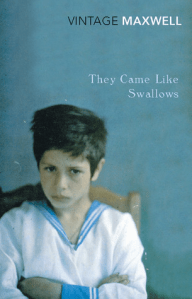
William Maxwell: They Came Like Swallows (1937)

They Came Like Swallows is American author William Maxwell’s second novel. Maxwell was famous as an author and editor. He helped shape the careers of writers like Eudora Welty, John Cheever, John Updike, John O’Hara and many others. I read and reviewed one of his later novels, So Long, See You Tomorrow in the early days of this blog. I was very impressed with it and keen on reading more of his work. Two of his books were suggested in the comments – One was They Came Like Swallows, the other one was The Château. Although I was so keen, it took me eight years to return to him. While I liked So Long, See You Tomorrow more, I found a lot to admire in They came Like Swallows. Once again, it is obvious why he’s called a “writer’s writer”. He’s so skillful.

They Came Like Swallows is a tragic book, even more so because we know it’s based on Maxwell’s childhood story. It’s set at the end of WWI, during the flu pandemic that killed twenty to forty million people. The story is told in three parts, each part told by another narrator. They don’t tell the same story from different angles, but each of them begins, where the other one stops.

Part one is told by eight-year-old Bunny, the younger child of the Morison family. His world turns around his mother and his mother only. He’s a very sensitive child, needs constant encouragement. He also has a keen imagination. Through his eyes we see the world transform into small villages, battles take place, fantastical things happen. His relationship with his older brother Robert is a source of terror. Robert is eight years older than Bunny and has little patience for the kid. At the end of part one, Bunny has been told, his mother’s expecting another child and he has come down with the flu.

Part two is told from Robert’s point of view. The tone is completely different. Robert has sorrows of his own. He’s lost a leg in an accident and tries hard to live a life like any other boy his age. He’s in this in-between state, not a kid anymore, but not yet a grownup. Because his mother had difficult pregnancies in the past, she and the boys’ father leave the kids with an aunt. Robert too, gets the flu and soon they hear that their parents have come down with it as well.

Part three is told from James Morison’s point of view and it’s the most devastating part. It’s obvious from the beginning, the mother will die, it’s only not clear, if anyone else will die, so I’m not going to mention that. The dad’s account is devastating on many levels. He’s lost his wife and the way grief grabs him and threatens to destroy him, is so well described. Equally well described are the reactions of the people who come to the funeral. I always find people are notoriously bad at expressing their sentiments when they hear of someone’s death. All the awkward phrases, the awkward and often unemphatic reactions are captured so well here.

I’m not so keen on stories told by kids usually but it’s done exceptionally well here because William Maxwell uses the kid’s imaginations. He doesn’t try to sound like a child but to let us experience the world through the eyes of a small child and a teenager and, later, a bereaved husband.

Something that struck me was the way the children were treated. Nowadays we have a tendency to treat even small children like grownups and a boy of sixteen would definitely be treated like that. Not so here. The book is eighty years old and to see how much the way we treat children has changed was really interesting.

While I didn’t love this book as much as the last one I read, I’m full of admiration for the craft and looking forward to reading The Château next. And I think it’s an outstanding portrayal of grief and the awkward ways people treat the bereaved. It also shows very well how devastating the pandemic was.

Should you wonder – the title is taken from Coole Park, a poem by William Butler Yeats.

I meditate upon a swallow’s flight,
Upon a aged woman and her house,
A sycamore and lime-tree lost in night
Although that western cloud is luminous,
Great works constructed there in nature’s spite
For scholars and for poets after us,
Thoughts long knitted into a single thought,
A dance-like glory that those walls begot.

There Hyde before he had beaten into prose
That noble blade the Muses buckled on,
There one that ruffled in a manly pose
For all his timid heart, there that slow man,
That meditative man, John Synge, and those
Impetuous men, Shawe-Taylor and Hugh Lane,
Found pride established in humility,
A scene well Set and excellent company.

They came like swallows and like swallows went,
And yet a woman’s powerful character
Could keep a Swallow to its first intent;
And half a dozen in formation there,
That seemed to whirl upon a compass-point,
Found certainty upon the dreaming air,
The intellectual sweetness of those lines
That cut through time or cross it withershins.

Here, traveller, scholar, poet, take your stand
When all those rooms and passages are gone,
When nettles wave upon a shapeless mound
And saplings root among the broken stone,
And dedicate – eyes bent upon the ground,
Back turned upon the brightness of the sun
And all the sensuality of the shade –
A moment’s memory to that laurelled head.

Have you read William Maxwell? Which of his books did you like the most?

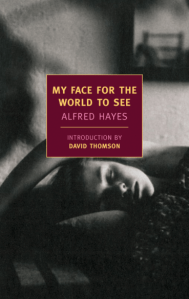
Alfred Hayes – My Face for the World to See (1958)

This wasn’t the best reading year for me. While I was very lucky with my nonfiction choices, more than one novel was a dud. Imagine how happy I was to see my faith in literature fully restored before the end of the year. Alfred Hayes’ novel My Face for the World to See is just marvelous. A perfect gem of a novel. I couldn’t fault a thing. I discovered it a few years ago on Guy’s blog here, but forgot all about it until Jacqui reviewed another of Hayes’ novels, The Girl on the Via Flaminia.

Alfred Hayes was born in London but moved to the US as a child. In 1943 he was drafted and spent time in the US army, in Italy. In Italy he contributed to some of the most famous scripts of Italian neo-realist cinema – Rosselini’s Paisà and de Sica’s Bicycle Thieves. The following ten years, he worked as a screen writer in Hollywood, writing  scripts for people like Fritz Lang, John Huston and many more.

While The Girl on the Via Flaminia, his earlier novel, is set in Italy, My Face for the World to See is set in Hollywood.

Before starting the review, I’d like to share the opening paragraphs, which set the tone and the mood of the novel.

It was a party that had lasted too long; and tired of the voices, a little too animated, and the liquor, a little too available, and thinking it would be nice to be alone, thinking I’d escape for a brief interval, those smiles which pinned you against the piano or those questions which trapped you wriggling in a chair, I went out to look at the ocean.

There it was, exactly as advertised, a dark and heavy swell, and far out the lights of some delayed ship moving slowly south. I stared at the water, across a frontier of a kind, while behind me, from the brightly lit room with its bamboo bar and its bamboo furniture, the voices, detailing a triumph or recounting a joke, of those people who were not entirely strangers and not exactly friends, continued. It seemed silly to stay, tired as I was and the party dying; it seemed silly to go, with nothing home but an empty house.

With hindsight, it’s amazing to see how perfect this beginning is. It captures the tone and the mood of the novel, as well as the narrator’s character. The narrator – he’s never named – is a successful, rich script writer, who spends some months of the year, in Hollywood, far from his wife and kid, who stay in New York. He’s successful but it doesn’t seem to mean much to him. He could be part of a crowd but he stays outside. There’s one person one could call a friend, the host, but other than that, he seems like the ship he watches – passing by, detached. At the same time, he’s the guy who is eternally watching, witnessing. A couple of moments after this short intro, he’s again a witness – this time to the near-suicide of a young, pretty wannabe actress. He saves her and this act is the beginning of a terrible mistake. While he may think he’s just being friendly when he contacts her again, it dawns on the reader that loneliness and boredom – also mentioned in the first paragraphs – might be the true reasons.

From that moment on, the reader gets to witness an awful Maelstrom of an affair. The beginning is somewhat sordid and the end disastrous.

I absolutely loved this novel because of the tone and the mood. And the writing style. It’s pared down and economical, not one superfluous word. It’s also chilling at times, because the narrator never fully engages with anything that happens. It’s almost as if he’s never really there. And the more he is withdrawn, the more the girl seems to sink deeper and deeper into her despair. I felt so sorry for this girl. A typical pretty small town girl who comes to Hollywood with big dreams, which a crushed instantly. She was hoping for “My Face for the World to See”, but what she gets instead is the wrong male attention. Almost all of her lovers seem to have been married and, invariably, it ends badly and she tries to console herself with alcohol. There’s a scene with a cat, who she loves dearly, that’s utterly heartbreaking.

I think one reason why I loved this so much is because it reminded me of Dorothy B. Hughes fantastic novel In a Lonely Place, which made my best of list in 2016. I’m sure Hayes knew the book and certainly knew the movie with Humphrey Bogart. Even though My Face for the World to See isn’t a crime novel, it has all the trademarks of a noir like In A Lonely Place. There’s the melancholy mood, the jaded, lonely people who try to connect but fail, love affairs that turn bitter within weeks.

Of course, Hollywood is the perfect setting for a story like this and one can easily see that Hayes knew what he was writing about.

I’m not entirely sure I will write a best of post this year, but if I do – My Face for the World to See will be on it.

A Tardy German Literature Month Wrap-up and Radetzky March Readalong Announcement

Does anyone else feel November went fast? I only just wrote a welcome post to German Literature Month and now it’s already over. That’s not why I’m late though. I caught a nasty cold.

I’d like to thank everyone who participated. It’s always wonderful to see all of your choices and your enthusiasm. So, thank you very much.

If you haven’t done so already, please add your posts to the German Literature Month Site. I’m still playing catch up and Lizzy’s collecting links for a final wrap-up post.

If you haven’t seen Lizzy’s post, you might not know that we are planning a Readalong of Joseph Roth’s Radetzky March early next year. The date hasn’t been fixed yet, so I’d like to know what would work for you.

We would like to extend this readalong over the course of one month, posting weekly on predefined portions of the novel. There will be questions, for those who’d like to use them, that will facilitate discussion.

I hope you’ll join us.

And thanks again for your participation.


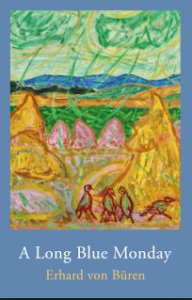
A Long Blue Monday by Erhard von Büren – Swiss Week Readalong

Published in 2013, A Long Blue Monday, is Erhard von Büren’s third novel. His earlier novels Wasp Days and Epitaph for a Working Man were published in 1989 and 2000 respectively. He lives in Solothurn, Switzerland.

A Long Blue Monday tells the story of Paul Ganter, a retired school teacher who has temporarily left his wife and taken an apartment in the city to write a book about Sherwood Anderson. Very possibly he could have done that at home, but we soon learn that this time out is about much more than just writing a book. He uses the time alone to delve into his feelings and memories and relives vividly an unhappy love story that happened over forty years ago, in the summer of 1959. That year he fell in love with Claudia, a girl from a very rich family and, in a desperate attempt to impress her, takes weeks off from school to write a trilogy of plays in the vein of the great American playwrights of the time. Every day he slaves over his work that seems to be a series of soliloquies put on paper. Once it is finished, he gives the play to his crush, hoping it will impress her. Sadly, just like all his other attempts at wooing her, this barely gets a reaction. Clearly, she’s not into him. Looking back, Ganter can’t help but admire the stamina of his younger self. And he realizes that while the result of his writing wasn’t successful, locking himself away, writing daily, going for long walks and experience the changes in the weather and nature surrounding him, was one of the most intense experiences of his life.

The story is told going back and forth in time. In the present, Paul spends a lot of time writing and reminiscing, but he also has long conversations with his daughter who discovers sides of her father she never knew existed. While the love story is central, it isn’t the most important aspect of Paul’s delving into his past. He also remembers vividly what it was like to come from a poor family, in which the men were battling alcoholism. He remembers how difficult it was to know what he wanted to do with his life and to achieve it. Trying to overcome the shortcomings of his upbringing, he became a master student. Unfortunately, for the longest time, he thought that he could master life and love just like he mastered school. This set him up to failure. Being shy didn’t help him either. Love and life choices are explored, but there’s one other important thing—the narrator’s intense love of American culture that finally leads him to become an English teacher and is now one of the reasons for his time out.

I hope my review will have told you several things—this is a very complex, rich book, but it’s neither straightforward, nor plot-driven. Funnily, for a novel that talks so much about American culture, it’s very unlike most American literature I know. It’s introspective and very quiet. Far more analysis of thoughts and feelings, than scenes and action. One could say, more telling than showing. The story meanders, goes back and forth in time, returns to certain events, adds additional information. Just like it happens to all of us in real life. We rarely remember events in a straightforward way.

I liked A Long Blue Monday very much. It’s a quiet book about a quiet, shy man, who feels strongly, struggles and fails, struggles some more, and then succeeds and finds meaning in all sorts of things. My favourite parts were the nature descriptions and if I had read this in English, you’d find dozens of quotes. The descriptions are lyrical and beautifully crafted. They are the most eloquent sign of the narrator’s rich interior life.

While reading A Long Blue Monday, I couldn’t help but think of another Swiss author, who writes similar descriptions— Robert Walser. If you know me, you know this is high praise.

I hope some of you have read this as well. I’m looking forward to the discussion.