Literature and War Readalong 2012

People have been announcing their challenges and events for 2012 for a while now so it was about time to let you see the list for next year’s Literature and War Readalong.

It was not easy to compile this list as the books needed to fulfill different criteria one of which was length. I didn’t want to include too many books over 300 pages. The only novel over 500 pages will make up for its length by being very readable.

The other criterion was the country. Like last year, I wanted to include books from as many different countries as possible. I know it looks as if there were more British books than anything else which is true, still I managed to include books from 8 different countries.

I will also join Anna and Serena for the War Through the Generations Challenge that is dedicated to WWI this year. My introductory post is due later this week. The first three novels in the readalong will also count for their challenge.

I have been asked whether it is possible to join but read something different. Since strictly speaking a readalong implies that people read and discuss the same book, it’s difficult but as I’m starting a Literature and War Project I thought of a good solution that will serve anyone who wants to join –  myself as well as I may be in the mood to read more than one novel focusing on war. The idea would be that anyone can join during the last week of the month and either participate in the readalong or review any other war themed book that will then be added to the project page. The objective of the page is to cover many different countries, wars, themes and even genres. For the War Through the Generations Challenge I will for example read a children’s book and maybe a crime novel set in the trenches. Next year I would also like to read a Sci-Fi novel like Joe Haldeman’s The Forever War that has been suggested by Max from Pechorin’s Journal. And finally I would like to read more non-fiction.

This year’s readalong will not always take place on Fridays but alternate between Monday and Friday depending on whether the Friday is during the last week of the month or not.
January, Monday  30

Helen Dunmore Zennor in Darkness , 320 p., England (1993), WWI

Spring, 1917 and war haunts the Cornish coastal village of Zennor: ships are being sunk by U-boats, strangers are treated with suspicion, and newspapers are full of spy-fever. Into this turmoil come DH Lawrence and his German wife Frieda, hoping to escape the war-fever that grips London. They befriend Clare Coyne, a young artist, struggling to console her beloved cousin John William who is on leave from the trenches and suffering from shell shock. Yet the dark tide of gossip and innuendo means that Zennor is neither a place of recovery nor of escape …
February, Monday 27

Sebastian Barry: A Long Long Way , 295 p.,  Ireland (2005), WWI

I discovered the book thanks to a comment from Danielle (A Work in Progress)

One of the most vivid and realised characters of recent fiction, Willie Dunne is the innocent hero of Sebastian Barry’s highly acclaimed novel. Leaving Dublin to fight for the Allied cause as a member of the Royal Dublin Fusiliers, he finds himself caught between the war playing out on foreign fields and that festering at home, waiting to erupt with the Easter Rising. Profoundly moving, intimate and epic, A Long Long Waycharts and evokes a terrible coming of age, one too often written out of history.
March, Friday 30

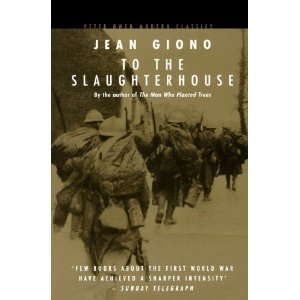
Jean Giono:  Le grand troupeauTo the Slaughterhouse 224 p., France (1931), WWI

Conscription reaches into the hills as the First World War come to a small Provençal community one blazing August. Giono’s fiercly realistic novel contrasts the wholesale destruction of men, land and animals at the front with the moral disintegration of the lonely and anxious people left behind. Yet not all is despair. The novel ends with a message  of hope.

April, Monday 30

Helen Humphreys: Coventry,172 p., England (2008), WWII

Another book discovered thanks to Danielle (here)

On the night of the most devastating German raid on Coventry, two women traverse the city and transform their hearts. Harriet, widowed during WWI, is “”firewatching”” on the cathedral roof when first the factories and then the church itself are set ablaze. In the ensuing chaos she helps a young man, who reminds her of the husband she has lost, find his way back home where he left his mother.
May, Monday 28th

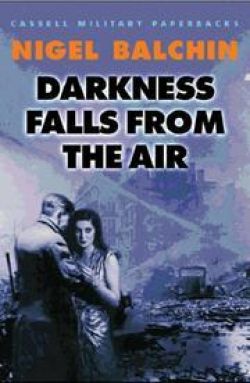
Nigel Balchin: Darkness Falls From The Air, 208 p., England (1942), WWII

I owe the discovery of Balchin to Guy (His Futile Preoccupations) who reviewed two of his books here and  here.

With ostentatious lack of concern, Bill Sarratt, his wife and her lover spend the war wining and dining expensively, occasionally sauntering out into the Blitz with cheerful remarks about the shattered night-life of London’s West End. But beneath the false insouciance lies the real strain of a war that has firmly wrapped them all in its embrace. Wit may crackle at the same pace as buildings burn, but personal tragedy lurks appallingly close at hand.
June, Friday 29

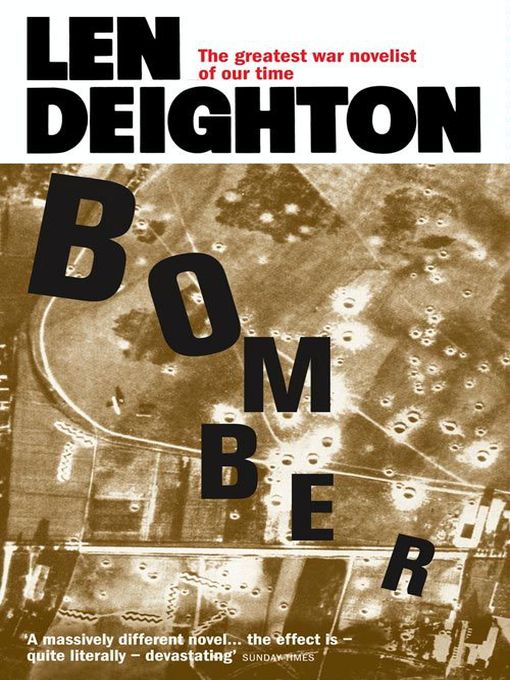
Len Deighton:  Bomber, 532 p., England (1970), WWII

This book is a suggestion from Kevin (The War Movie Buff). It is by far the longest on the list but it should be a very quick read.

The classic novel of the Second World War that relates in devastating detail the 24-hour story of an allied bombing raid.

Bomber is a novel war. There are no victors, no vanquished. There are simply those who remain alive, and those who die.Bomber follows the progress of an Allied air raid through a period of twenty-four hours in the summer of 1943. It portrays all the participants in a terrifying drama, both in the air and on the ground, in Britain and in Germany.In its documentary style, it is unique. In its emotional power it is overwhelming.Len Deighton has been equally acclaimed as a novelist and as an historian. In Bomber he has combined both talents to produce a masterpiece.

July, Monday 30

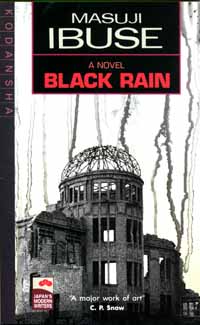
Masuji Ibuse: Black Rain – Kuroi Ame, 304 p., Japan (1969), WWII

I saw the book mentioned on Rise’s blog (in lieu of a field guide) where is was mentioned by Gary (The Parrish Lantern)

Black Rain is centered around the story of a young woman who was caught in the radioactive “black rain” that fell after the bombing of Hiroshima. lbuse bases his tale on real-life diaries and interviews with victims of the holocaust; the result is a book that is free from sentimentality yet manages to reveal the magnitude of the human suffering caused by the atom bomb. The life of Yasuko, on whom the black rain fell, is changed forever by periodic bouts of radiation sickness and the suspicion that her future children, too, may be affected.

lbuse tempers the horror of his subject with the gentle humor for which he is famous. His sensitivity to the complex web of emotions in a traditional community torn asunder by this historical event has made Black Rain one of the most acclaimed treatments of the Hiroshima story.


August, Friday 31

Aaron Applefeld: The Story of a Life – Sippur chajim, 208 p., Israel (1999), WWII

Aharon Appelfeld was the child of middle-class Jewish parents living in Romania at the outbreak of World War II. He witnessed the murder of his mother, lost his father, endured the ghetto and a two-month forced march to a camp, before he escaped. Living off the land in the forests of Ukraine for two years before making the long journey south to Italy and eventually Israel and freedom, Appelfeld finally found a home in which he could make a life for himself. Acclaimed writer Appelfeld’s extraordinary and painful memoir of his childhood and youth is a compelling account of a boy coming of age in a hostile world.

September, Friday 28

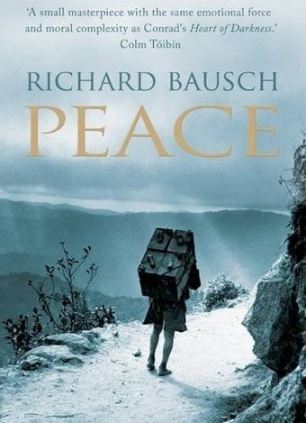
Richard Bausch: Peace, 171 p., US (2008), WWII

This was a suggestion from Sandra Rouse in a comment on one of this year’s readalong posts. 

It’s Italy, near Cassino. The terrible winter of 1944. A dismal icy rain falls, unabated, for days. Three American soldiers set out on the gruelling ascent of a perilous Italian mountainside in the murky closing days of the Second World War. Haunted by their sergeant’s cold-blooded murder of a young girl, and with only an old man of uncertain loyalties as their guide, they truge on in a state of barely suppressed terror and confusion. With snipers lying in wait for them, the men are confronted by agonizing moral choices…Taut and propulsive – Peace is a feat of economy, compression, and imagination, a tough and unmistakably contemporary meditation on the corrosiveness of violence, the human cost of war, and the redemptive power of mercy.
October, Monday 29

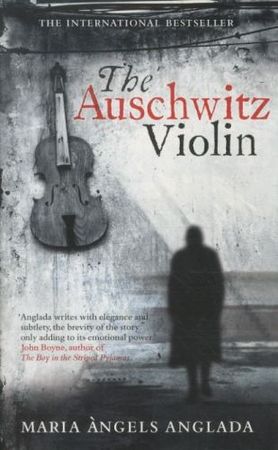
Maria Angels Anglada The Auschwitz Violin – El violí d’Auschwitz, 128 p., Spain (1994), WWII

In the winter of 1991, at a concert in Krakow, an older woman with a marvelously pitched violin meets a fellow musician who is instantly captivated by her instrument. When he asks her how she obtained it, she reveals the remarkable story behind its origin.

Written with lyrical simplicity and haunting beauty—and interspersed with chilling, actual Nazi documentation—The Auschwitz Violin is more than just a novel: It is a testament to the strength of the human spirit and the power of beauty, art, and hope to triumph over the darkest adversity.

November, Friday 30

Gert Ledig The Stalin Front  –  Die Stalinorgel , 198 p., Germany (1955), WWII

1942, at the Eastern Front. Soldiers crouch in horrible holes in the ground, mingling with corpses. Tunneled beneath a radio mast, German soldiers await the order to blow themselves up. Russian tanks, struggling to break through enemy lines, bog down in a swamp, while a German runner, bearing messages from headquarters to the front, scrambles desperately from shelter to shelter as he tries to avoid getting caught in the action. Through it all, Russian artillery—the crude but devastatingly effective multiple rocket launcher known to the Germans as the Stalin Organ and to the Russians as Katyusha—rains death upon the struggling troops.
December, Friday 28

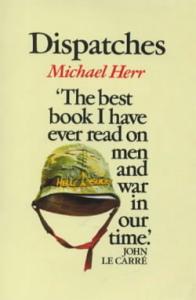
Michael Herr: Dispatches, 262 p., US (1977) Vietnam

This novel has been suggested by at least three people. Kevin (The War Movie Buff) and Max (Pechorin’s Journal)

If you’ve seen the movies Apocalypse Now and Platoon, in whose scripts Michael Herr had a hand, you have a pretty good idea of Herr’s take on Vietnam: a hallucinatory mess, the confluence of John Wayne and LSD.Dispatches reports remarkable front-line encounters with an acid-dazed infantryman who can’t wait to get back into the field and add Viet Cong kills to his long list (“I just can’t hack it back in the World”, he says); with a helicopter door gunner who fires indiscriminately into crowds of civilians; with daredevil photojournalist Sean Flynn, son of Errol, who disappeared somewhere inside Cambodia. Although Herr has admitted that parts of his book are fictional, this is meaty, essential reading for anyone who wants to understand Vietnam.

I hope that many of you will feel tempted by the one or the other title on the list and am looking forward to great discussions. The books are all very different in tone, style and themes. As always there are a some I can hardly wait to read.

*******

How does the readalong work?

This is just a quick info for those who are new to blogging and /or the readalong.

I will review the book on a set date during the last week of the month. If you choose to read along you can either participate in the discussion in the comments page or post a review on your blog. I will add all the links to the reviews at the bottom of my posts.

The books are usually announced with some additional information or a short introduction at the beginning of the month.

*******

This post will be copied into the Literature and War Redalong 2012 page so you can find it again at any time.

Molly Keane: Two Days in Aragon (1941)

Grania and Sylvia Fox live in the Georgian house of Aragon, with their mother, their Aunt Pidgie and Nan O’Neill, the family nurse. Attending Aragon’s strawberry teas, the British Army Officers can almost forget the reason for their presence in Ireland. But the days of dignified calm at Aragon are numbered.

I first read about Molly Keane’s Two Days in Aragon on Danielle’s blog. Molly Keane or M.J. Farrell, the pseudonym under which she published her books,  is one of Danielle’s reading projects and after having read Two Days in Aragon I can understand why. I’m trying to put into words what type of book this was but nothing I come up with seems to do it justice. Molly Keane captured beautifully the end of an area, portrayed a social system, drew complex character portraits and incorporated such a wide variety of topics that I’m full of admiration.

I love descriptions of big old houses. They seem to have a life of their own and their majestic presence can be felt so strongly, they are almost characters in their own right. Aragon is exactly such a house. The family home of the Fox’s is grand, old and full of history. There are hidden rooms and the ghosts of the ancestors seem to be hovering around. But Aragon is also a symbol. A symbol for a way of life about to end. Aragon also symbolizes oppression as it is the house of an Anglo-Irish family and as such represents everything that the Irish have come to hate and against which they are fighting in 1920, the year in which the novel takes place.

The end of an era can be brought by many things but war, rebellion, change of government are among the most frequent. All over the world when the colonized stand up against the colonists this signifies the end of a life in beauty and ease for the formerly advantaged. Molly Keane knew very well what she wrote about as she came from such a rich Anglo-Irish family who lived in privilege and never had to work. They loved their horses and hunting and eating well. All this was incorporated into the novel. The descriptions of these two days make one long to have been there, to have experienced the rituals, seen the beauty.

Molly Keane offers more than the description of a house and a way of life about to end. One thing I liked a lot in the novel were the characters. None of them likable, maybe with one exception (Sylvia), but all of them are drawn so vividly and in all their complexity that I was glued to the page.

Grania and Sylvia Fox live in the grand old house together with their mother and Aunt Pidgie. Their father has died after a hunting accident. Grania and Sylvia are very different which is also shown in their choice of men. Grania has an affair with Foley O’Neill, a socially unacceptable choice, while Sylvia is secretly in love with a British officer. One girl is described as a slutty, fat, blond and the other as a neat, groomed and very poised young lady. The mother has a bit of both of them but seems to like her passionate, wilder and slutty daughter far more.

Aunt Pidgie and Nan O’Neill, the house nurse, form a duo. Aunt Pidgie is an unwelcome elderly relative that is kept, far away, in the nursery. This reminded me of the first Mrs Rochester in Jane Eyre. The unwanted, especially women, were often locked away. Aunt Pidgie is a bit crazy but inoffensive. In the beginning we know nothing of her sufferings but when we learn more about Nan O’Neill and her well-hidden side of aggression and cruelty we start to pity this poor bird-like little woman. Nan O’Neill is the most complex and fascinating character. She loves Aragon and everything in it with a fierceness and as if it did belong to her. This has a reason. She is an impressive woman, commanding, extremely good-looking and adept at everything. She is especially good at hiding her true nature. Disappointment and lack of love have made her cruel and pitiless. In her role as nurse she is one of the most powerful characters in the novel. She knows about unwanted pregnancies and how to end them, about subtle ways how to torture someone in keeping them alive but constantly uncomfortable. A very chilling character.

I have read a lot of novels about the end of an era, many have houses in their center. I loved Waugh’s Brideshead Revisited as much as E.M.Forster’s Howard’s End and of course,  Bassani’s The Garden of the Finzi Contini. They are often nostalgic and melancholic books. This isn’t the case here, Two Days in Aragon is completely different in tone and although tragedy strikes all of them I wasn’t sad after reading it but rather full of admiration for Molly Keane and her very unique voice and fascinating approach to tell her story.  And I felt exhausted. She is such a vivid storyteller, I lived in those pages, I almost felt as if I had experienced two very intense days.

Louise Welsh: Tamburlaine Must Die (2004)

It’s 1593 and London is a city on edge. Under threat from plague and war, it’s a desperate place where strangers are unwelcome and severed heads grin from spikes on Tower Bridge. Playwright, poet, spy, Christopher Marlowe has three days to live. Three days in which he confronts dangerous government factions, double agents, necromancy, betrayal and revenge in his search for the murderous Tamburlaine, a killer who has escaped from between the pages of Marlowe’s most violent play. The Final Testament of Christopher Marlowe is a swashbuckling adventure story of a man who dares to defy God and state and who discovers that there are worse fates than damnation.

I really enjoyed Tamburlaine Must Die. I liked Louise Welsh’s latest novel Naming the Bones (here’s the review) and wanted to read another one and I wasn’t disappointed. However I know the book got very mixed reviews and this mainly because of the language. Clearly Welsh tried to write 16th century English and might not have been 100% successful. I didn’t care or – because I’m not a native speaker – didn’t notice. I thought the language was beautiful.

In her novella Louise Welsh lets Christopher Marlowe, the famous playwright, tell his final ten days. Someone has written a libel in his name, imitating his writing, signing with the name of the main-protagonist of one of his plays, Tamburlaine. Welsh imgines how and why he must have been killed, how he spent his last days, sleeping with men and women, drinking too much, picking fights, putting himself in danger through his blasphemies.

I think Christopher Marlowe is one of the most fascinating figures of literature. An immensely gifted writer, a rake, a debauchee, a spy, a rough neck, a ruffian, an innovator and subversive man  and many other things. The book is atmospheric and evocative, you see the streets of London, the intrigue, the danger of a city afflicted by the plague, the violence of the times. Any sign of not following the Church, not being loyal to the Queen, being a homosexual were highly dangerous.

We know Marlowe escaped the dungeon but only to face death through an unknown enemy. His murder has never been solved and to this day there are many speculations.

I think I start to realize what type of historical novels I like. I like it when a writer manages to give a voice to historical figures, makes them come alive, imagines how they thought and felt.

One thing that has been criticized is that she didn’t depict a fear-ridden Marlowe although he knew he was going to be killed. I think from what I know of the man, he wasn’t too anxious, he threw himself into life until his last moment. He would have gladly gone on living, writing more plays but if this wasn’t to be, then it wasn’t. As simple as that.

The best about the book is that it sparked my imagination. I’m in the mood to read Marlowe’s Tamburlaine, The Great and Doctor Faustus which influenced Goethe and Thomas Mann and I would also be interested in reading about him.

Louise Welsh based her book to a large part on Charles Nicholl’s The Reckoning: The Murder of Christopher Marlowe but David Rigg’s The World of Christopher Marlowe sounds equally interesting.

Has anyone read any of these or other books about Tudor England?

Jenn Ashworth: Cold Light (2011) Crime and Social Realism

An unsettling, darkly humorous tale of teenage girls in a predatory adult world, and a cocktail of lies, jealousy and unworldliness that leads to tragedy.

I have been looking forward to Jenn Ashworth’s new novel since I read A Kind of Intimacy at the beginning of the year (here’s the review). I had a bit of a problem not comparing the two books but once I let go of that I really liked this novel, it’s disturbing and chilling and you only find out at the very end what really happened.

Cold Light is a very appropriate title for this novel, although – as will be explained towards the end – it refers to bioluminescence.  It is a cold world in which today’s girls move and a predatory one. But is this really all that new? There is a lot that reminded me of my own coming of age. Not for anything in the world would I want to be 14 again. The competitions, the jealousy, the insecurity and the constant fighting off of boys or hoping to be noticed by them – depending on where on the good-looking scale you were positioned – was by far too upsetting. It’s all very horrible and can damage you for life. But there are other things young girls have to cope with nowadays that were not even thinkable 10-20 years ago. And today’s Britain (I’m just finishing Kat Banyard’s book The Equality Illusion and it echoes Cold Light) seems to be even worse than many other places.

Chloe is dead. Chloe will be 14 forever, 14, pretty and romantic. Since her presumed suicide 10 years ago she has become something like a cult figure. A symbol for young love and innocence. Now, ten years later, her former best friend Laura sits in front of her TV in a shabby little apartment and watches the groundbreaking ceremony for her memorial. The ceremony comes to an abrupt and macabre end when human bones are found in the damp soil. Laura nows whose bones they are and from this very first scene in the novel we know that some things must have gone seriously wrong ten years ago and we also know that there is a lot to be found out about Chloe, her ex-boyfriend who died with her and everyone else who was involved.

Laura will be watching TV all night, later joined by Emma with whom she is still in contact. They will be smoking and drinking until the early morning. Through flash backs and parts of their discussion the truth is slowly revealed. It’s the story of three friends who are jealous of one another, an older boyfriend who seems weird, a town in a state of alarm as a flasher who is getting more and more violent is chasing young girls. The three girls are only 14 yet they smoke, drink and have sex. We also hear a lot about innocent Chloe, how she exploited the obsessive best friend feelings of the others, how narcissistic and bullying she was, her delinquency and how she always got away with everything just because she was so pretty. Reading the story from Laura’s point of view we discover a lot about her family, the sadness of her childhood, about her father who seems to suffer from some kind of mental illness, her controlling mother and her obsession with Chloe that turns her into a stalker.

It’s an excellent book, disturbing and accurate and reminded me a great deal of the movie Fish Tank. I also thought of Harry Brown. Both movies paint a bleak picture of British youth. The first one also focusing on young girls being as well prey, victims and perpetrators.

Thanks again to Hodder and Stoughton who send me a review copy.

Georges Simenon: Maigret et les Vieillards aka Maigret in Society (1960)

Last year I felt the urge to read some Maigret and got four books. I reviewed the first Un Noël de Maigret aka Maigret’s Christmas. I liked quite a few things about it and since they are all short, under 200 pages, I thought I might try another one.

I’m not sufficiently familiar with Simenon’s Maigret novels to know which of the two that I have read is the more typical one. All I can say is that I liked the first but I’m completely underwhelmed by the second.

In Maigret et les Vieillard aka Maigret in Society Maigret has to solve the murder of an aristocratic ex-ambassador. He has been shot four times, in his own apartment, in the middle of the night. His old servant found him towards the morning and reports the murder at the Ministry of Foreign Affairs.

Maigret has the pleasure to interview people belonging to the Parisian High Society. A breed he isn’t exactly fond of. Although – typical for Maigret – he never judges people, we still understand how much he disapproves of them and thinks they are all a bit odd.

The Count had a “lover”, a princess, who was married to someone else. For over fifty years he wrote a daily letter to the princess which she would promptly answer. They had intended to get married after the death of her husband which had just occurred before the murder.

Despite the strange habits and a few questionable things he discovers, Maigret doesn’t see a motif or find a suspect.

I’m not sure whether this is a trait of Simenon or the Maigret novels but 80% of the book consists of dialogue. The lack of description and scenes was not to my liking. I love good dialogue but it was a bit average. He got the different talking styles of the people very well but the exchange wasn’t very interesting.

All in all I cannot recommend this novel. I’m also not keen on a detective who smokes a pipe and whose homey wife stays at home waiting for him with the dinner and his slippers …

The thing that I found most interesting is the fact how the books are rooted in their time. The mentioning of the death penalty startled me at first and then I vaguely remembered that the Capital punishment existed in France until the 80s. Should you, for one reason or the other, feel nostalgic about the 60s in France, you might like this.

Since I still have two other books sitting here, my final verdict is outstanding… I already have a feeling that I will have to look somewhere else for a detective series that is really to my liking or stick to those I already know. I think I need to get back to Simenon’s romans durs. They are definitely worth reading.

Franz Kafka: Brief an den Vater – Letter to My Father (1919)

This letter is the closest that Kafka came to setting down his autobiography. He was driven to write it by his father’s opposition to his engagement with Julie Wohryzek. The marriage did not take place; the letter was not delivered.

In his preface he [the translator Howard Colyer] states that he was most concerned to reproduce the raw “venting of feelings” in the letter as well as the extraordinary “momentum of the prose.” In both these aims he succeeds. Unlike earlier, and fussier, versions, his translation catches the naked energy of the original.

Written in 1919 and published posthumously in 1952 Brief and den Vater or, in its latest English translation, Letter to My Father, is a unique piece of writing. Although decidedly a letter, Max Brod, did not include it in Kafka’s correspondence but in his other work.

Before going into details I have to say a few words about the title. Being a native German/French speaker I did read the German original but since this blog is written in English I attached the English cover.  This latest translation is called Letter to My Father while former translations were either known as  Letter to His Father or Dearest Father. The title of the German, which of course hasn’t been given by Kafka himself,  would best be translated as Letter to the Father. I think that choosing a pronoun wasn’t a good idea, be it “his” or “my”. Dearest Father isn’t satisfying either. It is the opening of the letter but it gives the wrong idea. This isn’t a nice letter by a loving son. A neutral title like the one chosen for the German original is by far the best version, closely followed by Letter to His Father. Why a translator, who claims to want to stay close to the raw venting of feelings, chooses the possessive determiner “my” eludes me.

Putting aside my reservations regarding the choice of the English title, I would really like to urge anyone interested in Kafka who hasn’t done so already to read this book. It is incredibly precious and sheds a light on many of Kafka’s novels and stories, and can show where a lot of the angst and torment came from.

Kafka was already 36 years old when he wrote this letter that he never gave or sent to his father. Five years later Kafka would be dead. The trigger for the letter was his father’s reaction to Kafka’s engagement with Julie Wohryzeck. This is the second engagement in Kafka’s life, the first to Felice Bauer was equally broken off.

In his long letter Kafka gets square with his father. He describes in detail his upbringing, analyzes his father and himself and leaves almost nothing unsaid. It would have been interesting to know how his father would have taken such a letter but judging from the descriptions he wouldn’t have been impressed.

Reading the letter was equally fascinating and painful. We understand how much Kafka was afraid of this Über-Vater who was nothing less than a preposterous tyrant. Whatever he said was the abolute truth. He never doubted himself for one second and would never tolerate any contradiction. One of his favourite methods of education was irony and crushing his children with his verbal superiority. He would abuse and swear and make them look ridiculous. All of Kafka’s friends were criticized, all of his ideas were ridiculed.

The worst was how different the two men were. Hermann Kafka was a strong, vulgar, muscular, irascible, energetic man with a very loud and overbearing voice. He loved to eat huge amounts of food and swallow them down very fast. Franz on the other hand was weak and frail, sensitive, hesitant and delicate and represented everything his father despised.

The constant bullying and criticism infused him with feelings of guilt, anxiety and insecurity. But he also realized that his father wasn’t a superior being at all. Being degraded by someone who isn’t special must have made him feel even worse. His father scolded the children when they misbehaved at the dinner table but everything he asked of them, he didn’t do.

One part I found particularly interesting was Kafka’s analysis of his father’s Judaism. He clearly saw it as what it really was, a phony way of being accepted by society. He didn’t really believe or live according to the religion, he only used it to show himself in public and to further intimidate his son.

An endless source of pain were the different ways of seeing sexuality. When barley 16, Kafka’s father urges the young man to visit brothel,s and every time he wants to get married, he tells him to go and see prostitutes instead of getting married to the next best woman.

I can imagine how painful, crushing and ultimately damaging it must have been to grow up with such an egotistical bully.

The letter is very dense and offers much more on different other topics. If you are interested in Kafka and like his work, you shouldn’t hesitate to read it. The fear of the father hasn’t often been put into such eloquent words.

Literature and War Readalong May Wrap up: The Sea and Poison


Shusaku Endo’s novel The Sea and Poison proved to be a challenging read which is also reflected in the fact that some reviews will still be posted. I will of course link to them once they are done. For the time being you can always read Novroz’ review which complements my own very well.

For the time being thanks a lot for those who already participated. I know that the idea of reading about vivisection held some readers back but it isn’t a graphic book at all. Nevertheless it is a depressing book that seems to center on two major themes, one of which hospitals and their staff, the other war crimes.

What depressed me was the description of the hospital and the doctors. My late mother spent more time in hospitals than outside, so I have had my fair share of contact with doctors and most of them were not like Suguro but rather like Toda or Hashimoto. Doctors in hospitals that is. I’d like to emphasize this. Doctors who stay in hospitals after having been interns follow another agenda. A hospital in many cases isn’t much different from a Corporate Company. It’s all about results and money and hierarchy. What I didn’t know at the time of my reading is the fact that Endo suffered all his life. He was very ill, had tuberculosis and some of the treatments described in the novel in great detail were treatments he had to undergo regularly. For anyone interested in this background here is an interesting analysis.

Thanks to Kevin who did some research and added them in his comments, it became clear that the book was based on facts and that there had indeed been American POW on whom they performed vivisections. Here is the link he added to the comments section.

This leads us to the biggest problem of this book, as Kevin and Anna (Diary of an Eccentric) pointed out and which was probably the base for my doubting the incident. Why did Endo chose to describe the vivisection as if it had been performed under anesthesia when it is apparently well-known, that like in Germany, the vivisections were performed without the prisoners being anesthetized? I have no answer to this question and don’t want to start speculating.

Does anyone have an idea?