Michael Shaara: The Killer Angels (1974) Literature and War Readalong February 2014

The Killer Angels

Books are not always the way we expect them to be. Still, I’ve only rarely been this wrong. I was afraid Michael Shaara’s Pulitzer Prize winner would be dry, heavy on tactics and military jargon. It wouldn’t have been too surprising if it had been like that, after all, Shaara tells the story of the three-day battle at Gettysburg. But The Killer Angels is anything but dry or heavy. It’s a beautiful, lyrical novel, which focusses much more on the moods and emotions of the main characters than on tactics.

I liked the way this was told. We have seven different POVs, each chapter told by another person. That way the narrative constantly  switches from the Confederate Army to the Union Army. On the Union side we have Chamberlain and Buford, on the Confederate side we have the POVs of Lee, Longstreet, Fremantle, Armistead and a spy.

Gettysburg is said to have been the decisive battle. It was lost by the Confederate Army who had been mostly victorious so far. The way Shaara tells this, I got the impression that the defeat was due to a large extent to General Lee’s unfortunate belief in assault warfare. His second in command, Longstreet, cautions against it, but to no avail. It seemed that while Lee was one of the most beloved Generals, he was very old-school in his tactics. Longstreet wanted to be defensive and was proven right in the end. The battle cost the lives of numerous soldiers, many officers and many, many horses.

The amazing thing in this novel is that Shaara writes so well about moods and emotions. We see the men mostly before or after the battle. The way they experience life in the army, the apprehension and exhilaration before the fight. How they experience the weather, the other men. Politics are present but in the background. Everyone on both sides thinks it’s about slavery but we come to realize that it’s not. Slavery is a symbol for a way of life. In a way it’s a battle of change versus tradition. I never really saw it that way. And the book made me understand why the South fought. They were scared to lose their way of life. If they had known how to stay the way they were – big plantations, old money, traditions – without slavery, maybe they wouldn’t have minded so much. And they certainly didn’t like being told how to live. Fremantle is an interesting character, because he’s a British journalist and the way he compares the South to Britain is interesting and sheds light on many aspects.

I’m certainly no expert on tactics but I was wondering whether the terrain wasn’t to some extent responsible for the defeat.

While I liked this book a geat deal, I have one reservation. I had to check up on Shaara because the way this was written, how it glorifies some aspects, made me think that, while familiar with life in the military, Shaara doesn’t sound like someone who has seen action. And I was right. He served before the war in Korea but not during the war.

I will leave you with three quotes, which capture the mood of this book.

Chamberlain on his own

Isn’t that amazing? Long marches and no rest, up very early in the morning and asleep late in the rain, and there’s a marvelous excitement to it, a joy to wake in the morning and feel the army all around you and see the campfires in the morning and smell the coffee . . .

Lee on his own

The night air was soft and warm. Across the road there were still many fires in the field but no more bands, no more singing. Men sat in quiet groups, talking the long slow talk of night in camp at war; many had gone to sleep: There were stars in the sky and a gorgeous white moon. The moon shone on the white cupola of the seminary across the road – lovely view, good place to see the fight.

Chamberlain again – in a crucial scene that explains the title of the book.

Once Chamberlain had a speech memorized from Shakespeare and gave it proudly, the old man listening but not looking, and Chamberlain remembered it still: “What a piece of work is man . . . in action how like an angel!” And the old man, grinning, had scratched his head and then said stiffly, “Well, boy, if he’s an angel, he’s sure a murderin’ angel.” And Chamberlain had gone on to school to make an oration on the subject: Man, the Killer Angel.

I don’t know what other books the year will bring, but I have a feeling this one could make it on the Best of List. I love books which are rich in atmosphere, capture quiet, introspective moods and manage to bring the most different characters to life. I certainly didn’t expect to find all that in a war novel. The Killer Angels is a gorgeous book on an awful subject, reading it felt like seeing all the major participants of the battle during their most intimate moments. I’m grateful to Kevin who said I would be missing out, if I didn’t read it. He was right.

Other reviews

*******

The Killer Angels is the second book in the Literature and War Readalong 2014. The next book is the American Civil War novel  March by Geraldine Brooks. Discussion starts on Monday 31 March, 2014. Further information on the Literature and War Readalong 2014, including the book blurbs can be found here.
On Émilie de Turckheim’s Le Joli Mois de Mai (The Beautiful Month of May)

Le Joli Mois de Mai

Aimé, the narrator of Émilie de Turckheim’s short, dark, mean novel, cannot tell a story. Or that’s what he tells us. He’s not cultured, hasn’t had an education and, frankly, he seems a bit simple. A simpleton even. But it’s his story and his voice, which make this novel such a fun read, infused with black humour and full of absurd, comic situations. Just like child narrators and teenagers à la Holden Caufield, Aimé sees through the hypocrisy around him. He’s very literal and the way he unveils how people  lie with clichés and empty rhetoric, makes you laugh and gasp in horror at the same time.

You could call Le Joli Mois de Mai a very dark crime story. Monsieur Louis is found dead in the woods, a bullet in his throat. How did he die? And will he be the only victim? These are the questions we ask right away. And Aimé is willing to answer, only in his own time, and before we know the truth, we will hear a dark story of a teenage mother, abuse, violence, alcoholism and exploitation.

Monsieur Louis is dead and he has left a will. Five people will inherit everything. It should be surprising for the five heirs that Aimé and the horribly disfigured Martial, who have been living with Monsieur Louis, don’t get anything else than the right to stay at Monsieur Louis’s house. The five people who inherit the pension, the hunting grounds and the wood are a shady couple, an ex-policeman, an ex-soldier and a gay brothel owner. Greed clouds their judgment and influences their behaviour; they never wonder why would Monsieur Louis leaves everything to people he hardly knew.

I enjoyed finding out. I loved the way Aimé tells his story with so much naiveté and uncanny truthfulness. I laughed out loud quite few times, it’s so funny. It’s a shocking story, told in some of the blackest humour I’ve ever read.

The bad news – the book hasn’t been translated into English.

I first read about the author on Emma’s blog (Book Around the Corner). She’s reviewed one of her other books, Héloise est chauve (here). It sounds excellent as well. I hope Émilie de Turkheim will be translated. She’s a terrific writer. The voice was amazing, the way the story was told was shocking, funny and captivating. Her style is unique and from what I can see, all of her books are very different.

Literature and War Readalong February 28 2014: The Killer Angels by Michael Shaara

The Killer Angels

Michael Shaara’s Pulitzer Prize winning novel The Killer Angels is certainly one of the most famous novels about the American Civil War. Or rather about the decisive battle of Gettysburg that cost 50,000 lives. As far as I’m informed this was the battle that changed everything. While the Confederates were less numerous, they still won most battles so far. Gettysburg would change all that. I’m interested to see whether I will like a book that focuses on one battle only.

A few years back I saw the TV mini-series Gettysburg, which is based on this novel. It’s quite long but I enjoyed watching it and might rewatch it this month. It has a great cast: Tom Berenger, Martin Sheen, Jeff Daniels, Sam Elliott

Here are the first sentences of the novel

He rode into the dark of the woods and dismounted. He crawled upward on his belly over cool rocks out into the sunlight, and suddenly he was in the open and he could see for miles, and there was the whole vast army below him, filling the valley like a smoking river. It came out of a blue rainstorm in the east and overflowed the narrow valley road, coiling along a stream, narrowing and choking at a white bridge, fading out into the yellowish dust of June but still visible on the farther road beyond the blue hills, spiked with flags and guidons like a great chopped bristly snake, the snake ending headless in a blue wall of summer rain.

And  some details and the blurb for those who want to join

The Killer Angels by Michael Shaara (US 1974), American Civil War, Novel, 355 pages

The late Shaara’s Pulitzer Prize-winning novel (1974) concerns the battle of Gettysburg and was the basis for the 1993 film Gettysburg. The events immediately before and during the battle are seen through the eyes of Confederate Generals Lee, Longstreet, and Armistead and Federal General Buford, Colonel Joshua L. Chamberlain, and a host of others. The author’s ability to convey the thoughts of men in war as well as their confusion-the so-called “fog of battle”-is outstanding. This unabridged version is read clearly by award-winning actor George Hearn, who gives each character a different voice and effectively conveys their personalities; chapters and beginnings and ends of sides are announced. Music from the movie version adds to the drama. All this comes in a beautiful package with a battle map. Recommended for public libraries not owning previous editions from Recorded Books and Blackstone Audio (Audio Reviews, LJ 2/1/92 and LJ 2/1/93, respectively).

*******

The discussion starts on Friday, 28 February 2014.

Further information on the Literature and War Readalong 2014, including all the book blurbs, can be found here.

Howard Bahr: The Black Flower (1997) Literature and War Readalong January 2014

The Black Flower

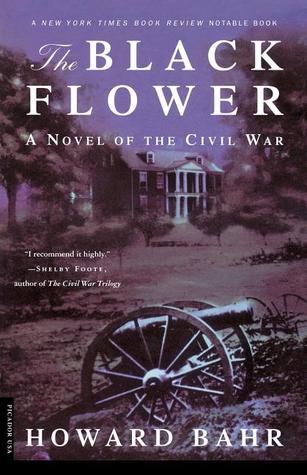
This year’s Literature and War Readalong starts strong with Howard Bahr’s powerful book The Black Flower, a novel on the American Civil War. The book is at times a bit patchy, with an eccentric structure and a style reminiscent of an expressionist novel, but it manages one thing admirably well: bringing the Civil War to life for those who were not there.

The book is set in 1864, before, during and after the battle that took place in Franklin, Tennessee. It is told from different POVs, but mostly we see the story unfold through the eyes of Bushrod Carter and Anna Hereford. But Bahr jumps from them to different others from whose point of view we see a small incident or a chapter. One particularly powerful scene is told from the point of view of a wasp.

Anna stays at her cousin’s house, which will be occupied by the army shortly before and after the battle. It will be turned into some sort of field hospital. That’s where Anna and Bushrod meet and fall in love, amidst the chaos and mayhem.

Before he meets Anna we see Bushrod together with his best friends, Virgil and Jack. They wait for the battle to begin and talk about old times. In the afternoon, in what is one of the best scenes of the book, they bury their dead, together with soldiers from the Union. Meeting them up close, shows Bushrod and his friends once more how alike they are and how absurd it is to kill them.

The Black Flower concentrates entirely on these few people and on what happens to them during a short period of time. The strength lies in the way Bahr magnifies details and in his almost expressionist writing. Passages like the one below reminded me of the paintings of Otto Dix.

In the starlight, and in the torchlight as far as it carried, the dead possessed the violated earth. They were draped all over the parapet, festooned in the osage orange hedges, blown back from the embrasures in meaty fragments. In the ditch before the works they lay in geologic strata of regiments and brigades, piled six and eight and ten deep: an inextricable mass of gray and brown, a tangle of accoutrements and muskets, a blur of faces and claw-like hands. Some were almost naked, torn to shreds by canister and rifle fire, the clothes ripped from their bodies;others lay whole and peaceful, dreaming among their comrades. Here and there, dead men who’d had no room to fall stood upright in the pile, still holding their rifles, their faces still set toward the memory of the vanished foe.

Some of the dead were busy. They twitched and jerked from the violence of their passing, they heaved stubbornly as still-living men tried to push up from underneath. The surface layer of wounded writhed and groaned and implored; the whole pile crawled with movement. Steam rose from the fragments, from open skulls and blue pails of entrails. The smell hung close to the ground in the damp night.

If you don’t know a lot about the American Civil War, this book is not going to give you a lot of information. But it will show you how much it cost in terms of human life, safety, and hope. Every war is horrible, but these early wars, with their mass amputations, and improvised field hospitals have a particularly gruesome side. I don’t think that I was fully aware of this. Bahr also describes very well how tired, dirty and worn-out these men were.

Most of the characters in the book are well rendered. Even the minor characters are carefully described. We feel for all of them. Of course we feel particularly strongly for Anna and Bushrod and when the end of the book comes, it’s quite heartbreaking and unexpected.

I was surprised to find almost modernist elements and an episodic structure in this book, as the novel starts rather conventionally. Once I had finished the book, I realised that Bahr not only manged to paint a canvas of this war, but that he also told a tale of  love and friendship without sugar-coating or glossing over anything.

I’m glad that the next book is also on the American Civil War and that it contains an introduction. Background information on a war I’m not that familiar with, was the only thing I was missing here.

Should anyone wonder  – the title is an allusion to Death.

Other reviews

Danielle (A Work in Progress)

Kailana (The Written World)

*******

The Black Flower is the first book in the Literature and War Readalong 2014. The next book is the American Civil War classic  The Killer Angels by Michael Shaara. Discussion starts on Friday 28 February, 2014. Further information on the Literature and War Readalong 2014, including the book blurbs can be found here.
Sarah Moss: Cold Earth (2009)

Cold Earth

Last summer I read Michelle Paver’s excellent ghost story Dark Matter and Max pointed out in a comment that the description reminded him of Sarah Moss’ first novel Cold Earth. Both novels are set in the North, under extreme conditions and both use a similar technique. The protagonists write diaries and/or letters. In Cold Earth the story is told from six different subsequent points of view, while there is only one in Dark Matter.

Cold Earth is the story of an archeological dig, set in a remote part of Greenland. Six young people, under the supervision of one of them, start excavating the remains of a Norse society. Something has wiped out that society, a fact that unsettles our diggers early on. At the same time they are aware that a pandemic is spreading and communication with the outside world isn’t possible. They are not only afraid that their families and friends might die but that nobody will come and get them once the date for their departure arrives. If  that wasn’t enough already, one of the six young people, Nina, the only one who isn’t an archeologist but working on a PhD in literature, pretends that the site is haunted and shows signs of either severe trauma or delusion.

The story is told from the point of view of the six people. The first part, Nina’s part is the longest. She’s the one who reacts the most to the circumstances. She has weird dreams at night that seem to come directly from the past, she is certain that someone or something walks around the camp at night. The others react to that in many different ways. There are those who are affected and those who just find her a pain in the ass. But the letters or journal entries all show that whether they believe in the ghost theory or in the possibility that Nina’s going mad, they have a hard time coping. Some have come carrying a past loaded with grief and sorrow others are badly affected by the idea that the pandemic is killing off their families and friends.

The longer they stay, the colder it gets and they have to expect the worst, namely that nobody will come and get them and that they will run out of food and not be sufficiently prepared to face  the Arctic winter.

I’m sure if I hadn’t read Dark Matter before, I would have liked this better. The elements which are similar, the ghost story parts, are much more scary and convincing in Dark Matter, I even thought that Paver did a better job in using a ghosts story as a means to illustrate fragility of human existence, and the influence of extreme weather conditions and surroundings on people. I also liked the structure better. Cold Earth starts strongly with Nina’s point of view, which takes up almost a third of the book, but the subsequent chapters, narrated by the others are shorter and shorter, as if she’d run out of breath. Of course you could say she chose that approach to create tensions but I felt some parts were too short to be entirely satisfying. What is very well done in Sarah Moss’ book is how she includes the dimension of society. Paver focusses more on the individual, Moss more on society and groups. I found it impressive how she described how hellish the wrong company can be. I’m not exactly a gregarious person and if I choose company it really needs to be the right one. I could sympathize with Nina who felt she wasn’t only among strangers but among people who were even a tad hostile.

I guess it depends on personal preference whether you will like Dark Matter or Cold Earth better. I could relate more to  the idea of a lonely person thrown into an awful situation than to a group facing disaster. I’m glad I read them both, as they are both extremely good, I just loved one more. If, like me, you like extreme and well-captured settings, you shouldn’t miss either one of tem.

If you’re interested here is Max’s very detailed and insightful review.

James Sallis : Others of My Kind (2013)

Other of my kind

Back in 2012 I read and reviewed Drive by James Sallis. I’ve been meaning to read more of him ever since and when I saw Others of My Kind at a local book shop I decided to read it.

The narrator of the book is Jenny, a woman who had been abducted as a child and held captive in a box under a bed for a couple of years. When her captor comes home at night, he gets her out, abuses and plays with her.  After managing to escape she lives in mall before she’s found and enters the foster care system. Suing for emancipation she becomes an adult at the age of 16. When the novel opens she works as production editor for a local TV station. One evening, when returning home from work, a detective waits for her in front of her house. Recognizing a fellow loner when she sees one, she asks the handsome detective in and serves him dinner. Right away there’s an intimacy and an understanding between the two. Jack has come to ask Jenny a favour. A twenty year-old woman who has been kept under similar circumstances has been found. The young woman shows signs of trauma and isn’t talking. Jack believes it would help if Jenny spoke to her. She agrees and the incident triggers memoroes of her own past.

Others of My Kind is a slim novel, saying more about the plot would spoil it too much. I found it very unusual in its choice of topic. In a way all of our expectations are turned upside down and we learn to see horrible things form an unexpected angle. I liked the main character Jenny quite a lot. She’s a character who has grown from what has happened to her and who has developed an astonishing capacity for compassion and a genuine ability to do something truly good without asking for anything in return. I found it refreshing that an author attempted to show that horrible circumstances don’t necessarily have to damage a person for life and that he managed to illustrate this without belittling the horrible events that happened in Jenny’s past. The result is a crime novel with an almost Buddhist vibe.

Sallis isn’t your usual crime writer. Not only because his stories are unusual but because of his pared down style. When you pare down sentences and scenes like Sallis, leaving only the most necessary, each and every single of your sentences will have a special power and meaning. Each element is chosen carefully, each scene stripped down to the bare minimum. A lesser writer would achieve something choppy and fragmented, while Sallis reaches another kind of fluidity. 

This book really put me in the mood to read more of him. I want to read The Killer is Dying next but I’m open for other suggestions.

Literature and War Readalong January 31 2014: The Black Flower by Howard Bahr

The Black Flower

As I wrote in my introductory post to this year’s readalong, I was at first tempted to include only books based on WWI but decided against that for numerous reasons. In the first readalong I had included two novels on the American Civil War, one of which had to be removed from the list as 2011 was the first year of the German Literature Month and I wanted to add a German novel in November. The novel on the American Civil War that we read in 2011 and which impressed me a great deal was Cold Mountain and when Kevin (The War Movie Buff) mentioned he’d just read another novel on the American Civil War that he found just as compelling, I decided, to include said novel at a later date. So it’s thanks to Kevin that we’re reading The Black Flower this year. I must say I’m very eager, not only because I hope we will like it, but because I’m glad to return to the American Civil War. This book is the first in a series of three books that are dedicated to that war and I’m sure it will be interesting to see how these very different novels will approach the subject. At first I thought that Bahr might have been inspired by Cold Mountain but since both books were published in 1997, I’d say that wasn’t the case.

Howard Bahr was a school teacher before he started to write. The Black Flower  was his first novel. He’s written other novels since then and they all received awards.

Here are the first sentences

Bushrod Carter dreamed of snow, of big, round flakes drifting like sycamore leaves from heaven. The snow settled over trees and fences, over artillery and the rumps of horses, over the men moving in column up the narrow road. A snowflake, light and dry as a lace doily, lit on the crown of Bushrod’s hat; when he made to brush it away, he found it was not snow but hoe cake dripping with molasses.

And  some details and the blurb for those who want to join

The Black Flower by Howard Bahr (US 1997), American Civil War, Novel, 272 pages

The Black Flower is the gripping story of a young Confederate rifleman from Mississippi named Bushrod Carter, who serves in General John Bell Hood’s Army of Tennessee during the Civil War battle that takes place in Franklin, Tennessee, in November 1864. Written with reverent attention to historical accuracy, the book vividly documents the fear, suffering, and intense friendships that are all present on the eve of the battle and during its aftermath. When Bushrod is wounded in the Confederate charge, he is taken to a makeshift hospital where he comes under the care of Anna, who has already lost two potential romances to battle. Bushrod and Anna’s poignant attempt to forge a bond of common humanity in the midst of the pathos and horror of battle serves as a powerful reminder that the war that divided America will not vanish quietly into the page of history.

*******

The discussion starts on Friday, 31 January 2014.

Further information on the Literature and War Readalong 2014, including all the book blurbs, can be found here.