Thank you for the Liebster Award

First a big thank you to Janet Allen (Popcorn Dinner) for my nomination. We only just “met” and I already receive an award. That’s so nice.

Yes, I know, I don’t always accept awards, or let’s say, I do accept them but then I don’t play by the rules, meaning I don’t post about them let alone pass them on. But this time I do as I still feel “post-freshly pressed festive”. However I amended it a bit and only give it to 7 other bloggers. Addotionally I thought that for a change I will give the award not to pure book bloggers but to people who love reading and also blog about other things.

For those who will receive my award and would like to play by the rules here you go

1. Each person must post eleven things about themselves (I skipped this)
2. Answer the eleven questions the person giving the award has set for you
3. Create eleven questions for the people you will be giving the award to
4. Choose eleven people to award and send them a link to your post
5. Go to their page and tell them
6. No tag backs

Now on to Janet’s questions

1. What is your favourite movie of all time? (yep, only one)

I’m almost as interested in movies as in books, despite that fact it’s surprisingly easy for me to name my favourite movie. It’s Peter Weir’s Picnic at Hanging Rock. When I saw it for the first time I was about 14 and since then I have re-watched it at least 5 times. Every time I watched it I liked it more. Be careful however, if you’d like to watch it and haven’t seen it before, the Director’s Cut is shorter and lacks a few important scenes.

2. Where is your favourite city?

This is difficult. Hmmm. It shouldn’t be, right? You would all assume I would say: in France. But I’m not sure it really is my very favourite city. No, I think my favourite city is in England. And it is not London. (The way Janet asked this question it’s almost a bit like a quiz. Can you guess my favourite city?)

3. How old were you when you realized there was no Santa Clause and did it matter to you?

I think I was 9 and the discovery was a huge shock but not because I found out that there is no Santa Claus but because I found out my mother was a bad cheater. The story is quite funny  but at the time I did NOT think that at all. Every year me and my mother’s best friend’s son and the whole family gathered in the living room on the 6th of December. Invariably the doorbell would ring and Santa Claus would come in and look really scary. He would then take out a huge book and read every bad thing the both of us had done during the year. It was awful. He knew it all. Every single thing we had done. After that lecture we had to recite a poem (I still have a terrific memory) and would afterwards be forgiven and receive some presents and a warning. He told us that if we didn’t behave better next year, he would come and get us, put us in his bag and take us to God knows where Santa Claus lives. The year when I turned 9 my mother accidentally lost a piece of paper which I found and on it – to my utter shock – I saw a list of all of my and my friend’s misgivings which were meant to be passed on to Santa Claus. Santa Claus, it turned out,  was a neighbour especially hired for the occasion. I was mortified. That was the end of Santa Claus. The Easter Bunny died on the very same day. And my belief in motherly reliability.

4. If you won an Oscar, what would it be for?

I think I could receive it for several things. The script, the score, acting, most probably the script though.

5. What three famous people (living or dead) would you invite to a dinner party?

C.G. Jung, Mircea Eliade and Neil Gaiman. Yeah, I know, it’s not obvious but, believe me, there actually is a connection.

6. If you had 10 minutes alone with your country’s political leader what would you say?

I think that could be a one minute thing. I’d say: “Didn’t you find anything more useful to do with your time?”

7. What’s the hottest (temperature-wise) you’ve ever been?

The desert in Morocco. When I got out of the car I had the ingenious idea of picking up a stone because I wanted to take something back home. It actually  burned my fingers. Heat like that is hard to imagine if you’ve never experienced it.

8. If you could have one superpower, what would it be?

Be invisible.

9. Have you ever had a surprise birthday party?

No. My friends know me very well. That’s not something I would enjoy.

10. What was the first movie you ever saw in the theater?

It was a Sunday afternoon Disney Special but I cannot remember which one it was. I think it was Bambi.

11. What is your favourite thing to do on a rainy day?

Lying in bed, under the roof, listening to the rain and read.

So finally here are my 7 nomenees

Pearls and Prose

Jaquelin Cangro

50 Year Project

Underneath the Shell Novia’s second home (Polychrome Interest)

Andrew Blackman

The Peacocks Feather Danielle’s second home  (A Work in Progress)

Bayou Quilts Jenclair’s second home  (A Garden Carried in Your Pocket’s)

*****

Now comes the last part, my 11 questions. Just answer those you like.

1. Which is your favourite painting or photograph? (Add it or link to it)

2. If you could stay in another city for a year, which one would it be?

3. Which language would you like to speak and why?

4. Which is your favourite book cover?

5. What craft would you like to be great at?

6. Which is your favourite dish. Recipe included!

7. If you could design a garden what would it look like?

8. Which is your favourite song or piece of music? It can be one you just like at the moment or one you always loved.

9. If you could wake up in a movie (or book)  – which one and why?

10. What is your favourite piece of clothing or accessory?

11. What book are you reading at the moment?

*****

That’s it from festive me, as of tomorrow, there will be business as ususal,  book reviews and book related topics, the odd movie review and…
What’s Going on Here? or Life On the Freshly Pressed Lane

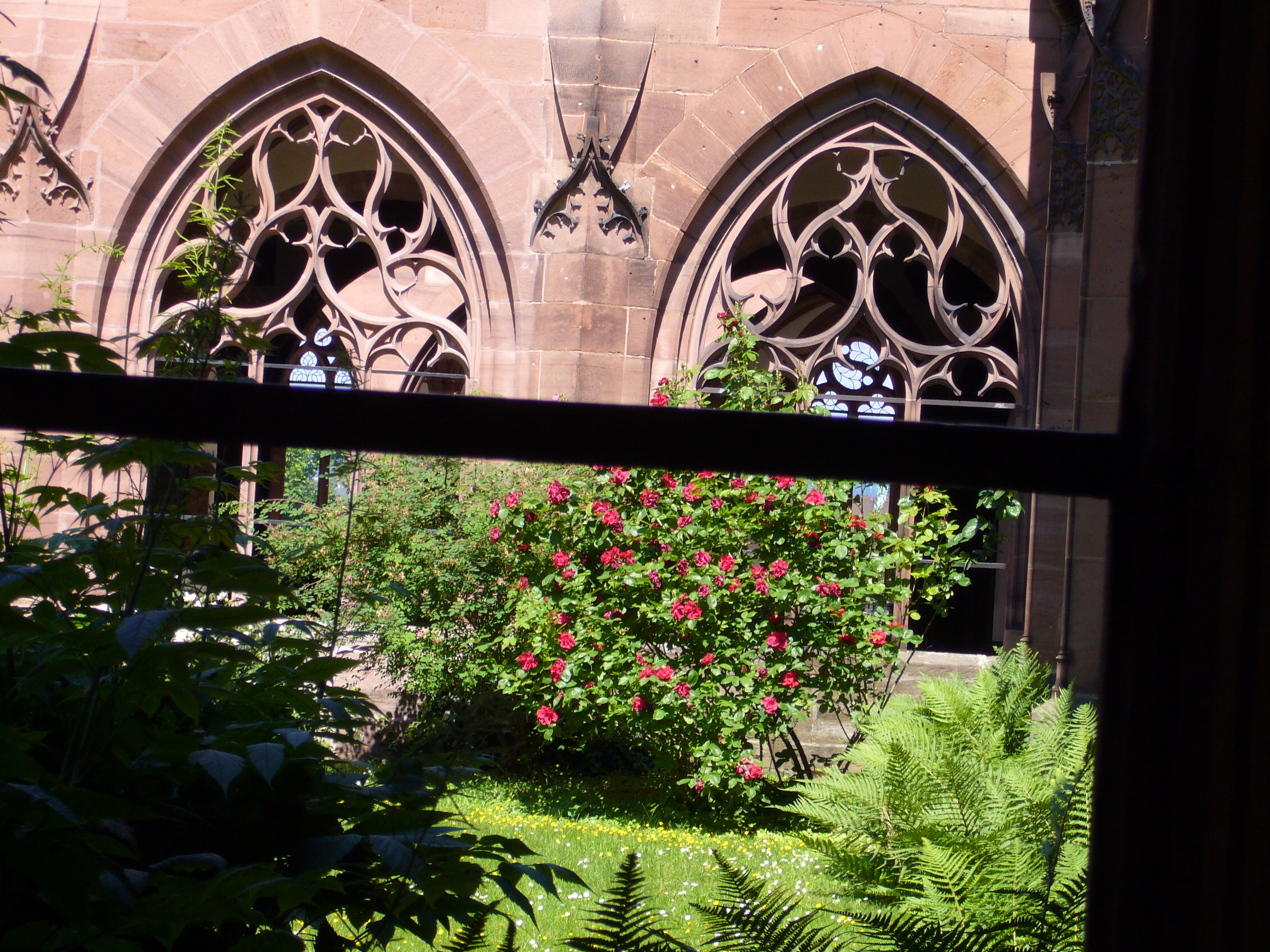
This is the cloister garden of the Cathedral of the town in which I live. I love to go for a walk around the garden. The symmetry is soothing. It’s one of the reasons why I love Gothic Cathedrals. Usually there are not many people here. The odd tourist but that’s all. It’s quiet and relaxing. The perfect place for introspection. And introspection is what I needed after the excitement of being freshly pressed. Especially since I didn’t check my e-mail and had no clue I had been chosen. When I logged on on yesterday I could hardly believe my eyes when I noticed 3000 views on one post, almost 200 likes, hundreds of comments, 70 new subscribers… Amazing. And for someone like me who answers every comment quite a challenge too. But I’m not moaning. I enjoyed it.

What can I say? Thank you. Thank you for  the “freshly pressed” experience. Thank you for your thoughtful, interesting, funny and engaging comments. I met great people thanks to this, I read about some very interesting ways of choosing a book and, of course, I also gathered a lot of reading suggestions.

I must honestly say I would never have thought that I would enjoy it this much. I can only repeat myself and thank you once more.

Thank you for your interest, for sharing your thoughts and for your kind words.

Hmmm… By the way, does anyone know, can you get freshly pressed more than once?

How Do You Choose Your Next Book?

I just finished a novel by a Canadian author and while I was still reading that book, I was thinking of what I might want to read next. Every day I picked a title and put it under the book I was reading on my nightstand. The books kept on changing. Some candidates returned more than once and after a while I realized, they all had a common theme: 18th/19th century France. So either I was going to read a historical French novel (Chantal Thomas’ Les Adieux à la reineFarewell my Queen) or a French classic (Maupassant’s Bel-Ami fr. Bel-Ami engl.). Funny enough both books have just been made into movies.

This made me wonder, how other people choose the books they are going to read next. I’m a mood reader and on top of that my moods change quite fast that’s why I never really know what I’m going to read until I finally start it. Before I do so however, I will have begun at least 5 – 10 books, reading first pages and first paragraphs. The only thing that is likely is that the book following the one I just finished will be very different. I will hardly ever read a crime novel after having finished one or a French classic after having come to the end of another French classic. It can happen but it is rare.

Unfortunately my system is faulty. Because I often give in to momentary moods, instead of waiting for an underlying theme to emerge, by the time I’m in the middle of a novel, it’s not always exactly what I wanted anymore. That’s when novellas and short stories come in handy. I’ll put the novel aside and read the one or the other shorter piece in between.

Last November I did something which proved to be really good. I made a list of all the novels, I felt like reading during the month, especially those which kept on returning, and in December I started to read from that list and whenever I finished a book, I picked the next one from my list. It worked really well and I didn’t pick one dud.

So, that’s me, usually, not able to tell you before I started it, what book I’m going to read next. And unfortunately forgetting those I felt like reading unless I make a note. The only exception of course is my readalong and some of the readalongs of others.

I have seen on other blogs that some people make a list for the whole year and stick to it. They will not necessarily read in order but they will pick books from the list. Others love an author so much that they will read their way through his or her books. Some have a small pile they read and then they make another small pile. Someone reads all the books from one editor. I know there are bloggers who only buy a book after having finished one, so the trip to the book shop will determine the next choice. Others will go to the library, bring home a huge amount of books, dip into them and finally settle for a very few.

While I don’t review them very often,when it comes to non-fiction I’m much more systematic. One book will lead to the next and most of them are connected.

As you can see, there is no end to the possibilities. I’m really curious to find out how you do it. Do you follow a plan or a list? Do you pick randomly? Do you stick to a genre?

How do you choose your next book?

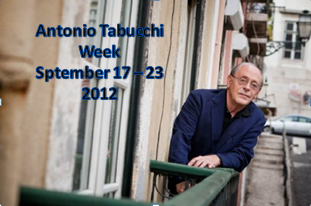
Antonio Tabucchi Week September 17 – 23 2012 and Giveaway

Ever since Stu’s Henry Green Week I wanted to host something similar for an Italian author and my first choice was always Antonio Tabucchi. He is one of the finest Italian writers and one I admire a lot.

Sadly what should have been a tribute to a living author has now turned into a commemoration as Tabucchi died earlier this year.

Tabucchi was a novelist, short story writer and academic. One striking feature was his love for Portugal, the Portuguese language and Fernando Pessoa. He didn’t only teach Portuguese literature at the university but he lived in Portugal (as a reaction among other things to Italian politics), wrote a novel in Portuguese and translated Pessoa.

He is one of the rare authors not writing in English who has been extensively translated. While I will read him in Italian, all those who would like to join can choose from a variety of other languages. He is available in English, French and German and most probably also in Spanish and Portuguese.

Tabucchi’s Indian Nocturne is one of my all-time favourite books. It has been made into a movie. I just read and reviewed Sogni di Sogni – Dreams of Dreams – a collection of imagined dreams attributed to famous writers, musicians and artists. But there are others that I want to re-read or discover for the first time like Tristano muore. Una vita.

If you have never read anything by this author I would suggest you start with one of his more famous novels like Pereira Maintains (Sostiene Pereira) or Indian Nocturne (Notturno Indiano). If you like short stories you may enjoy the beautiful collection of fictitious letters It’s Getting Later All the Time. If you go for quirky and inspiring, Dreams of Dreams may be the thing. But there are more.

Requiem: A Hallucination

Little Misunderstandings of No Importance

The Missing Head of Damasceno Monteiro

And in Italian (and other translations) only

Tristano muore. Una vita

Il tempo invecchia infretta

Il filo dell’orizzonte

In order to motivate you to join I’m giving away one copy of one of his most famous novels which has also been made into a movie with Marcello Mastroianni.

Pereira Maintains

In the sweltering summer of 1938 in Portugal, a country under the fascist shadow of Spain, a mysterious young man arrives at the doorstep of Dr Pereira. So begins an unlikely alliance that will result in a devastating act of rebellion. This is Pereira’s testimony.

The giveaway is open internationally. If you would like to win this book, just leave a comment. The only condition is that you take part in Tabucchi Week. What you will read is up to you, it doesn’t have to be the book you won.

The winner will be announced on Friday August 17 2012.

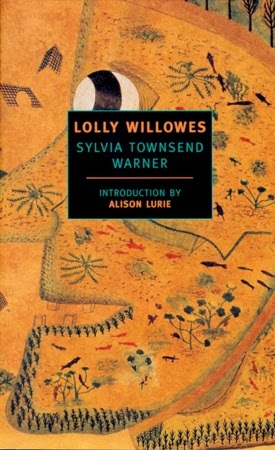
Sylvia Townsend Warner: Lolly Willowes (1926)

Lolly Willowes is a twenty-eight-year-old spinster when her adored father dies, leaving her dependent upon her brothers and their wives. After twenty years of self-effacement as a maiden aunt, she decides to break free and moves to a small Bedfordshire village. Here, happy and unfettered, she enjoys her new existence nagged only by the sense of a secret she has yet to discover. Finally that secret will set Lolly Willowes free.

Danielle (A Work in Progress) has an interesting series called Lost in the Stacks in which she introduces us to authors who have been forgotten or are not read much anymore. One of these authors was Sylvia Townsend Warner as you can read here: Lost in the Stacks – Sylvia Townsend Warner. Danielle mentioned that some of her novels are re-issued by NYRB or Virago and one of the titles Lolly Willowes looked especially interesting. And what a find it was. Not only does the novel tell the story of a unique and independent character but it is a lovely and very feminist book.

Until not too long ago the spinster was a character which could frequently be found in novels. I’ve read more than one novel containing either a spinster or which was about a spinster. They were mostly tragic and often infuriating. The way society treated these unmarried women who were clearly seen as a failure was not only condescending but very often exploitive. As Sarah Waters says in her excellent introduction to the Virago edition of Lolly Willowes, we can see the book to some extent as a re-write of older “spinster novels” like W.B. Maxwell’s The Spinster of this Parish (1922) and F.M. Mayor’s The Rector’s Daughter (1924). As the title of Townsend Warner’s book indicates, the topic has undergone a great change in her novel. The spinster has a name, she is no longer a helpless, independent appendage. Apart from being one woman’s story, the book contains also a subtle reflection on the times, just before and after WWI. The role of the spinster changed considerably after WWI. With so many young men gone, these unmarried elderly women were now seen even more as a useless burden.

Laura, called Lolly, Willowes lives with her father until the age of 28. When he dies her family assumes she will be better off living with her married brother and his family in London instead of staying in the country on her own. The loss of her father is a great tragedy for Lolly. She who lost her mother at an early age, loved living with her father and being relatively independent. She  was never interested in men or getting married. A quiet, introspective life, dedicated to her hobbies, botany and brewery, was all she ever wished for.

She disliked going out, she seldom attended any but those formal parties at which the attendance of Miss Willowes of Lady Place was an obligatory civility; and she found there little reason for animation. Being without coquetry she did not feel herself bound to feign a degree of entertainment which she had not experienced, and the same deficiency made her insensible to the duty of every marriageable young woman to be charming, whether her charm be directed towards one special object or, in default of that, universally distributed through a disinterested love of humanity.

Still she doesn’t make a fuss and follows her brother and his wife and stays with them for several decades. She doesn’t like it there, her sister-in-law is too well-organized, too strict, in other words too boring. She relies completely on her husband, never contradicts him and never seems to spend time on her own. In these surroundings Lolly undergoes a transformation which starts to alarm her more and more over the years.

Or rather, she had become two persons, each different. One was Aunt Lolly, a middle-aging lady, light-footed upon stairs, and indispensable for christmas Eve and birthday preparations. The other was Miss Willowes , ‘my sister-in-law Miss Willowes’, whom Caroline would introduce, and abandon to a feeling of being neither light-footed nor indispensable.

Before WWI breaks out, the Willowes spend all their summer months in the country. Lolly loves these stays and the memory of the beauty of the country side and her reception for everything related to the senses – scents, colors, aromas – open a door in her soul and offer an escape route. She often sits in front of the fire in London and dreams of being in the country on her own. This character trait gives the author the opportunity to include beautiful and evocative descriptions like this one.

At certain seasons a fresh resinous smell would haunt the house like some rustic spirit. It was Mrs Bonnet making the traditional beeswax polish that alone could be trusted to give the proper lustre to the elegantly bulging fronts of tallboys and cabinets. The grey days of early February were tinged with tropical odours by great-great aunt Salome’s recipe for marmalade; and on the afternoon of Good Friday, if it were fine, the stuffed foxes and otters were taken out of their cases, brushed and set to sweeten on the lawn.

After WWI, the society has undergone serious changes. Lolly feels restless. The children of her brother do not really need her anymore and she wants to leave. Finally she wants what her heart has been desiring since years; live in the country on her own. Her relatives are shocked. Her brother has to confess that he has lost a lot of her money due to reckless investments and she cannot afford the house she wanted. Nevertheless, nothing can hold Lolly back, she leaves anyway.

The second half of the novel is dedicated to Lolly’s life in the country. The village she has picked is very mysterious and slowly Lolly undergoes a transformation and becomes a witch. It may sound as if we were entering the realm of the fantastic here and to some extent we do, but the Satan we meet in this book, has more in common with Bulgakov’s Satan than with some fantasy figure.

I’m glad I discovered this wonderful novel. It has freshness and vivacity, is clever and witty and the descriptions are detailed and atmospheric, the portraits of the society and the people are true to life and Lolly is a very endearing character, an illustration of the importance of “a room of one’s own” and the right of women to live an independent life, even outside of society and without a man. It’s certainly one of the rare novels in which a being considered to be a useless burden on society shows that she doesn’t need society in order to live a truly happy and  fulfilled life.

Have you read this or any other of Sylvia Townsend Warner’s novels?

Literature and War Readalong August 31 2012: The Story of a Life – Sippur chajim by Aharon Appelfeld

I haven’t read a lot of literature written by Israeli authors which is one more reason why I was keen on including Aharon Applefeld’s The Story of a Life – Sippur chajim. But that’s not the only reason. The Literature and War Readalong is also an opportunity for me to read some highly acclaimed authors I haven’t read before. The first time I read something about Aharon Applefeld I was surprised to find out that some poeple think he is one of the finest writers alive. An exquisite writer with a sense for language and style.

The Story of a Life is a literary memoir, one of my very favourite genres. At the outbreak of WWII Aharon Appelfeld was living in Romania with his parents, middle-class Jews. His memoir tells about a boy coming-of age during one of the worst periods in history. Applefeld had to endure a lot – the loss of his mother, the ghetto, escape, traversing many countries – until he found a new home in Israel. The book tells this story. If the whole book reads like the quote below I think we are in for a treat.

Here are the first sentences

At what point does my memory begin? It sometimes seems to me as if it only began at four, when we set off for the first time, Mother, Father and I, for a vacation into the heart of the shadowy, moist forests of the Carpathians. But I sometimes think that memory began to bud from within me before that, in my room, next to the double-glazed window that was decorated with paper flowers. Snow is falling and fleecy soft flakes are coming down from the sky with a sound so faint you cannot hear it. For hours I sit and gaze in wonder, until I merge with the white flow and drift to sleep.

*******

The discussion starts on Friay, 31 August 2012.

Further information on the Literature and War Readalong 2012, including all the book blurbs, can be found here.

Balzac: The Deserted Woman – La Femme abandonnée (1832)

When I read Le Père Goriot Old Goriot years ago I was fascinated by the tragic story of Mme de Beauséant. I knew Balzac had dedicated a novella to her which is included in the Scenes from Private Life. After reading one of Guy’s recent Balzac reviews, I decided it was about time to finally read the story. For those who read French you can find the story of The Deserted Woman or La Femme abandonnée in  Les Secrets de la Princess de Cadigan et autres études de femmes.

Gaston de Nueil, a young noble man, leaves Paris for Bayeux, a provincial city located in the Basse-Normandie region. His health is rather poor and he has to stay away from the capital until he recovers. Used to more interesting society than the one he finds in Bayeux, he is soon terribly bored and his imagination is set on fire by the story of the countess de Beauséant who lives like a recluse in her château in the Normandy. She is said to be a young woman of great beauty and even greater esprit who fled to Bayeux after having been abandoned by her former lover, the marquis d’Ajouda-Pinto. The separation was devastating and as she is trapped in a loveless marriage which cannot be divorced, the only way to keep at least some of her self-esteem was to withdraw from the world and dedicate her days to reading and praying.

Young, bored and curious about love, de Nueil falls in love with the unhappy countess before he has even set eyes on her. He walks in her gardens in the night, tries to catch a glimpse of her and is finally so love-sick that he decides to use a ruse in order to get access to her house.

When he finally stands before the woman he fell in love with because of her story and her reputation, he finds her even more beautiful and tragic than he expected.

The countess is 30 years old by now, while de Nueil is barely 23. She is trapped in a void, a loveless life, no contact to society, no future joy in sight. It’s not surprising that de Nueil’s infatuation moves her and finally leads her to accept him as her lover.

Writing more would spoil the story which is one of the best of Balzac’s short stories. You can read it on its own but when you are familiar with the Comédie Humaine you will like it even more. The countess is a key figure in Old Goriot and therefore important for the whole oeuvre. The story as such reminded me of many others. It bears some resemblance with Mme de Lafayette’s The Princesse de Clèves. The countess sounds just like the princesse when she first meets de Nueil. I was also reminded of  Henry James’ Mme de Mauves but most of all it reminded me of Colette’s Chéri. The end however is entirely different from all of these.

I like it when the title has a special significance, is complex and multi-layered. The title of this story seems simple but is excellent. To fully appreciate it, you will have to read the story.

As excellent as this story is, I wouldn’t recommend it to anyone who is not familiar with Balzac. I would still recommend Old Goriot as the best starting point. Paired with this novella, it would be an amazingly great introduction to Balzac’s work and convey a good feeling for the diversity of his talent. The Deserted Woman also contains all of the themes which are important in Balzac’s work such as the mechanics of society, the role of women, marriage, adultery, money and some sub-themes like the “inheritance”, the “fallen woman”, the “aging woman” etc.

I liked the story a great deal. I thought the way Balzac described how de Nueil falls in love is perceptive and uncanny at the same time. Falling in love of an idea, or ideal, may unfortunately very often be the reason for falling in love. I haven’t seen it described as eloquently very often. I think this part of the story applies to all sorts of idealisations; people falling in love with stars or other people they hardly know like people in chat rooms, internet forums or blogs.

If you’d like to read the novella in English and are interested in an overview of Balzac’s work and how it is grouped here is an excellent link The Human Comedy – La comédie humaine.