Matthew Frank: If I Should Die (2014)

If I Should Die

I’ve seen so many rave reviews of this crime novel, that I had to pick it up. It’s a police procedural, set in London. I’m not sure whether this is a first in a series but it’s possible. The main character is trainee detective, Joseph Stark, a twenty-five-year-old Irak and Afghan veteran, dealing with heavy PTSD. He’s still recovering from an ambush that cost the lives of his comrades and has left him scarred and wounded.

When Stark begins his work at the precinct, repeated attacks on homeless people are worrying the police. When one of the victims dies, the investigation intensifies. Things get chaotic when a homeless man confesses that he’s murdered someone. How are these attacks linked and who are the perpetrators? Only when the police find out that the homeless man is a veteran (Falkland), do they make progress, as Stark is able to communicate with him.

The book offers some interesting insight into what happened and what happens to veterans in Britain. It also explores youth gangs and homelessness. The characters are realistic and likeable. The writing’s tight, the social commentary pertinent. But – I was the wrong reader for this. The book is more than just a crime novel, it’s a character study of a young veteran with PTSD. All the reviews I read, praised that aspect, called it new and gripping. Unfortunately I couldn’t even tell you how many times I’ve come across the same character in books, movies, and TV series. Admittedly, more movies than books but nonetheless, the PTSD Afghan or Irak veteran has almost become a cliché. This novel adds nothing new. The worst parts for me were those dealing with the ambush in Afghanistan. I’ve seen too many movies dealing with this to find it of any interest. Maybe it’s unfair, but I felt I had to say this because I’m sure, there are others with my interests who might not find this part of the novel original.

So, if you’ve never watched a film about recent wars – this novel could be for you. It doesn’t only show what PTSD means, but it makes it very clear that even decorated veterans may very well end up homeless because nobody cares what happens to them once they have done their duty. I still enjoyed parts of this book because the writing is assured, the investigation and the social commentary are interesting and the characters are appealing. However, I found it was too long (460 pages). Did I find it gripping? No, but sometimes, interesting is enough.
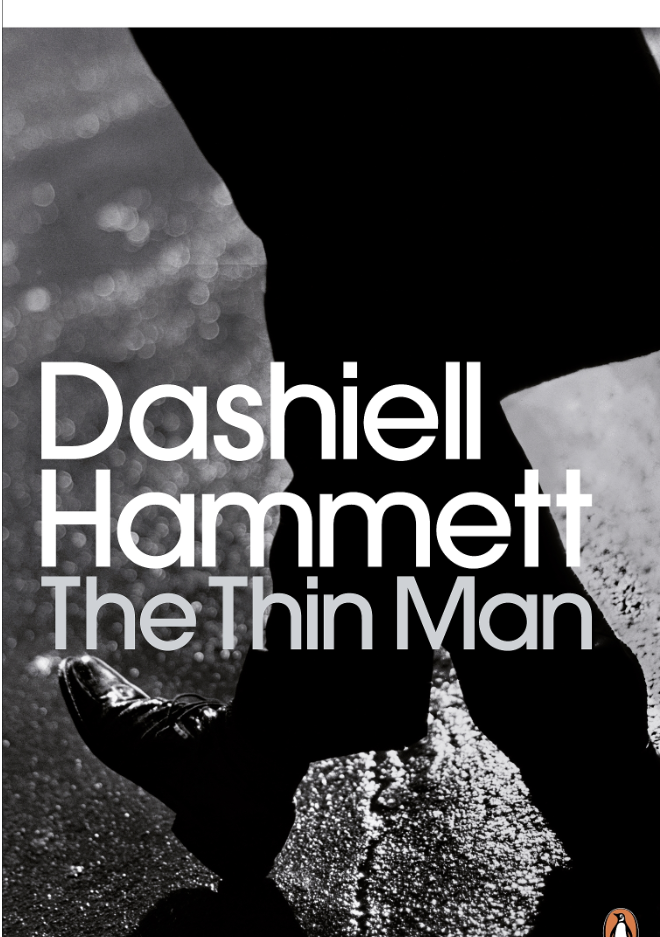
Dashiell Hammett: The Thin Man (1934)

The Thin Man

While I’ve devoured all of Chandler’s books, I’ve hardly read any Hammett. Way back when I started this blog, I read and reviewed The Glass Key – book and movie – and while I liked it, I never returned to him until now. Although I had both The Maltese Falcon and The Thin Man on my piles, I picked the latter. I’m pretty sure they are not in the same league and it wasn’t s as hard-boiled or noir as I expected. On the contrary. It has even some elements of a screwball comedy.

It’s the Christmas season and our hero, Nick Charles, is back in New York with his young wife Nora and their schnauzer Asta. Nick used to be a PI in New York before he met Nora and followed her to San Francisco where they share a business.

While waiting in a speakeasy for his wife who is Christmas shopping, a young woman walks up to him and introduces herself as Dorothy Wynant. Nick used to know her father and her when she was a kid. Dorothy hopes he’s got her’ father’s address but he hasn’t. He hasn’t heard from Wynant in years. Shortly after this encounter, Nick hears that Wynant’s secretary and former lover Julia Wolf has been found dead, shot four times, and that Wynant is missing. Interestingly, the dying Julia has been found by Wynant’s ex-wife, the manipulative, bitchy Mimi. Everyone, including the police, is convinced that Wynant shot Julia, only Nick doubts this.

While the readers are kept guessing who shot Julia, I can’t say that the crime-solving is the most interesting element in this story. What I enjoyed the most is the description of the couple Nick and Nora and the way they spend their days and nights. Most of the story takes place in their hotel room and a huge number of people drifts in and out. Friends, acquaintances, police men, criminals. Every one is constantly downing a drink. The last thing Nick does before he goes to bed – drink, the first thing he does when he gets up – he pours himself another drink. Nora and the others aren’t much better.

Nora might not be the best developed character but she’s fun. She’s the opposite of a nagging housewife. No matter what Nick does or what happens to him, she never gives him a hard time, never freaks out. She’s almost twenty years younger than her husband and very fascinated by his old life. When he’s dragged into the investigation of Julia’s murder, she joins him eagerly and tries to help him find out who killed her.

The tone and humour throughout the book, especially in the dialogue is very dry. Not as dark as in other novels of the era but refreshingly brittle.

I only found out after finishing this novel that Hammett wrote it for the women’s magazine Redbook where it was serialised in 1934. That may explain why it’s not as dark and why there are so many female main characters. There’s Nora, Nick’s wife, the hysterical Dorothy, Mimi, her bitchy mother and Dorothy’s aunt. The male characters are rather pale in comparison.

The THin Man is certainly not Hammett’s best but it’s fun.

Has anyone seen the movie?

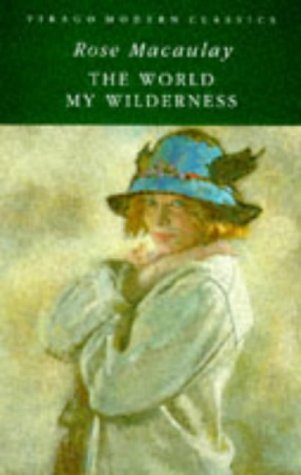
Rose Macaulay: The World My Wilderness (1950)

802630-5

What a beautiful and peculiar book. Rose Macaulay’s The World My Wilderness was her second to last novel. The first after a ten-year hiatus brought on by a lot of heartache and sorrow. In 1939 she caused an accident in which her lover was injured; in 1941 her apartment was bombed and she lost almost all of her possessions and then in 1942 her lover died. Before that Rose Macaulay was a successful author of mostly satirical books. The World My Wilderness is quite different; it’s a compassionate book that reflects her own sorrows as well as other elements of her biography, like childhood years spent in Italy.

The book is set in the South of France, London, and Scotland. The main character, 17-year-old Barbary, is sent to London to live with her father and go to art school. The war is over and her mother Helen wants to get rid of her for different reasons. She and her step-brother have gone wild during the war. They joined the maquis (resistance), and may or may not have been involved when Helen’s second husband, Barbary’s stepfather, known as collaborator, was killed by the resistance.

Barbary’s father has remarried as well and Barbary and her new stepmother, a very conventional woman, clash immediately. Barbary is profoundly miserable, misses her mother and France, but finds solace in the company of her stepbrother. Together they explore the ruins around St.Paul’s cathedral and discover that this wasteland bears some resemblance with their beloved maquis. The ruins are like a wilderness, and, like the maquis, populated by petty thieves and delinquents. Barbary, who is a talented painter, draws postcards of the ruins and sells them to tourists.

The main story is about whether or not Barbary will be allowed to see her mother again and return to France. But since this isn’t a plot-driven novel, its strengths lie elsewhere. This is a book full of lush descriptions and fascinating characters. They are all flawed and complex and whenever we think, we know them, they do something that surprises us. One technique that contributes to see the characters in all their complexity is a frequent change of point of view. Often we’re introduced to a character, seeing him/her through her own eyes and then, right afterwards, we see them through the eyes of others. The result is quite arresting. My favourite character was Helen, Barbary’s mother. She’s a free-spirit who loves art, men, freedom, and a good life. Conventions are not for her. In France she lives as she likes, while she was a constant source of scandal and gossip in London.

Here’s Helen’s take on country and family:

“One understands so well,” said Helen, languidly teasing a small green lizard cupped in her hand, “the desire not to work; indeed I share it to the full. As to one’s country, why should one feel any more interest in its welfare than in that of other countries? And as to the family, I have never understood how that fits in with the the other ideals—or, indeed, why it should be an ideal at all. A group of closely related persons living under one roof; it is a convenience, often a necessity, sometimes a pleasure, sometimes the reverse; but who first exalted it as admirable, an almost religious ideal?”

I expected The World My Wilderness to be a lot like Mollie Panter-Downes One Fine Day but it’s much more like a novel by Colette. Helen herself reminded me a lot of Colette and some of her heroines. She’s such an uninhibited, freethinking, sensual woman. While Helen is a cheerful woman, in love with life and love, she’s also a tragic figure because she was deeply in love with her second husband.

The World My Wilderness is also excellent in the way it describes post-war London with its ruins and struggling population. Everything is still crumbling—the houses and the society. It’s a world in change in which destruction is found right along a wild, mysterious beauty.

Summer slipped on; a few blazing days, when London and its deserts burned beneath a golden sun, and the flowering weeds and green bracken hummed with insects, and the deep underground cells were cool like churches, and the long dry grass wilted, drooped, and turned to hay; then a number of cool wet days, when the wilderness was sodden and wet and smelt of decay, and the paths ran like streams, and the ravines were deep in dripping greenery that grew high and rank, running over the ruins as the jungle runs over Maya temple, hiding them from prying eyes.

I wish I had been able to review this book right after I finished it but that was just before German Literature Month. It would have deserved a more careful review. I still hope you can tell, that I loved it. It’s a marvelous novel.

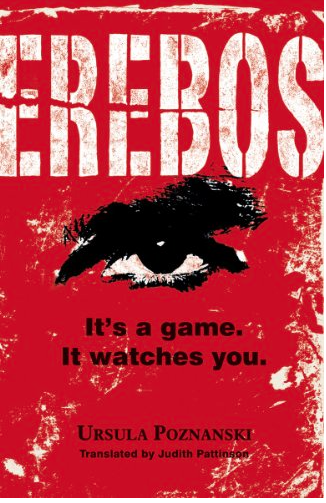
Ursula Poznanski: Erebos (2011)

Erebos Poznanski

Are you playing the game – or is the game playing you? A highly addictive thriller about power, manipulation and revenge.

‘Enter. Or turn back. This is Erebos.’

Nick is given a sinister but brilliant computer game called Erebos. The game is highly addictive but asks its players to carry out actions in the real world in order to keep playing online, actions which become more and more terrifyingly manipulative. As Nick loses friends and all sense of right and wrong in the real world, he gains power and advances further towards his online goal – to become one of the Inner Circle of Erebos. But what is virtual and what is reality? How far will Nick go to achieve his goal? And what does Erebos really want?

Enter Erebos at your own risk. Exciting, suspenseful and totally unputdownable.

I must honestly say, when Lizzy suggested Erebos as her readalong title, I wasn’t thrilled. I couldn’t tell you why. Certainly not because it’s a YA novel. Maybe because I wasn’t sure whether it was some sort of fantasy or a realistic thriller? And because I was worried about the writing. Some recent German thrillers that have made it into translation were anything but well written. Imagine my surprise when I detected that Erebos wasn’t only well-written but so gripping and believable, I couldn’t put it down. It might be the thriller of the year for me. Unfortunately for this review, part of the appeal is that we don’t really know what’s going on. Is it realistic? Is it fantasy? Science-fiction? I don’t want to say too much. Only that I think it would appeal to anyone, whether you like more fantastic stories, or only read realistic novels.

So what’s it about? At a school in London, students exchange a computer game. Those who play it are not allowed to talk about it. Those who don’t, either want to be part of what feels almost like a secret society, or they openly hate the game.

Nick is at first one of those who don’t play the game. He watches his friends and is worried. What happens to them? Why are they sucked into this game like this? Finally someone passes the game on to him and he tries it out. Initially, he’s skeptical but that passes quickly and he, like all the others, is sucked into the world of Erebos.

Being addicted to a game might be bad enough, but this one seems to have an agenda of its own. It seems to know the players and their secrets and uses this against them. Part of the game are assignments in real life, and soon the virtual danger become very real.

I deliberately kept this summary very short because, as I wrote earlier, part of the appeal is discovering what’s going on.

Nick is a great protagonist and we root for him. He’s likable but flawed and undergoes important changes.

I really loved how Ursula Poznanski described the world of the game and the addictive part was shown in a very believable way. Once the assignments in the real word start, an entertaining read turns into an eerie thriller. I couldn’t stop reading, wanted to find out what was behind it all. So often thrillers have disappointing endings. Here again, Erebos is an exception. It’s pitch perfect from beginning to end. A must read for those who love YA novels and for fans of original, futuristic thrillers. I’m not surprised that Erebos has won the Deutscher Jugendbuchpreis, the German prize for Children’s Literature. It’s captivating and topical.

I finished this book before the attacks in Paris but meanwhile, I’ve heard that the terrorists also communicate via computer online games. A communication that’s particularly hard to decipher. All of a sudden, Erebos his even more topical. It certainly has a lot to say about addiction, manipulation, and retribution. Don’t miss it.

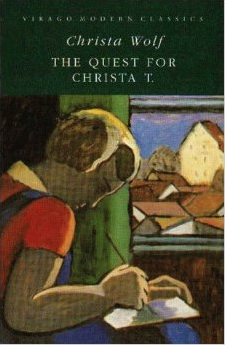
Christa Wolf: Nachdenken über Christa T. – The Quest for Christa T. (1968)

The Quest For Christa T.

I’m fond of paper weights. Especially those with a delicate glass ornament inside. Now imagine such a paper weight. Maybe there’s a fragile, colourful butterfly trapped in its centre. Take that paperweight and smash it against a wall. What you’ll be left with are shards of glass, splinters, some larger fragments, and maybe half of the butterfly will still be intact. That’s exactly what Christa Wolf seems to have done when she wrote the The Quest for Christa T. – Nachdenken über Christa T. What the narrator displays, is the fragmented story of her friend, who died too young, leaving behind a pack of notes and letters, and people who remember her, or think they remember her. The narrator sets out to capture her friend, an elusive woman, and piece together the story of her life and their friendship.

Remembering is complicated. We add, we subtract. Our memory plays tricks on us. The narrator goes back and forth between what Christa T. wrote down and what she thinks she remembers. The notes are not exhaustive. A lot has been left out. In order to capture her friend, the narrator deliberately adds, exaggerates, or embellishes.

Like the smashed paper weight, the story we read has beautiful broken parts; some are pieced together easily, others stay fragments.

The story has one chronological line, from the girls childhood, to the death of Christa T., but each chapter jumps back and forth on smaller timelines.

I really liked reading some of the passages of this book, but most of the time, I found it tiresome. And I wasn’t really interested in Christa T. I didn’t get what was so special about her. The narrator mentions rebellion and nonconformism, but on the outside her life didn’t seem rebellious or nonconformist. Are we meant to believe that having doubts, questioning the regime of the GDR was a rebellion in itself? I suppose so.

The most interesting aspect of the novel is how it shows the elusiveness of memory and of understanding another person. That’s quite well captured in the title which also evokes a central image that we encounter again and again. Sadly, the complex meaning of the title is lost in translation. “Quest” is much more active than the German “Nachdenken” – which means to think about something. A quest is a search, thinking however, can be done without moving. And then there’s the element of “nach” – which means “after” . In the image I mentioned before, we see Christa T.’s back, moving away. Very often we have the impression, all the narrator sees with clarity, is Christa T. walking away, disappearing. This is alluded to in the word Nachdenken – which sounds a bit like following someone in your thoughts.

As a whole, this book was frustrating but the different shards and pieces were beautiful. A lot is well said, subtly and brilliantly described. Many fragments are moving, especially those that deal with the loss of Christa T. The end is so sad. Not only because she is ill and dies but because they all lie to her. Doctors and friends alike. It doesn’t really allow them to say goodbye.

Another reason why I found the book frustrating is because it is muted, toned down. It seems to contain a lot of deliberate confusion. Maybe because Christa Wolf couldn’t write an unambiguous novel about a rebellious woman, without getting into trouble. Probably this might have been one reason for choosing such a fragmented, modernist approach.

I will return to Christa Wolf again but not very soon. I saw some reviews of this book. Three were more enthusiastic: HeavenAli here and Kaggsy’s Bookish Ramblings here Tony’s Reading List here. Booker Talk shares my frustration.

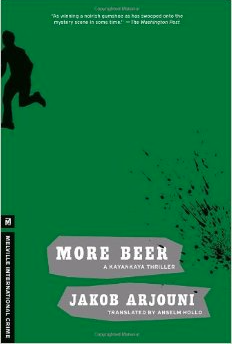
Jakob Arjouni: More Beer – Mehr Bier (1987) Kayankaya 2

More Beer

More BeerMehr Bier is the second novel in Jakob Arjouni’s Kayankaya series. It’s set in Frankfurt, Germany. PI Kayankaya is of Turkish origin. While Arjouni was still alive, he was called Germany’s answer to Raymond Chandler. I always found this comparison problematic. Arjouni writes extremely well. I’d say he’s definitely at the literary end of the crime spectrum. His books are hardboiled noir. Kayankaya is a cynical loner who gets beaten up more than once, still, I don’t think he has a lot in common with Marlowe. The differences are quite subtle but they are important. I remeber hating how Kayankaya killed a fly in the first novel. In this one, he beats a rat. Marlowe would never do something like that. I remember noticing after I’ve read three or four books by Chandler that Marlowe has a great fondness for animals. Kayankaya is much more jaded.

More Beer sees Kayankaya investigate the murder of a chemical plant owner. Four eco-terrorists have been charged with the murder, but it seems highly unlikely that they did go that far. Unfortunately,they don’t want to talk. Early on, it becomes obvious that there was a fifth man involved. But who and where is he? The defendants’ lawyer hires Kayankaya to find him. He investigates with his usual stubbornness, even pursuing after he gets beaten up a couple of times.

Kayankaya is a loner, a heavy drinker, a disillusioned man with an acerbic wit. And constantly mistreated because of his origins. I forgot how old these books are. This one was written in the 80s and to read about the way Kayankaya is treated was quite shocking. I think the status of people of Turkish origin has changed meanwhile. At least I hope so. Creating a character like this in the 80s must have been pretty provocative.

I’m not too sure what to think about this book. I found the first in the series, Happy Birthday, TürkeHappy Birthday, Turk, so much better. But while I didn’t care for the story of More Beer, I loved the writing. I’d forgotten just how well Arjouni writes. The novel is full of memorable metaphors like when the narrator compares rain drops on a windshield to a herd of animals running.  For that alone, I might reread it and will certainly not wait another ten years before I read the third one.

Arjouni, Jakob
Most of Arjouni’s novels have been translated and published by Melvillehouse.
Sadly the author died of pancreatic cancer in 2013. He was 48 years old.

Mehr Bier

Wednesdays Are Wunderbar – German Literature Month Giveaway – August by Christa Wolf

literatur_2015_gold-2

It’s Wednesday again and you already know what that means. We’re hosting a giveaway. This week’s copies are from Seagull Books (University of Chicago Press).

Screen Shot 2015-10-27 at 17.02.56

For this year’s German Literature Month I have the opportunity to give away two copies of Christa Wolf’s August, translated by Katy Derbyshire. Since I’m hosting a Christa Wolf week this year, I’m particularly pleased about this giveaway.

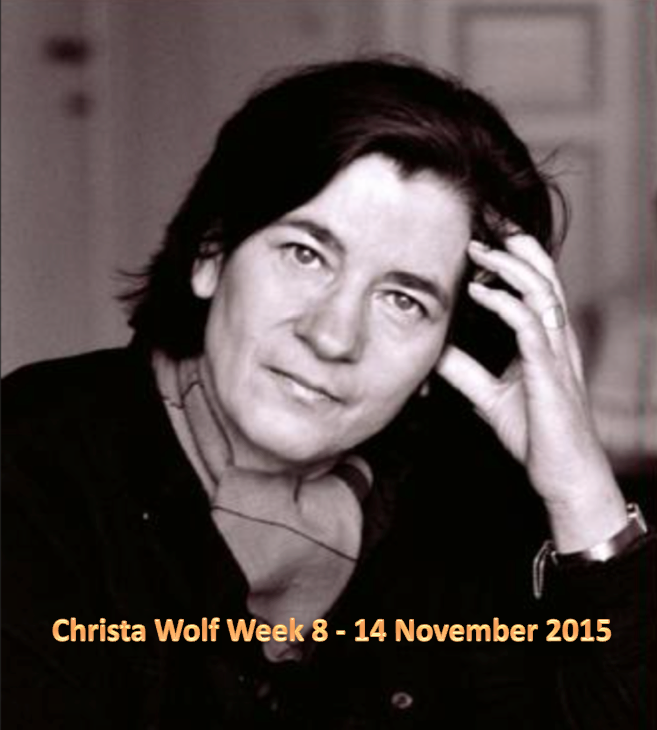
Christa Wolf Week

Here’s what the editor writes about August:

Christa Wolf was arguably the best-known and most influential writer in former East Germany. Having grown up during the Nazi regime, she and her family were forced to flee their home like many others, nearly starving to death in the process. Her earliest novels were controversial because they contained veiled criticisms of the Communist regime which landed her on government watch lists. Her past continued to permeate her work and her life, as she said, “You can only fight sorrow when you look it in the eye.”

August is Christa Wolf’s last piece of fiction, written in a single sitting as an anniversary gift to her husband. In it, she revisits her stay at a tuberculosis hospital in the winter of 1946, a real life event that was the inspiration for the closing scenes of her 1976 novel Patterns of Childhood. This time, however, her fictional perspective is very different. The story unfolds through the eyes of August, a young patient who has lost both his parents to the war. He adores an older girl, Lilo, a rebellious teenager who controls the wards. Sixty years later, August reflects on his life and the things that she taught him.

Written in taut, affectionate prose, August offers a new entry into Christa Wolf’s work and, incidentally, her first and only male protagonist. More than a literary artifact, this new novel is a perfectly constructed story of a quiet life well lived. For both August and Christa Wolf, the past never dies.

*******
If you are interested in winning this book, leave a comment, telling me why you’d like to read it.

The competition is open internationally. The winner will be announced on Saturday October 31 2015, around 18:00 Central European time.