Literature and War Readalong September 2017: Ceremony by Leslie Marmon Silko

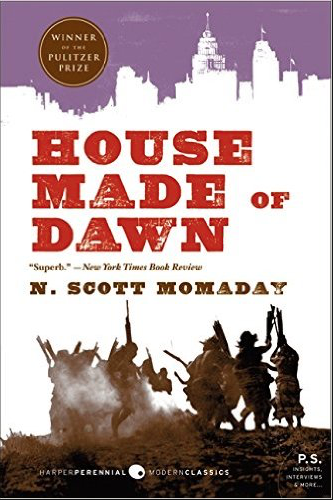
Leslie Marmon Silko’s novel Ceremony is the second Native American novel we’re reading for this year’s Literature and War Readalong 2017. I truly hope it’s more accessible than the first we read N. Scott Momaday’s House Made of Dawn. I struggled quite a bit with it as you can see here.

Leslie Marmon Silko was born in 1948, in Albuquerque, New Mexico. She is of mixed heritage, Laguna Pueblo, Mexican and white. She grew up on a Laguna Pueblo Reservation and continued to live there later in life.

Ceremony immediately became an American classic after its publication in 1977. It especially spoke to the Vietnam war veterans who related to the novels’ exploration of a veteran’s way of healing.

Here is the first sentence of Ceremony:

Tayo didn’t sleep well that night. He tossed in the cold iron bed, and the coiled springs kept squeaking even after he lay still again, calling up humid dreams of black night and loud voices rolling him over and over again like debris caught in a flood.

And some details and the blurb for those who want to join:

Ceremony by Leslie Marmon Silko, 243 pages, US 1977, WWII

The great Native American Novel of a battered veteran returning home to heal his mind and spirit
More than thirty-five years since its original publication, Ceremony remains one of the most profound and moving works of Native American literature, a novel that is itself a ceremony of healing. Tayo, a World War II veteran of mixed ancestry, returns to the Laguna Pueblo Reservation. He is deeply scarred by his experience as a prisoner of the Japanese and further wounded by the rejection he encounters from his people. Only by immersing himself in the Indian past can he begin to regain the peace that was taken from him. Masterfully written, filled with the somber majesty of Pueblo myth, Ceremony is a work of enduring power. The Penguin Classics Deluxe Edition contains a new preface by the author and an introduction by Larry McMurtry.

*******

The discussion starts on Friday, September 29.

Further information on the Literature and War Readalong 2017, including all the book blurbs, can be found here.

Tin Man by Sarah Winman (2017)

Sarah Winman’s Tin Man is another novel I bought because of some rave reviews. Luckily, this time, I enjoyed the book a lot. It’s actually surprising because Sarah Winman does something I normally don’t like. She switches narrators in the middle of the novel, using a narrative device that can easily sink a novel – the use of a diary. In this case, the switch added poignancy and turned a very good novel into an excellent, heartbreaking book.

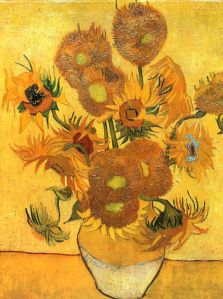
Before I start with a brief summary, let me emphasize what a great cover this book has. Until you read it, it’s just a pop of yellow color with a man riding a bicycle on it, but once you’ve read the book, you know that the yellow cover alludes to one of Van Gogh’s most famous paintings – The Sunflowers.

Van Gogh’s Sunflowers

The painting stands for beauty and the belief, as one of the characters’ mother says, that boys and men are capable of beautiful things.

As a matter of fact, the book starts with the painting or rather how Ellis’ mother won a copy of it in a raffle and put it on a wall, in an act of defiance. Her brutish husband would have preferred her to take a bottle of whisky. The year is 1950 and it’s Ellis’ birth year.

The book then moves to 1996. We are in Elli’s house. There’s a photograph of three people on a bookshelf. A photograph Ellis rarely looks at because two of the three people in it are gone. One, his wife, is dead. What happened to the other one, his best friend Michael ,will be revealed over the course of the novel.

Annie, Ellis’ wife, has been dead for five years, but the grief is still raw. It’s one of the reasons why Ellis works at night. In a factory. Factory work wasn’t exactly his calling. He wanted to become a painter but after his mother’s early death, his dad didn’t allow it.

Ellis’ whole life is slowly revealed. At its heart is his friendship with Michael, a lonely orphan, who lives nearby and visits often. The two boys are very close. Also physically close and for the longest time, one of them, Michael, thinks they will be lovers. They will, in fact, but it’s a furtive thing. Ellis doesn’t really seem to be gay. And once Annie comes along, there’s no doubt, this is the love of his life. At least romantically speaking, because in terms of emotional love, there’s not much of a difference. He loves Michael just as much as Annie.The truly magical thing, though, is that Michael and Annie become best friends as well.

Of course the reader wonders where Michael is. Why is Ellis’ best friend not with him and helps him to get over his grief?

Ellis has an accident and is on sick leave for a long time. Having so much time for himself, has a huge impact. He revisits his life, his aspirations, his dreams. And then he finds Michael’s diary and we finally learn what happened. How they lost contact and why they are apart.

The first part, Ellis’ part, is sad, but the second, Michael’s, is heartbreaking. The relationship seen through his eyes, gets another meaning and the book explores another form or grief—heartbreak.

Here’s what Michael says

I rest till I’m calm and my breathing has settled. I lift myself out and sit by the edge of the pool with a towel around my shoulders. And I wonder what the sound of a heart breaking might be. And I think it might be quiet, unperceptively so, and not dramatic at all. Like the sound of an exhausted swallow falling gently to earth.

Both men travel to the South of France, following Van Gogh’s itinerary but also, in Ellis’ case, exploring where Michael spent some time.

These parts are beautiful and capture the landscape, its colors and scents so well

It’s a rare overcast day and I walk over to Mausole, to the St. Paul asylum where Van Gogh spent a year before he died. The air along this stretch of road is filled with the scent of honeysuckle that has crept over a neighbouring wall. I think it’s honeysuckle. It’s sweet and fragrant, but I’m not good with plants – that was Annie’s thing. I veer off through olive groves where the sun has yet to take the colour of the wildflowers. In two weeks, though, the grass will be scorched and lifeless.

Since this novel is mainly set in the 90s of the last century and does explore what it was like to be gay back then, it touches on so many really sad topics like HIV, the way homosexuals were perceived by society, how many never came out, how they had to hide. Things have gotten so much better by now, that we almost tend to forget that not too long ago, they were very different. In the early 90s HIV was still synonymous with Aids. Once you were infected there wasn’t a huge chance you wouldn’t get seriously ill sooner or later and then, because there was no cure, die. There are passages, in which Michael visits men in an Aids ward. They are harrowing.

Tragic books, especially when they describe raw emotions can turn mushy or tacky. This one never crosses these lines. It’s moving and deeply touching without being sentimental. It’s an emotional ride that explores themes like grief and loss, loneliness and unrequited love, finding one’s path, following one’s calling and, most of all, fining beauty where there seems to be only ugliness. A truly beautiful book.

Toni Morrison: God Help the Child (2015)

I’m so annoyed with myself. I have three or four unread books by Toni Morrison on my piles but instead of reading those, I went and bought her latest, God Help the Child. That wouldn’t be a problem if this was a good book but it’s not. It’s so flawed, it could be a beginner’s novel. And the style? Well, when you pick a Toni Morrison novel, you expect it to be challenging. You don’t expect it to be bland mainstream, with descriptions like “the sky was baby-blue”. Honestly, what went wrong?

The book’s premise had so much promise. The blurb said it’s a book about the way parents damage their children and the repercussions this has later in their life, but somehow that’s not really what it is about. The book doesn’t really take this theme seriously. Maybe because it’s about so many other topics— race, skin color, trust, self-esteem, child abuse.

When the main character Bride is born, her mother rejects her immediately because of her black skin. Nobody in Bride’s family is this blue-black. In fact, they are so light, some of them did pass as white. Her mother, too, could, if she wanted, pass as white. Bride’s father is so shocked that he leaves her mother. He can’t imagine that two rather fair African-Americans could be the parents of such a black child. Of course, he suspects she was unfaithful.

Bride grows up as an outsider and only later, in her twenties, is she able to embrace her skin color and discover her beauty. She even learns how to underline it by wearing only white. At the age of twenty-two, she’s a successful executive at a cosmetic company, ready to launch her own beauty line. While she’s still fighting for her mother’s love, she’s also happy about her success and her beautiful lover, Booker, until the day she tells him something and he leaves her without an explanation.

The reader learns that Booker’s reaction has something to do with Bride’s idea of helping a woman who was convicted for child abuse.

I will stop here as the book basically is about why Bride does what she does and why this makes Booker flee. Both reasons are tied to the protagonists’ childhood.

For such a slim novel – under 180 pages – it has just too many themes. While some are really well done, especially all those linked to colorism, others didn’t get the depth they would have deserved. It isn’t fully explored what being rejected by her mother really meant for Bride. She does something cruel to gain her mother’s love and this affects her, but there doesn’t seem any real and deep damage. This struck me as odd.

What also struck me as odd was the number of child molesters we come across in this book. This too is such a serious problem, but it just didn’t get the careful treatment it would have deserved.

I’m really disappointed and wish I hadn’t bothered with this book. At the same time, I find colorism such an important topic, that I liked the book for that.

I’m glad this wasn’t my first Toni Morrison. It would have been my last. I’d rather read some bestseller than something that is written like a mainstream novel but saddled with heavy, carelessly treated themes. Don’t read this unless you’re a Toni Morrison fan and want to read everything she’s ever written. That said, I think she’s a terrific author and I’ll be reading more of her. Let’s just hope this was a one-off.

Have you read Toni Morrison? Which of her novels do you consider must-reads?

Han Kang: The Vegetarian – 채식주의자 -Chaesikju-uija (2007) Korean Literature

Ever since The Vegetarian  (채식주의자 – Chaesikju-uija) won the Man Booker International Prize for Fiction last year, I wanted to read it. I’m so glad I did. It’s so different from most other novels I’ve read recently; it’s mysterious, fresh, and powerful. It made me think of Yoko Ogawa and Kafka.

Han Kang was born in Gwangju, South Korea. Her writing has won many prizes. She currently teaches creative writing in Seoul.

The Vegetarian is divided into three parts, each told by another narrator who is related to the main character Yeong-hye, the vegetarian of the title.

Part 1, The Vegetarian is told by Yeong-hye’s husband. He is an ordinary office worker, while she’s a housewife. Things are not great between them but the marriage seems to work anyway until the day Yeong-hye decides she wants to be a vegetarian. She’s had upsetting nightmares and feels the urge to become a plant. What follows is quite shocking. This seemingly simple decision has unbelievable repercussions. Her refusal to eat meat triggers a flood of violence, especially from the men in the family. Her husband treats her sadistically; her father beats her. The women are baffled as well but they do not react so violently. During a family reunion, things escalate and Yeong-hye almost dies. (Trigger Warning – there’s a graphic description of one of Yeong-hye’s dreams. It’s short, less than a page, but describes a horrible cruelty against a dog. If, like me, you’re sensitive, skip it. I wish, I had been warned).

Part two, Mongolian Mark, is told by Yeonh-hye’s brother-in-law, an artist. Her vegetarianism and the subsequent family drama, trigger a dark and surreal side in him. After he hears that his sister-in-law’s Mongolian Mark is still visible, he becomes more and more obsessed with her. He fantasizes about covering her body in flower paintings and filming her while she makes love with a man whose body has been painted the same way. When he tries to live his fantasy, things get out of hand.

Part 3, Flaming Trees, is told by Yeong-hye’s sister. She’s divorced from her artist husband. At the beginning of this part she’s on her way to a psychiatric hospital. Yeong-hye has been there for months. She has stopped eating because she wants to be a tree. The doctors fear for her life. Her sister tries to feed her, but she also tries to understand her.

At the beginning of this post, I wrote that the book did remind me of Yoko Ogawa and Kafka. Like Ogawa, Han Kang explores the darker sides of passion, sexuality and lust, and like Kafka, she manages to make you feel what she wants to say. I often understood Kafka’s enigmatic stories on an emotional level. I tried to feel what he described, experience the mood, the atmosphere, and that’s how I understood him. Yeong-hye is an enigmatic person and her vegetarianism is about more than not eating meat. It’s a deeper form of vegetarianism. She wants to become a being that cannot harm anymore. The way Han Kang described it we can really feel how violent it is to eat meat. But not only that, the reactions also show us a patriarchal society in which violence is used to keep others in check. That someone wants to do something nobody else does – vegetarianism seems far less common in South Korea than in Western societies – threatens the status quo. Yeong-hye breaks free and this is seen as an act of rebellion that must be punished.

The three parts form a whole but they are very different. The first analyses the society and its patriarchal structure. Part two explores eroticism and sexuality and uses art as a means to symbolise certain aspects. Yeong-hye wants to be a tree but her brother-in-law, who wants to transform her and later himself into a flower, is interested in the erotic aspects of her desire. In part three, finally, psychological aspects are explored. Yeong-hye’s sister is the only person who tries to really understand her and her motivations.

Although Yeong-hye’s vegetarianism comes from other sources than most other people’s vegetarianism, the book is still very realistic at depicting the reactions of those who eat meat. I remember more than one family dispute, especially with my father, when I didn’t want to eat meat. He too, could react aggressively, as if my refusal threatened him. I remember one meal in particular and it still upsets me to think of it. He knew that I didn’t eat meat and when he invited me for dinner, I assumed I would just leave out the meat and eat everything else. But there was nothing else. Just meat in a sauce.

The Vegetarian is beautiful and mesmerising. Its message and images will stay with me for a long time. I loved it.

If you’d like to read another review – here’s Tony’s take on the novel. Those interested in South Korean literature will find many valuable resources on his blog.


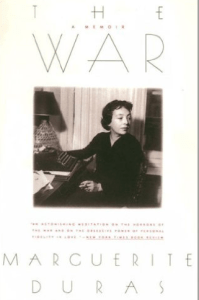
Literature and War Readalong April 2017: The War – La douleur by Marguerite Duras

Usually I like to say a few introductory words about my readalong titles, but I’m in bed with the flu and my head feels like it’s filled with cotton. The book has to speak for itself. Luckily, I found the first pages of  the translation of Marguerite Duras’ The War – La douleur online.

Here is the beginning:

I found this diary in a couple of exercise books in the blue cupboards at Neauphle-le-Chateau.

I have no recollection of having written it.

I know I did, I know it was I who wrote it. I recognize my own handwriting and the details of the story. I can see the place, the Gare d’ Orsay, and the various comings and goings. But I can’t see myself writing the diary. When would I have done so, in what year, at what times of day, in what house? I can’t remember.

One thing is certain: it is inconceivable to me that I could have written it while I was actually awaiting Robert L.’s return.

How could I have written this thing I still can’t put a name to, and that appalls me when I reread it? And how could I have left it lying for years in a house in the country that’s regularly flooded in winter?

The first time I thought about it was when the magazine Sorcieres asked me for a text I’d written when I was young.

The War is one of the most important things in my life. It can’t really be called “writing.” I found myself looking at pages regularly filled with small, calm, extraordinarily even handwriting. I found myself confronted with a tremendous chaos of thought and feeling that I couldn’t bring myself to tamper with, and beside which literature was something of which I felt ashamed.

April

Opposite the fireplace and beside me, the telephone. To the right, the sitting-room door and the passage. At the end of the passage, the front door. He might come straight here and ring at the front door. “Who’s there?” “Me.” Or he might phone from a transit center as soon as he got here. “I’m back — I’m at the Lutetia to go through the formalities.” There wouldn’t be any warning. He’d phone. He’d arrive. Such things are possible. He’s coming back, anyway. He’s not a special case. There’s no particular reason why he shouldn’t come back. There’s no reason why he should. But it’s possible. He’d ring. “Who’s there?” “Me.” Lots of other things like this do happen. In the end they broke through at Avranches and in the end the Germans withdrew. In the end I survived till the end of the war. I must be careful; it wouldn’t be so very extraordinary if he did come back — it would be normal. I must be careful not to turn it into something extraordinary. The extraordinary is unexpected. I must be sensible: I’m waiting for Robert L., expecting him, and he’s coming back.

The phone rings. “Hello? Any news?” I must remind myself the phone’s used for that sort of thing, too. I mustn’t hang up, I must answer. Mustn’t yell at them to leave me alone. “No, no news.” “Nothing? Not a sign?” “Nothing.” “You know Belsen’s been liberated? Yes, yesterday afternoon…” “I know.” Silence. “You mustn’t get disheartened, you must hold on, you’re not the only one, alas — I know a mother with four children…” “I know, I’m sorry, I haven’t moved from where I was. It’s wrong to move too much, a waste of energy, you have to save all your strength to suffer.

She said, “You know Belsen’s been liberated?” I didn’t know. One more camp liberated. She said, “Yesterday afternoon.” She didn’t say so, but I know the lists of names will arrive tomorrow morning. I must go down and buy a paper and read the list. No. I can hear a throbbing in my temples getting louder and louder. No, I won’t read the list.


And some details and the blurb for those who want to join

La douleur  – The War by Marguerite Duras, 217 pages, France 1985, WWII

This 1944 diary of a young Resistance member, written during the last days of the French occupation and the first days of the liberation, is only now being published – Duras says she forgot about it during the intervening years, and only recently rediscovered it in a cupboard. The loneliness and ambivalence of love and war have appeared in Duras’ work before, from The Lover to Hiroshima Mon Amour, in which a Frenchwoman reveals to her Japanese lover, after the bomb, that she was tortured and imprisoned in postwar France for her affair with a German soldier. In the first section of The War, Duras the heroine waits for her husband to return from the Belsen concentration camp. When De Gaulle (“by definition leader of the Right – “) says, “The days of weeping are over. The days of glory have returned,” Duras says, “We shall never forgive him.” It’s because he’s denying the people’s loss. When her husband returns, she has to hide the cake she baked for him, because the weight of food in his system can kill. (We are spared no detail of his physical degradation, even to being told the color of his stools.) When he is stronger, she tells him she is divorcing him to marry another Resistance member. In the second section, set earlier, at the time of her husband’s arrest, a Gestapo official plays a cat-and-mouse game with Duras, to whom he’s attracted, preying on her desperation to help her husband. In the third section, post-liberation, she switches roles, becomes an interrogator as Resistance members torture a Nazi informer. She also half-falls in love (with characteristic Duras dualism) with a young prisoner who childishly joined the collaborationist forces out of nothing more than a passion for fast cars and guns. In her preface, Duras says it “appalls” her to reread this memoir, because it is so much more important than her literary work. Certainly, like everything she has written in her spare, impassive voice, the book is at once elegant and brutal in its honesty: in her world, we are all outcasts, and the word “liberation” is never free of irony. A powerful, moving work. (Kirkus Reviews) –This text refers to an out of print or unavailable edition of this title.

*******

The discussion starts on Friday, 28 April 2017.

Further information on the Literature and War Readalong 2017, including all the book blurbs, can be found here.

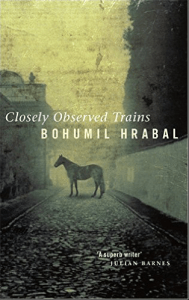
Bohumil Hrabal: Closely Observed Trains – Ostře sledované vlak (1965) Literature and War Readalong March 2017

Published in 1965, Bohumil Hrabal’s Closely Observed Trains – Ostře sledované vlaky, was one of the author’s greatest successes and has even been made into a movie. Hrabal wrote a first version of this book, which was more radical but had no chance of getting published. While this second version still contains a lot of what was unacceptable in Czechoslovakia at the time – the depiction of unheroic death and sex – by the time it was published, the public was ready and embraced Hrabal’s irreverent tale, in which sex ultimately leads to a young man’s demise.

Closely Observed Trains tells the story of a young man, Milos Hrama, who is an apprentice at a train station. Milos is back at work after three months of sick leave. He tried to kill himself after failing in bed with his girlfriend. He’s still a virgin and afraid that if he has a second chance with his girlfriend, the result will be the same.

It’s the end of the war and the Germans are slowly being defeated. But still trains from and to the Eastern front arrive at the small but strategically important station. Trains that transport wounded soldiers, maimed cattle, animals on their way to the slaughterhouse. Some of this is described quite graphically. I even had to put dow the book a few times.

The little station has been the scene of a scandal. One of the employees, dispatcher Hubicka, used the official stamps and applied them to the naked bottom of a beautiful telegraphist. The story has made the rounds and people come to have a look at the audacious Hubicka. Many are scandalised, but many more admire him for his gutsy behaviour. The station master pretends he’s shocked, but he’s too involved with his own life to really care. He’s busy climbing the social ladder, licking asses, caring for his beloved pigeons, and shouting at people.

All this fascinates Milos whose over sexed imagination is combined with the fear of failing again in the future. In many comic scenes he tries to talk about his fears to different people.

The sexual aspects of the novel are in many instances hilarious, but the book is still very serious. Some of the humour is used to ridicule collaborators and the Germans themselves aren’t spared. There’s no empathy for the enemy. Towards the end, when Dresden is bombed, one of the character’s laconic comment to a wounded German soldier, “You should have stayed home, shouldn’t you?”, is quoted again.

The most striking aspect of the book is that it combines scenes of horror and humour and in doing so achieves a distortion that gives the story an absurd feel. It’s as if the war wasn’t taken seriously, not because the people don’t get how serious it is but as an act of defiance. It’s as if the characters were saying to the Germans—you may think you defeated us – think again – you failed because we refuse to take you and your war seriously.

I enjoyed reading this book a great deal. It reminded me of some Czech movies I’ve seen during a Czech movie festival. Many of them used the same type of humour. It’s a mix of the absurd and the burlesque. Exaggerations, tall tales. At times this humour is close to slapstick but always stops right before turning into this cruder humour. It’s the behaviour, the attitude of the people that’s funny. They aren’t goofs, they are eccentrics.

I expected a lot from this slim novel and am happy to say – I wasn’t disappointed.


Other Reviews

TJ (My Book Strings)

Marina Sofia (findingtimetowrite)

*******

Closely Observed Trains is the third book in the Literature and War Readalong 2017. The next book is the French WWII memoir La douleur  – The War by Marguerite Duras. Discussion starts on Friday 28 April, 2017. You can  find further information on the Literature and War Readalong 2017, including the book blurbs here.

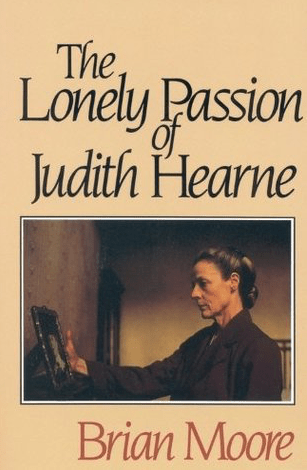
On Brian Moore’s The Lonely Passion of Judith Hearne (1955)

I finished Brian Moore’s The Lonely Passion of Judith Hearne two weeks ago, but am still not sure how to write about it. My reaction to it was very strong; it even gave me nightmares. I wonder if I can do it justice as there’s so much to discuss. It’s excellent and multifaceted and has a lot to say about religion, spinsterhood, family duty, shattered dreams and the woes of being an unattractive woman.

It’s peculiar that after having written two reviews about women who were punished for being too beautiful (Asking For It and Little Deaths), I’m now writing about a book in which the main character suffers, among other things, from being unattractive. Clearly, it’s hard to be a woman.

Judith Hearne is a 40-something spinster who has lived a rather dull and lonely life. Out of a sense of family duty and fuelled by her religious beliefs, she has cared for an ailing aunt until her death. The aunt in question was a rather formidable person and Judith lived under her thumb. Caring for her took up all of Judith’s time. It made it impossible to find love and friendship and now, at 40, she thinks it’s over. Even in her youth she wasn’t good-looking and sadly, age hasn’t made her look interesting. Not yet.

Here’s what she thinks about herself:

She watched the glass, a plain woman, changing all to the delightful illusion of beauty. There was still time: for her ugliness was destined to bloom late, hidden first by the unformed gawkiness of youth, budding to plainness in young womanhood and now flowering to slow maturity in her early forties, it still awaited the subtle garishness which only decay could bring to fruition: a garishness which, when arrived at, would preclude all efforts at the mirror game.

At the beginning of the novel, Judith Hearne has just moved into new lodgings in a shabby boarding house in Belfast. Here’s how the novel begins:

The first thing Miss Judith Hearne unpacked in her new lodging was the silver-framed photograph of her aunt. The place for her aunt, ever since the sad day of the funeral, was on the mantel piece of whatever bed-sitting-room Miss Hearne happened to be living in. And as she put her up now, the photograph eyes were stern and questioning, sharing Miss Hearne’s own misgivings about the condition of the bed-springs, the shabbiness of the furniture and the run-down part of Belfast in which the room was situated.

After she has found a place for her aunt’s picture, she needs to find another one for the Sacred Heart. This beginning shows exactly what kind of person Judith Hearne is. She’s poor and single and the two only things that give her solace are the memory of her aunt and her religion. And a few possessions of value like a watch and pretty shoes with buttons that look like winking eyes.

Judith Hearne is a piano teacher with only a few pupils left. One of the reasons she’s losing pupils is only discovered later in the novel—when things get too stressful, she drinks. Her good education and valuable belongings, catch the eye of one of the other boarders, Mr Madden, the brother of her landlady. Unfortunately, poor Judith thinks he’s really interested. She knows her time is running out and seeing how kind Mr Madden is with her and how he likes to talk to her, gives her hope.

And maybe, although it was a thing you could hardly bear to think about, like death or your last judgment, maybe he would be the last one ever and he would walk away now and it would only be a question of waiting for it all to end and hoping for better things in the next world. But that was silly, it was never too late.

It soon becomes clear that Mr Madden is looking for a business partner, not for a wife. He’s returned from America where he has lived for a long time. According to Miss Hearne, he’s more American than Irish. He lacks manners and dresses differently. If she was honest to herself and not so desperate, she would have to admit that he’s not her type.

Being single might not have been as bad for Judith Hearne if she had friends and family but she doesn’t. There’s only one family she calls her friends, the O’Neill’s. Judith pays them a visit every Sunday. It’s the highlight of her week. She tells herself that they are like family, that the O’Neill kids are like her grandchildren. And she’s sure that they look forward to seeing her too, after all, she goes there well prepared.

For it was important to have things to tell which interested your friends. And Miss Hearne had always been able to find interesting happenings where other people would find only dullness. It was, she often felt, a gift which was one of the great rewards of a solitary life. And a necessary gift. Because, when you were a single girl, you had to find interesting things to talk about. Other women always had their children and shopping and running a house to chat about. Besides which, their husbands often told them interesting stories. But a single girl was in a different position. People simply didn’t want to hear how she managed things like accommodation and budgets. She had to find other subjects and other subjects were mostly other people. So people she knew, people she had heard of, people she saw in the street, people she had read about, they all had to be collected and gone through like a basket of sewing so that the most interesting bits about them could be picked out and fitted together to make conversation.

Brian Moore uses stream-of-consciousness and various points of view to give us an insight into most of his characters thinking. That’s why we know that nobody in this novel thinks kindly about Judith Hearne. Seeing the O’Neill’s before Judith’s arrival on one Sunday is enlightening. Moore is brilliant at unmasking his characters’ feelings and thoughts and knowing what they think and comparing it to what she thinks they think is chilling.

Before moving into this boarding house, Judith Hearne isn’t happy but once things go wrong with Mr Madden, she heads for a crisis. A crisis that unhinges her, because she pretty much loses everything including her faith. The end of the novel, which I won’t describe, tells us how she moves on, after having lost her faith and her illusions.

Different readers will find different things interesting in this book. As someone who was born into a Catholic family, I found the religious aspects especially perturbing.

Just before starting the book, I saw the title of an article about the pope saying he thought it was better to be an atheist than a hypocritical Christian. I couldn’t help but think of this while reading The Lonely Passion of Judith Hearne, a book that is, among other things, very much about just that – religious hypocrisy.

Being rejected by a man, is painful but being let down by her religion and its representative, a priest, is far worse for Judith Hearne.

It’s not often that a title is so well-chosen or that it does double duty like in the case of Moore’s eponymous title. Yes, the book is about loneliness, and it’s about the last hope to find love. But it’s also a description of utter despair and suffering and that’s alluded to in the title as well. After all, “passion” is also a reference to the “passion of the Christ” or his final suffering and martyrdom. We find in this book the same doubts, the same “why have you forsaken me feeling”, only Judith Hearne, being human, has another fate awaiting her.

Before ending, I’d like to say a few words about confession. There’s a heartbreaking scene in this novel, in which Judith Hearne goes to confession. She goes to confess her sin – drinking – but also because she hopes for spiritual help. The scene reminded me of one of Frank O’Connor’s amazing short stories First Confession.

This is a bit of a hodgepodge review and I’m sorry for that. It’s an excellent novel but it reminded me of so much, that it was hard to write about it coherently and I didn’t want to turn this into a memoir piece, telling you all about me and why I left the church. Maybe I’ll do that in another post some day.

The Lonely Passion of Judith Hearne is an excellent novel because Moore is astute. The characters are brilliantly drawn and explored. We see all of their foibles which, at times, is quite funny. The ending however was heartbreaking.
This post is a contribution to  Cathy’s and Raging Fluff’s Reading Ireland Month