What Did the Victorian Lady Look Like? or Women, History and Make-up

I like to read make-up artist Lisa Eldrige’s blog and also like to watch her tutorials. Recently I discovered two videos she did with historian Madeleine Marsh, the author of the book Compacts and Cosmetics: Beauty from Victorian Times to the Present Day. The book focuses not only on cosmetics but also on women’s history, their lives, the politics, culture and social circumstances of the times. The videos Lisa Eldrige did are so interesting and fascinating that I thought I’ll add them here. They are really worth watching, especially for those who love historical novels or novels from the Victorian and later eras.

As Madeleine Marsh says : “Vintage make-up is history that you can hold, smell and you can touch and I really think it makes our past come to life.”  (Madeleine Marsh in video I)

Both videos are great and will tell you a lot about the link between history and make-up. Did the Victorians use make-up? What did the Flapper look like? What was used during WWII? How did the 70s change the way we look?

I love these two videos, they are informative, fun and colorful and I hope you will like them too.

Siri Hustvedt: The Shaking Woman or A History of My Nerves (2010)

While speaking at a memorial event for her father, the novelist Siri Hustvedt suffered a violent seizure from the neck down. Was it triggered by nerves, emotion – or something else entirely? In this profoundly thought-provoking and revealing book, Hustvedt takes the reader on her journey through psychiatry, philosophy, neuroscience and medical history in search of a diagnosis. Conveying the often frightening mysteries of illness, she illuminates the perenially mysterious connection between mind and body and what we mean by ‘I’

Siri Hustvedt is one of my favourite writers. Whenever she has a new novel out I’m likely to buy and read it. I’m a bit behind as I haven’t read Sorrows of an American and The Summer Without Men yet. Until now I haven’t read any of her essays but was planning on doing it and when I saw The Shaking Woman or The History of my Nerves in a bookshop I bought and read it immediately.

Whether someone likes this book or not depends a lot on the expectations. Many readers where disappointed to find a blend. The Shaking Woman is halfway between essay and memoir, very dense, hardly anecdotal but highly informative and thought-provoking.

“Nerves” is such an interesting term and topic. I recently watched the movie Housewife, 49 based on the diaries that a 49-year-old housewife wrote during WWII. She is  depressed and, as she says, “nervous” or has problems with her “nerves”. I also seem to remember distinctly Mrs Bennett in Pride and Prejudice exclaiming on and on “My poor nerves”. By using the word we may mean quite a lot of things and this is precisely what Siri Hustvedt hints at too.

During a speech for her late father Siri Hustvedt started to shake violently from chin down. She continued to speak and the shaking wasn’t in any way audible, it didn’t affect her capability to speak in any way. She says she didn’t even feel nervous or anxious before the speech. If this had happened only once she might not have felt tempted to undergo so many tests and read such a lot about various topics. But it did happen again and from what I understood still happens to this day.

Everybody with a chronic disease can feel with Siri Hustvedt and her struggle to make sense of what happens. It’s the nature of many chronic diseases that are somewhere on the borderline between physical and psychological to be hard to diagnose and even harder to treat.  These are some of the topics she writes about. But she doesn’t only write about the different tests and treatments she undergoes, she looks for a deeper meaning. What does it mean when you say “I’m ill”? Who is this “I”? What does it mean when you say you are physically ill? Is your mind not part of your body?

Who are we anyway? What do I actually know about myself? My symptom has taken me from the Greeks to the present day, in and out of theories and thoughts that are built on various ways of seeing the world. What is body and what is mind? Is each of us a singular being or a plural one? How do we remember things and how do we forget them? Tracking my pathology turns out to be an adventure in the history of experience and perception.

She thinks for a long time that what she has is a convulsion disorder and therefore we hear a lot about the history of hysteria, its early treatment and what has become of it now. She parallels hysteria and shell-shock and wonders why both terms are now out of fashion.

One of the doctors she consults tells her she has a panic disorder and she also reads a lot about this.

But it wouldn’t be Siri Hustvedt if she stopped there. She goes far beyond her illness and so, in the end, this book is less about a symptom than about the mind as a whole. She also writes at length about migraine and different ways of perceiving the world. About memory and imagination.

When I read a novel, I see it, and later, I remember the images I invented for the book. Some of these images are borrowed from intimate places in my own life. Others, I suspect, are taken from movies or pictures in books and paintings I’ve seen.

She also writes about mysticism, Merleau-Ponty, Simone de Beauvoir, Freud and mixes all kind of views and theories.

At the end she has explored numerous things but still doesn’t know what she really has.

The Shaking Woman describes one woman’s intellectual journey that starts with a symptom and ends with an exploration of all sorts of disciplines, theories and views on consciousness. It seems as if the inconspicuous sounding word “nerves” was a little door that Hustvedt opened to enter a huge, huge landscape. I’m glad I took the journey with her.

Stéphane Hessel: Indignez-Vous! /Time for Outrage!/Empört Euch!

Indignez-Vous!

Indignez-Vous!

Bookaroundthecorner reviewed this tiny little booklet a few days ago and since I had bought it last October when it came out and am one of the happy few to own a first edition, I thought I might as well read it. Besides it is only 13 pages long + an additional 14 of introduction and afterword.

Since the French original came out the essay has been translated into many different languages and is a success pretty much everywhere. There is always a very good indicator whether a book is spoken of in Germany when you look at the number of reviews and the number of comments the reviews get on amazon and whether there are articles and TV programs on Swiss TV as well.

Reviews of Indignez-vous! generated up to 200 comments on amazon.de. One could say that Stéphane Hessel hit a nerve.

In France alone it sold far over 600’000 copies, in Germany I think it hit the 1’000’000 mark a while back already.

Hessel, a German Jew,  is a charismatic man and  looks back on a life story that isn’t shared by many. Hero of the Resistance, member of de Gaulle’s Free French organisation in London, he was captured upon returning to France in 1944, tortured and sent to two different concentration camps which he both escaped. He helped to draft the UN’s Universal Declaration of Human Rights in 1948 and became a famous French advocate for Human Rights.

With this background and credibility it isn’t surprising that he would make people listen.

Time for Outrage!

Time for Outrage!

Hessel wants to incite a sense of outrage in his readers. Outrage is the fuel for resistance and the only way to stop things as he says. Our world is drifting away from democratic principles with the supremacy of money over everything else.

The worst attitude facing social injustice and exploitation is indifference. There are numerous things that outrage Hessel, one of the most important ones – and source of a lot of controversy – is his take on the situation in Palestine and his statements against the Israeli government. Despite being of Jewish origins he was promptly accused of anti-Semitism. Silly, really as there is a long tradition of Jewish intellectuals,  starting with Hannah Arendt, who criticized Israel.

Empört Euch!

Empört Euch!

It may come as a surprise but his answer to all the problems and conflicts is non-violence. Be outraged, do not stay indifferent and change things in a nonviolent way, is his core message.

That this book is such a success in France where the current politics give a lot of reason for outrage isn’t surprising. That it is an equal success in Germany isn’t any more astonishing. You cannot write anything and name Jews, Resistance, Nazism, concentration camps and Israel and not be read in Germany. To overlook this book would seem to many a German intellectual almost a sign of anti-Semitism. But there is more to it. His call for non-violence is something that strikes a chord in Germany more than anywhere else. The last time people were really outraged, they ended up killing people (RAF) and this cannot be a solution.

Still, why is it such a success? I think because it is so unflinching. There isn’t any superfluous word in this slim book, no adornment, no digression.

It is short and to the point and tells you without any ambiguities what his author considers to be right and wrong.

I am one of those who is against all sorts of relativism that seems to me just a means to avoid clear thinking and taking responsibility. The most outrageous things are just explained away by people who do not want to take position. There isn’t an excuse for everything, no matter how much some would like this. I particularly abhor cultural relativism and can still remember how I was ostracized as a young student because I dared criticizing the practice of female genital mutilation practiced in many African countries. One female fellow student dared telling me that I was “showing all the sings of the deluded belief of Western and Judeo-Christian supremacy” in criticising an African custom. Now I may be naive but I think whenever something harms someone it can not be right, whether this may be rooted in someone’s culture or not.

Another point in which I agree with Hessel is when he makes clear that outrage that leads to terror is not a solution.

Hessel would like to reach young people but I have my doubts whether his essay is read by the very young. I think those under 30 are getting more and more apolitical. I’m not even sure that growing insecurity will wake them up. Still, one should always try.

Hessel is a “phenomenon” that our world needs. A world that tends to pay attention to the young and good-looking rather than to the elderly. Although strong in numbers they seem to be treated more and more like a minority.  We need positive role models in every age group. Hessel demonstartes that you can be 93 years old and your thinking can still be fresh, your engagement intense and your ideas important enough to create an interest in a lot of people.

I attached a great interview for German-speaking readers.

Once Upon A Time Challenge

No matter what I said about challenges at the beginning of the year, forget it. Of course I’m joining the Once Upon A Time Challenge. I loved last year’s R.I.P. hosted by Carl and this is the lighter springtime side to R.I.P’s autumnal darkness. And I love fairy tales, folklore, fantasy and mythology.

There are different levels in the Once Upon A Time Challenge, please go there and find out all about it.

I decided to sign up for the Journey which leaves everything open from reading only one book to as many as I want, fiction and nonfiction.

I’m just about to finish a few fairy tale retellings, so this is timely in any case. I have a few ideas for other books I might read but I’m not sure it’s wise to tell it yet as I have seen in the last few weeks a few projects being left behind due to time constraints. The only book I am sure to review is Red Riding Hood and a few other retellings of the Little Red Riding Hood fairytale.

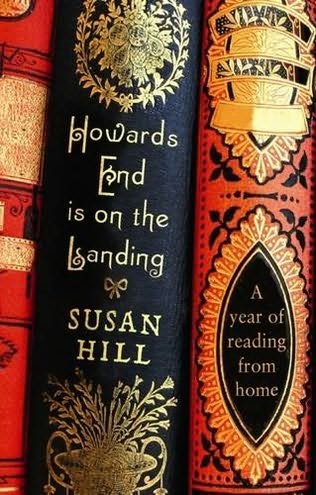
Susan Hill: Howards End is on the Landing (2009) A Bookish Memoir

Early one autumn afternoon in pursuit of an elusive book on her shelves, Susan Hill encountered dozens of others that she had never read, or forgotten she owned, or wanted to read for a second time. The discovery inspired her to embark on a year-long voyage through her books, forsaking new purchases in order to get to know her own collection again. A book which is left on a shelf for a decade is a dead thing, but it is also a chrysalis, packed with the potential to burst into new life. Wandering through her house that day, Hill’s eyes were opened to how much of that life was stored in her home, neglected for years. Howard’s End is on the Landing charts the journey of one of the nation’s most accomplished authors as she revisits the conversations, libraries and bookshelves of the past that have informed a lifetime of reading and writing.

I can’t tell you exactly how long it took to read this book. An evening? Two? Certainly not longer. I devoured it. What is more fascinating to read than a bookish memoir? And written by a writer. On top of that Howards End is on the Landing also contains some information on Strange Meeting, the first book I chose for my Literature and War Readalong.

Shouldn’t we all stop buying books from time to time and first read what is at hand, on our own shelves? This is exactly what Susan Hill did for a whole year. During this year she discovered and rediscovered a lot of books and writers, was reminded of many memories that are linked to books and writing and chose her own personal canon of 40 books.

It is an extremely interesting and entertaining and at times frankly puzzling book. Susan Hill doesn’t read Canadian or Australian literature. Why not? Too foreign. She thinks Joyce, Proust and a few others are unreadable. Are they? There were bits and pieces of information like this that did surprise me. But she is honest. She isn’t pretending for one second. It is obvious that this is the book of a reader, it is nothing like Francine Prose’s outstanding Reading Like a Writer, it is only about personal choices and tastes. There are whole chapters dedicated to her favourite female writers: Barbara Pym, Anita Brookner, Virginia Woolf, Penelope Fitzgerald and Iris Murdoch.  She has met quite many of the writers she mentions and tells anecdotes that are interesting too.

One whole chapter is dedicated to diaries, another one to picture books, one to things that fall out of books, another one is dedicated to annotations in books and  she muses over short stories (not her favourite form).

Sebald gets a whole chapter which surprised me after what she said about Proust and Joyce and others. I’m glad I am already reading his Austerlitz or I would have to rush and get one of his books. She really makes him sound appealing. I agree with her, there is no writer like Sebald.

His subject matter is extraordinary, unpredictable and odd – he seems to collect the unusual and be interested in the outlandish, but, through his eyes, even the ordinary and prosaic becomes somehow strange. Everything he sees, everywhere he goes, every person he meets, all are filtered through some curious lens of his own devising.

Something that I liked is her evaluating some of the classics and giving advice with which one of their novels one should start. One should read Hardy’s The Mayor of Casterbridge and not start with Tess of the d’Urbervilles or Jude the Obscure. Sounds sensible.

If she had two choose among the ghost stories she knows, she would choose M.R. James’ O Whistle and I’ll Come to You and Edith Wharton’s  Mr Jones. Given that it’s a genre in which she excels, I take her word for it.

When it comes to short stories in general she likes John McGahern, William Trevor and Katherine Mansfield.

Travel books are also covered and here it is Patrick Leigh Fermor who gets a special mention. He is also mentioned in her chapter on editing books, something she has also been doing for quite a while. Fermor is one of her authors.

One chapter I enjoyed particularly was the one on diaries. I would have liked to start all the books mentioned right away and have never heard of some the authors she loves to read and reread. Namely the Reverend Francis Kilvert and Frances Partridge. But she also loves Virginia Woolf’s A Writer’s Diary and, surprisingly (as she doesn’t like his novels at all), The Journal of Sir Walter Scott.

All in all I highly recommend this book. It’s very colloquial and reading it feels like talking to a good friend about the books and stories he or she likes. I found a lot of books I’m looking forward to reading now, especially those that are waiting on my shelves. In this sense it is an inspiring book that put me in the mood to concentrate more on the books I already have and not acquire so many news ones.

Out of the list of 40 novels she indicates, I chose to reproduce a list of the novels written by women that she thinks to be among the best. I chose only the women because a) they are not as numerous and b) I would like to read more female authors this year and c) you should still have a reason to read her memoir.

I read and reviewed Carson McCullers and read To the Lighthouse as I have read all the novels by Virginia Woolf (except Voyage Out). The Rector’s Daughter and The Blue Flower are those I am most curious about.

Which ones of these novels do you know and like?

The Ballad of the Sad Café by Carson McCullers

The Last September by Elizabeth Bowen

Middlemarch by George Eliott

The Blue Flower by Penelope Fitzgerald

To the Lightouse by Virginia Woolf

The House of Mirth by Edith Wharton

The Rector’s Daughter by F.M Mayor

The Pursuit of Love by Nancy Mitford

The Bell by Iris Murdoch

Family and Friends by Anita Brookner

The Finn Family Moomintroll by Tove Jansson

Best and Worst Books 2010

After debating with myself for at least one week, whether or not I should do a Best of 2010, I finally gave in. Since I only started blogging in August many books are not reviewed here. Unfortunately some haven’t or will never be translated either. I did also add the worst books of this year. Not very nice, I know…

Most engrossing reads

These were the books where I never checked how many pages were left because I had finished them before even getting the chance to do so.

Francesc Miralles Amor en minúscula. Please find here his Spanish website. This writer needs to be translated!

Ulli Olvedi Über den Rand der Welt. Olvedi is a German Buddhist, teacher of Qi Gong and novelist.

M.C. Beaton Death of a Witch. Cozy crime in a Scottish setting with cat.

Ayelet Waldman Love and Other Impossible Pursuits. She has a style that just swipes you away and all her themes are so interesting.

Elizabeth Lupton Sister. Great thriller.

Ruth Rendell A Judgment in Stone. Fascinating psychological study of a criminal mind.

Most beautiful

You want to live in the world created by a beautiful book, jump right into it and stay there.

Harper Lee To Kill a Mockingbird. Atticus, where have you been all my life?

Rosamond Lehmann Dusty Answer. I love Rosamond Lehmann. This moved me and it is beautiful and thanks to this book I started blogging because it made me discover A Work in Progress and….

Elizabeth Taylor Mrs Palfrey at the Claremont. Just perfect.

Niccolò Ammaniti I am not scared. Childhood memories, intense pictures, such a beautiful, beautiful book.

Meg Rosoff What I Was. This has a truly dreamlike quality. Something very, very special.

Most fascinating

Books that were different, thought-provoking, engaging, not easy but worthwhile.

Sheri S. Tepper The Gate to Women’s Country. That’s what I call original. Feminist SciFi.

Audrey Nyffenegger Her Fearful Symmetry. The setting (Highgate Cemetery), the topic (ghosts), the writing. Marvelous.

Sjón The Blue Fox. Fairytale, historical, poetical.

John O’Hara Appointment in Samarra. This is a must read for aspiring writers. His writing teaches you a lot.

Most interesting

Occasionnaly you want to learn something when you read a novel. These two teach you something, are entertaining and really surprisingly good reads.

Lisa Genova Still Alice. What if you had early onset Alzheimer’s? Who would you be without your memory, without your intellectual faculties and how would others react?

Allegra Goodman Intuition. Did you ever wonder what scientists do in a lab, how researchers live? Intuition tells you this and a lot more. She kept me interested in a topic I am normally not interested in. Plus the style is limpid.

Most accomplished

This is the category of the stylists. Two of the books mentioned have been written by poets.

Jennie Walker 24 for 3. The work of a poet. I hardly found a book in which more parts were quotable than in this one.

Gerard Donovan Julius Winsome. Beautifully crafted. Sad and touching story. If you ever really loved an animal you know what he is talking about…

Jennifer Johnston The Gingerbread Woman. How to survive a tragedy? Told in compelling prose.

Andrew Sean Greer The Story of a Marriage. Puzzling, nice construction, short and efficient.

Most touching

Books that speak to you, your soul or something you experienced. In these cases everything spoke to me.

Susan Breen The Fiction Class. A teacher of creative writing, a difficult mother, a possible love story.

Maria Nurowska Jenseits ist der Tod. Death of a mother and how to bury her. Raw emotions. Incredible. I read the German translation of this book. The original is Polish.

Best Short Story

Lauren Groff Blythe (from her collection Delicate Edible Birds). If someone took the pieces of Anne Sexton’s life and wrote a short story about it, that is what would come out.

Would I have wanted to be the author?

I always ask myself this question. Occasionally I say yes.

These are this years’ choices:

Francesc Miralles Amor en minúscula

Maria Nurowska Jenseits ist der Tod

Niccolò Ammaniti I am not scared

Harper Lee To Kill a Mockingbird (why be modest?)

Non Fiction

Deepak Chopra’s The Book of Secrets. Chopra is famous but I don’t necessarily like his books. This one was different. It is one of the best introductions to Hinduism and the different yogas you can find. It combines theory with exercises. A truly great book and recommended by Ken Wilber whom I admire loads.

Paul Leyhausen Cat Behaviour: Predatory and Social Behaviour of Domestic and Wild Cats. One of the most interesting books on cats.

Georg Diez Der Tod meiner Mutter. Unfortunately this hasn’t been translated. It is an outstanding memoir about the death of a mother, the love of a son and saying goodbye.

Steven Pressfield The War of Art. You want to write or be otherwise creative? Why don’t you? Procrastination. Pressfield’s book is like dynamite…

Isabel Gillies Happens Everyday. Also a memoir. The style is simple not very engaging but I enjoyed it a lot. It is the story of the end of a marriage. But that is not the engrossing part, the engrossing part was the description of Oberlin College. Campus life in the States, something we do not have here.

The worst reads this year

Sebastian Barry’s The Secret Scripture. I hate this type of coincidence and Maggie O’Farrells’ The Vanishing Act of Esme Lennox tells a similar story only in a more appealing way.

Jo Nesbos The Snowman. Did he want to kill me through boredom? He almost achieved. Predictable and boring.

Alice Sebold The Lovely Bones. This is a bit difficult. Why did I not like it? I just didn’t. Period.

Maria Nurowska

Teresa Rodriguez: The Daughters of Juárez (2007) Roberto Bolaño, Bordertown and The Story That Wants to be Told

For more than twelve years, the city of Juárez, Mexico — just across the Rio Grande from El Paso, Texas — has been the center of a horrific crime wave against women and girls. Consisting of kidnappings, rape, mutilation, and murder, most of the atrocities have involved young, slender, and poor victims — fueling the premise that the murders are not random. As for who is behind the crimes themselves, the answer remains unknown — though many have speculated that the killers are American citizens, and others have argued that the killings have become a sort of blood sport due to the lawlessness of the city itself. And despite numerous arrests over the last ten years, the murders continue to occur, with the killers growing bolder, dumping bodies in the city itself rather than on the outskirts of town, as was initially the case, indicating a possible growing and most alarming alliance of silence and cover-up by Mexican politicians.

The subtitle of this book reads A True Story of Serial Murder South of the Border. Ciudad de Juárez must be one of the most dangerous cities on Earth. For women and men alike. I heard about the serial murders on poor maquiladora (assembly factories) workers while reading a blog post on MAC’s tasteless new cosmetics series, dedicated to the dead women of Juárez. I started to investigate and found numerous films online. I read that there has been a movie starring Jennifer Lopez, Bordertown (don’t think it is very good), which is dedicated to the Juárez murders and that even Bolaño’s novel 2666 was in large parts dedicated to those crimes. I had decided to tell their stories long before I read about Bolaño and since I haven’t read him yet, there is no actual influence here. My story is progressing slowly. Too many points of view. But I can’t stop. The story wants to be told. It feels odd. While writing I am stiil researching as well. This is the first nonfiction book on those dead women I picked up. It is probably what is called a true crime book. Something I never read but the story has a hold on me.

Ciudad the Juárez is a Mexican border town that has grown from 200’000 to 2’000’000 in 40 years. Factories from across the border have opened up their doors and hire cheap workers by the thousands. Preferably young women and girls. They make 3 – 5 dollars a day in 9-14 hour shifts. Many are as young as 12 and work with forged passports. Girls are preferred as they are cheaper and said to be more accurate on the assembly lines. In the factories they have air conditioning, clean toilets, showers, and light. I mention this because when they come home, they don’t have that. Many of them live in shacks. No lighting, no electricity, no warm water and a hole in the floor instead of a toilet. These are the poorest of the poor. Many of these girls and women work double shifts or go to school as well. They disappear on their way home from work or school. One after the other. Their families are so poor, they have no telephone, no mobile phone. When the girls go missing  a manifold ordeal begins. How do you get to the police to tell them someone is missing without a car? Once you are there, they tell you to wait 72 hours and come back. And they laugh and say your daughter is a loose girl and that she will come back eventually.

This happened to thousands of families. Many of the girls were never found. The others were found dead. I spare you too many details, just let me say that they were raped, tortured and mutilated and either left dying in the desert or disposed openly near the city.  And almost none of the killers has been found. Who kills the girls of Juárez? The police? Serial murders from the US? People who do snuff movies? Frustrated Mexican men? Drug dealers? Brujos? Satanists? The dead girls look all similar. They are between 17 and 25, slender, petite, with long dark hair and very pretty faces.

I am haunted by these stories. I cannot help much but I can raise awareness. And I can tell their stories. Below you see the remembrance crosses of some of the victims and an Amnesty International clip. Women’s organizations try to help now. Tereza Rodriguez is a reporter with Univision. Her book is full of stories and full of loose ends about the possible killers. It’s interesting and horrible to read. If you would like to know more, just go to youtube and type Ciudad the Juárez. There are movies from Women’s groups and mothers who mourn their daughters. Be prepared, this might be one of the darkest stories you will ever hear. No wonder some of the families think it’s the devil commiting these crimes. It is hard to believe that one human being does this to another one.