Returning to Virginia Woolf

Maybe it’s because I’m reading Alexandra Johnson’s books and Virginia Woolf is an author who is central in them or perhaps it is because of Sigrun’s (sub rosa) Virginia Woolf project which I like to follow, whatever it is, Virginia Woolf was often on my mind lately.

I have this odd habit that when I like an author a lot I try to keep at least one of his or her books for later. There are a few authors whose complete works I have read but, due to my reluctance to run out of books to look forward to, they aren’t numerous.

Virginia Woolf is one of those authors where the thought I may finally have read all she has ever written fills me with a certain apprehension. While I’m still keeping Moments of Being for later, I have finally started The Voyage Out, the only novel I hadn’t read yet.

It’s funny to return to her and finalize the reading of her novels with the first book she wrote. It feels as if I had completed a circle. I started reading Virginia Woolf with Mrs Dalloway. I didn’t know that Mrs Dalloway was a returning character. I didn’t even know that Virginia Woolf had any returning characters. But here she is, in The Voyage Out, Mrs Dalloway, in all of her “glory”. Was she always this obnoxious? Frankly, I don’t remember. What I remember of my first Virginia Woolf novel was how much I liked the style.

The Voyage Out is very different from later books but at the same time it contains so many aspects typical for Virginia Woolf”s writing. I know many people read the body of work of an author they cherish chronologically but in her case, reading backwards wasn’t a bad choice. One could too easily overread important aspects of this early novel or, as was done when it was published, dismiss it as being nothing special.

Reading The Voyage Out makes me realize once more what I like the most about her writing. Yes, the style, especially in the later novels, is fantastic, with its flow of interior monologue, the way she uses time and how she describes the passing of time. But there is something else that stayed with me forever since the day I have read Mrs Dalloway. Her writing has an exhilarating quality, an effervescent intensity of feeling that made me think of a German expression which I adore: “Champagner Wetter” or “Champagne weather”. Champagne weather is used to describe a very fresh but sunny spring morning on which the air is still cool, nature has returned to life, the first tentative, tiny leaves appear, the first blossoms can be seen. It’s already a bit warm in the sun but still chilly in the shade. It’s like drinking the first glass out of a freshly opened, nicely cooled Champagne bottle. It bubbles and goes to your head. Virginia Woolf’s novels are full of scenes conveying the mood of champagne weather.  

I will write a “proper” review once I have finished the book but I’m enjoying it too much to wait until then. So far I can see that the story is told chronologically and sequentially, nothing daring really. But there is already a very striking way of writing about people’s interior lives. One of the main themes is the role of women and the way they are treated or rather mistreated by society. Parts of the novel reminded me of E.M. Forster, others of Henry James’ Portrait of a Lady. Rachel, one of the main characters, has a lot in common with Isabel Archer. Still there are scenes which are already typically Woolf. She had a very particular way of showing the passing of time or how the interior worlds of people coexist. There is a wonderful scene towards the middle of the novel in which we see a hotel at night.  First we see it from the outside, all its windows are illuminated, the people are getting ready to go to bed. Later we approach and enter the building, brief glimpses into the various rooms draw pictures of the inhabitants. At the end of the scene, they are lying in their beds, separated only by thin walls, dreaming or just sleeping, drifting off into unknown territory, as if on a big ocean liner. It is a recurring scene really, as the book starts with the voyage on a ship.

It is possible that I will start rereading her books in chronological order when I have finished The Voyage Out and Moments of Being. My favourite of her books are Mrs. Dalloway, To the Lighthouse and Flush. I didn’t like The Years or The Waves much and can never even keep them apart. I also didn’t care for Orlando at all. Not sure why, it’s generally a favourite of many people but I remember I found reading it was painfully boring. Jacob’s Room and Between the Acts were two I liked but the memory of them is barely more than a vague impression.

I often hear people say, they are intimidated by Virginia Woolf, just like many are intimidated by Proust or James Joyce. For those who didn’t dare reading her so far, The Voyage Out and Flush are excellent starting points.

Have you read The Voyage Out or any other of Virginia Woolf’s novels? Which is your favourite?

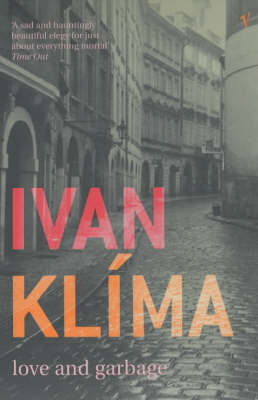
Ivan Klíma: Love and Garbage – Láska a smetí (1988)

Donning an orange vest, the narrator–a banned Czech writer–sweeps the Prague streets with a group of the society’s other outcasts–an old sailor given to drink, a sickly teenager, a foul-mouthed former beauty, a failed inventor, and an ex-pilot. As they go about their mindless job, the narrator learns of the dreams and sorrows of his coworkers and meditates on the life and work of Franz Kafka, the power of literature, and his relationship with his dying father. 

Love and Garbage is my first book by Czech writer Ivan Klíma. It’s said to be one of his best. Klíma had a difficult life. Born in Prague in 1931, he spent some years of his childhood in the concentration camp Theresienstadt.  Later he was an editor in his home town. He spent 1969/70 in the US where he taught Czech literature at a university but when he returned to Prague in 1970 he was forbidden to publish until 1989. Love and Garbage contains a lot of Klíma’s own story but it isn’t, as he says, autobiographical.

The narrator, a writer who isn’t allowed to publish, starts working as a street sweeper. The slow and contemplative work allows him to explore his city, to think about his life and an essay on Kafka he is writing and helps him forget his lover. Because he chose to work as a street sweeper and it isn’t necessity who forces him to do this job, he likes it. He likes his colleagues, most of them are outcasts too. The work he is doing doesn’t only allow him to think about his life but it turns into a philosophical meditation on what the society deems worthless. Garbage and human beings alike. As a child the writer who is Jewish lived in Theresienstadt and most of his relatives were killed. The Jews, he muses, were like garbage for the Germans, worthless and had to be discarded and burned. The novel is full of linked symbols and elements, of scenes that are mirrored and repeated.

After he was forbidden to publish, he was desperate, caught in a marriage that didn’t mean much anymore, to a wife who had started a new life. She was studying psychology and trying to help others while he spent his days locked inside, chasing thoughts, trying to write. During this time he meets the sculptor Daría and falls passionately in love with her. When the affair ends, he decides to sweep the streets. This is symbolical as well, he starts to clean the city around him, to make room inside for another, clean start.

The writer is working on an essay about Kafka and often returns to him. He is reminded of Kafka constantly. For him, Kafka was the purest possible writer, an outcast like himself, not really understood and unhappy in love.

When the novel begins, the narrator is heartbroken but that doesn’t explain the sadness in the book. The sadness comes from looking back, thinking about his childhood in the concentration camp and all the people he lost. The only person still alive from that period is his father but he is very old and ill. The saddest thing is that despite everything that happened in the past and that his country had to endure, instead of having a better life now, they live under a communist regime. The constant threats and lack of freedom make life unbearable. His affair with Daría is an attempt at finding happiness but it turns bitter eventually and when he tells his wife about it, it seems at first that he will end up losing both women.

Love and Garbage is a challenging read. It demands concentration as the story moves back and forth in time, breaking up the chronology, sometimes up to three times per page. It took a bit of getting used to but once I had read a few pages I liked it. This type of writing doesn’t allow you to fall into some sort of reader’s trance but wakes you up constantly. This may sound like a gimmick but that’s not what it is at all. It’s a cunning way to mirror the narrator’s interior life.  It’s not so much an interior monologue as a way to render how freely thoughts move, unlike the person who thinks them. We easily move back and forth in our minds, a childhood memory can be followed by some thoughts about the past day. In our minds we can go wherever we want, at any time we choose.

I have read a lot of Czech writers who wrote in German but only a very few who write in Czech. As I have found out, Love and Garbage was meant as an answer to Kundera’s Unbearable Lightness of Being which Klíma considered to be chauvinistic.

I liked Klíma’s writing. It’s unusual, complex, poetic and highly descriptive. There is hardly an aspect of human life that isn’t touched and that’s why the book is like a delicately woven tapestry. One pattern evokes another one, one angle mirrors the next, all is linked and intertwined. Poetical passages follow psychological insights, philosophical thoughts come after realistic descriptions. The book is sad but the way the writer fights for the tiniest bit of happiness and the richness of his interior life are so beautiful, they illuminate the book from within.

Have you read Klíma or other Czech writers?

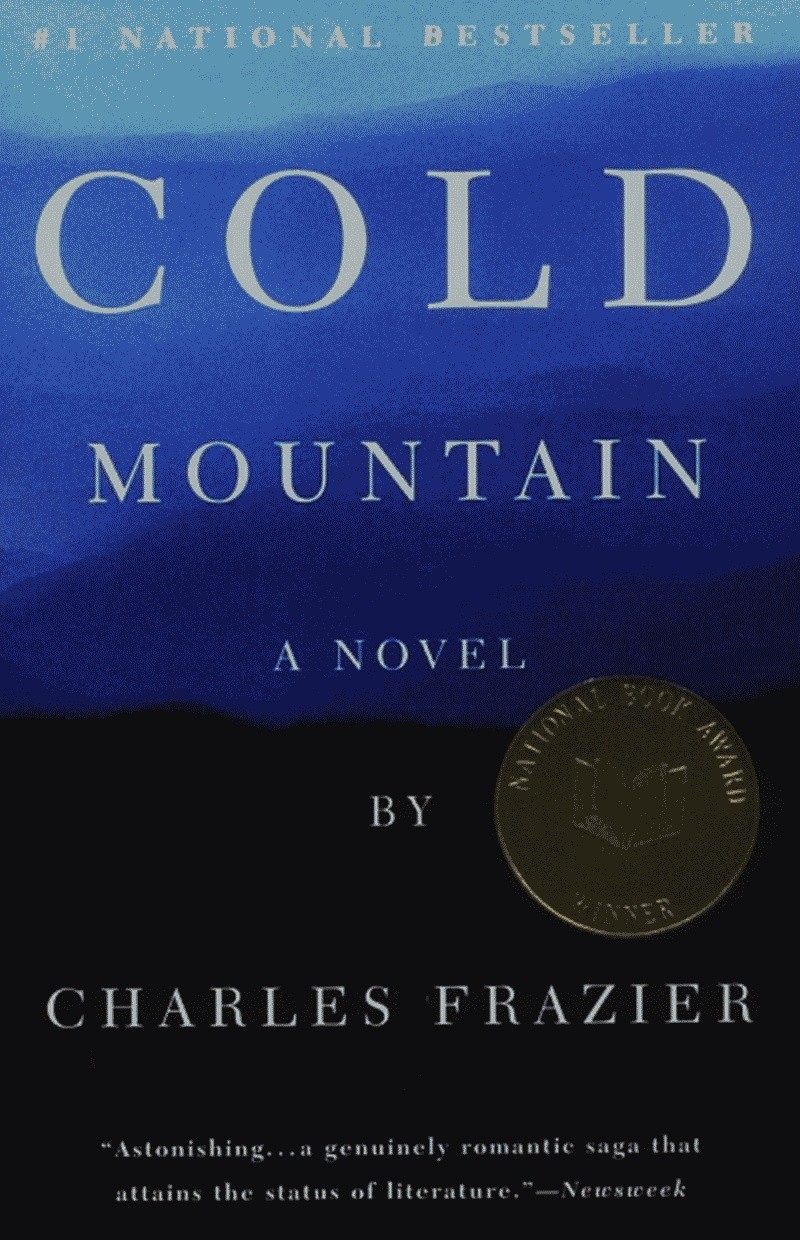
Charles Frazier: Cold Mountain (1997) Literature and War Readalong December 2011

The last book of this year’s readalong, Charles Frazier’s Cold Mountain,  is the only book on the American Civil War.

Cold Mountain juxtaposes the stories of Inman, a Confederate soldier, who was badly wounded at Petersburg, and Ada, the woman he loves, who waits for him in Cold Mountain. It describes Inman’s slow and long return to Cold Mountain and how Ada copes on her own after her father has died.

I have only just finished this book and I am still a bit stunned. This is an extraordinarily well-crafted novel. The structure is interesting from the beginning on. The chapters alternate between Inman’s and Ada’s point of view and are symmetrical. Motifs and themes that are described in one chapter will be echoed in the next. This is fascinating. At the beginning, for example, we see Inman at a hospital. He was badly wounded and most of the time he is lying in bed and watching the world through a window. The window is like the frame of a picture.

That summer, Inman had viewed the world as if it were a picture framed by the molding around the window. Long stretches of time often passed when, for all the change in the scene, it might as well have been an old painting of a road, a wall, a tree, a cart, a blind man.

In the next chapter we see how Ada struggles. Her father has died and left her nothing but a farm. The farmhands have all gone, either to war or they are hiding. Ada has lived almost all of her life in Charleston and has only lived in Cold Mountain for a few years, because her father was ill, and the mountain air was thought to be beneficial. She can sew, paint, play the piano and loves to read but never in all of her life has she worked with her hands. She doesn’t know how to keep the farm going, how to produce anything. She spends long stretches of time sitting in a chair, reading and staring through a window that starts to look like a frame, the sky outside like a painting.

There is nothing that Inman experiences, that Ada’s story doesn’t echo and vice versa. They both struggle to survive, they both find unlikely friends. I liked this structure a lot but there is more to this novel. It’s exceptionally well written. Words are chosen carefully, the prose is crystal-clear and manages to paint a picture of a breathtaking landscape that we see change with the seasons.

Maybe Ada would have starved or contracted an illness and died if Ruby hadn’t turned up at her farm. From that moment on her life is changed forever. Ruby has never read a book but she is so resourceful and attentive to every little detail of nature, one almost expects her to spin straw into gold. There is nothing she cannot use, mend, transform. And she knows how to teach Ada to become as capable as she is. All Ada knew so far was a life of leisure and that life now turns into work. It’s interesting to see how useless money has become during the war and how valuable it is to be able to produce your own food.

After a while, when plants grow and they have produced all sorts of things, the women are not only independent but almost completely self-sustaining. And they have become very close friends. They sit on the porch at night and Ada reads to Ruby. They talk and sit like an old couple. Content. At least Ruby is, Ada still longs for Inman.

After a while I started to dread his return. Their life seemed so peaceful, I couldn’t imagine how Inman would fit in. What would happen, would Ada send Ruby away, would they live together?

All this time Inman is walking and hiding. He is constantly in danger, he is a deserter after all and the country seems to have become lawless. Anyone can shoot you at any time. That’s what happens to him anyway. He is taken prisoner, shot and left for dead. He finds refuge with an old woman, who, like Ada and Ruby, lives completely on her own, with a little herd of goats.

This is a very powerful episode. The war is constantly present throughout the book. Inman remembers the battles, the dead men, the wounded. The butchery. But nowhere is this as much in the foreground as when he speaks with the old woman. I’m not very familiar with the American Civil War and the impression I got from reading Cold Mountain was that maybe initially there was a cause but very soon there were a lot of lawless people attracted who came in for the change and the freedom to go about killing people as they pleased.

While Ada and Ruby live an almost sheltered life, Inman, in crossing the country, sees the many faces of this war. The poverty, the illness, people who die for no reason, the cruelty, the violence. His own biggest fear however is that he is too damaged to live a happy life with Ada. The old woman says something that made me think and I wondered whether this is really true:

That’s just pain, she said. It goes eventually. And when it’s gone, there is no lasting memory. Not the worst of it anyway. It fades. Our minds aren’t made to hold on to the particulars of pain the way we do to bliss. It’s a gift God gives us, a sign of His care for us.

Something that struck me more than anything, besides the beauty of the language, the artful structure and the wonderful complexity of the characters, is how American Cold Mountain is. It’s a hymn to the landscape and the history of the country, that includes everything, the mythology of the Cherokee, the stories of the settlers, the possibilities that this country offers to resourceful people.

Cold Mountain is a stunning novel and I’m sorry, I feel haven’t done this book any justice. It’s a complex, rich and a very rewarding book. It’s rare that I feel envious of characters in a book but at times I thought that there could hardly be a better life than the life led by Ada and Ruby.

If you have seen the movie, it is still worth, reading the book. It is so much richer.

*******

Cold Mountain was the last book of the Literature and War Readalong 2011. The first book of the Literature and War Readalong 2012 is Helen Dunmore’s Zennor in Darkness. The discussion takes place on Monday, January 30 2012.

Best and Worst Books 2011

Looking back I must say that this was a very good reading year. That’s fortunate for me because to be honest in many other areas it was a nightmare and I hope that next year will be better. But readingwise it was wonderful. So many new authors, so many really great books. It couldn’t have been much better.

It’s always so difficult to say which books I liked the most but I noticed that whenever I thought “Best Books” and started to make a mental list, the same 12 books popped up again and again and only when I went back to the blog and looked at all the posts, did I remember many more. So, like last year, I’m cheating and do not present a Top 10 but a best of per category.  The 12 that popped up immediately can all be found under the category beautiful and enchanting.

All the quotes are taken from my reviews.

Most beautiful and enchanting books 

Saraswati Park by Anjali Joseph

“The calm, quiet and floating feeling that permeates Saraswati Park makes this one of the most beautiful novels I have read recently. Saraswati Park is about love and marriage, loss and discoveries but also about the power of imagination and memories, the beauty and danger of reading and ultimately also about writing.”

Three Horses by Erri de Luca

Three Horses was my first Erri de Luca but it will not be the last. “The scent of earth, sage and flowers pervades a story of love, pain and war.”

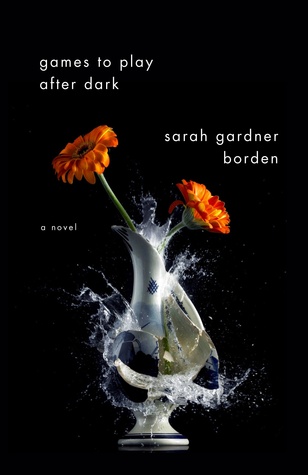
Games to Play After Dark by Sarah Gardner Borden

“It is hard to believe that Games to Play After Dark is Sarah Gardner Borden’s first novel. The topic, a marriage that falls apart, may not be the most original, the young mother who tries to combine the demands of her children and her husband and her personal needs, isn’t new but how she describes it, the details she evokes, the way she looks at what has been swept under the carpet and the bed and what is hidden in the closets is extremely well done.

Back When We were Grownups by Anne Tyler

Back When We Were Grownups is a novel about possibilities, lost dreams, second chances, family and love and ultimately about chosing the right path and belonging. I really loved this book. I liked Rebecca and many of the other characters, especially Poppy, the great-uncle. I liked how it shows that choosing a partner also means choosing a life and that maybe sometimes when we feel we are just drifting we are actually just sliding along because we are on the right path.

The Fish Can Sing by Halldór Laxness

Have you ever read a book and caught yourself smiling almost all the time? The Fish Can Sing is so charming I couldn’t help doing it. It’s also quite funny at times and certainly very intriguing. I’m afraid I can’t really put into words how different it is. As a matter of fact, Halldór Laxness’ book is so unusual and special that I have to invent a new genre for it. This is officially the first time that I have read something that I would call mythical realism.

The Square Persiommon by Takashi Atoda

I think the most intense reading experience is one that connects you to your own soul, that triggers something in you and lingers. Atoda’s stories even made me dream at night. I almost entered an altered state of consciousness while reading them.  The Square Persimmon managed to touch the part in me where memories lie buried and dreams have their origin.

Stranger by Taichi Yamada

Strangers is an excellent ghost story but it is also so much more than just a ghost story. It’s a truly wonderful book with a haunting atmosphere, a melancholy depiction of solitude and loneliness with a surprisingly creepy ending.

Enchanted Night by Steven Millhauser

Hot summer nights have a special magic. In the middle of the night, when everyone is sleeping and only night creatures are awake, the hot still air is heavy, time seems to stand still and the world is indeed enchanted. This is the magic captured by Steven Millhauser in his beautiful and poetical novella Enchanted Night. I have never read this book before but the images, the atmosphere felt so familiar. It was a bit like looking into my own imagination.

Goldengrove by Francine Prose

Reading Francine Prose’s novel Goldengrove felt at times like holding the clothes and belongings of a dead person in my hands. While I read it, and for a long while after I finished it, I felt as if I was grieving. It’s a really sad novel but at the same time it’s a very beautiful novel. It also reminded me of the series Six Feet Under. There is something very similar in the mood and the characters. Although I absolutely loved this novel I could imagine it isn’t for everybody.

Nada by Carmen Laforet

 Nada deserves to be called a classic. However it isn’t a classic because of the plot which can be summarized in a few sentences but because of the style. This is a young writer’s book who manages to capture the intensity of living typical for the very young and passionate.

The Cat by Colette

La Chatte has a subject to which I relate but it is far more than the story of a relationship between a man and his cat. It is a subtle analysis of love versus passion, of marriage versus celibacy, of childhood and growing up, of change and permanence. The story also captures the dynamics of disenchantment following the recognition that one’s object of desire is flawed.

So Long, See You Tomorrow by William Maxwell

So Long, See You Tomorrow  is a beautiful and melancholic short novel that explores a wide range of themes like memory, the past, isolation, loneliness, friendship, jealousy and violence. The central theme is that of the omission and the following regret. There are so many things left unsaid, things not done or too late in a life, that this core theme will speak to almost all of us. It’s often little things but they resonate for a long time in our lives and we might wish to turn back time and undo what has happened.

Most engrossing reads

These were the books where I never checked how many pages were left because I had finished them before even getting the chance to do so. In other words, the page-turners.

Underground Time by Delphine de Vigan

Les Heures souterraines or Underground Time is a chillingly good novel and shockingly topical. It’s accurate in its depiction of life in a corporate setting and of  life in a big city. It’s a very timely book, a book that doesn’t shy away to speak about the ugly side of  ”normal lives”.

Whatever You Love by Louise Doughty

Whatever You Love is a book of raw emotions. And that from the first moment on when we read about the police knocking on Laura’s door to inform her that her daughter Betty has been killed. Laura is a very emotional woman, she feels everything that happens to her intensely, her reactions are very physical. There are many elements in the book that made me feel uneasy.

You Deserve Nothing by Alexander Maksik

You Deserve Nothing was certainly one of the most entertaining reads this year. It offers an interesting mix of alternating and very realistic sounding voices, a Parisian setting and a wide range of themes.

A Kind of Intimacy by Jenn Asworth

I already jokingly “said” to Danielle in a comment that her top 2010 might become my top 2011 and,  yes, this book is certainly a candidate as it is astonishingly good. Very dark, absolutely fascinating, engrossing, and very well executed. While starting it I had forgotten Jenn Ashworth was compared to Ruth Rendell but the association immediately occurred to me as well.

everything and nothing by Araminta Hall

everything and nothing was one of those super fast reads, a book that I could hardly put down. Really riveting. The only complaint I have is that this is labelled as a psychological thriller. Although there is a part of it reminiscent of Ruth Rendell, it is like a background story and not really very gripping. At least not for me. Still I consider this to be a real page-turner for the simple reason that it captures chaotic family life in so much detail and explores some of the questions and problems parents who work full-time would face.

Best Books – Literature and War Readalong

How Many Miles To Babylon? by Jennifer Johnston

I loved How Many Miles to Babylon? I think it is a beautiful book. It doesn’t teach you as much about WWI as Strange Meeting (see post 1) but it says a lot about Irish history. I found this look at the first World War from an Irish perspective extremely fascinating.

The Things They Carried by Tim O’Brien

I expected The Things They Carried to be a very good book. A very good book about the war in Vietnam. What I found is not only an outstanding book about the war in Vietnam but also about the art of storytelling. I’m really impressed.

The Silent Angel by Heinrich Böll

Böll has a gift for description which is rare. And he represents a rare model of moral integrity, he is an author who wrote for those who have nothing, who tried to unmask hypocrisy and uncover everything that was fake and phony in post-war Germany. I don’t know all that many authors who are so humane.

Most touching

On the Holloway Road by Andrew Blackman. I read this novel in the summer and it’s one of a few books I haven’t reviewed. In this case because the reading caught me completely unawares. I had such an emotional reaction that I had to talk about it all the time. I still feel like reviewing it but I need some distance

Best classics

Mme de Treymes by Edith Wharton

Madame de Treymes has a Parisian setting which always appeals to me, as sentimental as this may be. It is a cruel little book and a very surprising one. All in all there is not a lot of description of the city itself, the novel rather offers an analysis of the society. It is interesting to see how Americans perceived the Parisian society and the differences in their respective values.

Hotel Savoy by Joseph Roth

Hotel Savoy has really everything. It is funny, sad, picturesque, touching and bitter-sweet and the ending is perfection. Roth describes people, the hotel and the little town with great detail. And every second sentence bears an explosive in the form of a word that shatters any illusion of an idyllic life. Roth served in WWI and never for once allows us to forget that the horror of one war and subsequent imprisonment have only just been left behind  while the next one is announcing itself already.

Grand Hôtel by Vicki Baum

Grand Hôtel is set in a luxurious hotel in Berlin between the wars. It’s walls shelter a microcosm of German society. The novel draws a panorama of the society and the times, reading it is fascinating and gives a good impression and feel for the time and the people. Vicki Baum includes a wide range of characters, the porter who waits for his wife to give birth to the first child, the aristocratic head porter Rohna, the many drivers and maids as well as some very interesting guests. Including the employees of the hotel gives the book a bit of an upstairs-downstairs feel and permits insight into the lives of the “simple people” who earn just enough not to starve.

Pedro Parámo by Juan Rulfo

It’s a powerful novel infused with the spirit of the Mexican Día de los muertos or Day of the Dead at the same time it is an allegory of oppression and freedom that comes at the highest cost. When you read Pedro Páramo it becomes obvious that “magic realism” has many faces.

Best non-fiction books

Making Toast by Roger Rosenblatt

I found Making Toast wonderful. It contains a lot of little endearing episodes like the one that gave the book its title, in which Rosenblatt states that the only thing he is really good at is making toast for the whole family in the morning. He describes how he gets up very early and, taking into consideration each family member’s taste, he produces a multitude of personalized breakfast toasts.

The Film Club by David Gilmour

The relationship between these two is unique. So much honesty, trust and friendship between a father and a son is wonderful. Not every parent has the chance to spend as much time with his kid, that is for sure, but every parent has certainly spent enchanted moments with his/her child and will be touched by this story. For us film lovers The Film Clubis  a great way to remind us how many movies there are still to discover, how many to watch again and in how many different ways we can watch them.

Howard’s End is on the Landing by Susan Hill

I can’t tell you exactly how long it took to read Howards End is on the Landing. An evening? Two? Certainly not longer. I devoured it. What is more fascinating to read than a bookish memoir? And written by a writer.

The Gifts of Imperfection by Brené Brown

Brené Brown is a researcher, specialized in topics like shame and perfectionism and analyzing how they are linked and keep us from living wholeheartedly. She is an incredibly honest and open person who is able to show her vulnerability.

Natural History of Destruction by W.G. Sebald

On the Natural History of Destruction is one of the most amazing books I have read this year. For numerous reasons. It is in line with the topic of my reading projects and readalong and contains descriptions that I have never read like this. On the other hand it gave me the opportunity to see another side of Sebald. One that I didn’t expect.

Cinderella Ate My Daughter by Peggy Orenstein

What happens when a feminist who knows exactly how things should be, gets pregnant and the child is – horror on horror – a girl? This is pretty much how Peggy Orenstein opens her entertaining, thought-provoking and occasionally quite shocking account Cinderella Ate my Daughter about what she sub-titles “Dispatches from the front-lines of the new girlie-girl culture”.

The Equality Illusion by Kat Banyard

Kat Banyard’s The Equality Illusion: The Truth about Men and Women Today takes an unflinching look at what it means to be a woman today and, due to the fact that Banyard is British, especially in the UK . Still, whether you are an Afghan woman fighting for girl’s rights of literacy or an American doctor performing late stage abortions, you have one thing in common: you lead a dangerous life and might end up being killed. Both things happened.  The first happened in Afghanistan in 2006, the second in the US in 2009. They illustrate the illusion of equality and show what a global phenomenon it is.

New Author Discoveries

These are the authors that made me think “I would like to read all of his/her books”.

Beryl Bainbridge,  William Maxwell, Jennifer Johnston, Peter Stamm, Annie Ernaux

The worst book this year

There is a lonely winner this year and it has so far not even been reviewed. I’m still determined to do so but I find adding quotes so tedious, only in this case it’s necessary to illustrate the problem I had with the book. Now you are dying to know the title, aren’t, you?

In a Hotel Garden by Gabriel Josipovici
Molly Keane: Two Days in Aragon (1941)

Grania and Sylvia Fox live in the Georgian house of Aragon, with their mother, their Aunt Pidgie and Nan O’Neill, the family nurse. Attending Aragon’s strawberry teas, the British Army Officers can almost forget the reason for their presence in Ireland. But the days of dignified calm at Aragon are numbered.

I first read about Molly Keane’s Two Days in Aragon on Danielle’s blog. Molly Keane or M.J. Farrell, the pseudonym under which she published her books,  is one of Danielle’s reading projects and after having read Two Days in Aragon I can understand why. I’m trying to put into words what type of book this was but nothing I come up with seems to do it justice. Molly Keane captured beautifully the end of an area, portrayed a social system, drew complex character portraits and incorporated such a wide variety of topics that I’m full of admiration.

I love descriptions of big old houses. They seem to have a life of their own and their majestic presence can be felt so strongly, they are almost characters in their own right. Aragon is exactly such a house. The family home of the Fox’s is grand, old and full of history. There are hidden rooms and the ghosts of the ancestors seem to be hovering around. But Aragon is also a symbol. A symbol for a way of life about to end. Aragon also symbolizes oppression as it is the house of an Anglo-Irish family and as such represents everything that the Irish have come to hate and against which they are fighting in 1920, the year in which the novel takes place.

The end of an era can be brought by many things but war, rebellion, change of government are among the most frequent. All over the world when the colonized stand up against the colonists this signifies the end of a life in beauty and ease for the formerly advantaged. Molly Keane knew very well what she wrote about as she came from such a rich Anglo-Irish family who lived in privilege and never had to work. They loved their horses and hunting and eating well. All this was incorporated into the novel. The descriptions of these two days make one long to have been there, to have experienced the rituals, seen the beauty.

Molly Keane offers more than the description of a house and a way of life about to end. One thing I liked a lot in the novel were the characters. None of them likable, maybe with one exception (Sylvia), but all of them are drawn so vividly and in all their complexity that I was glued to the page.

Grania and Sylvia Fox live in the grand old house together with their mother and Aunt Pidgie. Their father has died after a hunting accident. Grania and Sylvia are very different which is also shown in their choice of men. Grania has an affair with Foley O’Neill, a socially unacceptable choice, while Sylvia is secretly in love with a British officer. One girl is described as a slutty, fat, blond and the other as a neat, groomed and very poised young lady. The mother has a bit of both of them but seems to like her passionate, wilder and slutty daughter far more.

Aunt Pidgie and Nan O’Neill, the house nurse, form a duo. Aunt Pidgie is an unwelcome elderly relative that is kept, far away, in the nursery. This reminded me of the first Mrs Rochester in Jane Eyre. The unwanted, especially women, were often locked away. Aunt Pidgie is a bit crazy but inoffensive. In the beginning we know nothing of her sufferings but when we learn more about Nan O’Neill and her well-hidden side of aggression and cruelty we start to pity this poor bird-like little woman. Nan O’Neill is the most complex and fascinating character. She loves Aragon and everything in it with a fierceness and as if it did belong to her. This has a reason. She is an impressive woman, commanding, extremely good-looking and adept at everything. She is especially good at hiding her true nature. Disappointment and lack of love have made her cruel and pitiless. In her role as nurse she is one of the most powerful characters in the novel. She knows about unwanted pregnancies and how to end them, about subtle ways how to torture someone in keeping them alive but constantly uncomfortable. A very chilling character.

I have read a lot of novels about the end of an era, many have houses in their center. I loved Waugh’s Brideshead Revisited as much as E.M.Forster’s Howard’s End and of course,  Bassani’s The Garden of the Finzi Contini. They are often nostalgic and melancholic books. This isn’t the case here, Two Days in Aragon is completely different in tone and although tragedy strikes all of them I wasn’t sad after reading it but rather full of admiration for Molly Keane and her very unique voice and fascinating approach to tell her story.  And I felt exhausted. She is such a vivid storyteller, I lived in those pages, I almost felt as if I had experienced two very intense days.

Steven Millhauser: Enchanted Night (1999)

“This is the night of revelation. This is the night the dolls wake. This is the night of the dreamer in the attic. This is the night of the piper in the woods.”

Hot summer nights have a special magic. In the middle of the night, when everyone is sleeping and only night creatures are awake, the hot still air is heavy, time seems to stand still and the world is indeed enchanted. This is the magic captured by Steven Millhauser in his beautiful and poetical novella Enchanted Night. I have never read this book before but the images, the atmosphere felt so familiar. It was a bit like looking into my own imagination.

Thanks to Carl who reviewed the book not long ago (here is his review), I waited for a hot summer night to read it. I’m glad I did. It felt so right to read this novella during one of the very few hot nights we had this summer.

Here is the beginning of this wonderful book.

A hot summer night in southern Connecticut, tide going out and the moon still rising. Laura Engstrom, fourteen years old, sits up in bed and throws the covers off. Her forehead is damp. her hair feels wet. Through the screen of the two half-open windows she can hear a rasp of the crickets and a dim rush of traffic in the distant thruway. Five past twelve. Do you know where your children are? The room is so hot that the heat is a hand gripping her throat. Got to move, got to do something. Moonlight is streaming in past the edges of the closed and slightly raised venetian blinds. She can’t breathe in this room, in this house.

Laura isn’t the only restless being on this hot and sultry night whose quiet darkness is illuminated by moonlight. All over the little town people feel their yearnings and desires, think of their dreams and wishes. Many of them feel lonely and driven by a secret longing. There is the writer who has turned the nights into days. He writes until midnight, then goes out to visit an elderly woman, roams the streets and sleeps until after noon. He is 39 years old, lives with his mother and has been trying for years to write the definite historical novel. Mrs Kasco, the widow he visits in the middle of the night, still regrets that she didn’t seduce him, when he was still a teenager and she a fairly young woman. On the other side of the city a mannequin in a shop window feels a secret stirring and comes to life. A young man who has never made love to a girl is visited by the moon Goddess while he lies in a backyard dreaming. A mysterious piper plays a flute and attracts stray children. Black cats haunt the streets, four girls wearing masks break into houses. A lonely woman walks the street in a pink bathrobe. A sleezy man spies on a young girl who takes a moon bath.

The story of this hot enchanted summer night, in which abandoned dolls come to life in the attics of the houses, is told in small tableaux, little atmospherical sketches that seem to originate in our childhood imagination. I remember how, when I was a child, I used to check in the morning  whether my toys had moved. Like many children I secretly thought and hoped they were alive at night. My biggest wish was to catch a glimpse of their doings.

Millhauser doesn’t only capture childhood dreams and wishes but also those of teenagers, grown-ups and the elderly and interweaves them in this haunting tale which is written in beautiful, melodious prose that seems inspired by lyrics.

He’d like to wipe it all out, start things over again, give the land back to the Indians. Or better yet, give it to him, to Haverstraw, King of the New World: trapper, hunter, fisher, farmer, sower of appleseed, stargazer, trailblazer, pathfinder, deerslayer, barefoot boy with cheek of tan, Huck Finn on the Housatonic, crackerbarrel philosopher, wily old coot in a coonskin cap, shrew-eyed Yankee, inventor of the cotton gin, the printing press, the typewriter, founder of libraries, distributor of American jeans to the Indians, self-made tycoon in a thirty room mansion, a hometown boy, worked his way up, one in a million, lone ranger, a wayfaring stranger, a born loser, a man down on his luck.

I don’t know anything about Millhauser, only that he won the Pulitzer Prize for Martin Dressler, but his style is so accomplished that I’m curious about his other books.  Does anybody know them?

Jenn Ashworth: Cold Light (2011) Crime and Social Realism

An unsettling, darkly humorous tale of teenage girls in a predatory adult world, and a cocktail of lies, jealousy and unworldliness that leads to tragedy.

I have been looking forward to Jenn Ashworth’s new novel since I read A Kind of Intimacy at the beginning of the year (here’s the review). I had a bit of a problem not comparing the two books but once I let go of that I really liked this novel, it’s disturbing and chilling and you only find out at the very end what really happened.

Cold Light is a very appropriate title for this novel, although – as will be explained towards the end – it refers to bioluminescence.  It is a cold world in which today’s girls move and a predatory one. But is this really all that new? There is a lot that reminded me of my own coming of age. Not for anything in the world would I want to be 14 again. The competitions, the jealousy, the insecurity and the constant fighting off of boys or hoping to be noticed by them – depending on where on the good-looking scale you were positioned – was by far too upsetting. It’s all very horrible and can damage you for life. But there are other things young girls have to cope with nowadays that were not even thinkable 10-20 years ago. And today’s Britain (I’m just finishing Kat Banyard’s book The Equality Illusion and it echoes Cold Light) seems to be even worse than many other places.

Chloe is dead. Chloe will be 14 forever, 14, pretty and romantic. Since her presumed suicide 10 years ago she has become something like a cult figure. A symbol for young love and innocence. Now, ten years later, her former best friend Laura sits in front of her TV in a shabby little apartment and watches the groundbreaking ceremony for her memorial. The ceremony comes to an abrupt and macabre end when human bones are found in the damp soil. Laura nows whose bones they are and from this very first scene in the novel we know that some things must have gone seriously wrong ten years ago and we also know that there is a lot to be found out about Chloe, her ex-boyfriend who died with her and everyone else who was involved.

Laura will be watching TV all night, later joined by Emma with whom she is still in contact. They will be smoking and drinking until the early morning. Through flash backs and parts of their discussion the truth is slowly revealed. It’s the story of three friends who are jealous of one another, an older boyfriend who seems weird, a town in a state of alarm as a flasher who is getting more and more violent is chasing young girls. The three girls are only 14 yet they smoke, drink and have sex. We also hear a lot about innocent Chloe, how she exploited the obsessive best friend feelings of the others, how narcissistic and bullying she was, her delinquency and how she always got away with everything just because she was so pretty. Reading the story from Laura’s point of view we discover a lot about her family, the sadness of her childhood, about her father who seems to suffer from some kind of mental illness, her controlling mother and her obsession with Chloe that turns her into a stalker.

It’s an excellent book, disturbing and accurate and reminded me a great deal of the movie Fish Tank. I also thought of Harry Brown. Both movies paint a bleak picture of British youth. The first one also focusing on young girls being as well prey, victims and perpetrators.

Thanks again to Hodder and Stoughton who send me a review copy.