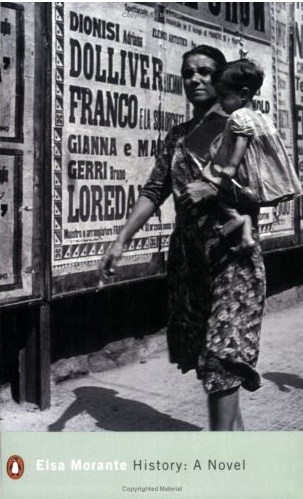
Antonio Tabucchi Week September 17 – 23 2012 and Giveaway

Ever since Stu’s Henry Green Week I wanted to host something similar for an Italian author and my first choice was always Antonio Tabucchi. He is one of the finest Italian writers and one I admire a lot.

Sadly what should have been a tribute to a living author has now turned into a commemoration as Tabucchi died earlier this year.

Tabucchi was a novelist, short story writer and academic. One striking feature was his love for Portugal, the Portuguese language and Fernando Pessoa. He didn’t only teach Portuguese literature at the university but he lived in Portugal (as a reaction among other things to Italian politics), wrote a novel in Portuguese and translated Pessoa.

He is one of the rare authors not writing in English who has been extensively translated. While I will read him in Italian, all those who would like to join can choose from a variety of other languages. He is available in English, French and German and most probably also in Spanish and Portuguese.

Tabucchi’s Indian Nocturne is one of my all-time favourite books. It has been made into a movie. I just read and reviewed Sogni di Sogni – Dreams of Dreams – a collection of imagined dreams attributed to famous writers, musicians and artists. But there are others that I want to re-read or discover for the first time like Tristano muore. Una vita.

If you have never read anything by this author I would suggest you start with one of his more famous novels like Pereira Maintains (Sostiene Pereira) or Indian Nocturne (Notturno Indiano). If you like short stories you may enjoy the beautiful collection of fictitious letters It’s Getting Later All the Time. If you go for quirky and inspiring, Dreams of Dreams may be the thing. But there are more.

Requiem: A Hallucination

Little Misunderstandings of No Importance

The Missing Head of Damasceno Monteiro

And in Italian (and other translations) only

Tristano muore. Una vita

Il tempo invecchia infretta

Il filo dell’orizzonte

In order to motivate you to join I’m giving away one copy of one of his most famous novels which has also been made into a movie with Marcello Mastroianni.

Pereira Maintains

In the sweltering summer of 1938 in Portugal, a country under the fascist shadow of Spain, a mysterious young man arrives at the doorstep of Dr Pereira. So begins an unlikely alliance that will result in a devastating act of rebellion. This is Pereira’s testimony.

The giveaway is open internationally. If you would like to win this book, just leave a comment. The only condition is that you take part in Tabucchi Week. What you will read is up to you, it doesn’t have to be the book you won.

The winner will be announced on Friday August 17 2012.

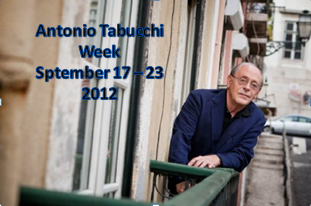
Elsa Morante: La Storia – History (1974) Literature and War Readalong August 2011

History was written nearly 3 decades after Morante spent a year hiding from the Germans in remote farming villages in the mountains south of Rome. There she witnessed the full impact of the war and first formed the ambition to write an account of what history does when it reaches the realm of ordinary people struggling for life and bread.

La Storia aka History is the last WWII centered book of this readalong. It’s also the most ambitious, starting before the war and ending just a few years after. It describes in minute details how the schoolteacher Ida Mancuso, her two sons and the people to whom they are connected are affected by the war. La Storia looks in great detail into the impact of war on civilians. In telling this ordinary woman’s daily life we see how precariously civilians live during a war. The constant bombing, the fear, the loss of the houses or apartments, of friends and the jobs, the lack of food and clothes, rape and brutality, fear of being transpotred to a camp, all this together is part of everyday life. What civilians endure is no less harrowing than what happens on the battlefields.

Summarizing this vast canvas of a novel that is driven forward by ebullient storytelling would be quite a challenge, that is why I decided to highlight a few points.

History starts in 19** and ends …. 19**, but the core chapters focus on the years from 1941 to 1947. Before each chapter we find detailed accounts of all the important historical facts of those years. Reading this overpowered me and that was probably the aim. One horrible event follows after another and each and every single country participated in one awful event or the other. It’s a mad circle, a maelstrom that sweeps along everything and everyone and whose impact shapes, distorts and changes the life of normal people who are unable to escape this crazy frenzy.

Following the accounts of History’s furious rage, we read about the simple, childlike Ida, whose mother was Jewish. This fact fills her with constant anxiety all through the novel and even pushes her to do crazy and dangerous things. Ida is a widowed schoolteacher, the older of her boys, Nino, is a foolhardy opportunist, while the other one, Useppe, is the child she conceived when she was raped by a German soldier at the beginning of the war. In the early chapters of the novel Ida lives in modest circumstances but she has an apartment and enough food. When the war breaks out and finally comes to Rome, their house is bombed and she must flee to the countryside where she and Useppe, the little one, live in one room together with numerous other people.

Ida’s older son Nino first joins the fascist forces, later changes over to the partisans and finally becomes a criminal after the war. His “career” seems somewhat typical and I found that in creating a character like this Morante managed to capture a lot that is wrong in Italy. Opportunism and corruption are everywhere.

Focusing on Ida, we witness the ordeal of the “ordinary people”, how much they had to endure. The hunger is unspeakable. What they have to eat is hardly imaginable. Grass, cats, rats, anything. Being homeless and having no clothes is horrible. Having to fight or steal for just a little bit of bread is hard to imagine. It’s a truly harrowing account.

One of the most interesting details is the narrator. Who tells this story? To whom belongs this voice that is audible at any time, that speaks to us directly and from the heart of this novel?  Is it History speaking to us? It seems to be, as the way Morante describes people, animals and things seems to signify that everything is animated. So why not History itself? History is such a force, it seems as if it has become a being driven to destroy.

What I loved about this novel is that everyone has a voice. Useppe is as much a person as are his dogs Blitz or Bella. Their thoughts and feelings are rendered in great detail. I think in doing so she manages to emphasize that in a war everyone is equal, everyone is threatened. I also liked the detailed in the descriptions, the exuberant storytelling.

Despite all the positive aspects I also had a few problems with the novel, especially at the beginning. I didn’t like Ida. I know, it will sound mean, but she was too simple for me. She isn’t very introspective, she is almost a simpleton, still she is touching and the tragedies she endures moved me. I understand Morante’s choice for a character like this but I didn’t always enjoy it.

While reading this novel I found myself smiling a lot. Useppe’s and his dog’s thoughts are so charming in their naivety. The end of this novel moved me a lot. Without giving away too much, I can tell that it showed that there are far more victims in wars than winners, that wars still impact people long after they have ended and that history doesn’t spare anyone. There is no escaping this force that wreaks havoc in human lives.

Before closing I would like to ask a question of anyone who might have read this novel, now or at another point in time: Isn’t it dangerous to treat History like a being? Isn’t this blurring the fact that History isn’t an undefined, independent force but, in the end, it is people who harm other people?

Other reviews:

*****

History was the eight book in the Literature and War Readalong. The next one will be Tim O’Brien’s The Things They Carried. Discussion starts on Friday September 30, 2011 .

Literature and War Readalong August 26 2011: La Storia – History by Elsa Morante

The readalong book for August, La Storia or History,  is one of the most important books of Italian literature. It is also quite a substantial book, depending on the edition, it is over 800 pages long which is why I decided to post the introduction already today to give anyone who would like to read along the opportunity to do so.

I’m already on page 150 and fascinated by her writing that reminds me of Latin American literature in its exuberance. Before the individual chapters there are detailed accounts of the history of Italy. La Storia is pretty much the story of a woman, the schoolteacher Ida Ramundo, and the history of a country. Given all the atrocities Germany committed we tend to forget that there were allies like Italy. The history of Italy during WWII is  story of megalomania, bad choices and bad planning and borders quite often on the ridiculous. But there are also stories of resistance and heroism. This, however, is not the topic of this novel.

I did a bit of research and found out that a lot of this novel is based on Morante’s own life. Her mother was half Jewish and a teacher, like Morante herself.

Elsa Morante was married for quite a long time to Alberto Moravia, author of  La Noia (Boredom) and many other outstanding books.

History isn’t Morante’s only novel, she is also the writer of Aracoeli and L’isola di Arturo (Arturo’s Island).

La Storia has been made into a mini-series starring Claudia Cardinale as Ida Ramundo.

Gianrico Carofiglio: Involuntary Witness aka Testimone inconsapevole (2002) First in an Italian Legal Thriller Series

A nine-year-old boy is found murdered at the bottom of a well near a popular beach resort in southern Italy. In what looks like a hopeless case for Guido Guerrieri, counsel for the defence, a Senegalese peddler is accused of the crime. Faced with small-town racism fuelled by the recent immigration from Africa, Guido attempts to exploit the esoteric workings of the Italian courts. More than a perfectly paced legal thriller, this relentless suspense novel transcends the genre. A powerful attack on racism, and a fascinating insight into the Italian judicial process, it is also an affectionate portrait of a deeply humane hero.

Former anti-Mafia prosecutor Gianrico Carofiglio is said to write some of the best legal thrillers Italy has to offer. I am not an expert when it comes to legal thrillers but  his novel Involuntary Witness, the first in the series centering on Avvocato Guido Guerrieri, is really good. Guerrieri is such a likable character and the themes of the novel are varied, spanning from racism, immigration, relationships and marriage, the meaning of life, to the Italian criminal system.

Guerrieri has recently been divorced and is very depressed. At the beginning of the novel he has panic attacks, can hardly sleep. He is a vulnerable, pensive  man who likes to read, have long discussions about books, movies and music. He loves St. Exupéry, Picnic at Hanging Rock and the music of David Gray. As a criminal lawyer he has to do some dubious things and tries to ignore whether his clients are guilty or not. After all, he is paid to get them out, no matter what they did. But Guerrieri has  a conscience that’s why he often wonders if what he does is really right. He also lives dangerously occasionally.
One of the best parts of the novel is the change Guerrieri undergoes. The person at the beginning of the novel isn’t the same as the one at the end. Just to watch him, follow him, first through his misery and later when he starts to enjoy life again, feels so realistic. I started to believe after a while that the description was based on a real person.

Guerrieri is good at his job, no doubt about it. There is always work for him. We sense that Carofiglio knows what he is writing about. The descriptions of the city and the court, the people, the lawyers, judges, policemen, prosecutors are realistic. The series is set in the Southern Italian town of Bari, an attractive location, close to the sea.

The story is rather simple. A nine year old boy is found murdered in a well. Due to some unfortunate circumstances a Senegalese immigrant is accused of the murder. The case looks hopeless as there is a lot of evidence against the man. Guerrieri isn’t even sure at first whether he should accept to defend him but he feels pity and finally accepts.

I wasn’t familiar with the subgenre of the legal thriller. At least not in book form. The focus is really on the trial and whether the accused will be sentenced or not. Guerrieri isn’t playing the role of an investigator. He thinks his client is innocent but he doesn’t try to find someone who might have done it or even find out why the child has been killed.

In Italy Carofiglio’s novels are considered to be much more than just thrillers and I can see why. The books seem to tell the story of an interesting man who happens to be a criminal lawyer and is excellent in his job, but this isn’t the most important element of the books. Guerrieri’s outlook on life, the way he sees and analyses people is far more important.

Involuntary Witness is an excellent book and I am certainly going to read the next in the series. I absolutely want to know what happens to Guerrieri and where life and love will lead him.

Do you know the series or any other legal thrillers that you like?