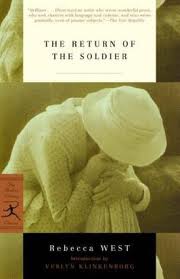
Literature and War Readalong March 25 2011: The Return of the Soldier by Rebecca West

There is still plenty of time for anyone who wants to join the Literature and War Redalong this month to get a copy of Rebecca West’s The Return of the Soldier. It is only 90 pages long which makes it all the more feasible. If all those of you who expressed an interest in this book will read along we might be quite a crowd. We will see. There are at least two different paperback editions available. I got the one from The Modern Library with an introduction by Verly Klinkenborg. The other one is a Virago edition with an afterword by Sadie Jones.

Rebecca West’s book is unique as it was published in 1918, before the war had ended. She tells the story of a returning soldier who suffers from shell-shock. I am particularly interested in this topic and curious to compare her handling of it with Pat Barker’s Regeneration trilogy which is for me still one of the greatest books on WWI, shell-shock and the development of the new medical discipline, psychiatry.

I was very surprised to find out that The Return of the Soldier that seems so well-known in the English-speaking world has not been translated into German. The only two of her books that made it into German are Black Lamb and Grey Falcon and The Fountain Overflows.

Rebecca West was only 24 when she wrote this novel but already an acclaimed journalist and women’s rights activist. This isn’t an account of the front line but purely a story that takes place on the home front.

Shell-shock is extremely typical for most WWI accounts. It seems as if there had never been so many cases of shell-shock in any war as in WWI. Psychologists state that one of the reasons for this lies in the trench warfare. Being in the trenches for such a long time infused the soldiers with a deep feeling of helplessness that makes shell-shock much more probable than any othe type of warfare. The moment the soldiers were allowed to leave the trenches and move about shell-shock was far less frequent.

Here is the link to the Rebecca West Society if you want to find out more about the author, upcoming conferences and events.

The Return of the Soldier has also been made into a movie.

Joseph Roth: Hotel Savoy (1924)

Hotel Savoy

Written in 1924, Hotel Savoy is a dark, witty parable of Europe on the verge of fascism and war.

I read Joseph Roth’s The Radetzky March years ago in school and had sworn at the time that I will re-read it and read as much as I can of this incredible author. A while back I stumbled upon a really nice discovery in a local bookshop, a little slipcase containing seven of Joseph Roth’s novels. It consists of Hotel Savoy (Hotel Savoy) (1924) Hiob (Job) (1930) Radetzkymarsch (The Radetzky March) (1932) Beichte eines Mörders (Confession of a Murderer) (1936) Das falsche Gewicht (Weights and Measures) (1937) Die Kapuzinergruft (The Emperor’s Tomb) (1938) and Die Geschichte von der 1002. Nacht (The String of Pearls) (1939).

Roth is one of three Austrian authors (the other two being Robert Musil and Heimito von Doderer) who wrote about the end of the Danube Monarchy. The end of an era, the changing of the times, is often central in his books.

I decided to read Roth’s books chronologically and started with Hotel Savoy.

What an absolutely wonderful novel this is. Beautifully written, astonishingly varied in style, themes and characters. How can you capture so much in under 120 pages? The style is very different from Radetzkymarsch but not less enchanting. His sentences are very special, often composed of a list of nouns which might have been a challenge for a translator.

I am happy, once more, to shed an old live, like I did so often these past years. I see the soldier, the murderer, the man who was almost murdered, the resurrected man, the captive, the wanderer.

Or this powerful sentence:

I enjoy the floating feeling, calculate how many wearisome steps I would have had to climb if I wasn’t sitting in this luxurious lift, and I throw down bitterness, poverty, homelessness, migration, hunger,  the past of the beggar, throw them deep into the shaft, from where they cannot reach me, the hovering one, ever again.

Hotel Savoy is a “Heimkehrer Roman”, the story of the former soldier Gabriel Dan who after WWI and several years of having been a prisoner of war in a Siberian camp returns to Poland. He is a descendant of Russian Jews and one of his uncles lives in the city in which he stops. He wants to travel westwards to Paris or any of the other big Western cities. As far away as he can get from Russia and a painful past full of deprivations, it seems.

He moves into a room on one of the upper floors of the grand and glamorous looking Hotel Savoy. As pompous as it may seem from the outside, the interior is rundown.

The first three lower floors are reserved to rich people, bankers, aristocrats, factory owners and patrons. The upper floors belong to the poor who cannot pay their rent. After a few weeks their suitcases and luggage is confiscated and they are left completely destitute.

What a colorful group of people they are in those upper floors. Dancers and clowns and people who return from the war or people who have lost everything in one foolhardy transaction. They are eccentrics and lunatics and more than one of them is terminally ill. There is singing and dancing and cheerfulness and a lot of dying going on.

Gabriel hopes to be able to extract some money of his rich uncle, Phöbus Böhlaug, but to no avail. His uncle’s avarice is frightening.

There is nothing else to do for Gabriel than stand at the train station daily and hoping for work. Every other week the train station is flooded by prisoners returning from the camps. One day he meets one of his old comrades the peasant Zwonimir.

What a character, this Zwonimir. Full of life, exuberant, funny and droll. He makes friends easily has a funny sense of humour and detects everything phony in the rich and pompous people around him.

They work hard and enjoy themselves in the evening, drinking copiously, going to cabarets and the vaudeville, walking through the city, exploring the quarters where only Jews live.

I always enjoy novels set in hotels. They are full of interesting characters from the most diverse social backgrounds. In this inter-war period hotels were often the only place where people could stay. It took those who returned from the war an awfully long time to get back to their homes and they had to stay somewhere on the way. Others had lost their houses or just fled the countryside.

It is a fascinating microcosm this Hotel Savoy. The very poor and the very rich rub shoulders.

One of the central episodes is the arrival of Henry Bloomfield an incredibly rich banker who left Europe for America but returns once a year to his hometown. No one really knows why he chooses to come back to this little town when he could stay in Berlin.

While he resides at the Savoy, people cue up to talk to him and present their business ideas hoping he might finance them. Gabriel is lucky and is chosen by Bloomfield as temporary assistant. He will listen to all the stories and sort the valuable ideas out.

This novel has really everything. It is funny, sad, picturesque, touching and bitter-sweet and the ending is perfection. Roth describes people, the hotel and the little town with great detail. And every second sentence bears an explosive in the form of a word that shatters any illusion of an idyllic life. Roth served in WWI and never for once allows us to forget that the horror of one war and subsequent imprisonment have only just been left behind  while the next one is announcing itself already.

I was reminded of other novels set in hotels, pensions or clubs like Muriel Spark’s The Girls of Slender Means, Vicki Baum’s Menschen im Hotel (Grand Hôtel), Elizabeth Taylor’s Mrs Palfrey at the Claremont, Assouline’s Lutetia, Thomas Mann’s Felix Krull and Anita Brookner’s Hotel du Lac.

I am sure there are many more. Do you know any others?

I translated the quotes from the original German. Any mistakes are entirely my own.

Haruki Murakami: Sputnik Sweetheart (2001) aka Sputoniku no koibito (1999)

The narrator, a teacher, is in love with the beguiling, odd Sumire. As his best friend, she is not adverse to phoning at three or four in the morning to ask a pointless question or share a strange thought. Sumire, though, is in love with a beautiful, older woman, Miu, who does not, can not, return her affections. Longing for Sumire, K (that is all we are told by way of a name) finds some comfort in a purely sexual relationship with the mother of one of his pupils. But the consolation is slight. K is unhappy. Miu and Sumire, now working together, take a business trip to a Greek Island. Something happens, he is not told what, and so K travels to Greece to see what help he can offer.

Sputnik Sweetheart was my second Haruki Murakami. The first one I read was South of the Border, West of the Sun which I liked a lot but I was told many times that it wasn’t a typical Murakami.

It was a strange experience to read Sputnik Sweetheart but not because of the book, I didn’t think it was all that weird but my reactions to it were weird as it reminded me of a lot of other books I have read before. Instead of enjoying it my mind started to rush around like a hungry little monkey looking for food and trying to solve the riddles of the 1001 allusions. If I hadn’t been so busy doing this, I would have enjoyed it much more while reading it but looking back on it I think it is a marvelous book. Unusual, original and fascinating. And furthermore, having finished it, I saw that what happened to me, this mad chasing of “clues”, is probably not completely unintentional. I think the author is well aware of our European triggers and pulls them one by one.

I read quite a few reviews who stated that it wasn’t easy to describe what the book is all about. I don’t think that’s true. It’s a pretty straightforward story and you can summarize it in a few sentences. The problem is that wouldn’t do the book any justice as plot line is not Murakami’s main concern.

K, an elementary school teacher, is madly in love with Sumire, a strange, intelligent, loner type girl who wants to become an author. Sumire however falls for Miu, a married woman and 18 years her senior. They meet at a wedding reception and due to a misunderstanding related to the writer Jack Kerouac, Sumire’s favourite author of the month, Sumire calls Miu Sputnik Sweetheart.

Ever since that day Sumire’s private name for Miu was Sputnik Sweetheart. She loved the sound of it. It made her think of Laika, the dog. The man-made satellite streaking soundlessly across the blackness of outer space. The dark, lustrous eyes of the dog gazing out of the tiny window. In the infinite loneliness of space, what could Laika possibly be looking at?

Sensing that a change is needed in Sumire’s life, Miu offers her a job. Part of this job is a trip to Europe. The two women travel from France to Italy and from there to Greece and there Sumire disappears. Miu asks K to come to Greece and help her look for Sumire. He travels to Greece but the whole adventure proves to be futile.That is the story in a nutshell.

The central theme of this novel is loss. In many different forms. And getting lost and being lost, and losing as well as never reaching what we want. The people in this little universe that is Sputnik Sweetheart all chase something. Most of them love someone who loves someone else. They feel trapped and isolated like little satellites circling aimlessly through space.

So that’s how we live our lives. No matter how deep and fatal the loss, no matter how important the thing that is stolen from us – that is snatched right out of our hands – even if we are left completely changed people with only the outer layer of skin from before, we continue to play out our lives this way, in silence. We draw ever nearer to our allotted span of time, bidding it farewell as it trails off behind. Leaving behind a feeling of immeasurable emptiness.

They also chase dreams that seem unreachable. Sumire who wants to become a writer, can’t write a real novel, Miu who wanted to become a pianist had to give up the piano.

And there are the side stories of lost animals. Sumire had  a little tortoise-shell cat that climbs a tree and is never seen again. K had a little dog, his only childhood friend, whom he loses too. And there are the black cats. Since I am an owner of black cats I could relate to this very well. Many of Murakami’s novels are populated by black felines.

K’s and Sumire’s love and friendship is a very beautiful one. They are both loners and bookish people who talk endlessly on the phone. It is sad that Sumire does absolutely not feel attracted to K. Despite the attraction Sumire’s feels for Miu, K is her true love.

I have read a few newspaper articles that came out at the time of the publication of Sputnik Sweetheart in Germany and quite a lot of them stated that Murakami wasn’t really a Japanese author because there are endless references to European culture. It is true, that this is surprising. In this novel, he enumerates many European composers like Mozart and Brahms, and also European performers. Apart from one book, Soseki’s novel Sanshiro, every book, movie or city that is mentioned is European.

Does the fact that a Japanese author cites so many European things make him less of a Japanese writer? I absolutely don’t think so and believe that on the very contrary,  this is a typically Japanese novel. The excellent evocation of futility of beauty for one thing, but then also the mix of genres (adventure story, ghost story, detective and love story) and the quoting of books. And quoting is only one thing, there is also a subtle intertextuality. Does K not remind us of the K in Kafka’s book? And the Doppelgänger motif is reminiscent of a lot of German literature.

Maybe we have to study modern Japanese paintings to be able to get Murakami.

Be it as it may, I’m extremely glad I read this book and am looking forward to the next one.

As a little visual impression of Murakami’s books I attached another Murakami’s work.

Both paintings are by Takashi Murakami.

This was my first Murakami for the Haruki Murakami Reading Challenge. Other reviews of this and other Murakami novels can be found there.

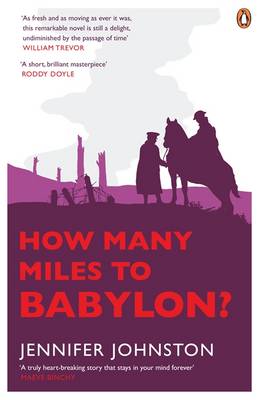
Literature and War Readalong February Wrap up: How Many Miles to Babylon?

I wanted to thank all of you who have participated this month. I loved the book and enjoyed the discussions.

Even though there is also a friendship at the heart of How Many Miles to Babylon? this book is totally different from Susan Hill’s novel Strange Meeting which we read in January. As you can easily see my review doesn’t emphasize the role of the friendship between Alec and Jerry as much as Anna’s or Danielle’s (and here as well) does.

I realized when reading the other posts and a few of the comments that some had a bit of a problem with this novel. There were different reasons for this. For one Alec doesn’t appear to be a very likable character, he was even called a coward by some. For several reasons I never thought of him like that and was wondering why. I realized that from the start, I was totally fixed on his going to be executed. I saw him like some Breaker Morant character (which he isn’t) and thinking he did something that would have this consequence set the tone for me from the beginning. Another point of criticism which, with hindsight, seems fair, is the fact that the WWI elements are toned down. WWI seems to serve more as a pretext for the tragic story and to write about Irish history. WWI itself is rather just a backdrop. I did not mind this at all but can understand that this can bee seen differently.

I think we all equally agreed that the mother in this book was an extremely negative figure, the whole family situation, as Kevin pointed out, is highly dysfunctional.

What I couldn’t really solve was the question about the title. Why did she choose this nursery rhyme as the title for her novel? In an article on the net I found one tiny hint, saying that it did underline the relationship between the soldier and his superior.

On Wikipedia I found this list which enumerates how many times the rhyme has been used in popular culture

In popular culture

In literature

In film

In popular music

  • It is parodied as “How many miles to Babyland?” on Lenny and the Squigtones– a comedy album by the characters Lenny and Squiggy from the 1970s sitcom “Laverne & Shirley”.

This is quite a considerable list. It eludes me why this rhyme is so popular with writers and I am still open for any interpretation why Jennifer Johnston chose it as her title.

Jennifer Johnston: How Many Miles to Babylon? (1974) Literature and War Readalong February

Alec and Jerry shouldn’t have been friends: Alec’s life was one of privilege, while Jerry’s was one of toil. But this hardly mattered to two young men whose shared love of horses brought them together and whose whole lives lay ahead of them. When war breaks out in 1914, both Jerry and Alec sign up – yet for quite different reasons. On the fields of Flanders they find themselves standing together, but once again divided: as officer and enlisted man. And it is there, surrounded by mud and chaos and death, that one of them makes a fateful decision whose consequences will test their friendship and loyalty to breaking point.

We know from the beginning of this novel that it is not going to end well. Alec is held in detention and knows that he will die. Because he is an officer and a gentleman, as he states, they have given him his notebooks, pen and ink and he writes down the story of his life. The story spans from his lonely isolated childhood in rural Ireland to the war-torn trenches in France. The tone of the novel is melancholic, full of nostalgia for a world that has been lost and is at the same time infused with the profound love of a country.

By now the attack must be on. A hundred yards of mournful earth, a hill topped with a circle of trees, that at home would have belonged exclusively to the fairies, a farm, some roofless cottages, quiet unimportant places, now the centre of the world for tens of thousands of men. The end of the world for many, the heroes and the cowards, the masters and the slaves.

Alec’s childhood was a lonely one. Caught between two parents who hated each other and who kept a polite and icy distance, he was the pawn with which his mother played. He didn’t like his mother, a haughty, cruel but beautiful woman whose strict rules and relentless following of etiquette ruined every childhood joy. What his parents do not know for a long time is that Alec has a secret friend. Alec and Jerry have a lot in common. Their love of horses, their sense of humour, they share so much, unfortunately not the social class. Alec is an only child of a wealthy Anglo-Irish couple whereas Jerry is part of the Catholic underclass. When their friendship is found out, Alec’s mother freaks out and decides to go on a 4 month trip to Europe with Alec.

When Alec comes back he doesn’t see Jerry anymore. Jerry is working while Alec is still studying. And then the war breaks out. At first there seems to be only a rumour of war. Jerry knows it long before Alec hears it and most people think it isn’t really true.

We paid very little attention to the war when it happened first. Belgium and Flanders seemed so far away from us. Our fields were gold and firm under our feet. Autumn began to stroke the evening air with frost. Smoke from bonfires was the only smoke to sting our eyes. Cubbing began in the early morning, the earth temporarily white with mist and dew. A few familiar faces disappeared. War was on the front pages of the newspapers daily brought from Dublin on the train.

Many do not feel that this is their war or that they should assist the British. Tensions inside of Ireland start to be palpable, tensions that bear the foreboding of the things that will come, the striving towards independence. However people who feel loyal towards Britain send their sons. Alec’s father considers it to be foolish to go to a war when you are not forced to go but his mother, out of spite and vengeance against his father, drives Alec away.

Meanwhile Jerry had already enlisted and the two young men meet in the training camp near Belfast in which they stay for six weeks until they get shipped to France. Their superiors do not like to see an officer talk to an enlisted man. Alec, due to his social class, has become an officer immediately.

When they finally arrive in France they stay separated. Alec shares quarters with a British officer, Bennett, a guy with a lot of humour, while Jerry sleeps with the other enlisted men. Still the three of them meet occasionally and ride about the country together.

They hardly see any action for a long time and stay far off the trenches for a while. When they are finally sent to the front line they will spend a lot of their time cleaning and reconstructing the badly damaged trenches.

We spent three more days in the front trenches, mainly shoveling and making props. It rained a considerable amount of the time. Sometimes sleet cut into the men’s bare hands, and at night there was sharp frost that covered the bottom of the trenches with a thin film of ice. We extended the line to our left. It was hard work moving the earth, heavy with water, always crouching till ones back and shoulders ached pitifully. The men hated it and worked slowly, grumbling most of the time. For most of the day there was concentrated shelling of the German lines by our artillery. The shells screeched over our heads sometimes for hours at a time. After a while I became so used to the noise that I felt strangely unprotected when it stopped, then slowly the process of thinking had to begin again.

The cold is unbearable and Alec suffers a lot from it. They constantly drink rum as it is the only way to warm up. Here again Alec and Jerry are caught talking together and the superior officer forbids it. But that is not the only trouble they are in. The Irish are not appreciated at all. On top of that there are rumors of a movement that wants to fight for the independence of Ireland. Jerry is suspected to be part of that movement and one day he confides in Alec.

“I don’t know how you can contemplate ever fighting again.”

“It won’t be like this. There’ll be no trenches, no front lines. No waiting. Every town, every village will be the front line. Hill, rock, tree. They won’t know which way to look. Even the children, for God’s sake, will fight them. It won’t be like this, I promise you that. Oh, Alec, it’s some thought.”

When Jerry receives a letter from his mother in which she informs him that his father has gone missing, he runs off to look for him and the tragedy unfolds.

I loved How Many Miles to Babylon? I think it is a beautiful book. It doesn’t teach you as much about WWI as Strange Meeting (see post 1) but it says a lot about Irish history. I found this look at the first World War from an Irish perspective extremely fascinating.

As Jennifer Johnston said, she wanted to write about the Troubles but didn’t feel ready yet. This is the prehistory of the Troubles. The Irish War of Independence started right after WWI in 1919 and was closely followed by the Irish Civil War. This succession of wars was the reason why Ireland stayed neutral during WWII. They simply couldn’t afford to be in another war in such short time.

How Many Miles to Babylon? hints at all this. But it is not only a very Irish novel because of the historical elements but also for its imagery, the symbolism and the many references to Irish mythology and culture.

The motif of the swans is a recurring element. There are swans on the lake on the property of Alec’s parents, they see swans in France, some soldiers shoot a swan which does upset Alec terribly. Since Alec reads W.B. Yates at the beginning of the book I think the swans are an allusion to Yates’ famous poem The Wild Swans at Coole which seems to mourn a time long gone.

In contrast to the gratuitous killing of the swans stand the mercy killings. Wounded horses are killed, a wounded man is killed…

I really liked this enchanting novel. I loved the poetical prose, the melancholic tone and the feeling of nostalgia that pervaded it.

What did you think of the novel in general and its treatment of WWI?

Other reviews:

Anna (Diary of an Eccentric)

Danielle (A Work in Progress) and here as well

Fence (Susan Hated Literature)

*****

How Many Miles to Babylon? was the second book in the Literature and War Readalong. The next one will be Rebecca West’s The Return of the Soldier. Discussion starts on Friday March 25, 2011 .

Daniel Glattauer: Every Seventh Wave (2011) aka Alle sieben Wellen (2009) The Sequel of Love Virtually

Every Seventh Wave

A while back I wrote about Daniel Glattauer’s Love Virtually which has been released meanwhile. I just saw that the sequel, Every Seventh Wave,  will be published this year as well. Usually I include the amazon blurb at the beginning of my posts but this one  contains too many spoilers of the first book.

Like its predecessor, I have read Alle sieben Wellen when it came out in Germany. For all those who like Love Virtually, they can look forward to a sequel that is very close to the first book. The story of Leo and Emmi, their e-mail exchange goes on. More passionate and more intense than before. And still they ask the same questions. Should they meet or should they not? To the somewhat playful tone of the first book Glattauer adds a bit of a darker undertone. I cannot say too much or it would be a spoiler.

Even though I didn’t like the idea of a sequel at all and if I had had something to say, it wouldn’t have been written but since it was and I liked the tone of the first book, I had to read this one as well. And it isn’t disappointing. It is as witty, charming, thought-provoking and enjoyable as the first.

All those who thought that Emmi and Leo’s story shouldn’t finish like it did in Love Virtually will enjoy this book. All those who loved the style of Glattauer the first time, will enjoy this as well. Although Love Virtually can be read on its own, this one can not. If you want to read Glattauer, you should start with the first one.

I have no problem with the translation of the title this time, it is pretty literal but I still like the German cover better.

The Austrian author Daniel Glattauer has written quite a few books that have been successful in Germany and other German speaking countries. Like so very often none of them has been translated. Should you read German you can find more information on his website.

Ruth Rendell: The Tree of Hands (1984)

Once, when Benet was about fourteen, she and her mother had been alone in a train carriage and Mopsa had tried to stab her with a carving knife. It was some time since Benet had seen her mad mother. So when Mopsa arrived at the airport, looking drab and colourless in a dowdy grey suit, Benet tried not to hate her. But the tragic death of a child begins a chain of deception, kidnap and murder. Domestic dramas exploding into deaths and murders …threads are drawn tightly together in a lethal last pattern.

I read and reviewed A Judgment in Stone last year and have mentioned how much I liked it. It was one of my favourite reads of 2010. On one of the comment thread’s Guy Savage suggested another book by Ruth Rendell, The Tree of Hands, and that is how I discovered this novel.

I have to emphasize once more what a great writer Ruth Rendell is. This book is different from A Judgment in Stone but also very engrossing. After having read The Tree of Hands I can also see why A Kind of Intimacy was compared to Rendell’s books. The description of the streets and their inhabitants shows a lot of parallels plus the people are equally deranged.

In the Tree of Hands the stories of at least 6 people are interwoven but it is skillfully done and they are all linked together in a logical way. The novel works like those rows of domino stones that have been set up in order to see them fall one by one. The falling down of the first stone makes the others follow. One action in the novel triggers another action and they are all equally fatal and catastrophic.

I was a bit wary at the beginning as Mopsa, Benet’s mother, is said to have a mental illness. Using mental illness as an explanation for a crime is often insufferable to me. But fortunately Mopsa is just the first domino stone. Being totally irresponsible she steals a child without ever thinking of the consequences but then she leaves and lets all the other people deal with the aftermath of his kidnapping.

The book really has a chain reaction at its core and one bad decision leads to another. And it also describes quite a lot of negative, selfish and frankly bad people. What struck me, even though Mopsa is mentally ill and on top of that clearly not a good person, she is by far less deranged than some of the other nasty characters in this book.

One of the main stories is the story of Benet, a young mother and extremely successful writer who lives in a beautiful house in Hampstead. At the beginning of the book her mentally ill and very unstable mother, Mopsa, comes to visit her and her little boy, James. Benet is a very loving mother and James is the most important person in her live.

The second main story revolves around another young mother, Carol, her son Jason and her young boyfriend Barry. Carol is a superficial and unrestrained woman with a flaming temper. At the age of 28 she is already a widow and has three children from different men. Two have been taken away, only the smallest, Jason, is living with her and Barry.

At first the two strands of the story run in parallel until a tragedy happens and Mopsa steals Jason.

I am tempted to write a lot more as there are a few aspects that I find interesting but unfortunately it isn’t possible, it would spoil too much. I can however say that the novel also explores the concept of parenthood and if someone who loves a child dearly might not be a better parent than a biological parent.

Something that struck me in this book is the overuse of the sedative Valium. This dates the book. Surely nowadays people in novels don’t pop pills like sweets and they might not use benzodiazepines as often anymore. This constant use of downers and alcohol is of course symbolical and just underlines that the people in the novel do not want to face any problems or consequences of their actions.

Ruth Rendell’s writing is suspenseful, her characterizations are psychologically plausible and the descriptions of different social milieus spot-on. Do I have to mention that I will certainly read another Ruth Rendell or Barbara Vine very soon?