Elizabeth Taylor: Mrs Palfrey at the Claremont (1971)

On a rainy Sunday in January, the recently widowed Mrs Palfrey arrives at the Claremont Hotel where she will spend her remaining days. Her fellow residents are magnificently eccentric and endlessly curious, living off crumbs of affection and snippets of gossip. Together, upper lips stiffened, they fight off their twin enemies: boredom and the Grim Reaper. Then one day Mrs Palfrey strikes up an unexpected friendship with Ludo, a handsome young writer, and learns that even the old can fall in love …

I am not that easily moved but Mrs Palfrey at the Claremont moved me a lot. What a touching story. Elizabeth Taylor is really a wonderful writer. Her style is so exquisite. I am really annoyed with myself as I read it much too fast. This should be savoured sentence by sentence. I think I will have to re-read it. I loved the style of Blaming too but I didn’t care for the characters. I found them so unkind. This is quite different. Mrs Palfrey is really a darling. But the other characters, even the embittered ones, are still endearing. They are all very eccentric and put up a front. They know exactly that the Claremont, that has seen better days, much like they have, will be their last chance at a little bit of freedom. After the Claremont comes the hospital and ultimately death. Their boredom and the way they try to grasp every little bit of excitement is described so well.

I don’t think hotels like this still exist and if so the people who live there must maybe even be richer than those described. The elderly women and the only old man at the Claremont are very well off. And lonely. No one visits them, they have become a burden to their families.

When Mrs Palfrey falls in the streets and handsome Ludo, an aspiring writer, kindly comes to her rescue she takes the opportunity and asks him to be a  stand-in for her own grandson who doesn’t visit her.

The other people at the hotel envy her immediately and she becomes quite a success thanks to Ludo. Their relationship is very special and Mrs Palfrey even develops a little crush. Ludo uses her as the model for his novel that he calls after something Mrs Palfrey said: “We aren’t allowed to die here”. He does have a bit of a bad conscience to exploit her like this but he does like her too and enjoys spending time with her. She is nothing like his own mother who couldn’t care less about him.

The novel is full of bon mots that are like little pearls on a necklace. Some are used by the narrator, some by the protagonists. Some are pretty, many are funny, like this one, uttered by Ludo during his first dinner with Mrs Palfrey: “I have never enjoyed myself more with my clothes on”. Here is what the narrator says about Mrs Palfrey: “She would have made a distinguished-looking man, sometimes, wearing evening dress, looked like some famous general in drag.” This may sound unkind but Elizabeth Taylor isn’t unkind, she really likes her characters, their crankiness and eccentricities.

I truly enjoyed this novel, it’s sad, funny, bitter-sweet and beautiful. And thought-provoking. After all, none of us is spared old age, let alone the grim reaper. And some of us may have old parents or grandparents. Maybe we really should visit more often.

I would like to watch the movie and attached the trailer for you.

Has anyone seen it? Joan Plowright is a wonderful actress and seems perfect in this role.

Jennifer Johnston: The Gingerbread Woman (2000) A Novel by One of Ireland’s Finest Writers

On a rainy afternoon on Killiney Hill a young man walking, without his overcoat, happens upon a woman gazing out over Dublin bay, standing perilously close to the edge. From their testy encounter develops a remarkable friendship which will enable each to face afresh their very different, damaged pasts, and to look, however tentatively, towards the future.

Jennifer Johnston’s book The Gingerbread Woman is easily one of the best books I have read this year. I enjoyed every word of it.  Johnston, although said to be one of the finest Irish writers, wasn’t known to me before I read about her on Danielle‘s and Kim’s blog. I believe they both mentioned other novels. I felt like starting with this one as I liked the description on the cover.

35 year-old Clara recovers from an operation and a broken heart while Laurence tries to come to terms with his grief. He has recently lost his wife and his little daughter. Clara and Laurence meet on a walk and later bump into each other again in a pub. Clara notices how lonely and sad Laurence is and asks him to stay at her house instead of the hotel. The dog Pansy is especially grateful as she had to sleep in the car. The story of these two wounded people is told in alternating points of view. Clara, who works for newspapers and teaches Irish literature at small universities, tries to write a novel. During the course of the book she writes parts of the novel that reveal her tragic love story. Laurence reveals his story in telling it to the people in the novel and in flashbacks. Clara’s mother and her doctor are interesting characters as well. The relationships she has with both of them, as with everybody actually, are far from the ordinary. She is quite an original character and I was surprised that her tragic love story was so banal. The reader guesses what is wrong with her lover right away but clever and hardheaded Clara is tragically clueless. (Hard to imagine but I have seen this sort of story happen many times –  as said, it is quite banal – and, believe me, no amount of good advice did beware the women from a painful disappointment).

Clara is very weak and ill, post-operative as she says. We wonder all through the book what health problem she had, even more so when the doctor mentions that the operation is linked to a sexual encounter. Big question mark on my side.

What is really special about this book is the feeling of immediacy. Clara is a character who doesn’t spare anyone. She always seems to say the truth. The conversations with her are deep and meaningful. If people were really talking like this, if they were this real,  how wonderful this would be.

Johnston is known for tackling Irish issues. This book is no exception. I found it interesting to read an inside point of view. We all have our opinions of Ireland, the IRA, the North and the South but probably we all know shit. We don’t know how deep the rift is between the two parts of this divided country.

Jennifer Johnston is truly an outstanding writer and I will certainly read many more of her books. I already have How Many Miles to Babylon, Two Moons and Fool’s Sanctuary on my TBR pile.

Jennifer Johnston has written some 15 novels. Which ones did you read or are you planning to read?

Arnaldur Indriðason: Silence of the Grave (Reykjavík Murder Mysteries 2) aka Grafarþögn (2001) An Icelandic Mystery

Silence Of The Grave (Reykjavik Murder Mysteries 2)

Building work in an expanding Reykjavík uncovers a shallow grave. Years before, this part of the city was all open hills, and Erlendur and his team hope this is a typical Icelandic missing person scenario; perhaps someone once lost in the snow, who has lain peacefully buried for decades. Things are never that simple. Whilst Erlendur struggles to hold together the crumbling fragments of his own family, his case unearths many other tales of family pain. The hills have more than one tragic story to tell: tales of failed relationships and heartbreak; of anger, domestic violence and fear; of family loyalty and family shame. Few people are still alive who can tell the story, but even secrets taken to the grave cannot remain hidden forever.

Silence of the Grave is the second of Indriðason’s successful mysteries. When reviewing Sjón the other day I had forgotten that I had the German edition (Todeshauch) of this book somewhere. Very much in the mood to read more Icelandic literature I picked it up and was hooked right away. I wouldn’t compare it to Mankell though (as it is usually done in Germany), they don’t have a lot in common apart from two disillusioned inspectors and being disillusioned is all the two inspectors have in common. Mankell’s books are much more psychological. Indriðason is bleaker, drearier. You’d better put a coat on should you read this as it is chilly, very chilly. Picture one of the Absolute Vodka adds. Right, that’s how cold it is. In every sense. We tend to forget that Iceland is not only about beautiful landscapes but there is the city of Reykjavík in which the people have pretty much the same problems as anywhere else. Delinquency, drugs, child abuse, domestic violence. And all this in a climatically challenged setting of excessively long winter nights and never ending summer days.

The novel starts in April and already it is getting dark after 9 p.m. and the days start in the wee hours of the morning.

Inspector Erlendur is divorced. He has two children he rarely sees. One is a junky, lying in a coma all through the novel,  the other is completely estranged from him. His ex-wife hates him. This is important as his personal story gets as much attention as the crime that is to be solved. Both stories are interwoven with a third story line that takes place during WWII. This third story is one of the worst stories of domestic violence I have ever read.  We know that this is somehow tied to the crime that has to be solved. It is also interesting to read about Iceland during WWII.

In the beginning of the novel it is not a 100% clear if there really has been a crime. Children find some human bones on a construction site. Archeologists have to dig them out with painstaking slowness. It takes the whole book until we know who is buried. What is discovered is very surprising. There are as many differnet possibilities with regard to the victims as with regard to the murderers.

I am not always happy when authors jump back and forth in time and mix many story lines but Indriðason did a good job. He also did a good job at describing Iceland and its harsh winters. The moment you leave Reykjavík you are at the mercy of nature. Many people get lost in winter during storms and die a white death. A handy cover-up for many a crime, as we are told.

Silence of the Grave was very different from any other crime novel I have read so far. No comparing it to Mankell (more psychlogical), Larsson (more elaborate) or Nesbø (bad!), please. I liked reading it, kept on guessing and wondering who, where, why, when but I am not sure I am sufficiently interested in Erlendur and his life to read another one in this series soon.

I am always fascinated how different covers look in other countries. The one I have is the blue hardback one. I think it does the book more justice than the English and the German paperbacks.

Roger Martin du Gard: Confidence africaine aka African Secret (1931)

Confidence africaine

Roger Martin du Gard, one of the less famous French Nobel prize laureates is mostly known for his huge eight-part novel cycle Les Thibault, the story of a family from the turn of the century until the end of WWI. Almost all of his efforts have gone into this immense work. Apparently it was Tolstoi’s War and Peace that triggered his writing. I was always interested in du Gard but I didn’t dare diving into that ocean called Les Thibault. I am sure this is wrong as its most prominent features  are the wide range of human relationships and the graphic realism of the sickbed and death scenes which would fascinate me. And I would be especially interested in the seventh volume, L’Eté 1914 (“Summer 1914”), that contains the dramatic description of Europe’s nations being swept into war.

Roger Martin du Gard  wrote a few lesser known books one of which is Confidence africaine, a short piece of fiction of barely 80 pages. It is short but wonderfully accomplished. The narrator, called du Gard, visits a friend’s son in a sanatorium. In the sanatorium he meets the Italian Leonardo who visits his nephew Michele. Leonardo and his family live in North Africa. They own a library. Some months later du Gard visits him when travelling in Northern Africa and stays at their house. Leonardo lives with his sister and her husband under the same roof. When du Gard’s stay ends both men take a ship and set over to France. During a long, warm and enchanted night, Leonardo tells du Gard the secret of his incestuous relationship with his sister. This is told as if it was the most natural thing in the world. It is neither analyzed, nor rationalized, just told. It seems though as some of the sad developments that took place in their lives are considered by Leonard to be related to the incest.

I was wondering if du Gard, who was a friend of André Gide and also homosexual, meant to question what we tend to call deviant sexuality. I don’t know that much more about his biography to be sure. The topic of homosexuality and  sexuality in general, temptation, religion etc. is recurring in his books. Many of the protagonists in his novels have issues with the Roman Catholic faith. This novella could be seen as a variation on that theme.

The scene on the boat is extremely well written, and the whole novella is masterful but I can’t say I liked it. I found the story too odd. It is one of the novels the protagonists of Katherine Pancol’s novel rave about (see my post) and it is generally much liked in France.

What I know for sure is that I am still extremely tempted to read Les Thibault.

Elizabeth Taylor: Blaming (1976)

When Amy’s husband dies on holiday in Istanbul, she is supported by the kindly but rather slovenly Martha, a young American novelist who lives in London. Upon their return to England, Amy is ungratefully reluctant to maintain their friendship, but the skeins of their existence seem inextricably linked as grief gives way to resilience and again to tragedy. Reversals of fortune and a compelling cast of characters, including Ernie, ex-sailor turned housekeeper, and Amy’s wonderfully precocious granddaughters, add spice to a novel that delights even as it unveils the most uncomfortable human emotions.

Blaming was my first Elizabeth Taylor novel. I read a recommendation on amazon a few months back and was very interested to read it. It is Elizabeth Taylor’s last novel. She wrote it while she was dying of cancer and it was published posthumously. This got me thinking quite a bit. To think that someone who knows his own death is approaching rapidly would write such a depressing novel makes me very sad. From a stylistic point of view this is a fascinating book. She is an accomplished writer and I truly admire her art. Her descriptions of places, actions and people ring true. There is an episode in which Martha and Amy are having dinner. Amy waits for Martha to eat but she keeps on talking and puts her fork down again and again. Such an exasperating habit that I have watched many times in people. The world Elizabeth Taylor creates is a very desolate one. There is hardly any person in this book that likes any of the others. Amy is by far the worst. She seems very judgmental of people and most of the time she doesn’t even register them. Her grief is intense but more because she has lost comfort and company than because she seems to miss her husband. I got the impression that she uses everybody and found her very boring. Towards the end she seems to develop a certain consciousness of her failings. Hence the blaming. But she is not the only one who fails. They all fail each other one way or the other.

Elizabeth Taylor ‘s daughter wrote an afterword in which she said she liked this and other novels because of the sense of humour. Especially also in the depiction of the granddaughters. Now that is something that eludes me. I did not think it was funny in any way. Those two girls, especially Isobel, are the most obnoxious fictional children I have ever come across. Unfortunately they seem very realistic.

I don’t necessarily mind reading something sad but this seems such a restrained world and apart from the American Martha and the factotum Ernie, they are  uninteresting people.

Since I often read as a writer and not only as a reader I would probably read another one of her books some day.

Just a quote to illustrate why:

Back along the suburban streets with the admired privet hedges, the houses with their bowed and bayed windows, the skeleton laburnums which in spring would give such pleasure. Gardens were all in darkness now, but television lit up rooms, or shadows passed behind drawn curtains. Sometimes light sprang up in bedrooms.

Any suggestions for another of her novels? Did I pick the dreariest one?

Sjón: The Blue Fox (2008) aka Skugga-Baldur (2004) An Icelandic Novel

The year is 1883. The stark Icelandic winter landscape is the backdrop. We follow the priest, Skugga-Baldur, on his hunt for the enigmatic blue fox. From there we’re then transported to the world of the naturalist Friðrik B. Friðriksson and his charge, Abba, who suffers from Down’s syndrome, and who came to his rescue when he was on the verge of disaster. Then to a shipwreck off the Icelandic coast in the spring of 1868.

The fates of Friðrik, Abba and Baldur are intrinsically bound and unravelled in this spellbinding book that is part thriller, part fairy tale.

Winner of the Nordic Literary Prize and nominated for the Icelandic Literature Prize

Different. Very different. Mysterious. I don’t always feel like finding out more about a book but this time I did. The Blue Fox is a haunting story full of ice and snow and darkness. Historical fiction and fairytale. It takes place at the time when Iceland has finally gained independence from Denmark. Fridrik, one of the protagonists, studied in Copenhagen. He is a naturalist and a herbalist. He returns to Iceland to burn down his late parents farm and erase all of his old life. But then he finds Abba, a young woman with Down’s Syndrome, who is kept in captivity. He decides to stay for her sake until the day she dies an early death. The book tells also the story of the priest Baldur Skuggason and the little blue vixen he is hunting. This is a very short novel but it is rich and multi-layered. Compellingly atmospherical and descriptive. What we don’t know unless we do a little bit of research is the fact that Skugga-Baldur, the Icelandic title, refers to a ghost being, part fox, part cat. A mysterious mythological creature. The English translator decided to name one of the forms of Skugga-Baldur. The German opted for the title Schattenfuchs, meaning shadow fox. Even though it has fairytale elements The Blue Fox is also very realistic. The writing is sparse, the information is well-chosen, we get a good impression of life in Iceland at the end of the 19th century. One thing that I found very interesting is the fact that Down’s Syndrome never existed in Iceland. Sjón deliberately chose to write about it as he was shocked when he found out that children showing signs of it in the womb are immediately aborted.

Sjón writes the lyrics for  Björk and also wrote the lyrics for the movie Dancer in the Dark. He is a well-known Icelandic poet. His affinity to poetry is very obvious.

I don’t think that I have read a lot of Icelandic literature so far apart from bits from the Edda and I have books by Halldor Laxness on my TBR pile.

Does anyone have recommendations? Any Icelandic writers you like or know of?

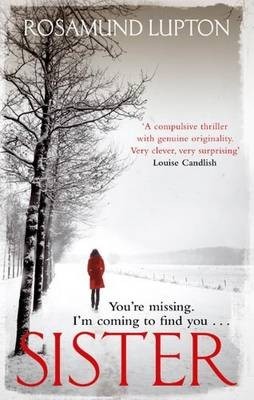
Rosamund Lupton: Sister (2010) A Great New British Thriller Writer

Nothing can break the bond between sisters …When Beatrice gets a frantic call in the middle of Sunday lunch to say that her younger sister, Tess, is missing, she boards the first flight home to London. But as she learns about the circumstances surrounding her sister’s disappearance, she is stunned to discover how little she actually knows of her sister’s life – and unprepared for the terrifying truths she must now face. The police, Beatrice’s fiance and even their mother accept they have lost Tess but Beatrice refuses to give up on her. So she embarks on a dangerous journey to discover the truth, no matter the cost.

That was a fast read. Even though this was a busy week and the novel had some 370 pages I read it in a few days. That certainly says something. I liked it a lot. The writing reminded me of Maggie O’Farrell. Should she ever choose to write a thriller, that’s what it could look like.

Sister is the story of  Tess and Beatrice, two sisters who are extremely close, even though the older one, Beatrice, lives in New York, while the younger, Tess, is still in London where she goes to an art school. When Beatrice gets the phone call from her mother saying her sister is missing she is highly alarmed and flies back to London immediately. When the sister is found dead and declared to be a suicide Bee – as her sister used to call her – is the only one who does not believe it was suicide. She is certain it was murder. And she won’t change her mind. No matter what the police, her mother or Tess’ psychiatrist say.

The story is told in part as if Beatrice was writing  a letter to her dead sister, telling her the whole story after the murderer has been found and arrested. In part she writes the letter, in part she tells the whole story to a lawyer. Consecutive flash backs. The story is also interspersed with dialogue between the sisters.  There are many red herrings as so many men who were in Tess’ life seem suspicious. The ending is quite a twist. That’s the only flaw I could find in this book. It seems a little bit artificial but then again it is not an improbable ending.

There are  many colorful characters in this novel. Art students, immigrants, doctors, scientists, policemen. The bond between those sisters is certainly the most important relationship in the book and it is very deep and moving. The story of their childhood is not an easy one which is another reason why they were so close. All through the novel Beatrice finds other people to relate to and some relationships like the one with her mother are completely transformed. Bee herself is also changed considerably. When the novel starts she is afraid of life, at the end she is ready to embrace and enjoy it.

Sister is Rosamund Lupton’s first book. The next should come out in 2011. I am already looking forward to reading it.