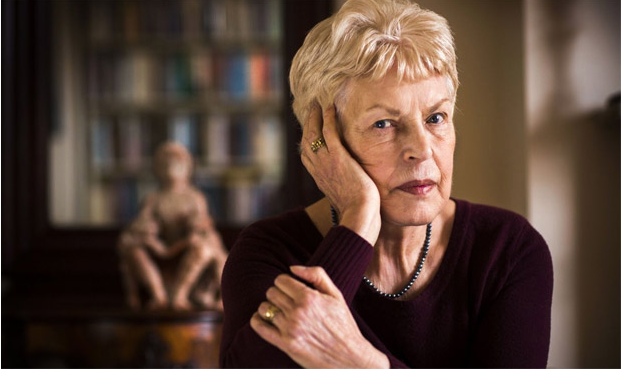
Ruth Rendell – 17 February 1930 – May 2 2015
This is so sad. She’s a writer I liked and admired so much.

Ruth Rendell – 17 February 1930 – May 2 2015
This is so sad. She’s a writer I liked and admired so much.
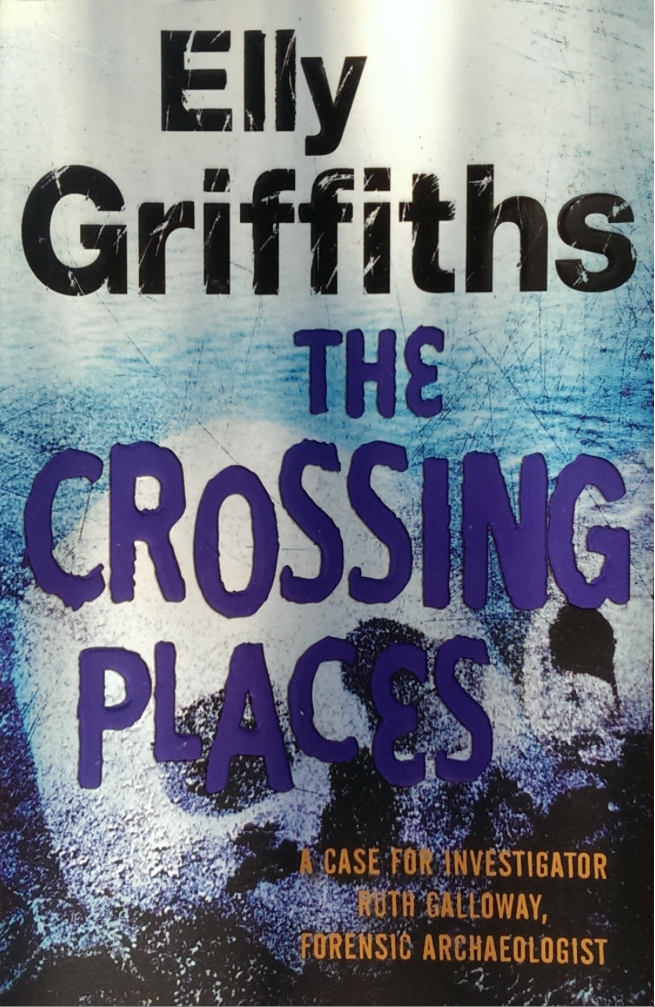
Elly Griffiths’ The Crossing Places is the first novel in her Ruth Galloway series. Ruth Galloway is a forensic archaeologist, who lives and works in Norfolk. Ever since she participated in a dig ten years ago, she’s loved the marshes and is, since then, renting a cottage that overlooks an empty, wild landscape, and the North Sea.
This is a novel with a leisurely pace and Elly Griffiths takes a lot of time to introduce Ruth Galloway. I liked her right away. She’s a single woman, a bit on the clumsy side, and not exactly slim or very attractive. But that doesn’t make her a beggar when it comes to men. She doesn’t need anyone to feel whole and rather lives alone than in the wrong company. This was one of many character traits that made me like her instantly. And of course she’s an expert in her field.
The second main character in the series, DCI Harry Nelson, is likable in a gruff kind of way. The two complement each other rather nicely.
They first meet when human bones are discovered on the marshes and Nelson asks Ruth to identify them. Ten years ago, a little girl went missing. She was never found, but Nelson never gave up hope that they still might find her one day. Naturally, he assumes that these are her bones, but Ruth tells him they are over two thousand years old.
Shortly after this another small girl goes missing and Ruth is threatened. It looks as if she’s somehow roused the murderer and got in his way.
If, like me, you love your crime novels with a strong sense of place, then Elly Griffiths’ Ruth Galloway series is for you. It’s one of those, in which the setting is a character in its own right. The saltmarshes, the weather, the loneliness of the place, and the fauna, are all intricate parts of this book. But that’s not all this atmospheric book has to offer. Ruth is a great character and I’m curious to see how she will develop. Since she’s a forensic archaeologist, we learn a few things about archaeology, which I found interesting, although the way we learn about it, is a tad clumsy at times. But that’s really my only reservation.
I thoroughly enjoyed this book. It’s not edge-of-your-seat gripping and, in spite of the many suspects, I thought it was pretty clear who was the bad guy, but that didn’t diminish the story one bit.
I have to admit that I’m partial to Elly Griffith’s choice of setting. I’ve been in Norfolk and loved it and the way she captures it is great.
I discovered the novel thanks to a review on Crimeworm. If you love crime and mystery it’s worth checking out her blog. You’ll discover some great books.
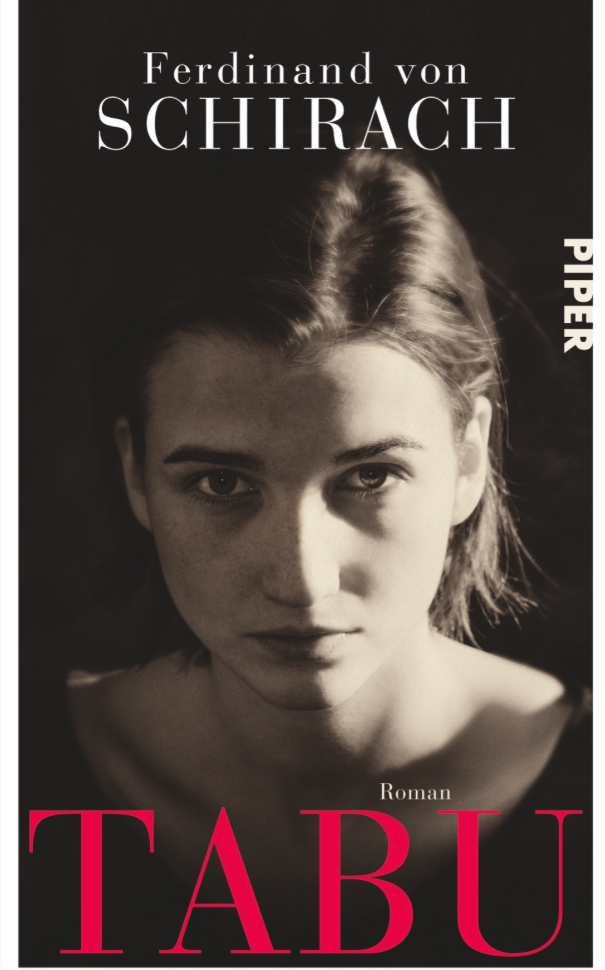
I bought Ferdinand von Schirach’s last novel The Girl Who Wasn’t There – Tabu (Taboo) when it came out in German, but didn’t feel like reading it until now. Meanwhile it’s available in translation and I’ve seen a few reviews on English blogs.
Since I liked his first books Crime – Verbrechen, Guilt – Schuld, and The Collini Case – Der Fall Collini I was looking forward to The Girl Who Wasn’t There. I didn’t expect a crime novel per se, as von Schirach, even when he writes about crime, is more interested in justice and human dignity than crime-solving or reasons for committing a crime. He recently published a book of essays, which all circle around the idea of human dignity. No surprise then that Tabu wasn’t a “proper” crime novel. So, that’s not the problem I had with this book. My biggest problem was the style and that I felt he didn’t really have a story, only themes he wanted to explore.
Interestingly the reception in English-speaking countries – by professional critics and bloggers – is far more favourable than the reception in Germany. Could it be that the translation improved the text? I don’t think that’s the reason but you never know.
I like spare prose and it served von Schirach well in his first two story collections. His prose was still quite alright in The Collini Case, but it drove me up the wall in this novel. The prose isn’t only spare but clumsy. His overuse of parataxis and short main clauses just didn’t feel right. Parataxis is often used to convey a feeling of alienation. Of course, if a character, like the main character Sebastian von Eshburg, feels dead inside because his father committed suicide when he was only a kid – there must be a feeling of alienation, nonetheless, I would have hoped von Schirach would have tried to convey it in another way.
The book is divided into several parts; each has a color as its title. The longest parts tell about von Eschburg’s childhood and how he became a famous artist. Then we see a man being questioned and threatened by a police man. The next part has another narrator – defence lawyer Biegler. That part is much more lively. Biegler is a lusty, driven man. An interesting character. He accepts to defend von Eschburg, who is accused of murder, because he suspects von Eschburg has confessed a crime he might not have committed. The last parts are dedicated to the trial and its outcome.
Overall I didn’t care for this book. I’m familiar with von Schirach’s themes by now and I found the essay collection more interesting than this novel. The style, as I said, is annoying in German. Nonetheless there were parts I liked. Biegler’s chapter is great because Biegler is a great character. I also enjoyed reading about von Eschburg’s childhood because the setting von Schirach chose – the Swiss Graubünden region – brought back childhood memories.
Unfortunately I can’t say this is a must read. It has interesting elements but that wasn’t enough for me. Since some of the main topics are important – violence, the representation of sex and violence in art, sex trafficking, torture – it could still be a good choice for a book group.
A last comment on the title. The German title refers to the main theme, while the English title refers to the alleged crime.
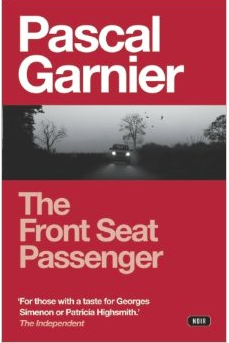
I’ve seen French crime writer Pascal Garnier mentioned on so many blogs that I could no longer resist and had to read him. La place du mort – The Front Seat Passenger seemed like a good choice as it’s short and the story sounded intriguing.
Fabien loses his wife in a car accident. Until that day he thought they were fairly happy. At least as happy as you can be when you’ve been married for a long time and have taken the other one for granted. Still, finding out she wasn’t alone in that car but with her married lover comes as a bit of a shock. While he may not be mourning her, he’s outraged and comes to the conclusion: If that guy took my wife – I’m going to take his widow. And he starts to pursue the other man’s wife, follows her, observes her, enters her apartment.
After his wife’s death he moves in with his divorced friend Gilles. Both men are unemployed and spend their days playing with Gilles’ small son, looking out of the window, smoking pot. Their playful cohabitation is often interrupted by Fanchon, Gilles’ ex-wife, who doesn’t think it’s funny that the two men behave as if the weren’t any older than her small kid. It’s a hilarious set up.
Fabien is anything but likable. He’s sarcastic, frustrated, acerbic. His comments and observations are a lot of fun. Not everything is amusing though. He may be astute when it comes to others, but he doesn’t seem to have a good feeling for himself and so, after a while, the reader feels uneasy.
The writing is surprisingly good, placing this crime novel firmly among the more literary of its kind. I really liked how he included small details – like the movements of pigeons on a windowsill, for example.
The first hundred pages of this book were really excellent but unfortunately from then on it went downhill. What started as a great contemporary French crime novel turned into a Hollywood plot. Think “Misery” with a twist. I have no idea why Garnier chose to flush his original story down the toilet. I can’t imagine he couldn’t come up with another idea for an ending, so it must have been a deliberate choice. I’m just not sure why.
Not one of the other reviews I read had a problem with the end. I have to admit, the writing is so good, that I, too, was tempted to forgive the end but I failed.
Because the first hundred pages were outstanding, I’ll be reading more of him. I just hope the next book will not be such a mixed bag.
Here are two more favourable reviews by Guy here and Emma here.

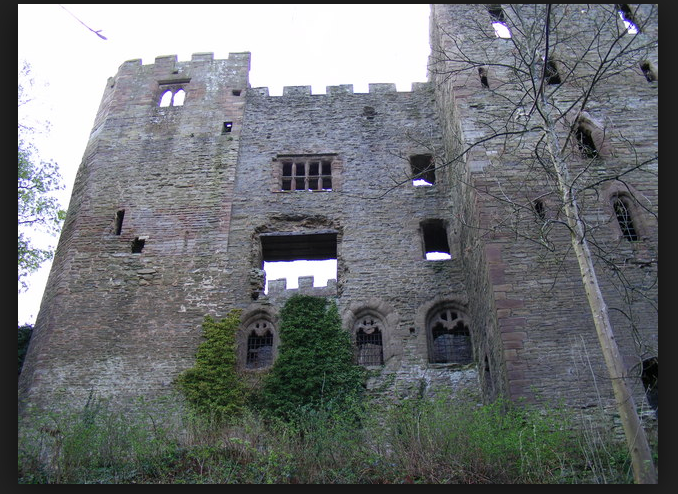
In the affluent, historic town of Ludlow, a teenage boy dies in a fall from the castle ruins. Accident or suicide? No great mystery, so why does the boy’s uncle, newly-retired detective sergeant Andy Mumford take his personal fears to diocesan exorcist Merrily Watkins? More people will die before Merrily, her own future uncertain, uncovers in those shadowed, medieval streets, a dangerous obsession with suicide, the nature of death and the afterlife.
I bought The Smile of a Ghost by accident, thinking it was the first in the Merrily Watkins series, but it’s already book seven. I think it says a lot about a series though if new readers do not feel left out and don’t get the impression that there’s a huge amount of backstory that would be annoying for those already familiar with the books.
When you read about some of the elements of the novels, notably that they are set in small English towns and that the main protagonist/investigator is a vicar, you might be led to thinking this is cozy crime. You’d be very wrong. The series is far edgier than you’d expect. And in some ways quite eccentric. Think Trollope meets the Gilmore Girls and you have a pretty good idea of the flavour of the series.
The main investigator is thirty-six-year-old Merrily Watkins, vicar of Ledwardine, in Herefordshire, near the Welsh border. Merrily isn’t only a vicar she’s also a deliverance minister – in other words an exorcist. And she’s the single mom of a teenage daughter and dates a rock musician. With these ingredients it’s not surprising that the books offer a mix of solid mystery, with a gothic flair and a very realistic look at life in contemporary Britain.
In this seventh book of the series Merrily has a lot of trouble with the church. Exorcist is a role that many among the clergy want gone. It whiffs too much of medieval superstitions. But Merrily persists. She’s not entirely sure herself whether she believes in ghosts, all she knows is that there are phenomena nobody can explain and if people feel the need of a priest to help them, why should the church refuse this. It’s decided that she can go on doing what she does but only after consulting with a whole group of people first, one of which a retired, pompous psychiatrist.
Merrily is a very independent person. She hates these new rules. But she’s got more troubles of her own . Her boyfriend, rock musician Lol, has moved to Ledwardine and they try to keep it a secret for the time being. Someone knows though or they wouldn’t receive hate mail. Jane, Merrily’s feisty daughter, starts to investigate, only to find a few other worrying things.
When a young boy, Robbie Walsh, falls from Ludlow castle, it looks like an accident at first. His uncle, newly-retired police investigator Mumford doubts it was an accident. As usual the boy stayed with his grandparents for the holidays. He loves staying at Ludlow. His own home is anything but peaceful. His mother is a druggie and pregnant with a much younger guy’s kid. Robbie’s a history buff and knows everything about Ludlow, including its ghost stories. Shortly before he dies he’s seen with Belladonna, an eccentric goth musician who has bought a house in Ludlow. She’s often seen at night in a dark cape, possibly naked underneath, holding a flickering candle. Does she have something to do with Robbie’s death? Was it a suicide?
If Mumford’s mother wouldn’t pretend she’s still seeing Robbie and he’s talking to her, Merrily might not have been drawn into this, but since there’s the possibility of a haunting, Mumford asks her for help.
Shortly afterwards Mumford’s mother is found dead in the river and a girl jumps from the castle. There’s clearly something very sinister at work here. A suicide cult led by Belladonna? Drug-dealing youth who force others to throw themselves from the ruin? Murder?
I loved this book and will return to this series again. It has such an arresting mix of elements: a suspenseful mystery, elements of ghost stories, a strong sense of place and setting, social commentary and a lot more. The characters are wonderfully well drawn. Merrily and her daughter Jane are a great team. They made me think of the Gilmore Girls more than once. The only reservation I have is the length of the books. None is shorter than 500 pages, many are over 600 and a lot of these pages are filled with church politics. It didn’t bother me too much because everything else was so different and fresh. And I had a tiny problem with the occasional use of vernacular though. It’s just something I don’t like.
I highly recommend this series. It offers a terrific mix of elements, wonderfully likable characters, and great setting and atmosphere. I was almost sad when I came to the end of the novel and didn’t have another one at hand. And I would love to visit Ludlow Castle.
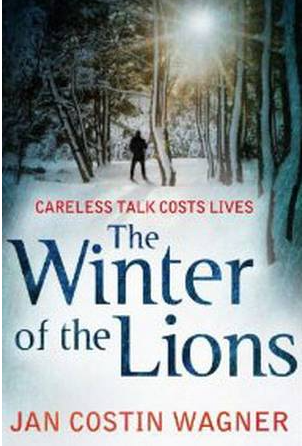
Jan Costin Wagner may very well be THE discovery of this year’s German Literature Month for me. I started The Winter of the Lions, book three in the series, in October and since then I’ve already read Silence, book two, have started book one, Ice Moon, and ordered the remaining two novels. Book five just came out in German. Now you certainly wonder why I’ve started the series backwards. There’s a reason, although, now that I’m reading book one I know, I shouldn’t have worried. I knew that Detective Kimmo Joentaa loses his wife in book one. I thought that a large part of the book would focus on her illness, but she dies in the first two pages and the book is about grief and loss, not about illness. The death of Joentaa’s wife, which is a recurring theme in every book, underlines that each novel is, at its core, a meditation on death.
It’s interesting that reading the series backwards makes me much more aware of how much Joentaa is changing. And it’s precisely this change which makes the series such a great read. Joentaa is not only likable but complex and sensitive, a truly appealing character. I’m also pleasantly surprised about how different each book is, although there are many similarities. In the first, Ice Moon, most chapters are written from Joentaa’s point of view, a few from the murderer’s perspective. In book two, Silence, we have a whole chorus of voices. Joentaa’s is only one of many. In The Winter of the Lions, Wagner uses a similar approach as in Ice Moon. Most chapters are written from Joentaa’s point of view, only a few from the point of view of the murderer.
What makes this series so outstanding is the choice of themes. While the detective has to find the murderer the books are much more an exploration of the reasons why someone was killed than simple “whodunits”. Only in finding the reason for a murder, does Joentaa find the killer.
The careful uncovering of the reason behind a series of murders is even more important in The Winter of the Lions than in the first two books. While book one focuses on the meaning of death, book two is a study of guilt, and book three looks into the way we treat other people’s tragedies.
The Winter of the Lion starts on Christmas Eve. Joentaa has been a widower for two years and has come to terms with his loneliness. He even looks forward to spend Christmas on his own. While he’s still at the police station, a young woman wants to report a rape. She’s a prostitute and pretends one of her customer’s has raped her. When Joentaa begins to ask questions, she withdraws. She doesn’t want to go into details.
Surprisingly, the same woman rings Joentaa’s door bell a little while later, when he’s back home. She spends the night with him and they begin a very unusual relationship.
The strange woman isn’t the only one to disturb Joentaa’s quiet Christmas. One of his colleague’s, the police pathologist, is found stabbed in a snowy wood. A little while later a puppeteer is killed and a famous talk show host is attacked.
All of the victims of the perpetrator in The Winter of the Lions took part in a talk show, in which victims of accidents, fires, and murder were the topic of the discussion.
One of the many questions the book asks is: When does one person’s tragedy become another person’s entertainment? I would love to write in more details about the topics in the book but I would spoil it.
What made me love Wagner’s books even more was his writing style. This is crime at the literary end of the spectrum. The sentences are short, spare, and very precise.
As if all of this wasn’t enough there’s a haunting atmosphere in every book and the Finnish setting is another bonus, especially since each book takes place during another season. I loved to read about the long nights in winter and the endless days in summer.
Should you wonder why a German author chose to set his books in Finland —Wagner is married to a Finnish woman and spends half of the year in Finland.
This is one of the best crime series I know. Haunting, atmospherical, with philosophical depth and impeccable writing.
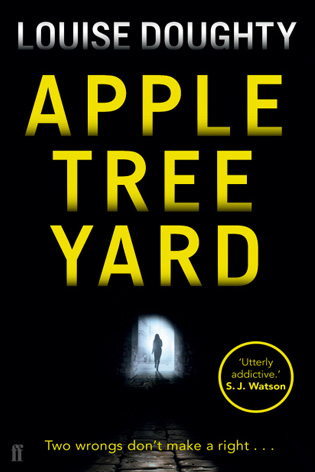
I wanted to read Apple Tree Yard as soon as it was out last year because I’d enjoyed Louise Doughty’s earlier novel Whatever You Love so much. I didn’t really know what to expect, didn’t read any reviews, and so I was glad to find out that not only is the book very different from her earlier novel, but just as good, maybe even better.
Apple Tree Yard tells the story of an affair that goes terribly wrong. Yvonne Carmichael is in her fifties, married with two grown-up kids. She’s a scientist and very successful in her work. Her marriage could be better but yshe and her husband do get along fine. What it is that makes her follow a man and start an affair with him? Boredom? Love—or rather lust— at first sight? Maybe a bit of both.
The book opens with a prologue that gives away a lot. We know Yvonne Carmichael and her lover have been arrested and are being tried and we also know that the prosecution has found out something that could be fatal for Yvonne. I think it’s quite impressive that Louise Doughty managed to give away this much in the prologue and still was able to write a page-turner that held my interest until the last page.
What worked particularly well for me was that large parts of the story were written as if Yvonne was talking to her lover, which was intimate and eerie at the same time.
Apple Tree Yard is the third crime novel with a London setting that I’ve read this year and, once again, the setting is almost a character.
The book is a crime novel but it explores a lot of themes in a very arresting way. Unfortunately mentioning some of them would really spoil the book. One theme I can mention, which is important, is the exploration of a marriage. Yvonne and her husband still share a lot but they are clearly not in love.
Apple Tree Yard is part thriller, part court-room drama, nicely paced, intricately plotted and infused with a bitter-sweet, melancholy mood that is quite rare in crime novels. A very gripping and intense novel.
 Beauty is a Sleeping Cat