Muriel Spark Week 23 – 29 April 2012

I recently discovered on Danielle’s blog that Simon from Stuck in a Book organizes a Muriel Spark week in April. I have only read two of her novels so far, The Girls of Slender Means and The Prime of Miss Jean Brodie. I liked them both a lot but think I preferred The Girls of Slender Means which is set in London during WWII. It is more touching and has one of the most memorable endings ever. The Prime of Miss Brodie is excellent too and quite funny.

Going over my piles I discovered that I had two unread books by her. Unfortunately not the one that Simon likes best, Loitering with Intent.

The ones I have got are The Go-Away Bird and Other Stories and Territorial Rights which is set in Venice.

Which is your favourite Muriel Spark novel? Will you join as well? Here are the details Muriel Spark Week

Nina Bawden: The Birds on the Trees (1970)

The expulsion from school of their eldest son shatters the middle-class security of Maggie, a writer, and Charlie, a journalist. Since childhood, Toby has been diffident and self-absorbed, but the threat of drug taking and his refusal (or inability) to discuss his evident unhappiness, disturbs them sufficiently to seek professional help. Veering between private agony and public cheerfulness, Maggie and Charlie struggle to support their son and cope with the reactions- and advice- of friends and relatives. Noted for the acuity with which she reaches into the heart of relationships, Nina Bawden here excels in revealing the painful, intimate truths of a family in crisis. Toby’s situation is explored with great tenderness, while Maggie’s grief and self-recrimination are rigorously, if compassionately, observed. It is a novel that raises fundamental questions about parents and their children, and offers tentative hope but no tidy solutions.

Nina Bawden’s novel The Birds on the Trees was one of the so-called Lost Man Booker titles in 2010. These were books that would have been on the Man Booker short list in 1971 if the dates for the Prize hadn’t been moved. While reading about this, I encountered the expression Hampstead novel, a label I had never heard of before. It seems this label was used to describe a specific type of novel, not only set in Hampstead but focussing on leftist-liberal intellectuals of the middle-class. Margaret Dabble and Iris Murdoch were named as well. When I hear a description like that I have to fight the urge to yawn.  That does sound boring, doesn’t it? In any case, the fact that Bawden was nominated for the Lost Man Booker in 2010, with a novel that was, as critics wrote, so clearly a Hampstead novel, triggered a lot of more or less interesting response in the media and some referred to older articles. One article I read was particularly interesting because it looked at settings in British literature. If you are interested here is the link. The writer argues that to a certain extent you can deduce the themes and topics from the location of a book. It’s highly unlikely that you will find the same topics in a novel located in Peterborough as in a novel set in Wales. This may be very obvious for a British reader but for me it was highly enlightening.

Hampstead novel or not, The Birds on the Trees is the story of a family crisis. The family is an intellectual middle-class family. The mother is a writer, the father a journalist. The book opens in the past, when Toby, the oldest son, is barely five years old and runs away at Christmas. He is an odd little boy. Strangely quiet and polite for his age. The book then fast-forwards 13 years. Toby is 18 and has been expelled from school because of marijuana abuse. He has two younger siblings, 11-year-old Lucy and the 5-year-old Greg. The parents are shocked and horrified and have no clue what to do with their son. For Maggie, the mother, it’s clear, he has to go to Oxford, one way or another. Charlie, the father, would rather give him a break and let him figure out what he would like to do. But these are not the only two people with a strong opinion and some saying in the matter. Aunt Phoebe, the  domineering widowed sister of Charlie, meddles as well. And Maggie’s mother plays an important role too.

The structure and character portraits of this novel is what I liked best. It moves from one person to another, changing from first to third person narrative and gives the point of view and impressions of each character. The voices are very authentic, the dialogue rings true. Through all those inputs we see how much is really going on under the surface and how dysfunctional the family is.

Toby cannot stand it anymore at home after his expulsion and after having stayed at his grandparent’s home for a while, finally moves to London to live with an older friend. It seems he starts to use other drugs and when the parents go and get him, he is on the verge of a nervous breakdown and diagnosed with schizophrenic disorder. Electro shock is the chosen cure. I didn’t like this part of the story at all and had a problem to fully understand why Toby was called mentally ill. He seemed more aloof and detached than genuinely depressed or psychotic.

If Toby’s illness and the horrifying “cure” had been all this novel had to offer, I would have hated it, I’m sure, but there is so much more going on. It isn’t only well written but the different story lines and aspects are thought-provoking and captivating. Maggie, the mother, is by far the least appealing character. After a while she started to really get on my nerves. There is an instance in which she discusses with her husband whether it is OK to take the things that happen and turn them into a novel. This is a very important moment that could easily be missed. If I hadn’t done some research I wouldn’t have known that Nina Bawden told the story of her own family. Her son suffered from mental illness, abused drugs and finally killed himself in 1982. This may explain to some degree why the book is so flawed and at the same time so interesting. It seems as if she was in writing it, trying to answer the question of responsibility and at the same time imagining a positive outcome.

One of the core themes that I found to be extremely well executed is favouritism. Toby was the first child and remained, even after the others were born, very obviously the favourite. Although his little sister loves him, she and her younger brother start to believe that they might have been adopted. It seems the only explanation why Toby is always the center of attention.

While the end of the book and the description of the mental illness aren’t convincing, I still enjoyed this novel because it manages to capture insecurity and conflicting emotions at the heart of families so well. Some of the character portraits are great. With a few exceptions, there is hardly a conflict-free relationship in this family and the book illustrates them all. Depending on who talks to whom, the interaction triggers different aspects in the personality of the characters. One person who is quite insufferable in contact with someone may be quite charming the moment he or she speaks to someone else. Often people show only one part of their personality to someone and keep another part for someone else. Through the interior monologues and dialogues all the facets of the characters are wonderfully well shown. Maybe, as some journalists argued, the book didn’t deserve the Man Booker, being too flawed and too Hampsteadish, true enough, still I thought it was a great read.

Does anyone know Nina Bawden? Has she written other books that are worth reading?

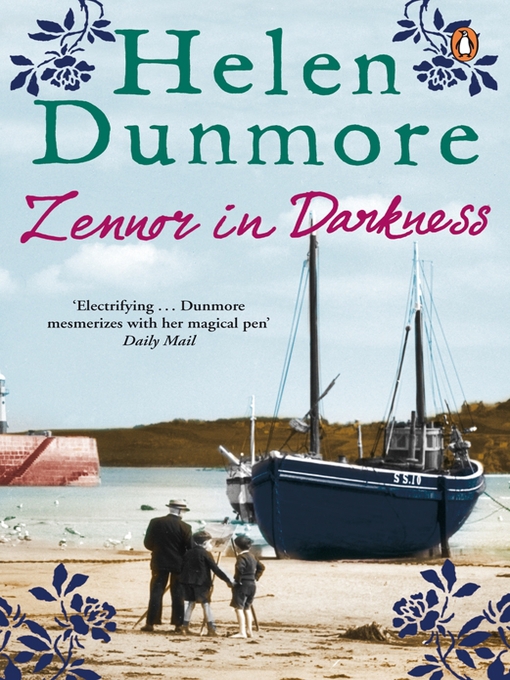
Helen Dunmore: Zennor in Darkness (1993) Literature and War Readalong January 2012

Helen Dunmore’s first novel Zennor in Darkness is set on the Cornish coast in 1917. The sound of war can be heard from afar. The first young men return from France, some of them are missing limbs, others are shell-shocked like Claire Coyne’s cousin John William. Although the war is present on every page, in the suspicions of the people, the fear that all the boys will be drafted, the noise the wind blows over from France, the scarcity of money and food, this is a novel of dreamlike beauty. Dunmore conveys the soft light of the Cornish coast, the beauty of the lovely landscape, the slow pace of life. This softness is mirrored in the way she changes the point of views, blurring the edges, softening the transitions, so that it feels as if one person’s consciousness and interior monologue, was flowing gently into that of another character. Reading it made me dreamy and I felt as if I was watching a water-color come to life. I read this book very slowly. I could have finished it in a few evenings but I put it aside frequently to make it last.

Zennor in Darkness interweaves the fictional story of Claire Coyne, and her cousin John William with the story of D.H.Lawrence and his wife. Claire lives alone with her father. Her mother who died while she was still very little was from Cornwall, while her father is an outsider, just like Lawrence. He comes from a rich Londoner family and was always seen as an intruder. Claire’s maternal grandparents, her aunts, uncles and cousins live close by. The children are a tight-knit community since they were little kids. They are so close that, although it seems logical for us, nobody suspects Claire and John William to be lovers.

The war has taken its toll, hundreds of thousands are dead and a lack in officers makes it possible for someone like John William who isn’t noble, to become an officer. He returns from France for a brief visit before he will join a training camp where he will stay a few months before being sent back to France.

Before his return Claire has befriended D.H. Lawrence. She is fascinated by him and even more so by his attractive German wife, Frieda. Not everyone is happy about their stay in Zennor. Germans are suspected to be spies and people would like to see them gone. Lawrence and his wife are happy in Cornwall. Their dream of a community of like-minded people has been shattered after Katherine Mansfield and her husband have left but still they love Cornwall and their simple life. Lawrence works in the garden, befriends the villagers. It’s not as easy for Frieda but she likes it as well. To the Lawrences Cornwall means more than just a place to stay, it is a refuge, a shelter and to watch their dream being crushed is painful.

Lawrence discovers that Claire is talented at drawing and encourages her to pursue a career. She introduces him to John William and Lawrence feels, more so than Claire, that John William hides something. One evening, when the two men walk alone in the balmy Cornish night, John William lets himself go in front of Lawrence, unable to hide the signs of shell-shock any longer.

Zennor in Darkness is a very beautiful novel and if anything it made me want to read more of Helen Dunmore. And it also made me want to return to D.H. Lawrence whose books I have abandoned for too long. I’ve always liked D.H.Lawrence, his novels, short stories, essays and letters and found that she captured him and his relationship with his wife very well. Frieda was a von Richthofen. A cousin of the famous Red Baron. Abandoning her marriage, her children and her privileges must have cost her a lot. I was always fascinated by this free spirit. The end of the book moved me. I knew the part related to the Lawrences, still it made me angry, while the fictitious story of Claire and John Williams made me sad.

What I found astonishing is the combination of beauty and horror. The descriptions of the Cornish coast, its air, light, flora and fauna alternate with passages like this one.

In Flanders the struggle for the Passchendaele Ridge continues. The poppy-blowing fields are ploughed by German and English guns, and sown with a litter of lost equipment, a seeding of blood and bone. Soon it will be autumn there too, and heavy northern rains will fall. Men will be listed missing, presumed drowned – a new classification for the lists in the newspaper. They are presumed drowned in the mud in which they live and often die. The men who came ‘right away to Blighty’ with John William will return to Flanders with their new commissions soon. Their training lasts only three months, and then they are wanted back at the Front. Hammond will die on a mission described to him by a senior officer as ‘rather a tricky bit of patrol-work’. His body will not be found. Simcox, a dozen feet to the left of him, will survive.

Ultimately however Zennor in Darkness is a novel about the difficulty to know another person. Either because you see them as strangers, or because they are too close for you and you lose all perspective. Like in real life, in many instances a stranger understands another character better than his own family, while at the same time, the community projects fear on the outsider.

In any case this was an excellent start to the Literature and War Readalong 2012.

Other reviews

Danielle (A Work in Progress)

Lizzy (Lizzy’s Literary Life)

Sarah (A Rat in the Book Pile)

Zennor in Darkness is also my first contribution to the War Through the Generations Challenge hosted by Anna and Serena.

*******

Zennor in Darkness was the first book in the Literature and War Readalong 2012. The next one will be Sebastian Barry’s A Long Long Way. Discussion starts on Monday February 27, 2012.

Henry Green: Party Going (1939)

Take a handful of idle bored rich people, put them in a confined space and see what happens. A minor writer may turn this tested recipe into a dull and boring exercise, a major writer will produce an amazing piece of writing which isn’t only brilliantly well written but a psychologically accurate comedy of manners.

Heavy fog has trapped the members of a party about to board a train for France in a London railway station. They were to leave for a couple of weeks. Max, their host, organizes these parties regularly and who is invited and who is not is of great importance.  Surely they cannot stay outside on the train platforms in the middle of those brutal and vulgar masses who will end up drinking and singing, now, can they? So they leave their porters and their luggage outside and move into the railway station hotel where Max has reserved some rooms for them.

This stay at the hotel may have been comfortable enough, boring, yes, but sipping tea, taking baths and slagging off others behind their back is amusing for a while. Unfortunately Claire’s aunt has committed the indecency of falling ill and becoming quite the nuisance for all of them. It’s particularly horrible for Claire as everybody knows she will board that train, no matter what, but, before she can do so, she must convince the partygoers that she isn’t heartless, no, on the very contrary, it’s her aunt’s fault entirely. Nobody should dare falling ill and spoil other people’s fun. Here’s Claire talking to Evelyn about her aunt.

(…) absolutely everyone else is dead and mother’s abroad as you know. It’s rather touching that’s why she came to see us off really it’s her only link. No, but it’s not touching actually because she goes and gets ill. Oh, Evelyn, it’s so unfair, isn’t it?

I’m sure you have realized by now that these characters are far from kind or pleasant. They are a bunch of egotistic, selfish and spoilt people who take everything that gets between them and their pleasure as a personal affront. Be it the fog, the sick aunt or anything else.

What made Party Going such an incredible read is the way it is told. Point of views change constantly, people move from one person to the other and always pretend to be different from how they really are. What we see is exactly what we would see if we were present at that very moment with only a little background information on the motives and true feelings but no other background information whatsoever. Still I felt, I got to know these people better than some of those whose whole biography I have been informed of in other novels. While reading Party Going we feel like unseen guests eavesdropping on other guests who are all nasty and mean behind each other’s backs and constantly pretend to think or feel different from what they let perceive. Sometimes the deception is minor but on many occasions the discrepancy between the true feelings and what is shown is considerable.

When Alex came to an end and she had not properly heard what he had been saying so she said something almost under her breath, or so low that he in his turn should not catch what she had said, but so that it would be enough to tell him she was listening.

There are shocking moments in the novel. Especially when these people talk about the masses, the poor. They, of course, are a nuisance too. Their maids and porters are not perceived as human beings, they are just commodities.

“Would you like me to come down with you to see if we can do anything about your things?”

This seemed to Julia the sweetest thing she had ever heard, to offer to brave those frantic drinking hordes of awful people all because someone was upset about their charms (…)

There really isn’t a likable character in this book, apart from the enigmatic handsome Max whose two girlfriends both appear, although he thought he got rid of one of them. Max is very rich, generous and quite elusive. Kind to everyone but hard to keep in one place. He likes his drink too much and this is part of his charm, as we are told, because all the girls think they will be able to save him.

It’s like watching a movie, the dialogue, and the commentary that accompanies it, is fantastic. I know some people will think this too experimental but I thought this was maybe one of the most accomplished pieces of modernist writing I’ve read in a long time. It works like a clock. All the pieces fit into each other, all the little cogwheels gear into each other and move at a steady pace. More surprisingly, Green not only has an ear for dialogue and is a brilliant observer, he also writes quite beautiful passages.

It was so luxurious he nodded, perhaps it was also what she had put on her hair, very likely it may have been her sleep reaching out over him, but anyway he felt so right he slipped into it too and dropped off on those outspread wings into her sleep with his, like two soft evenings meeting.

The novel is available in a collection with two other novels Loving, Living, Party Going. I’m grateful to obooki for pointing out Party Going because I had planned to read Loving instead. Party Going is brilliant.

The review is part of Henry Green week hosted by Stu on Winstonsdad’s Blog. If you are interested, here is his introductory post. I know that quite a few people take part in Henry Green week and I’m curious to see what they read and how they liked it.

Literature and War Readalong January 30 2012: Zennor in Darkness by Helen Dunmore

Two or three years ago I read Helen Dunmore’s The Siege a painfully realistic and harrowing account on the siege of Leningrad. This was such a stunning novel, one of the best WWII novels I have ever read, accurate, moving, descriptive and captivating despite the bleak topic. When I discovered that she had written a novel on WWI, Zennor in Darkness, I didn’t hesitate and put it on this year’s readalong list right away. Helen Dunmore hasn’t only written novels, but short stories, children’s books and poetry as well. I think her wonderful prose shows that.

The story is set in a Cornish coastal village in 1917 and combines fact with fiction. D.H. Lawrence and his wife have indeed stayed there but the story is invented. The core theme seems similar to Return of the Soldier and deals with shell shock. But it is also a story of artists and writers. I have a weakness for books about artists and love Cornwall as a setting.

Here are the first sentences

One faint shriek. Then another. Three girls fling themselves over the top of the last dune and skid down warm flanks of sand. Marram grass slashes their ankles and sand kicks up behind Clare and Peggy, into Hannah’s eyes. She is the heaviest and the last.

Have you read Helen Dunmore?

*******

The discussion starts on Monday, 30 January 2012.

Further information on the Literature and War Readalong 2012, including all the book blurbs, can be found here.

Louise Doughty: Whatever You Love (2010)

Two police officers knock on Laura’s door and her life changes forever. They tell her that her nine-year old daughter Betty has been hit by a car and killed. When justice is slow to arrive, Laura decides to take her own revenge. 

Whatever You Love is a book of raw emotions. And that from the first moment on when we read about the police knocking on Laura’s door to inform her that her daughter Betty has been killed. Laura is a very emotional woman, she feels everything that happens to her intensely, her reactions are very physical. There are many elements in the book that made me feel uneasy.

The loss of her daughter hits Laura like a cutting knife. The pain is sharp and unbearable. And she is all alone to deal with this as her husband has left her for another woman. After Laura has seen the body of her dead little girl, we go back in time with her to the days when she first met David, Betty’s father.

The early days of their relationship are very passionate, very sexual. David is a strange man, withholding feelings and caring at the same time and also with a love for dangerous behavior like on the day when he holds Laura over a cliff. He might have slipped at any moment or let her fall. Laura is shocked and fascinated at the same time, revolted and attracted.

While  she is pregnant with their second child, David meets Chloe. At the time when Betty is killed, he is married to Chloe and they have a baby boy. The end of David’s and Laura’s marriage is ugly. There are fights and jealous outbreaks by both women. Laura gets anonymous phone calls and letters. She never tells David but she is sure they are from Chloe. Once she threatens Chloe and it stops but when Betty is killed, it starts again.

Struggling to overcome her grief, Laura relives the loss of her husband and when she finally hears that the man who killed her daughter in a hit-and run has been let go by the police, she freaks out and decides to take revenge.

From that moment on I thought I knew what was going to happen but I was quite wrong. Things turned out very different from what I expected.

I read this at super speed. I was very captivated. It is well written and has a nice pace that drags you along. There is a lot to identify with even if you have no children. It makes you think about relationships, the end of infatuation, adultery, family, raw and contradictory feelings and emotions like guilt, loss, jealousy and passion. What I liked best about the novel is the fact that there are no easy answers and the characters are complex with some very contradictory traits.

Jo Walton: Among Others (2010)

With a deft hand and a blazing imagination, fantasy writer Walton mixes genres to great effect. Elements of fantasy, science fiction, and coming-of-age novels combine into one superlative literary package that will appeal to a variety of readers across age levels. After engaging in a classic good-magic-versus-bad-magic battle with her mother that fatally wounds her twin sister, 15-year-old Morwenna leaves Wales and attempts to reconnect with her estranged father. She was sent to boarding school in England, and her riveting backstory unfolds gradually as she records her thoughts, feelings, and experiences in a series of journal entries.

Jo Walton’s Among Others is an absolutely charming book. Despite the fact that there are some magical things happening this isn’t a fantasy novel.  It is a novel about fantasy and SF and, if anything, I would call it magical realism. What is charming about this book is not the magic, which is raw, wild and dangerous but Morwenna’s voice and her love of books, reading and libraries.

Morwenna’s story unfolds in a series of diary entries. The year is 1979 and Morwenna has just arrived at and English boarding school. She is a 15-year-old girl from Wales whose twin sister has died in an accident. The very same accident has left her injured and crippled. As we learn in the novel the accident was the result of their evil mother’s doing. The girls tried to stop her from getting more power through magic and that’s how the accident happened.

Morwenna is an outsider at her new school. She is crippled and the only one from Wales. But that isn’t the only thing that makes her an outsider. She knows that she is different. Her mother is a witch. Morwanna only just met her father whose sisters are witches as well, she sees and talks to faeries and she is addicted to reading SF novels. Novels are her consolation.

“It doesn’t matter. I have books, new books, and I can bear anything as long as there are books.”

Books are her escape route but also her way to make sense of the world. Her enthusiasm and love for books is one of the most important elements in this novel. At the boarding school she discovers what libraries have to offer, is introduced to inter library loan which opens the world for her even more and finally she is invited to a SF book club. Once a week she will discuss all her favourite SF and fantasy writers and learn about new books and authors and go on reading her new discoveries in her spare time.

I sat on the bench by the willows and ate my honey bun and read Triton. There are some awful things in the world, it’s true, but there also some great books. When I grow up I would like to write something that someone could read sitting on a bench on a day that isn’t all that warm and they could sit reading it and totally forget where they were or what time it was so that they were more inside of the book than inside their own head. I’d like to write like Delany or Heinlein or Le Guin.

At the book club she meets Tim a gorgeously beautiful boy with a bad reputation. It’s for her to discover whether it is founded or not.

I haven’t read a lot of SF and although I knew the names, I hardly knew any of the books still it was captivating to read about them, to see what elements she picked for her life, what themes, questions and speculations fascinated her.

The voice of Morwenna is very well rendered. This sounds like a young girl discovering the world and new books. We follow her thoughts and see how they develop, how wrong assumptions are corrected, how new things are learned.

The magical parts can be read in many different ways. A sceptical reader could just assume that it is all in Morwenna’s imagination. That grief, sadness and the constant pain she is in lead her to fantasize. It would make sense as well. If you are less sceptical you can just accept the fact, that, yes, she does see fairies and has an evil witch mother. The fairies are very interesting beings and she also mentions that they have nothing in common with Tolkien’s elves. Some of them look like gnomes, others are very beautiful. They are tied to places and seem like some sort of condensed energy.

A part that spoke to me is, the description of Morwenna’s pain. The descrptions were very realistic. The way chronic pain changes, how she tries to handle it, the cures that are provided, the wrong therapy she gets from conventional doctors and how she finally gets better through acupuncture.

Jo Walton lives in Canada but she is from Wales. The differnce between Wales and England is emphasized all through the novel. Half of the French side of my family is from Brittany. The difference to the rest of France is very similar. And you also find a lot of magical beliefs in Brittany. I grew up believing in loup-garous (werewolves) and nobody would have made me go out during a full moon when we were on holidays in Morlaix.

Amon Others is a very unusual coming of age story and I’m glad I read about it on Gavin’s blog (here is her post). I can’t imagine that anyone who loves books wouldn’t be able to relate to the intense love of reading that is capured in this book.