Literature and War Readalong April 30 2012: Coventry by Helen Humphreys

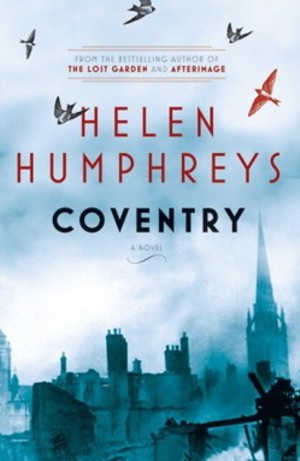
With last month’s book we have left WWI behind us and move on to WWII. The first of the WWII books is Helen Humphreys’ novel Coventry. I thought this would be my first novel by this author but I have read another one before, The Lost Garden, a wonderfully lyrical coming-of-age story which I liked a lot. With this in mind I’m keen on reading Coventry. Helen Humphreys is British but she lives in Ontario, Canada. Helen Humphreys has won several prizes, she is the author of 4 novels, one book of narrative non-fiction and four collections of poetry. I have a weakness for poets who write novels or novelists who write poetry because the writing is usually far above the average.

On the back cover of the novel it says that Coventry is “a memorial to the terrible losses of wartime, and a celebration of remembrance, determination and resilience.” The book tells the story of two women and moves back and forth between 1919 and the night of the 14 November 1940.

Here are the first sentences

The swallow arcs and dives above the cathedral. Harriet March watches it flicker through the darkness ahead of her as she walks along the cobblestones towards the church. The bird moves in the night air with all the swiftness of sudden feeling, and Harriet stops at the base of the ladder, tracking the flight of the lone swallow as it shivers up the length of the church spire.

*******

The discussion starts on Monday, 30 April 2012.

Further information on the Literature and War Readalong 2012, including all the book blurbs, can be found here.

Muriel Spark E-Book Giveaway Winner and Poll


It’s time to announce the giveaway winner of the e-book The Prime of Miss Jean Brodie by Muriel Spark courtesy of Open Road Integrated Media.

I drew the winner via random.org list generator.

The book goes to Marcus (Cinesprit).

Happy Reading Marcus!

******

The poll which I added to the last post is now at the bottom of this one.

You can still vote until the next giveaway will be announced.

Claudia Piñeiro: All Yours – Tuya (2003) An Argentinian Crime Novel

I had never heard of Claudia Piñeiro before I saw her book All Yours reviewed on Guy’s blog. I wanted to read more Latin American literature this year and an Argentinian crime novel sounded like a good start.

All Yours, or Tuya as it is called in Spanish, is as entertaining as it is amusing. It introduces us to the world of Inés, a middle-aged housewife, mother of Lali and wife of Ernesto. A real perfectionist when it comes to her home and keeping up appearances, a master in the art of self-delusion. More than once while reading I was exclaiming “What a nutter”.  Of course I was glad that she was such a nutter as this is why Tuya is so entertaining.

When Inés discovers a lipstick-written note, a heart signed “All Yours”, in her husbands briefcase, we are at first startled to hear that she doesn’t think it’s all that bad. After all, she believes, sooner or later all men cheat on their wives. The outcome purely depends on how gracefully the wife handles it.

Since her own unfaithful father left her mother after having been confronted with his infidelity, Inés decides not to act but to observe. One night when her husband is called to his office – there seems to be a computer related emergency which happens quite frequently -, she follows him. Of course he doesn’t drive to the office and Inés observes him while he meets with his secretary in Palermo Park. They are fighting and at one point Ernesto pushes the secretary away. The woman trips, falls and breaks her neck in the fall. How wonderful, Inés thinks, she will help her husband to cover up the whole incident. She will provide him with an alibi… But for the time being, she stays in the dark, drives home and doesn’t say a word that she has watched everything. Inés is happy, she believes that the secretary was Ernesto’s lover, and now that she is dead, nothing can separate them anymore. Right? Not quite, as we will see and from here on, things do not go as planned at all.

This isn’t the only instance in which Inés is wrong and we start to learn that absolutely nothing is at is seems in this novel and that what Inés pretends to be a picture book family is in reality rotting from the inside.

All Yours is told in alternating points of view. The most important parts are Inés’ first person narratives. Being a highly unreliable narrator, she tries to pretend everyting is fine until the very end of the book. Other parts of the story focus on Lali, Inés’ daughter. They are in dialogue form and reveal that the daughter has as much to hide as her parents but that she knows everyting about the two of them. Lali blames and hates her mother more than anyone else and towards the end of the book we realize she may have reason. Some of the chapters are police reports and third person narratives. Each of these elements together give the reader the full picture.

All Yours reminded me a lot of German crime writer Ingrid Noll’s novels in which seemingly harmless and invisible women start to develop their criminal and vengeful side. They are perfectionists, driven by an urge to save appearances at any price. We don’t warm to these women, we don’t feel for them but we enjoy the delicious frisson that we experience while following them on their journey towards retribution.

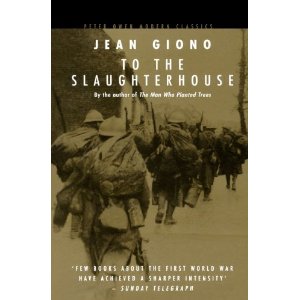
Jean Giono: To the Slaughterhouse – Le grand troupeau (1931) Literature and War Readalong March 2012

There are so many different ways to write about war. Some novels focus on the experience of the soldier, some will focus on what the civilians go through, some move back and forth between the front lines and the home front. While Jean Giono’s Le grand troupeau – To the Slaughterhouse does move back and forth, the book is still completely different from anything else that I have read so far.

Giono’s technique does need some getting used to. What he describes is equally beautiful and horrifying. The result may very well be one of the most radical anti-war books that I have read.

If you are looking for an action-driven novel, this isn’t one to turn to, Giono’s novel is far more like the description of paintings. I was reminded of Otto Dix’ WWI paintings more than once. Some of the very visual descriptions in this novel are as graphic and gruesome as Dix’ work.

The war has come to a little village in the French Provence region. All the men are drafted and go to war, leaving the women, old men, children and animals behind. Some of the men are shepherds. They have to abandon their herds. Left on their own,  the animals are endangered, they have accidents, get wounded. One day a massive herd enters the village. It’s an awful sight. So much suffering, so much pain.

Julia’s husband Joseph has gone to war, as has her sister-in-law’s young lover, Olivier. The story moves back and froth between life in the village and the men. It’s more a series of pictures than a real story. Very powerful and graphic pictures.

Giono chose to show us how war affects the body. It’s not the fighting he is interested in but what happens when someone is wounded. How the wounds fester, how the juices flow out the dead bodies. The rats which are always mentioned in WWI novels are present here as well but we see how they eat the faces of the dead men.

I had a faint feeling in my stomach for most of the time while reading but I saw what he wanted to achieve and I thought the idea was amazing. He didn’t stop at describing the horrors of the war and what it did to the bodies of the men, he described the beauty as well. The scents in the air, the taste of food, the beauty of the landscape.

There are hunting scenes and scenes of slaughter and the bodies of the dead animals resemble those of the dead and wounded men.

Human beings and animals both suffer pain, their bodies are vulnerable and frail, they can be killed and harmed and wounded and the result will be the same. At one point he goes one step farther, describing how the earth suffers too, when her body is ripped open by explosives. Giono includes the entirety of creation in his novel and shows that every being existing in this world, wants beauty, love and tenderness, shelter and food and when this is not provided, when aggression is let loose, the body is harmed, wounded and the being ultimately dies.

It’s a highly symbolical novel, with a profound message of peace. It was hard to read but I am glad I did. It really would be hard to find a more eloquent anti-war statement and a book which manages like this one, to show, that since we all, animals and human beings alike, suffer pain, we are equal. This profound message makes To the Slaughterhouse not only a plea for human rights but for animal rights as well.

Other reviews

Danielle (A Work in Progress)

To the Slaughterhouse is my fourth contribution to the War Through the Generations Challenge hosted by Anna and Serena.

*******

To the Slaughterhouse was the third book in the Literature and War Readalong 2012. The next one will be Helen Humphreys’ Coventry. Discussion starts on Monday April 30, 2012.

Muriel Spark E-Book Giveaway and Readalong Plans for April and May

With my own Literature and War Readalong and Carl’s Once Upon a Time Challenge which has just started, April and May look like busy months but in a very good way. Since I’m quite excited about some of the events I wanted to share them with you. There are some great readalongs taking place and it would be nice if the one or the other reading this would join as well.

April Reading Along with Beauty is a Sleeping Cat

The first readalong is Frank Delaney’s Ireland which im going to read together with Mel u from The Reading Life. The choice is inspired by his Irish Short Story Month. We will read and post on it either in week 2 or 3, in April. Should you want to join us, please leave a comment on my or Mel’s blog.

Emma from Book Around the Corner is hosting a yearlong book club and I’m going to join for the next book which is Tracy Chevalier’s Remarkable Creatures. The readalong takes place on Thursday, April 26.

In May I’m going to join Bettina (Liburuak) for a readalong of Alice Walker’s The Color Purple. The readalong takes place on May 31st. Details will be announced on Bettina’s blog, beginning of May.


As you know, Muriel Spark week, hosted by Simon (Stuck in A Book) and Harriet (Harriet Devine’s Blog) is going to take place from April 23 – 29.

Open Road Integrated Media has just released eight of Muriel Spark’s novels and I’m very glad that I have the opportunity to give away two e-books.

The first e-book I’m giving away is the famous The Prime of Miss Jean Brodie. It’s a book I personally liked a lot.

If you would like to win this e-book, just leave a comment. The giveaway  winner will be announced next Tuesday, April 3 2012.

As I said before, Open Road Media offers two e-books. Which one will be the second book is up to you, that’s why I included a poll. Please vote for the second book you would like to be given away.

Please don’t click the category “other”. I couldn’t get rid of it but it doesn’t exist.

The book with the highest poll result will be given away next week.

The poll has been moved and can be found here

Once Upon A Time Challenge VI

I’m so glad that Carl’s Once Upon a Time Challenge has started. I have been looking forward to it since weeks. Every since I have finished Robin McKinley’s Chalice and was in the mood to read more fairy tale retellings and fantasy.

If you want to know the details of the challenge, do please visit Carl’s blog. You have different challenge levels and four genres to choose from: Fairy tales, Folklore, Mythology and Fantasy. The challenge runs from March 21st to June 19th. There will be two readalongs as well. The first one in April – Brandon Sanderson’s Mistborn, the second in May – Neil Gaiman’s Neverwhere. I would love to join for Mistborn.

I will be busy in the next few months and so I decided to do The Journey which is only one book.

One reason why challenges are so much fun is the fact that one can make a list. Although I have only committed to one book, I may read more. I want to focus on fairy tale retellings and fantasy this year and here a few of my possible choices.

Ash by Malinda Jo

The Rose and the Beast by Francesca Lia Block

Briar Rose by Jane Yolen

The True Story of Hansel and Gretel by Louise Murphy

Solstice Wood by Patricia McKillip

Spindle’s End by Robin McKinley

The Ice Queen by Alice Hoffmann

How about you? What are you going to read?

Returning to Virginia Woolf

Maybe it’s because I’m reading Alexandra Johnson’s books and Virginia Woolf is an author who is central in them or perhaps it is because of Sigrun’s (sub rosa) Virginia Woolf project which I like to follow, whatever it is, Virginia Woolf was often on my mind lately.

I have this odd habit that when I like an author a lot I try to keep at least one of his or her books for later. There are a few authors whose complete works I have read but, due to my reluctance to run out of books to look forward to, they aren’t numerous.

Virginia Woolf is one of those authors where the thought I may finally have read all she has ever written fills me with a certain apprehension. While I’m still keeping Moments of Being for later, I have finally started The Voyage Out, the only novel I hadn’t read yet.

It’s funny to return to her and finalize the reading of her novels with the first book she wrote. It feels as if I had completed a circle. I started reading Virginia Woolf with Mrs Dalloway. I didn’t know that Mrs Dalloway was a returning character. I didn’t even know that Virginia Woolf had any returning characters. But here she is, in The Voyage Out, Mrs Dalloway, in all of her “glory”. Was she always this obnoxious? Frankly, I don’t remember. What I remember of my first Virginia Woolf novel was how much I liked the style.

The Voyage Out is very different from later books but at the same time it contains so many aspects typical for Virginia Woolf”s writing. I know many people read the body of work of an author they cherish chronologically but in her case, reading backwards wasn’t a bad choice. One could too easily overread important aspects of this early novel or, as was done when it was published, dismiss it as being nothing special.

Reading The Voyage Out makes me realize once more what I like the most about her writing. Yes, the style, especially in the later novels, is fantastic, with its flow of interior monologue, the way she uses time and how she describes the passing of time. But there is something else that stayed with me forever since the day I have read Mrs Dalloway. Her writing has an exhilarating quality, an effervescent intensity of feeling that made me think of a German expression which I adore: “Champagner Wetter” or “Champagne weather”. Champagne weather is used to describe a very fresh but sunny spring morning on which the air is still cool, nature has returned to life, the first tentative, tiny leaves appear, the first blossoms can be seen. It’s already a bit warm in the sun but still chilly in the shade. It’s like drinking the first glass out of a freshly opened, nicely cooled Champagne bottle. It bubbles and goes to your head. Virginia Woolf’s novels are full of scenes conveying the mood of champagne weather.  

I will write a “proper” review once I have finished the book but I’m enjoying it too much to wait until then. So far I can see that the story is told chronologically and sequentially, nothing daring really. But there is already a very striking way of writing about people’s interior lives. One of the main themes is the role of women and the way they are treated or rather mistreated by society. Parts of the novel reminded me of E.M. Forster, others of Henry James’ Portrait of a Lady. Rachel, one of the main characters, has a lot in common with Isabel Archer. Still there are scenes which are already typically Woolf. She had a very particular way of showing the passing of time or how the interior worlds of people coexist. There is a wonderful scene towards the middle of the novel in which we see a hotel at night.  First we see it from the outside, all its windows are illuminated, the people are getting ready to go to bed. Later we approach and enter the building, brief glimpses into the various rooms draw pictures of the inhabitants. At the end of the scene, they are lying in their beds, separated only by thin walls, dreaming or just sleeping, drifting off into unknown territory, as if on a big ocean liner. It is a recurring scene really, as the book starts with the voyage on a ship.

It is possible that I will start rereading her books in chronological order when I have finished The Voyage Out and Moments of Being. My favourite of her books are Mrs. Dalloway, To the Lighthouse and Flush. I didn’t like The Years or The Waves much and can never even keep them apart. I also didn’t care for Orlando at all. Not sure why, it’s generally a favourite of many people but I remember I found reading it was painfully boring. Jacob’s Room and Between the Acts were two I liked but the memory of them is barely more than a vague impression.

I often hear people say, they are intimidated by Virginia Woolf, just like many are intimidated by Proust or James Joyce. For those who didn’t dare reading her so far, The Voyage Out and Flush are excellent starting points.

Have you read The Voyage Out or any other of Virginia Woolf’s novels? Which is your favourite?