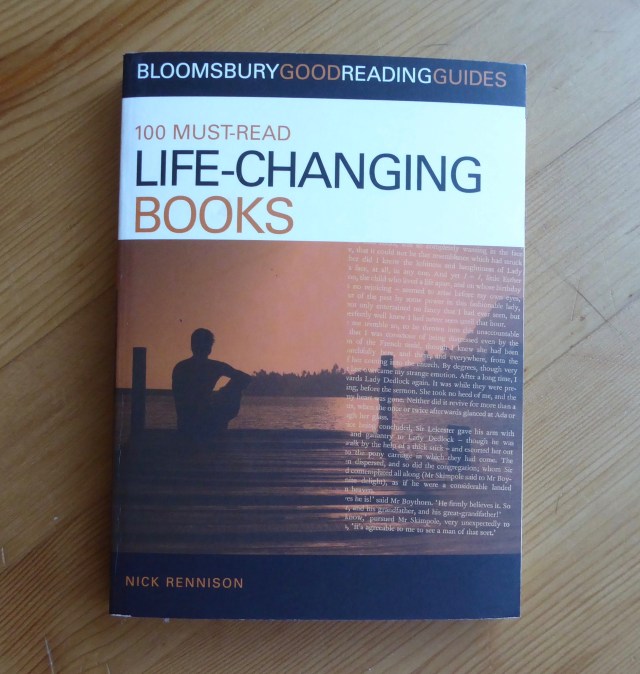
I’m very fond of these little Bloomsbury Reading Guides. I say little because they are just a bit bigger than a hand. I own quite a few of them. I find them well-done, informative, and a good introduction to different kinds of books and genres.
Now “life-changing” might make a few people roll their eyes thinking this is about self-help books. But it’s not. It’s about books that have had a major impact on people’s lives for various reasons. Either because they were ground-breaking, or because the author wrote about something in a new way. Because they talk about social injustice, philosophy, or psychological ideas. Many are novels that were highly influential. Some of these books literally changed a lot of people’s lives. Because they made them see the world in a new way or understand things better. In his introduction, Nick Rennison writes that this isn’t meant to be a best of. Just a varied list.
The idea that there can be a definitive list of the books most likely to change lives, and change them for the better, is a ludicrous one. Books can change lives but they do so in a wide variety of often subtle ways. Very different books can, in different ways, be life-changing and the selection of titles in this book reflects that. 100 Must-Read Life-Changing Books finds space for, amongst others, a children’s novel about a young girl who discovers a key to a secret garden, a Chinese text on a war from the sixth century BC, a black comedy set in WWII, the autobiography of one of the twentieth century’s most remarkable statesmen, a handbook on happiness by one of the world’s great religious leaders and a fable about a pilot who meets a story-telling child in the Sahara desert.
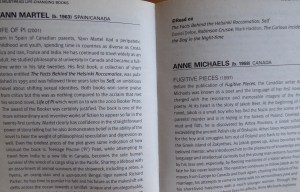
The authors and their book are presented in alphabetical order. Author and book are then presented in a short bio, summary and history of the influence of the book. These chapters are followed by Read on lists, which either contain other books by the author or books by other authors that are similar.
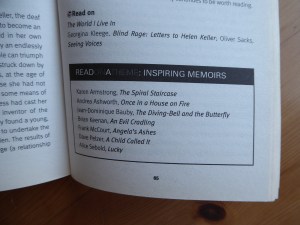
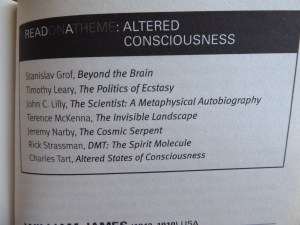
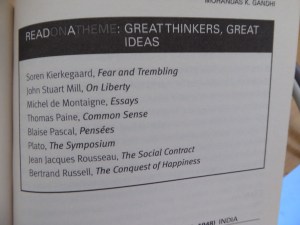
Throughout the book you can find themed boxes with lists of books.
Here are some of the authors you can find in this book – I’m picking two for every letter:
Isabel Allende, Marcus Aurelius, Frances Hodgson Burnett, Albert Camus, Jung Chang, Dalai Lama, Simone de Beauvoir, Anne Frank, Sigmund Freud, Ghandi, Jean Giono, Stephen Hawking, Hermann Hesse, C.G. Jung, Helen Keller, Barbara Kingsolver, Harper Lee, Primo Levi, Nelson Mandela, Alice Miller, Friedrich Nietzsche, Boris Pasternak, Sylvia Plath, Sogyal Rinpoche, J.K Rowling, J. D. Salinger, Alexander Solzhenitsyn, Henry David Thoreau, Sun Tzu, Kurt Vonnegut, Edmund White, Naomi Wolf, Paramahansa Yogananda
As for the books – you’ll find titles as varied as The Little Prince, Siddharta, The Origin of Species, Walden, The Beauty Myth, A Room of One’s Own, Life of Pi, The Outsiders, On the Road, The Art of War and many more.
Because I have already read many of the books that are mentioned here, I like to use it as a refresher or when I’m in the mood to read books on a theme or books that might be similar.
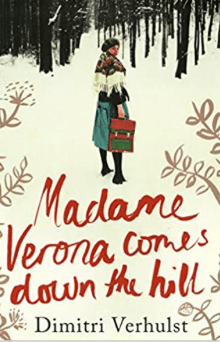
Dimitri Verhulst is a Belgian writer who writes in Flemish. He has written poetry, short stories, and novels. His novella Madame Verona Comes Down the Hill– Mevrouw Verona daalt de heuvel afwas first published in Belgium in 2006. The translation is from 2009. In the book it says it was translated from the Dutch but that is inaccurate as he writes Flemish. The two languages are similar but not interchangeable.
Madame Verona Comes Down the Hill is a love story, or, to be more precise, a story about a love that goes on long after the beloved has died.
Mme Verona and her composer husband Monsieur Potter moved to a small village in Belgium. Their house is high up on a hill far away from other people, surrounded by a vast forest. Sadly, Mme Verona’s husband gets very ill and dies. Most reviews go into more details about his death, but I will refrain from that as it is a major spoiler.
Mme Verona is very beautiful and since there are almost only men in the village, they all hope she might come down and possibly choose a new mate. But she never does. She continues her life pretty much as if her husband were still alive. Of course, she misses him. But he is everywhere.
When she looked out the window at the valley, she looked with him. That was partly why she never urged visitors to stay for dinner, preferring the intimacy of the idea and feeling of dining alone with her husband. Just the two of them, and a bottle that proceeded towards its original emptiness half as fast as before.
Monsieur Potter knew he was dying and, as a last act of love, he cut down enough trees to assure his wife had enough firewood until she would eventually die as well.
In memory of her husband Madame has a tree cut down. She wants a cello made from its wood. The man who cuts down the tree, isn’t the one who will make the instrument as it takes twenty years for the wood to be ready for use.
At the beginning of the book, Mme Verona and her dog get ready to go down to the village. She knows that it will be the last time she goes there. Before she leaves, she muses that if she was asked at the gates of heaven what her one striking characteristic was, she would say that dogs always sought out her company. Just like they always sought out her husband’s company. That’s why they always had dogs or were followed by dogs. If it had been possible, they would have adopted every stray they encountered.
I liked the beginning of the novella very much. The writing is very distinct, very unusual. A mix between sarcasm, wit, empathy, and even lyricism. I expected a story about Mme Verona, but after the initial pages, the story moves away from her and we are introduced to the village and its eccentric inhabitants. We’re told funny anecdotes like the one where a cow becomes mayor for one year or those involving the vet who is also the GP for the village. As amusing as this was, I had to finish the book to fully understand its structure. It’s one of those circular stories that end where they start and only become a whole once you’ve finished it.
I’ll leave you with a few quotes that illustrate Verhulst’s style and humour.
But even when he wasn’t working, Monsieur Potter enjoyed being here, seeing the aureoles force their way down through the foliage and listening to the rustling wind, either alone or with Madame Verona, and sliding downhill with her on a sled, the winters telling him that lovers were children, trying to reach back into the past to seize the time they hadn’t spent together. Wanting to have shared their entire lives with each other, because love refused to settle for less.
About the dog looking forward to a walk:
The prospect of finally being able to empty his shrunken bladder on posts, letterboxes and car wheels elicited his most charming bark and would have him ramming his mistress’s legs with joy except that he realised she was too old for that kind of doggery, and that it would most likely lead to his having the implantation of a plastic hip on his conscience.
Madame Verona is a charming story of love that survives death. It’s ideal for those readers who like sophisticated, quirky writing and long, complex sentences.
Some of you know that I have an all-year pass to Masterclass, which means I can take any class I want without any restrictions. I’m also immediately informed when new classes are added. Over the last few years, I have taken several of these classes and enjoyed them a great deal. I say “have taken” but mostly, I watch the lesson videos and read the workbook. I haven’t decided yet to which one I’d like to fully commit, meaning doing the exercises and possibly submitting them and engage in a discussion with fellow writers. When you actively take the classes, you have the chance of receiving feedback from the teacher. This chance is especially high when a new class is uploaded.
Masterclass offers a wide range of classes for a very reasonable price. Some are writing classes, but not all of them. I’ll probably write another, more detailed post this month to tell you about some of the great content I discovered.
Last year, many new writing classes were uploaded, one of which was the courseReading and Writing Poetry by Billy Collins. Billy Collins was the poet laureate of the U.S. from 2001-2003 and the poet laureate of New York State from 2004 and 2006. I must admit, I wasn’t familiar with him but started the course out of curiosity and was immediately smitten. He’s such a lovely person and the way he teaches is very engaging and inspiring. You can see some of that in the intro I attached below.
In the course he reads many of his poems, explains the way he works, where to find inspiration. But he also talks about other poets and their work, since the course isn’t only about writing but also about reading poetry.
Discovering his poems was a joy. I like how so many of them have very mundane themes but with a surprising twist.
One of the poems he analyses is his ownElk Water Falls. Since this was my introduction to his poetry, I’m sharing it here.
Elk Water Falls
is where the Elk River falls
from a rocky and considerable height,
turning pale with trepidation at the lip
(it seemed from where I stood below)
before it is unbuckled from itself
and plummets, shredded, through the air
into the shadows of a frigid pool,
so calm around the edges, a place
for water to recover from the shock
of falling apart and coming back together
before it picks up its song again,
goes sliding around the massive rocks
and past some islands overgrown with weeds
then flattens out and slips around a bend
and continues on its winding course,
according to this camper’s guide,
then joins the Clearwater at its northern fork,
which must in time find the sea
where this and every other stream
mistakes the monster for itself,
sings its name one final time
then feels the sudden sting of salt.
Another one he speaks of in the course is this:
The Lanyard
The other day I was ricocheting slowly
off the blue walls of this room,
moving as if underwater from typewriter to piano,
from bookshelf to an envelope lying on the floor,
when I found myself in the L section of the dictionary
where my eyes fell upon the word lanyard.
No cookie nibbled by a French novelist
could send one into the past more suddenly—
a past where I sat at a workbench at a camp
by a deep Adirondack lake
learning how to braid long thin plastic strips
into a lanyard, a gift for my mother.
I had never seen anyone use a lanyard
or wear one, if that’s what you did with them,
but that did not keep me from crossing
strand over strand again and again
until I had made a boxy
red and white lanyard for my mother.
She gave me life and milk from her breasts,
and I gave her a lanyard.
She nursed me in many a sick room,
lifted spoons of medicine to my lips,
laid cold face-cloths on my forehead,
and then led me out into the airy light
and taught me to walk and swim,
and I, in turn, presented her with a lanyard.
Here are thousands of meals, she said,
and here is clothing and a good education.
And here is your lanyard, I replied,
which I made with a little help from a counselor.
Here is a breathing body and a beating heart,
strong legs, bones and teeth,
and two clear eyes to read the world, she whispered,
and here, I said, is the lanyard I made at camp.
And here, I wish to say to her now,
is a smaller gift—not the worn truth
that you can never repay your mother,
but the rueful admission that when she took
the two-tone lanyard from my hand,
I was as sure as a boy could be
that this useless, worthless thing I wove
out of boredom would be enough to make us even.
And here’s another one I like a lot:
Central Park
It’s hard to describe how that day in the park
was altered when I stopped to read
an official sign I came across near the great carousel,
my lips moving silently like the lips of Saint Ambrose.
As the carousel turned in the background,
all pinions and mirrors and the heads of horses
rising to the steam-blown notes of a calliope,
I was learning how the huge thing
was first designed to be powered
by a blind mule, as it turned out,
strapped to the oar of a wheel in an earthen
room directly below the merry turning of the carousel.
The sky did not darken with this news
nor did a general silence fall on the strollers
or the ball players on the green fields.
No one even paused to look my way,
though I must have looked terrible
as I stood there filling with sympathy
not so much for the harnessed beast
tediously making its rounds,
but instead of the blind mule within me
always circling in the dark —
the mule who makes me turn when my name is called
or causes me to nod with a wooden gaze
or sit doing nothing on a bench in the shape of a swan.
Somewhere, there must still be a door
to that underground room,
the lock rusted shut, the iron key misplaced,
last year’s leaves piled up against the sill,
and inside, a trance of straw on the floor,
a whiff of manure, and maybe a forgotten bit
or a bridle hanging from a hook in the dark.
Poor blind beast, I sang softly as I left the park. poor blind me, poor blind earth turning blindly on its side.
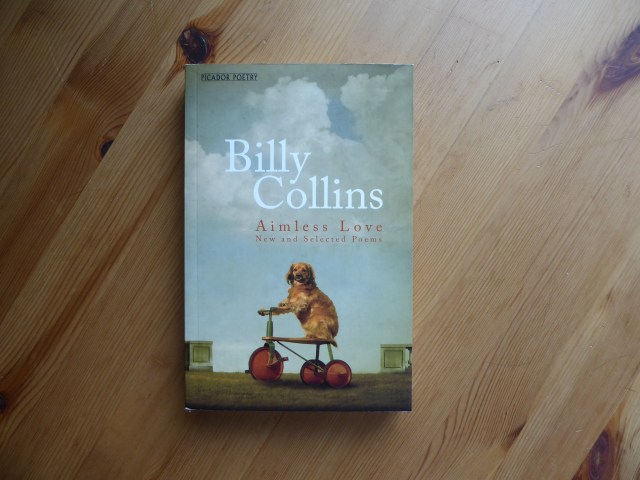
The Billy Collins collection I’ve got, Aimless Love – New and Selected Poems contains poems taken from four collections and about fifty new ones. All the poems I quoted here, can be found in Aimless Love.
I like the narrative quality of his poetry and that he takes something very mundane for his beginnings and then often moves to a bigger thought. The poem A Boy Shooting at a Statue is an excellent example for this.
Boy Shootig at a Statue
It was late afternoon,
the beginning of winter, a light snow,
and I was the only one in the small park
to witness the lone boy running
in circles around the base of a bronze statue.
I could not read the carved name
of the statesman who loomed above,
one hand on his cold hip,
but as the boy ran, head down
he would point a finger at the statue
and pull an imaginary trigger
imitating the sounds of rapid gunfire.
Evening thickened, the mercury sank,
but the boy kept running in the circle
of his footprints in the snow
shooting blindly into the air.
History will never find a way to end,
I thought, as I left the park by the north gate
and walked slowly home
returning to the station of my desk
where the sheets of paper I wrote on
were like pieces of glass
through which I could see
hundreds of dark birds circling in the sky below.
Maybe, unlike me, you already knew Billy Collins. If not, I hope I made you discover a new poet that you will like as much as I did. And maybe you’re even tempted to take his Masterclass.
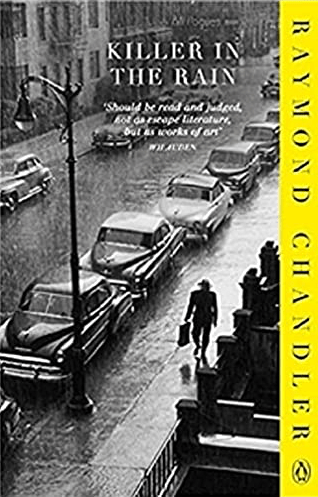
The novelette Killer in the Rain is one of the later short works of Raymond Chandler. He reused some of the elements with great effect in his first novel The Big Sleep.
As a teenager and early teen, I read all of Chandlers novels and loved them very much. Whenever someone asked me who my favourite writer was, I didn’t need to think twice – Chandler. As much as I loved him, I didn’t return to him because I rarely reread books. So, a few years back, someone asked me the question again and I said “It used to be Chandler”. That made it sound as if I didn’t like him anymore, but that wasn’t what I meant, it just meant – it’s been so long, I can’t be sure anymore. While I read and loved all of his novels, I hardly read any of his short stories and novellas, so it was with a lot of trepidation, that I started Killer in the Rain. What an experience this was. This isn’t as good as any of the novels, but it already has all the trademarks and reminded me why he once was my favourite author. Next time someone will ask me the question again, the answer will be – Chandler. And not in past tense, no.
Killer in the Rain is set in LA in the 30s and tells the story of a PI – probably Marlowe – who is asked to look after the daughter of a rich client. She’s been blackmailed and her dad is afraid that she’s got caught up in something sinister. Marlowe finds out the blackmailer owns a lucrative porn book lending business. When he goes to visit him, he finds him dead, his client’s daughter sitting stark naked and completely stoned on a chair, and someone running from the crime scene as soon as Marlowe enters. A little later, one of Steiner’s cars is found in a river, with a body in it.
Telling you more would spoil the story, but I think, this gives you an idea of what to expect.
Killer in the Rain is the novelette that’s closest to his novels in style. We can already see how different from other hard-boiled detectives Marlowe is – he isn’t named in the story, but we can assume it’s him. Marlowe cares. He’s anything but tough. Sure, he can act tough, doesn’t shy away from using a gun and shoot at someone, but he doesn’t do it lightly. As in all the later novels, solving the murder isn’t that important. Marlowe wants to help his client, keep him or her safe. While not as developed as in other books. there’s a social commentary here as well. The corruption of the police is obvious. Marlowe is one of two things that make me love Chandler so much. The other is his style. His books are written in a slang that’s not always easy to understand, especially not since a lot is made up. Chandler loved figures of speech and used them extensively in the novels. Here too, I found many wonderful sentences that made me chuckle.
“Carmen Dravec sat in Steiner’s teakwood chair, wearing her jade earrings.”
“Then all the expression went out of her white face and it looked as intelligent as the bottom of a shoe box.”
“Her giggles ran around the room like rats.”
As the title of the novelette evokes – it’s raining a lot in this book. The weather is always important in Chandlers work. It helps to create a moody atmosphere. I can’t remember if it rains often in his other books, but it does here and in The Big Sleep.
If you’ haven’t read Chandler yet and don’t know where to start this is a good pick. If you like it, you’ll already know that there’s much more and much better stuff where this came from. As for me, I might actually become a rereader after all.
Do you have a favourite Chandler novel? Mine is The Long Goodbye.
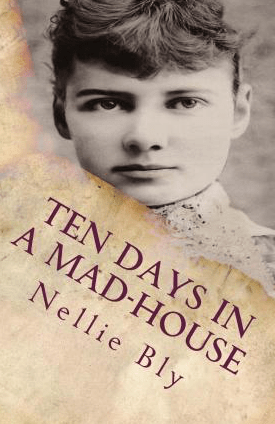
In 1887, young journalist Nellie Bly accepted an undercover assignment and had herself committed to the Women’s Lunatic Asylum on Blackwell Island, New York. In Ten Days in a Mad-House she tells her story. The account was first published as a series in a newspaper and then, at the end of 1887, as a book. Nellie Bly was only nineteen when she accepted the assignment.
There were rumours of neglect and violence at Blackwell’s Island and her editor wanted her to look into this. Nellie accepted but didn’t think she’d stand a chance to be committed because, after all, she had absolutely no mental health problems. First, she went to a boarding house for poor women where she acted as if she was crazy. She only spent a night there and was then questioned by the police and a judge and sent to a psychiatric institution. She was more than surprised that she was able to fool ordinary women, police, and judges. But surely doctors would see through her ruse. She was afraid that once they would question her, she wouldn’t be sent to her real destination, Blackwell’s Island. She shouldn’t have worried. It soon became obvious that the doctors didn’t really care. She was poor, seemed to have no family, and acted in a strange way – enough to be sent to Blackwell’s Island from where she most likely would never return.
Together with a few other women, who were just as sane as she was, Nellie was finally sent to Blackwell’s Island. What followed was a real horror trip.
Blackwell’s Island was by no means an exception. Everywhere in the world there were such asylums for poor women (and men too), many of which were initially not ill at all but were committed because their families wanted to get rid off them or because they didn’t behave as they should have. There were cases of illness too, for sure. Many of the cases Nellie Bly describes have been brought to the Island because of language problems. There are many Germans in the asylum who don’t speak any English. When they react with fear or anger, it is seen as a symptom of their illness.
A pretty young Hebrew woman spoke so little English I could not get her story except as told by the nurses. They said her name is Sarah Fishbaum, and that her husband put her in the asylum because she had a fondness for other men than himself.
The account is absolutely shocking. The way these women are treated would have tested the healthiest and strongest, but for women with any kind of mental health or other health problem, the treatment was atrocious. It reinforced their illness or, in many cases, pushed them over the edge.
But here was a woman taken without her own consent from the free world to an asylum and there given no chance to prove her sanity. Confined most probably for life behind asylum bars, without even being told in her language the why and wherefore. Compare this with a criminal, who is given every chance to prove his innocence. Who would not rather be a murderer and take the chance for life than be declared insane, without hope of escape?
There are many awful things in the asylum. Some of the worst are: the cold, the food, the brutality, the neglect.
It’s constantly cold at the asylum, but the women don’t even get proper clothing. When they complain, they are either hit or brought to other, more awful wards. The food sounded so disgusting that reading about it made me gag. It’s not even food. It’s horrible slosh. Many of the women can’t eat it; it makes them vomit. For that, too, the nurses chastize them. Personal hygiene is almost impossible. The descriptions of the way they are bathed and combed made me shudder.
My teeth chattered and my limbs were goose-fleshed and blue with cold. Suddenly I got, one after the other, three buckets of water over my head—ice-cold water, too—into my eyes, my ears, my nose and my mouth.
And there’s the violence. Nurses deliberately push women to react and then punish them, by jumping or choking them. Or sending them to what they call chain gangs.
The longer, Nellie is there, there more she’s shocked and even scared. What if they can’t get her out?
During her stay, she’s seen by a few doctors, but they don’t listen to her. For them, her insanity is a given. They never question it. And since these women are poor, the treatment too, isn’t questioned. After all, they say, they should be grateful as they live off charity.
The days go by awfully slowly as there’s no distraction. They aren’t even allowed to read. This kind of treatment, as Nellie can observe, makes many a sane woman lose her mind.
What, excepting torture, would produce insanity quicker than this treatment? Here is a class of women sent to be cured. I would like the expert physicians who are condemning me for my action, which has proven their ability, to take a perfectly sane and healthy woman, shut her up and make her sit from 6 A. M. until 8 P. M. on straight-back benches, do not allow her to talk or move during these hours, give her no reading and let her know nothing of the world or its doings, give her bad food and harsh treatment, and see how long it will take to make her insane. Two months would make her a mental and physical wreck.
Nellie is freed after ten days and subsequently writes her account. It raised awareness and made things a bit better, as more money was collected to improve some of the conditions.
Ten Days in Mad-House is interesting for many reasons. It’s a first-hand account of a mental institution and therefore an important historical document. But it’s also interesting as a piece of early investigative journalism. The writing is very different from the way journalists write now. It’s far too detailed and quite dry.
If you’re interested in the history of mental institutions, the history of women and mental health, or the history of journalism, you’ll find this fascinating. But you’ll also find this fascinating if you’re interested in female pioneers. Nellie Bly was an amazing woman and went on to have an interesting journalistic career that ended when she married and took over her husband’s company.
Nellie’s story has been made into a movie in 2015. It looks quite good. I might try to track it down. I’ll just have to bear in mind that neither the women, nor the place, looked even remotely like those in the film.
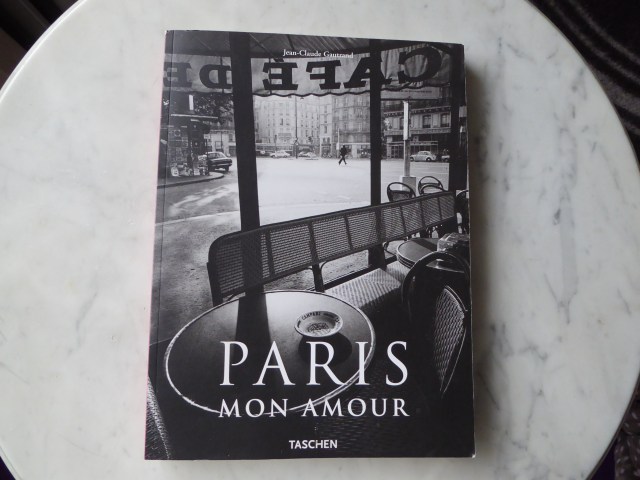
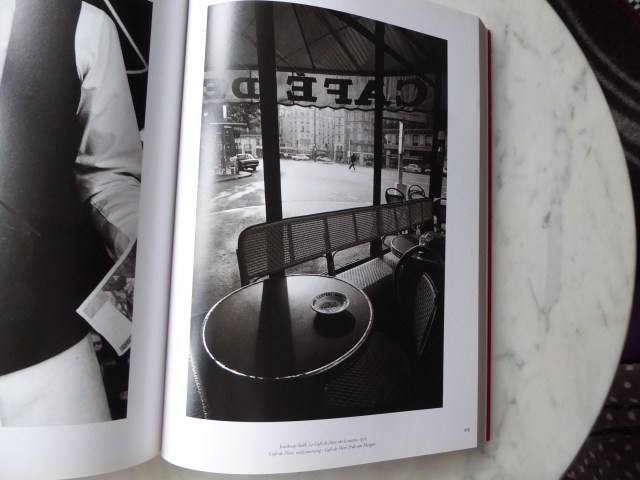
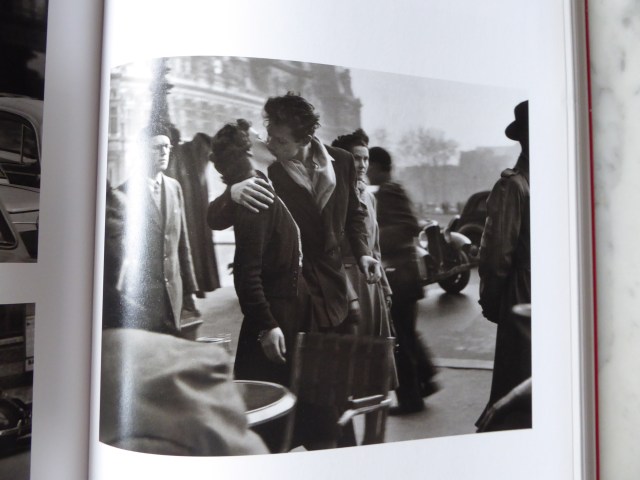
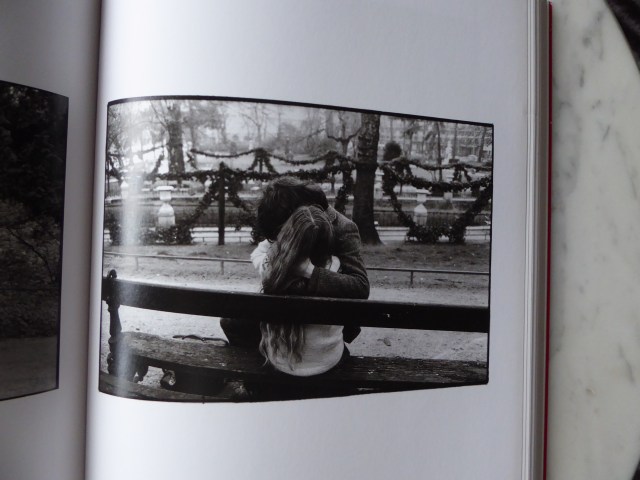
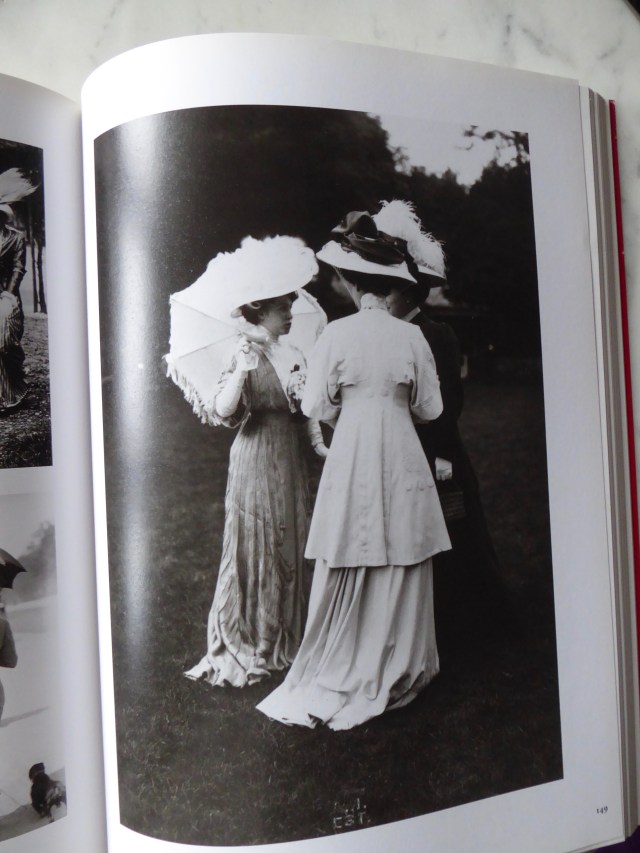
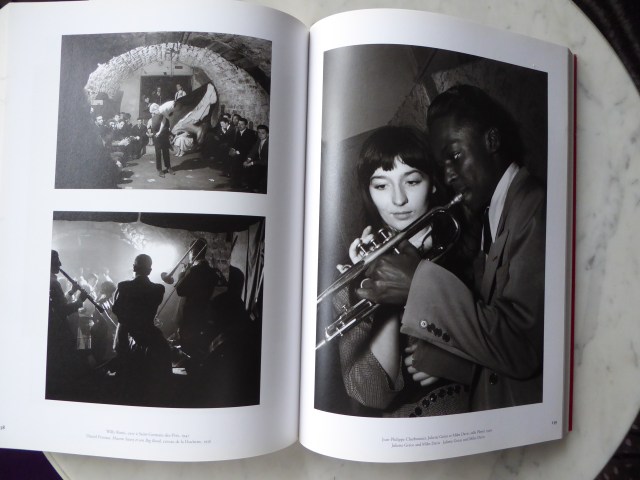
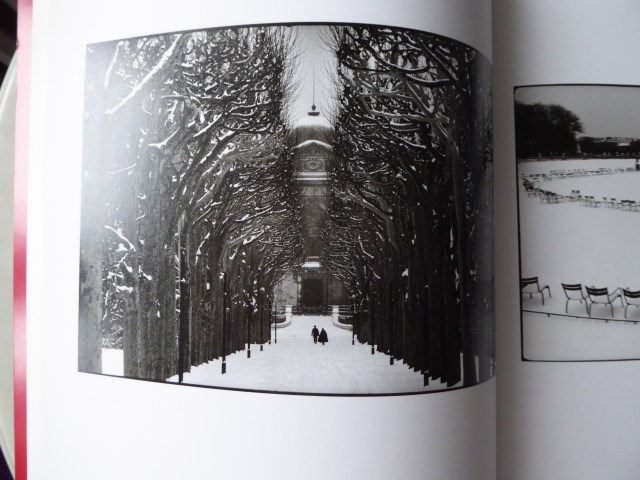
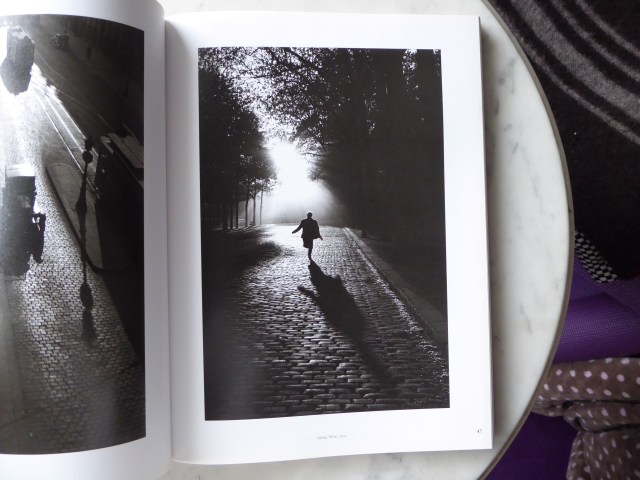
I’ve had Paris Mon Amour for ages and it’s still one of my favourite coffee table books. I never tire of black and white photos of the old Paris and this book combines some of the most famous ones. But that isn’t the only thing this book offers. It’s also a splendid introduction to some of the most famous photographers like Henry-Cartier Bresson, Jeanloup Sieff or Robert Doisneau.
The pictures are grouped by themes – parcs, children, lovers, streets, the métro, life of ordinary people, fashion, war, cafés and bistros, jazz clubs.
The oldest photos are from the 1850s the newest from the 80s.
Many of these photos are iconic. Many contributed to an idealized, mythical, and often clichéd idea of Paris, depicting things that are long gone.
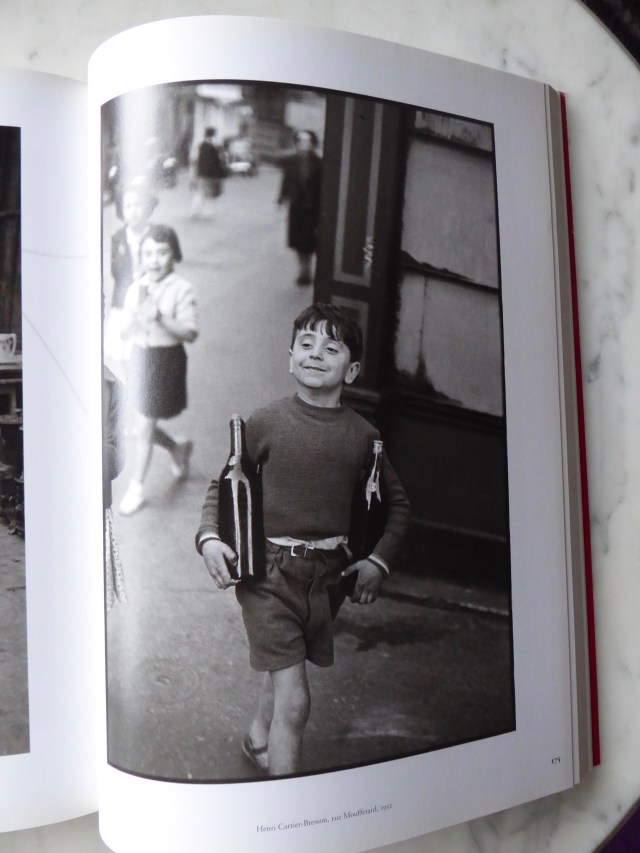
This very famous photo was taken by Henri Cartier-Bresson and is very typical of his work.
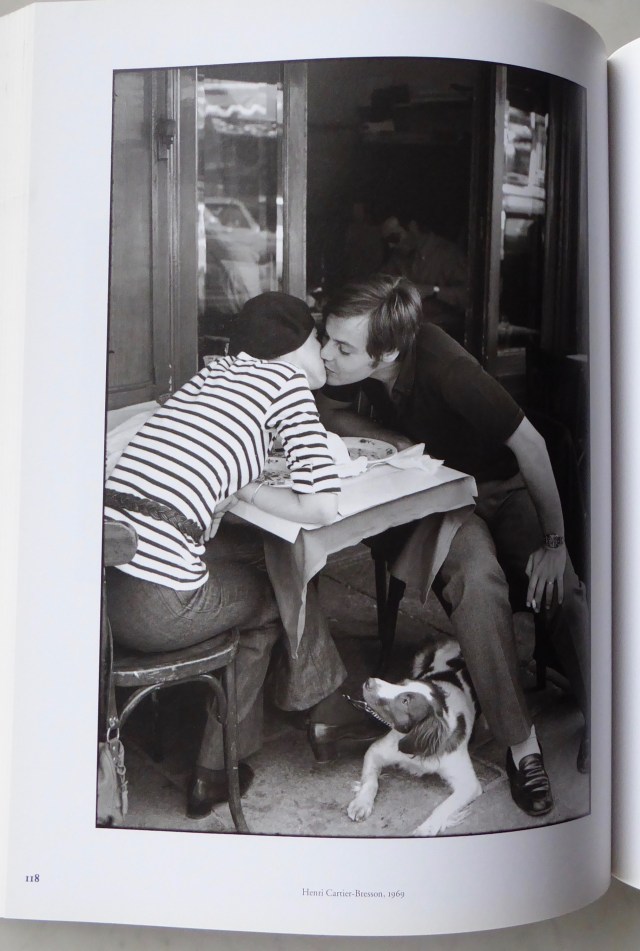
This is another, lesser-known picture by Cartier-Bresson. Don’t you just love how the dog looks at the couple?
Jeanloup Sieff is better known for his nudes, but this shot from the Café de Flore, early in the morning, is among the most loved Paris photos.
This image of two lovers kissing, was taken by Robert Doisneau. I think I have at least two, if not three French novels whose covers show this picture.
This photo of two lovers kissing in the Jardin du Luxembourg, isn’t as famous but I think it’s lovely. It was taken by Édouard Boubat.
Some of the newest photos can be found in the chapter on fashion, but I chose this one from 1910. It reminds me of Proust. It’s called La mode au bois – Fashion at the Bois de Boulogne and was taken by Séeberger.
Juliette Gréco and Miles Davis at a Jazz Club, were photographed by Jean-Philippe Charbonnier.
This photo of the Jardin des Plantes is one of my favourites. The photographer is Philippe Gautrand.
And this beauty was shot by Sabine Weiss.
The editor Taschen is well-known for beautiful but very modestly prized books on art and photography. This one is no exception. It’s a large tome. As you can see, it’s almost the size of a bistro table, but doesn’t cost more than a paperback. An ideal book for Paris and photography lovers.
Gustave Flaubert’sA Simple Heart–Un Coeur Simplewas published in 1877 in the collectionTrois Contes, the last book that was published in his lifetime. It’s the first novella or short story, depending a bit on how you define novella.
A Simple Hearttells the story of Félicité, the fifty-year-old maid of Mme Aubain, a formerly rich widow. Félicité who is an orphan, has known heartache in her life. She once was in love but the man abandoned her for another. She then moved and found occupation with Mme Aubain. Mme Aubain’s acquaintances often envy her because of Félicité’s dedication and loyalty. The maid has no life outside of this family. She’s particularly devoted to the daughter of the family. Mme Aubain has two children, Paul, the older, and Virginie the younger child. Because Félicité accompanies Virginie to catechism, she is introduced to religion. This will kindle in her a new love, a more mystical love.
Virginie isn’t the only one Félicité is dedicated too. There is also a nephew who takes advantage of her. When both children die, it affects Félicité deeply. But then there’s hope. Mme Aubain is gifted a parakeet, Loulou, and because Félicité is so fascinated, so mesmerized by the bird, her mistress finally gives Loulou to her. They live together in Félicité’s small room under the roof. A room that is filled with memorabilia and things that the family didn’t want anymore.
Loulou is Félicité’s everything. The biggest love of her life. She even sees a representation of the Holy Spirit in him. But since this is a tragic story, the bird, too, will bring heartache.
A Simple Heart is a sad story. It describes the kind of life that many poor, uneducated, single women must have led in the 19th century. Félicité is deprived of almost everything – family, education, companionship, love. Her loneliness runs deep. Her love desperately seeks to find an outlet, whether through someone else’s child, a relative, an animal, or religion.
A Simple Heart is not easy to read because it is quite depressing and a bit icky – I can’t reveal why because I don’t want to spoil the story.
It’s not the first time I’ve read this. I read it before because it’s a story that is famous for the way Flaubert handles time. It’s masterful. In sixty pages, he manages to tell the story of a whole life, alternating between fast-forwarding and slowing down. At the end, we almost think, we’ve read a novel because, thanks to his writing style and technique, there’s so much to find in this novella.
People often ask, when it comes to classic authors, which book would be a good starting point. While there’s no doubt that Madame Bovary is a masterpiece, this short story would make a perfect introduction to Flaubert.


 Beauty is a Sleeping Cat