Ferdinand von Schirach: The Collini Case – Der Fall Collini (2011)

After having liked both short story collections Crime (here) and Guilt (here) by Ferdinand von Schirach it was only a matter of time until I’d get to his first novel The Collini CaseDer Fall Collini. It has been published in Germany end of last year and is due out in English in a few weeks.

Ferdinand von Schirach is one of Germany’s most prominent defence lawyer’s. And he is the grandson of Baldur von Schirach who was convicted of being a war criminal. Given this family history it’s not surprising his new book has a WWII theme. But it wouldn’t be a Ferdinand von Schirach book if it was only about a war crime.

It’s not easy to write a decent review about The Collini Case without giving away too much. Collini is a 6o-year-old Italian who has been living in Germany for a long time. One day – and this is not a spoiler as it happens on the first pages – he enters a hotel room pretending to be a journalist and brutally kills the 80-year-old business tycoon Hans Meyer. He then waits patiently until he is arrested.

Leinen is a young lawyer. The Collini case is his very first case. While there is no doubt that Collini has murdered Meyer, finding out why he did so is important as it can determine the sentence. Unfortunately Collini doesn’t want to speak. This makes it hard for the young lawyer and there are other adversities which make it even harder.

Von Schirach said in an interview that he doesn’t think of himself as a crime writer as the “who did it” doesn’t interest him at all. He wants to know why. And so it’s not surprising that the novel entirely focuses on the question why a spotless man like Collini committed a gruesome murder.

What fascinated me and most readers of von Schirachs’s stories was the fact that they were all based on true stories. Very naturally I was wondering the same here. Is it true? While it is obvious that the lawyer isn’t von Schirah in this case, the trial and the many amazing twists and turns are all based on a real case.

The case as such and how it is presented, the court room part, the look into the way Germany has dealt and still deals with its past are really interesting and I liked reading about it. Some of it left me speechless and was quite shocking. Some of it was very sad. Interestingly though that wasn’t the main appeal of this novel for me. I’ve read quite a few reviews and was surprised how much people wrote about the case and the trial only. What makes this an outstanding book in my eyes is another dimension. Without revealing too much I can say that one of the most important points of the book is the loss of memories. Imagine you find out that a person you like is not what you thought but that on the contrary has been hiding a dark and unpleasant secret. Wouldn’t that make you feel as if you’ve lost all your memories tied to that person? That’s I think one of the reasons why family secrets are so damaging. They can alter the perception of your past to such an extent that you will feel robbed of it.

Once more von Schirach has shown that he not only knows how to tell a story in crystal clear and very taut prose but that he can write interesting, thoughtful and thought-provoking books.
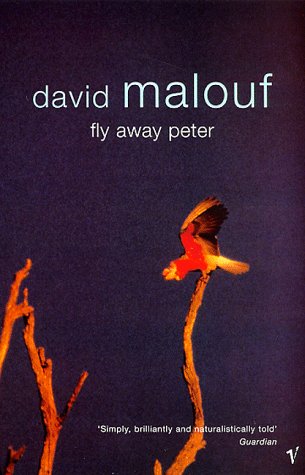
David Malouf: Fly Away Peter (1982)

There really are numerous ways to write about war. While some elements will always remain the same – especially when one of the novel’s themes are the trenches of WWII – accomplished authors, will still find a way to write something completely new. David Malouf’s Fly Away Peter is an excellent example for this.

Being an Australian writer Malouf writes about the war from the Australian perspective which works on two very different levels. One focuses on the land and nature, the other on the people. I have a feeling I would have overread a lot if I hadn’t seen so many Australian WWI movies and read Charlotte Wood’s stunningly beautiful The Submerge Catherdral (here).

It seems to be a trademark of a lot of Australian writing to emphasize the beauty and uniqueness of the flora and the fauna of the continent. Much of it must seem like paradise to the inhabitants and so it’s not surprising Malouf starts the book with the description of nature. Jim Saddler, a young Australian who has never been outside of the country, knows more than anyone about birds. He lies hidden in the marshes and watches them for hours. Ashley Crowther, another young man, but from a very different background, has returned from England where he went to university and come back to take care of his vast family estate. The marshes are part of it. When the two men meet, something almost miraculous happens. Without knowing Jim, Ashley senses the knowledge and the passion he has for birds and offers him a job. This is a dream come true for Jim, a man from a very modest background. The plan is to turn the marshes into a bird sanctuary and Jim will work there, observing, making lists.

While observing one of the rare birds, Jim meets Imogen, an English woman who arrived in Australia not long ago, and has decided to stay here. She is a photographer and earns a living with nature photography.

When the war breaks out none of the three characters thinks at frist it has a lot to do with Australia but in the end, the two men sign up. Of course Ashley will be an officer, while Jim becomes just a simple soldier.

Once in France, the tone and style of the book changes considerably. During the first half of the book, Malouf’s writing was poetic and the structure of the sentences unconventional but when he starts to describe the horror of the war, the writing, moves into the background and is more conventional.

Most of what is described from Jim’s point of view, we know from other WWI novels; the rats, the mud, the corpses, the gas. That is not new but what is new is how the earth is evoked which leads to comparisons. The rich earth of the Australian marshes produced so much beauty, here the earth swallows up everything, they all sink into it in the end.

One of my favourite war movies, Beneath Hill 60,  describes the contribution of Australian miners to WWI. Something the film directors chose to leave out, is mentioned in the book. While digging the tunnel systems beneath Hill 60 and arriving at the enemy lines, the miners discovered the skeleton of a  mammoth.

Jim is a witness of this discovery. It’s a key scene in the novel as it is an example of continuity.

It was a great wonder, and Jim stared along with the rest. A mammoth, thousands of years old. Thousands of years dead. It went back to the beginning, and was here, this giant beast that had fallen to his knees so long ago, among the recent dead, with the sharp little flints laid out beside it which were also a beginning. Looking at them made time seem meaningless. (….)

Continuity is a major theme of the book, continuity and opposites. The land and nature exist and will always exist. They are endless while humanity is not and the individual man even less so. Man creates opposites, the good and the bad, the ugly and the beautiful, the cowardly and the heroic, they all take place inside of the continuity.

The mammoth is a symbol for this and so are Imogen’s photos. At the end of the novel she thinks about how she met Jim. She captured a bird on a  photo while he captured it in his mind. The bird is long gone and so is the picture in Jim’s mind because Jim is gone, but it’s still here, as she remembers both and there is still the photo as well.

It’s hard to do justice to a book like Fly Away Peter in a short post. I hope I was able to convey the beauty and make you curious to find out for yourself. I couldn’t help but had to compare it to two other shorter WWI novels we read last year, Susan Hill’s Strange Meeting (here is the review) and How Many Miles to Babylon by Jennifer Johnston (here is the review). While the latter will always be my favourite, Fly Away Peter is excellent as well and adds another dimension. It contains a rich a meditation and philosophical exploration of WWI from an Australian perspective which is well worth reading.

Have you read David Malouf? Which is your favourite of his books?

The review is a contribution to the Aussie Author Challenge as well as to War Through the Generations.

If you’d like to read another review, Danielle hast posted about it here.

Nicci French: Tuesday’s Gone (2012)

Psychotherapist Frieda Klein thought she was done with the police. But once more DCI Karlsson is knocking at her door.

A man’s decomposed body has been found in the flat of Michelle Doyce, a woman trapped in a world of strange mental disorder. The police don’t know who it is, how he got there or what happened – and Michelle can’t tell them. But Karlsson hopes Frieda can get access to the truths buried beneath her confusion.

A few months ago I read and reviewed Blue Monday, the first in the new series written by writer duo Nicci French. I thoroughly enjoyed it as you can read here and was looking forward to the sequel. Tuesday’s Gone is the second novel in the series with psychotherapist Frieda Klein and DCI Karlsson. I didn’t expect it but I’m glad to say that this book was even far better than the last. The characters are more rounded, the story is much more suspenseful and some loose strands of the first book are nicely tied together. The only bad news is, you should read Blue Monday first as the sequel contains numerous spoilers, even mentioning the solution to part one.

Who is this man the police find in Michelle Doyce’s apartment, sitting on a sofa, naked and decomposed? The autopsy shows the man was murdered and since Michelle is a woman with a rare mental disorder it seems likely she killed him. Or at least the police would hope so as that would cut a lengthy investigation short and save a lot of tax money.

For some reason DCI Karlsson isn’t happy with this interpretation and asks psychotherapist Frieda Klein to talk to Michelle. Frieda is no expert in this type of disorder and consults with a specialist. As hard as it is to talk to Michelle, they find a way to communicate and it seems highly unlikely she committed the crime.

Frieda thinks it’s far more crucial to find out who the man was. It takes a while and they discover that his name is Robert Poole but when they inform his brother that they found his body they are in for a surprise. Robert Poole died six years ago. It looks as if the dead man on the sofa used a fake identity, had a lot of money transferred to a bank account in Poole’s name and withdrew it again on the day of his murder.

While the police are willing to pay Frieda for her work, like in the first book she does a lot of research on her own account. One cannot shake the feeling that a lot of what she does has something to do with personal atonement.

Once they find out that the victim was a con man and they start interrogating some of his victims, the book gets really interesting. There are many loose ends but they are all tied together in the end. Some elements of part two are still important in this part and will also play a role in the next.

We get to know Frieda much better in this book, some of her family history is revealed, her love life gets a new twist. DCI Karlsson and some other secondary characters are further developed. And once more the location, the city of London, plays an important part and we learn a few interesting historical facts while following Frieda on her nightly walks through her beloved town. While the book has a satisfying ending, there are clearly indications that there will be a third part soon.

I really enjoyed Tuesday’s Gone and could hardly put it down. While the first in the series had some minor flaws Tuesday’s Gone is as good as Nicci French’s standalones. This has turned into a really gripping series with complex, flawed but likable main characters.

On Juan Carlos Onetti’s A Brief Life – La vida breve (1950)

Picture a lazy summer afternoon. The heat is unbearable. You’re in a room with the blinds half down, lying on a bed listening to the voices of complete strangers in the apartment next door. You’re in a languid dreamy mood. Your imagination starts to invent a story based on the snippets of the conversation you hear.  After a while the lives next door seem more real than your own.

Many of the chapters in Juan Carlos Onetti’s famous novel A Brief Life capture this type of mood, describe inertia paired with a vividly active imagination. I liked this, because I like those motionless summer afternoons spend lazily doing nothing else but day-dreaming. I liked the languid and languorous feeling those chapters conveyed. Seeing the narrator Juan María Brausen captivated by his imagination was appealing but the narrator was not. I hated him big time. I rarely if ever use the word “misogynist” but I felt the narrator was exactly that. His wife has just undergone a mastectomy and the way he thinks about her, her pain, her mutilated body, is unfeeling, self-centered and lacking any kind of empathy. It just annoyed me so much that after 150 pages I stopped reading. Because life is indeed very brief, I decided to abandon this novel.

The novel is well written and parts of it had an atmosphere and a mood I liked a lot but it was also confusing at times. It constantly switches from the narrator’s real life to the invented story about a doctor living in the fictional city Santa María. From there it switches to a third narrative strand showing the narrator inventing himself a double life and visiting the woman, a prostitute, who lives next door.

I suppose if the narrator hadn’t annoyed me so much – and not only because he is misogynistic – I would have finished the book as I found the narrative technique interesting.

I was curious to see whether other people had felt the same and googled “Onetti and misogynist”. I’m not sure why I didn’t trust my own impression but I was relieved to see that it was something critics and readers had commented on very often.

Onetti was a Uruguayan writer. He is famous for his novels and his short stories. I’ve read the collection Tan triste como ella a few years back and liked the melancholic tone. Onetti fled to Spain after having spent 6 months incarcerated in a mental hospital by the military government. Onetti was married 4 times (why did that not surprise me?).

I’ve read Onetti’s novel for Spanish Literature Month hosted by Richard (Caravana de recuerdos) and Stu (Winstonsdad’s Blog). It’s part of a readalong. It will be interesting to see what others thought, if they finished it and how they liked it.

Tatiana de Rosnay: The House I Loved (2012)

Her newest novel, Rose, is already an early spring hit in France. Again written initially in English, this historical work evokes Paris under the Second Empire and the grand urban redesign ordered by Baron Haussmann: Rose, an aging widow living in her family home in a small street near the church of Saint Germain des Prés, receives a letter announcing that her home is slated for destruction to make way for the new Boulevard Saint Germain.

I haven’t read any of Tatiana de Rosnay’s novels before. Knowing she is one of the most successful French writers made me a bit suspicious but when I saw a copy of Rose in our local bookshop I felt drawn to it immediately as the novel is about Paris. It’s only after browsing the book that I found out, the original, The House I Loved, was written in English and Rose is a translation. I wasn’t even aware that Tatiana de Rosnay has written most of her latest novels in English and – less surprisingly – that this contributed to her international success.

The House I Loved is written in  the form of a long letter from Rose to her deceased husband. She tells him that she has, after all, been informed that she has to move. Her house is among those which will be destroyed to make way for the large boulevards which are part of the redesign of Paris ordered by the Prefect, Baron Haussman. The idea to lose the house breaks Rose’s heart. She loves this house, loves it for its history and because it is the family home of her husband. For her, whose mother was cold and distant, the house has become her home just like his family has become her family.

In this long letter she looks back on her past, how she grew up, how they met, speaks to him about her children, their life together, the sadness about the death of her son, about her husband’s illness, his confusion and his death. The memories and remembrances are often interrupted by the present. The people who will tear down the house will arrive soon but she has still not left. She speaks of the destruction, how the city changes.

I had a bit of a problem with the way this was told. The tone is very sentimental, at times corny, the voice too modern for the time depicted. I think it would have been much better as a third or a simple first person narrative instead of this epistolary confession. Still I’m very glad I have read this. It captured a particular moment in the history of the city of Paris very well. I love Paris for its big Boulevards and Avenues, the Paris of the Baron Haussmann. They represent Paris for me. When those big Boulevards were designed, the old medieval streets had to go, the houses were torn down. I tend to forget at what cost the remodeling of the city was achieved. It is so hard to imagine what it would have meant to own a family house, full of memories and histories and to be informed that it will be torn down and destroyed for the sake of modernisation and sanitation. Tatiana de Rosnay captures the enormity of such a loss very well.

In oder to achieve authenticity, Tatiana de Rosnay said in an interview, she wrote most of the novel with a pen, by candlelight. “I had the idea for this novel 15 years ago, after seeing pictures of streets now forgotten,” she explains. “It contains my two obsessions: memories embedded in the walls and family secrets.”

If anything The House I Loved made me want to pick up a few non-fiction books on this topic or Zola’s novel La CuréeThe Kill, which Emma reviewed recently here.

If you don’t mind a sentimental tone and are fond of historical novels and books set in Paris you might enjoy this entertaining novel.

I have attached a video about an exhibition of photos taken during the time. Although it is in French, you see many amazing photos. The person interviewed speaks about the numbers – how many houses were destroyed and why and about the photographer and why there were no people on the photos (at that time they couldn’t capture movement – so the streets had to be empty).

This review is a contribution to Karen’s and Tamaras‘s event Paris in July

The Canadian Book Challenge 6

I was hoping to find a Canadian Literature Challenge. These days I’m very interested in literature written in English outside of the UK and the US. The Canadian Book Challenge seemed just the thing I was looking for. I came across the challenge on Gavin’s blog Page 247.

The host is John Mutford from The Book Mine Set. His blog is dedicated to Canadian literature. If you are interested here’s the sign up post with all the details you need to know. In theory the idea is to read 13 books. It sounds like a lot but interpreting what John writes I would say it doesn’t seem as if you must reach that number. Aim for it, if you read less, it’s not the end of the world, if you read more, all the better.

I have a lot of Canadian literature on my book piles and have read quite a few authors in the past. Authors writing in English and in French. I asked and if you’d like to join, you can choose books written in English or French as long as the author or the topic is Canadian.

I know that I usually do not stick to my book lists but I still keep on making them. Possible choices for this challenge are

A Map of Glass by Jane Urquhart. Urquhart isn’t an easy writer but she is a fascinating one who writes beautifully.

Margaret Atwood’s Lady Oracle. Atwood is another immensely fascinating author I have meant to return to. I loved Cat’s Eye and Surfacing and some of her short stories.

The Birth House by Amy McKay. I haven’t read this author yet but everyone who read this novel was impressed.

The Stone Angel by Margaret Laurence is a book I discovered not too long ago on Danielle’s blog (A Work in Progress). It sounded like another Canadian must-read.

I would like to read the one or the other novel by Nancy Huston and some other Canadian authors writing in French.  Since I recently discovered Louise Penny’s Canadian crime series, I’ll certainly read one of those as well.

Are you joining? Do you have any Canadian literature suggestions?

Alvaro Mutis: Amirbar (1990) The Fifth Adventure of Maqroll

And if you want to change your life – for the better – and have never read the Colombian novelist Alvaro Mutis, you owe it to yourself to get acquainted with The Adventures and Misadventures of Maqroll. A collection of seven novellas that can be read at a run or singly, it features the greatest rainbow-chaser since Quixote, but a lot sexier and ravenous for both learning and love, not to mention fantastical, doomed schemes to make a pile of loot.

Alvaro Mutis is a Colombian author who lives in Mexico. He is famous for his stories about Maqroll the Gaviero (the Lookout). The Adventures and Misadventures of Maqroll – Empresas y tribulaciones de Maqroll el Gaviero is composed of seven novels and novellas which can be read as a whole or individually. Each tome is around 120 pages long and they seem to vary greatly in style and narrative technique. Some are like diary entries, others are letters, still others contain more straightforward story telling.  I’ve had  the novella Amirbar, part 5 of Maqroll’s story, on my book piles since years and never got around to reading it. Richard’s (Caravana de recuerdos) and Stu’s (Winstonsdad’s BlogSpanish Literature Month seemed like the perfect time.

Reading Amirbar was an amazing experience. While Mutis is compared to Conrad – although he himself calls Dickens his greatest influence – I felt he was much more like a Latin American Blaise Cendrars. Amirbar reminded me of Cendrars’ amazing book L’or – Gold but is still a very distinct book. It has also something of the Tales from the Thousand and One Nights.

All the Maqroll stories are told by a narrator who works for some big corporate company and meets his friend Maqroll in different countries and cities at different times. Maqroll is a mariner and adventurer who travels the world without ever settling down for long. The sea is his chosen home and when he is at land it’s only to make business, most of it either illegal or highly adventurous. Whenever he meets his friend, the narrator, he tells him all of the stories that have happened in the meantime. When they do not meet, he writes long and winding letters all containing fantastic stories as well.

At the beginning of Amirbar, Maqroll and the narrator are in the US. Maqroll is ill and almost dying, he has contracted some tropical fever. The narrator takes care of him and sends him to live with his brother in California for a while. It is there that Maqroll tells them the story of Amirbar – a gold mine.

This is how the novel begins (translation taken from the English version)

Los dias mas insolitos de mi vida los pase en Amirbar” nos cuenta Maqroll el Gaviero. En Amirbar deje  jirones de mi alma y buena parte de la energiaque encendio mi juventud. De  alli descendi tal vez mas sereno, no se, pero cansaado ya para siempre. Lo que uno despues ha sido un sobrevivir en la terca aventura de cada dia. Poca cosa. Ni siquiera el oceano ha logrado restituirme esa vocacion de soñar despierto que agote en Amirbar a cambio de nada.

I spent the strangest days of my life in Amirbar. In Amirbar I left shreds of my soul and most of the energy that fired my youth. Perhaps I came down from there more serene, I don’t know, but I was everlasting weary too. What has happened to me since then has been a matter of simply surviving each day’s difficulties. Trivialities. Not even the ocean could give back to me my vocation for dreaming with my eyes open; I used that up in Amirbar and received nothing in return.”

Maqroll is driven by the urge to find gold, not so much because of its monetary value as we understand but because it symbolizes much more to him. It’s an obsession, a magical metal, something that calls for him from the entrails of the earth in which it is buried. The mine is in the Colombian Andes. He first discovers another one but has to flee it when they find a grave with people who have been murdered by some sort of Military Junta. Finding the skeletons puts them in grave danger. The next mine he explores is Amirbar. The wind in the tunnels systems of the mine seems to have a voice and what it is calling is the word “A-mir-bar” which has a special meaning for Maqroll.

One of the traits of Maqroll is that he has a lover wherever he is. In Amirbar it is Antonia who gets unhealthily attached to him. The relationship between Maqroll and Antonia is one of many small side stories in the book, one of many stories which turn into a desaster. Another important trait is Maqroll’s love of books. He is always reading. Most of the books he reads are obscure historical texts. He loves to immerse himself in another era and read about people who are long gone.

As fantastic as some of the stories sound they are infused with a high dose of realism. Set in a corrupt country, some of the characters are arrested, the gold is confiscated more than once and those who help Maqroll end up in prison and are tortured.

You can easily read Amirbar or any other story on its own but one thing is for sure, it will very probably make you want to read them all. I’ve read a few reviews since I started the book and it seems Amirbar isn’t even the best of the stories. In Maqroll Mutis has created some sort of alter ego, a character who feels so real that in his real life Mutis speaks about him with his friends as if he really existed.

Amirbar is a wonderful book, full of life, stories and tales. Reading it is an adventure in itself. I think it would be an excellent introduction to Latin American literature because despite of its complexity and exuberant story telling it is a very accessible, entertaining book.

Amirbar is a contribution Richard’s and Stu’s Spanish Literature Month.