Kim Echlin: The Disappeared (2009) Literature and War Readalong March 2015

The Disappeared

Friends of mine visited Cambodia. They loved the country for its beauty, but they told me that it wasn’t an easy country for travelling as you’re not allowed to move as freely as you’d like because of the danger of the land-mines. A friend of mine is half-Cambodian. He was born in Europe, after the war, but spent a couple of months in Cambodia where he joined a bomb disposal unit. He came back changed and traumatized.  He wouldn’t speak for months. Thirty years of war ravaged the country and left the deadly long-lasting legacy of millions of land-mines. Cambodia is among the ten countries with the most landmines. Currently there are still 8 – 10 million. Cambodia has one of the highest rates of disability. Since 1979 there are some 40 amputations per week. To clear Cambodia of its land mines could take up to 100 years.

The war as such isn’t easy to understand. First there were the Khmer Rouge and Pol Pot, later the Vietnamese invasion. Mostly these wars were genocides. Depending on which side was in  power it would try to wipe out the other side using torture, rape, mutilation and shootings.

I usually don’t start a book review with so much back information but I felt it was needed in this case, although it’s still not nearly enough.

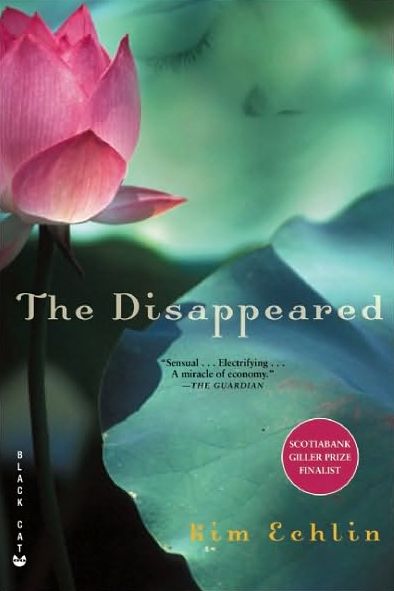
Kim Echlin’s novel The Disappeared begins right after the Khmer Rouge have fled the country. Anne Greves is in Phnom Pen looking for her lover Serey. She met him in Montreal ten years ago when she was only sixteen. Serey, a student and musician, fled Cambodia during the rise of the Khmer Rouge. He has no news of his family. The two young people begin a passionate love affair until Serey returns to Cambodia. Anne hopes he will keep in touch but he doesn’t. She waits and waits and the years go by. She has other lovers but she can’t forget Serey. Meanwhile she has learned the Khmer language and decides to travel to Cambodia and search for Serey in all the clubs of Phnom Pen.

When she finds him she discovers he too couldn’t forget her and they become lovers again until the day Serey disappears once more.

The Disappeared is a stunning novel. Beautiful and harrowing. Through the eyes of Anne we discover the beauty, tragedy, and horror of Cambodia. Thanks to her lover, and because she speaks the language, she is able to immerse herself fully. While the Pol Pot regime is over, Cambodia is still in a state of war, people are still hunted, tortured an executed.

The book is written like a lament. Often Anne addresses her lover.

I see your long silence as I see war, an urge to conquer. You used silence to guard your territory and told yourself you were protecting me. I was outside the wall, an intoxicating foreign land to occupy. I wondered what other secrets you guarded. Our disappeared were everywhere, irresistible, in waking, in sleeping, a reason for violence, a reason for forgiveness, destroying the peace we tried to possess, creeping between us as we dreamed, leaving us haunted by the knowledge that history is not redeemed by either peace or war but only fingered to shreds and left to our children. But I could not leave you, and I could not forget, and I did not know what to do, and always loved you beyond love.

Serey stands for millions of disappeared people. Most relatives never find out what happened to their loved ones, but Anne, fuelled by her passion and because she’s a foreigner who cannot fully comprehend the risk she’s taking, doesn’t let go until she’s found out what happened to the man she loves.

Many of the chapters are like short vignettes. Some contain not much more than lists of atrocities. War is awful but genocide is even much more horrible. To read about what is done to women and children, even babies, is hard to stomach.

Nonetheless it’s a beautiful, captivating book. Anne is passionate about her man and his country, discovering everything, breathlessly. This gives the reader the feel of being on a trip through a foreign country, led by a highly knowledgable guide. It is foreign but you feel like you’re quickly becoming a part of it.

The language is the language of a poet although Kim Echlin doesn’t write poetry. It’s lyrical and full of powerful images.

Kim Echlin managed something admirable. She captured the universality of grief, loss, and war, but at the same time she brought to life a country’s story that we’re either not familiar with or not interested in. In this, the novel is a call for compassion.

Why do some people live a comfortable life and others live one that is horror-filled? What part of ourselves do we shave off so we can keep on eating while others starve? If women, children, and old people were being murdered a hundred miles from here, would we not run to help? Why do we stop this decision of the heart when the distance is three thousand miles instead of a hundred?

The book explores the question of how much we can really understand of a foreign country. I liked that Anne never accepted to stay an outsider. She wanted to be part even if that meant that she put herself in danger.

The Disappeared isn’t easy to read but I loved this haunting book. It’s an amazing achievement, an intense, lucid, lyrical, and compassionate novel about a devastating conflict and a love that surpasses everything.

I’m going to end this post with one of my favorite scenes from the book. It takes place in Montreal. I think it shows what a wonderfully expressive writer Kim Echlin is and illustrates her style, how she renders dialogue.

We rode your bike to the great river. Stars and water and night. Down the riverbank, wrapped in darkness. You led me along a dock where boats were moored in narrow slips and we jumped onto the deck of a sloop called Rosalind. You took a small key from your jeans pocket and unlocked the cabin door. I followed you down the three steep steps into a tiny galley and you opened a cupboard door and took out a box of floating candles. You said, At home it is Sampeas Preah Khe, the night we pray to the moon. My grandmother always lit a hundred candles and sent them out on the black river.

Why?

To honor the river and the Buddha.

You handed me a book of matches and I lit them with you, one by one. We sent out the ninety-ninth and hundredth out together and wathched the trail of small flames drifting away. You said, My grandmother told me in the old days young people did this and prayed for love.

Other reviews

 My Book Strings

Vishy (Vishy’s Blog)


*******

The Disappeared is the first book in the Literature and War Readalong 2015. The next book is the Vietnamese novel Novel Without a Name – Tiêu thuyêt vô dê by Huon Thu huong. Discussion starts on Friday 29 May, 2015. Further information on the Literature and War Readalong 2015, including the book blurbs can be found here.
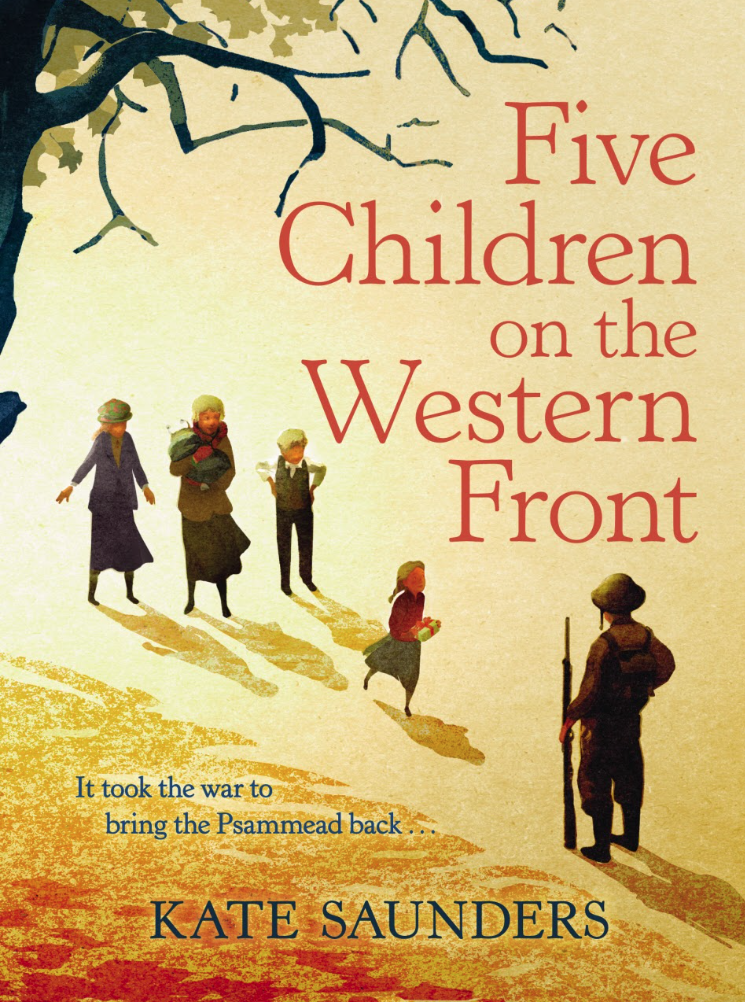
Kate Saunders: Five Children on the Western Front (2014)

Five Children on the Western Front

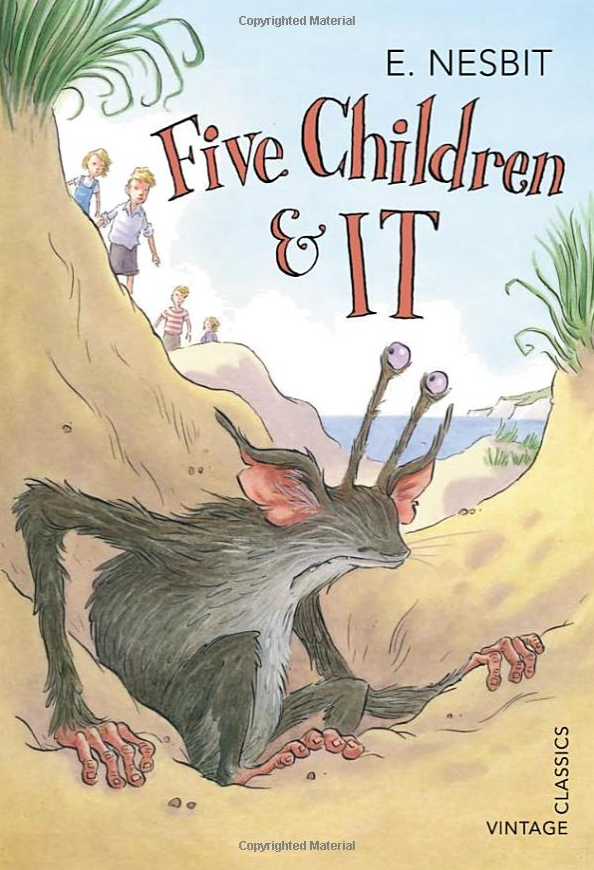
Five Children on the Western Front is a delightful story inspired by E. Nesbit’s famous children’s book Five Children and It. I’m still surprised how much I loved this book. I’m not always keen on sequels of classics, but since I haven’t read Nesbit’s tale yet, I couldn’t compare. And I’m aware that the main character of the book “It” – or Psammead -, the sand fairy, is Nesbit’s creation and not Saunders’, nonetheless her book offers many new elements.

When the five children were younger, they had many adventures with a furry, snooty creature they discovered in a gravel pit. The sand fairy was able to grant wishes and those wishes, which were always over at sunset, transported them back and forth in time. Often with hilarious consequences.

But since then many years have gone by. Cyril, Anthea and Robert are in their twenties, Jane is about sixteen, and the youngest, the Lamb, is eleven and not even the youngest anymore. There’s a sixth child, the nine year-old Edie.

The younger kids were often jealous of their siblings’ adventures with the sand fairy and are overjoyed when they discover the grumpy creature in their gravel pit. It’s the beginning of WWI and the sand fairy is stuck in their world. He cannot go home, he cannot make any wishes. Or only accidental ones. The kids take him home and hide him in a sand bath on the attic.

Like in the first book they have many hilarious adventures. They are even more mysterious this time because the sand fairy can’t control them. Some of the adventures are more troubling than funny. Cyril has enlisted and is soon followed by Robert. More than one wish transports them to the trenches where they become witnesses of the horrors.

The beginning of the book was so lovely and light, I was a bit afraid it wasn’t showing the proper respect for the war, but it turned darker and darker, showing the danger, the seriousness and the consequences of the war. Death and facial disfigurement are as much part of the tale as the changing times— women who leave their homes to become nurses, the first opportunities for women to study medicine.

I’m amazed that Kate Suanders was able to combine two such different moods. The characters are so endearing and their affection for each other is heartwarming. I didn’t want the book to end and will certainly read Nesbit’s story. The sand fairy is such a great creation. He has telescopic eyes, the ears of a bat, long, gangly limbs and a rotund body. He’s smug, nosey, grumpy, selfish and mean. There’s a reason why he returned during the war. He’s done a lot of bad things in his lifetime and has to make amends.

Screen Shot 2015-03-26 at 09.58.57

Kate Saunders wrote an interesting afterword in which she writes how she got the idea. She loved Five Children and It as a child and, later in life, realized that these Edwardian children would be part of the generation that had to go to war and was so heavily decimated. Losing her own son at the age of nineteen, helped her give the book emotional depth.

I really recommend this novel. It’s charming and sad. I thought she did well not to modernize it. The children sound like children of the time, which gives the story a nostalgic feel.

I only hope I won’t think differently about it once I’ve read E. Nesbit’s story.

Have you read E. Nesbit? Which of her books do you like best?

Emil Hakl: Of Kids and Parents – O rodičích a dětech (2002)

Of Kids and Parents

I have Stu of Winstonsdad’s Blog to thank for bringing this little gem to my attention. Since he’s hosting an Eastern European Literature Month this March, I thought it was fitting to choose Hakl’s novel as my first contribution.

Emil Hakl is a Czech writer who has published poetry, short stories and novels. His novel Of Kids and Parents won prizes and was even made into a movie called Of Parents and Children.

A forty-year-old son and his seventy-year-old father spend an afternoon and evening walking through Prague, stopping at different pubs and bars, drinking heavily, and talking about everything. There is nothing these two men don’t find worthy as a topic of conversation. Air plane types, nasty drinks, WWII, women, ambition, history, trees, cooking . . . They exchange stories of their lives, tell each other anecdotes, reminisce, quarrel about who knows more about something, who has the better taste. The language is hefty, the way they talk very open. After only a couple of pages two very distinct characters come alive. And we feel we are there with them, downing one juniper brandy after the other, mocking other patrons, and living an intense moment of authentic communication.

We learn a lot about these two men. The stories of their lives, how they were marked by their times, what they think about current politics. They don’t always see eye to eye with each other. The father often interrupts the son to add some piece of information. The son gets upset because the father’s too loud, too unselfconscious. Nonetheless they are always attentive and genuinely interested in each other. They know each other’s tastes and foibles and they care about each other.

While we follow them on their walk, we get introduced to a Prague that’s far from the Prague a tourist would see. They don’t walk down big streets lined by Jugendstil houses, but down alleys that reek of piss and whose recent industrial buildings are already in decay.

Both characters think of themselves as ordinary but the way they talk, the way they see things, and the intensity of their interest in everything and everyone makes these two men far from ordinary.

Here are a few samples.

“So, what’s new?” I asked

“Nothing’s been new in this world for more than two billion years, it’s all just variations on the same theme of carbon, hydrogen, helium, nitrogen,” Father said.


“I’ve been saying to myself for a long time now that one of the few dignified forms of employment in this world is to be a hired killer, too bad I didn’t take it up when I was young,” Father said, “I don’t mean in relation to this lot, a hired killer has to be free of all emotions and that’s what’s nice about it . . . You sure don’t want any chicken?”


“I remember it like it happened the day before yesterday because it was the first time I’d seen real tanks. What a rush! The motors roared, smoke hung above the woods, the tanks rumpled along one after another, and still there was no end to them! And we stood until the afternoon. Granddad shook his fist at the but I waved at them, secretly so he couldn’t see it . . . . I remember one tiny officer with a moustache and one of those broad flat caps of theirs who kept looking round at us from an armoured car and he just couldn’t get it: grandfather threatening, little boy waving . . . “


While reading this I was wondering if there are similar books out there from a mother/daughter point of view. I’d be glad for any suggestions/recommendations. It would be interesting to see how they compare in terms of topics, setting etc.

As I said, I’m really grateful Stu suggested this book. I loved every moment of it. It’s so rich, intense, and full of life. But also highly intelligent and lucid. It says a lot about being human and getting older. About history and how it repeats itself again and again. And about the humans who think they are the crown of creation while they are not. And I shouldn’t forget to mention that, at times, it’s a very funny book.

Literature and War Readalong March 31 2015: The Disappeared by Kim Echlin

The Disappeared

Kim Echlin’s novel on the war in Cambodia is the first title of this year’s Literature and War Readalong.

I chose The Disappeared for various reasons the most obvious being that we haven’t read anything on the war in Cambodia so far. The fact that it was nominated for many awards and has been translated into 19 languages made it a worthy choice as well. Another reason was that it came highly recommended by one of my favourite bloggers (Gavin from Page247) who sadly has stopped blogging in 2013.

Kim Echlin is a Canadian author, journalist, and educator. She has published a couple of other novels before The Disappeared and a new novel is due this year.

Here are the first sentences

Mau was a small man with a scar across his left cheek. I chose him at the Russian market from a crowd of drivers with soliciting eyes. They drove bicycles and tuk tuks, rickshaws and motos. A few had cars. They pushed in against me, trying to gain my eye, to separate me from the crowd.

The light in Mau’s eyes was a pinprick through black paper. He assessed and calculated. I chose him because when he stepped forward, the others fell back. I told him it might take many nights. I told him I needed to go to all the nightclubs of Phnom Penh. The light of his eyes twisted into mine. When I told him what I was doing, the pinprick opened and closed over a fleeting compassion. Then he named his price, which was high, and said, I can help you, borng srei.

And some details and the blurb for those who want to join

The Disappeared by Kim Echlin (Canada 2009), War in Cambodia, Novel, 336 pages.

After more than 30 years Anne Greves feels compelled to break her silence about her first lover, and a treacherous pursuit across Cambodia’s killing fields. Once she was a motherless girl from taciturn immigrant stock. Defying fierce opposition, she falls in love with Serey, a gentle rebel and exiled musician. She’s still only 16 when he leaves her in their Montreal flat to return to Cambodia. And, after a decade without word, she abandons everything to search for him in the bars of Phnom Penh, a city traumatized by the Khmer Rouge slaughter. Against all odds the lovers are reunited, and in a political country where tranquil rice paddies harbour the bones of the massacred, Anne pieces together a new life with Serey. But there are wounds that love cannot heal, and some mysteries too dangerous to know. And when Serey disappears again, Anne discovers a story she cannot bear.

Haunting, vivid, elegiac, The Disappeared is a tour de force; at once a battle cry and a piercing lamentation, for truth, for love.

Literary fiction of the highest order, this is an unforgettable novel set against the backdrop of Cambodia’s savage killing fields.

*******

The discussion starts on Tuesday, 31 March 2015.

Further information on the Literature and War Readalong 2015, including all the book blurbs, can be found here.

Deborah Levy: Swimming Home (2011)

Swimming Home

Picture this—A dark road in a mountainous area, in the South of France at night. It’s summer. The sound of insects in the dark. A couple is talking in a car. The woman, Kitty Finch, is driving the car. The conversation is slightly off. The atmosphere brooding. That’s how Deborah Levy’s novel Swimming Home begins. Then it rewinds and we learn how the two people ended up in the car together. In the first chapter a red-haired woman swims naked in a pool. The people who have rented the villa to which the pool belongs are watching her. They have no clue who she is. Finally, Isabel, a war correspondent, and the wife of a famous poet, Joe, jumps into the pool, grabs the young woman by her ankle and forces her to leave the water. Other people have watched the scene. An elderly therapist,who rents the villa next door, Joe, the famous poet, Laura and Mitchell, family friends, and Nina, Joe’s and Isabel’s teenage daughter. Kitty Finch tells them that there was a mix up in the dates. Jurgen, the caretaker of the villa, has made a mistake. They are all enthralled by Kitty Finch, her striking red hair, her beauty, her green finger nails and the fact that she skinny dips in the pool of strangers as if it was the most natural thing in the world. But what is even more surprising – Isabel offers her a spare room.

Inviting a mysterious stranger is daring at the best of times, but inviting someone who behaves as oddly as Kitty Finch is downright reckless. Soon it’s obvious that her presence upsets an already fragile balance and people start to show what they were hiding behind their masks. The reader senses—something bad will happen.

Writing more would spoil this wonderful book. I truly admired Deborah Levy’s understated style. The book felt fresh, uncluttered, like a well-aired room. Everything she writes reminds you of something but proves to be very different in the end. People never say what you would expect them to say. On the other hand Swimming Home was one of those books I couldn’t read without being constantly reminded of other books or movies. I suppose that’s because the setting, the South of France, is so charged with meaning. I was reminded of Françoise Sagan’s novel Bonjour Tristesse, which has equally unhinged characters, desire and raw emotions at its heart. The movies La Piscine, starring Alain Delon and Romy Schneider, and Swimming Pool, starring Charlotte Rampling, came to my mind as well.

I also liked that Deborah Levy used so many point of view characters. The POV changes in every chapter and it’s not always clear who is the main character. Kitty Finch who serves as a catalyst for each of the other characters or Nina, the teenage daughter on whose POV the book ends? Or the poet who seems to occupy the emotional centre?

I’ve owned a copy of this novel for some time, but Violet‘s recent post was the reasons I picked it up finally.

Giuseppe Tomasi di Lampedusa: Il Gattopardo – The Leopard (1958)

The Leopard

Published posthumously, Giuseppe Tomasi di Lampedusa’s only novel Il GattopardoThe Leopard is one of the most important novels of Italian Literature. If I hadn’t watched Luchino Visconti’s movie, I would have read it much earlier. The English translation of the title is actually a misnomer because a gattopardo is a serval and not a leopard. The two animals allude to something quite different. While the English title emphasizes the strength and nobility, the Italian evokes extinction.

Il Gattopardo is a historical novel, set in Lampedusa’s native Sicily during the Risorgimento, the unification of Italy, in the 19th Century. The novel starts in 1860 and ends in 1910. The main character is Don Fabrizio Corbera Prince of Salina, a Sicilian nobleman, the last great head of the house of Salina. Don Fabrizio is a melancholic intellectual, who finds solace in mathematics and studying the stars. Even if he wasn’t living in such troubled times of civil war and revolution, he’d be uneasy because he is aware his house is coming to an end as none of his children is as great as he is. None of them embodies the spirit of the true aristocrat. He would have wished that his nephew Tancredi was his son. He is extremely fond of Tancredi and does everything to help the impoverished young man to make an excellent match. The chosen one is Angelica, the extremely attractive but not very refined daughter of Don Calogero Sedàra, a rich businessman and social climber who actively supported the revolution.

Like so many great European classics the Gattopardo doesn’t really have a plot other than history, the passing of time, and the changes they bring. It’s one of a few novels who describe the end of an era, therefore it’s not surprising it’s full of motifs and metaphors of decay, death and ending. This doesn’t mean however that it’s a depressing book. Thanks to the intrusions of the author it’s very witty. And it’s also a sensual book, full descriptions of lavish interiors and lush gardens.

What I admired the most is how Lampedusa weaves recurring motifs and metaphors into the text and how the structure of the narrative reinforces them. One of the first scenes in which we see Don Fabrizio on his own takes places in the garden of Villa Salina in Palermo. Don Fabrizion is alone with his dog Bendicò. The Prince is a great lover of dogs and this is one of his dearest. It’s a summer evening and the garden is filled with scents. The roses and other flowers are in full bloom. They are at the point where the scent is about to turn from delicious to overripe.

But the garden, hemmed and almost squashed between these barriers, was exhaling scents that were cloying, fleshy and slightly putrid, like the aromatic liquids distilled from the relics of certain saints; the carnations superimposed their pungence on the formal fragrance of roses and the oily emanations of magnolias drooping in corners; and somewhere beneath it all was a faint smell of mint mingling whith a nursery whiff of acacia and a jammy one of myrtle; from a grove beyond the wall came an erotic waft of early orange-blossom.

It was a garden for the blind: a constant offence to the eyes, a pleasure strong if somewhat crude to the nose.

It’s one of many instances in which the reader feels the change and the end, without being told. This first scene is echoed in the last scene of the novel, which takes place in Concetta’s rooms. She was the Prince’s favourite daughter. The house Salina has changed so much that even the clergy doesn’t let them dictate rules anymore. They have a chapel in which they display relics. Unfortunately the church has decided to examine them and found that they were not authentic. Angelica wants to help them fight the decision but Concetta resigns. A lesser author would have ended on the thoughts of the elderly woman but Lampedusa chose to show us the Prince and Bendicò one last time. One is hanging on the wall as a painting, the other one is a moth-eaten piece of fur lying on the floor and finally thrown out of the window and discarded.

A whole chapter is dedicated to the death of the prince. It’s one of the greatest death scenes I’ve ever read. And one of the most beautiful. The prince compares himself to an hourglass. His energy has been leaving him for years and now – towards the end – it accelerates. Soon all the grains of sand will have left his body. And, just like in an hourglass, they will not be lost. They will just not be this body anymore but disperse and turn into something else eventually. I though this was a pretty picture and surprisingly non-Christian.

I haven’t done this book any justice. It would deserve a whole series of posts. One could say so much about all the individual elements. I’m sure I’ll re-read it some day. Maybe I’ll write a series then. For the time being I would just like to urge everyone who hasn’t read it yet to do so.

I expected a great novel, a novel that I would love, but I didn’t expect it to be this subtle and nuanced, this melancholic and funny. It’s truly one of the greatest works of literature.

If you own a copy with an introduction – don’t hesitate reading it. This isn’t a novel that can be spoilt and an introduction will help you navigate the confusing history of the unification. Unfortunately my copies (the Italian and the French translation) had no introduction.

Elizabeth Jane Howard: After Julius (1965)

After Julius

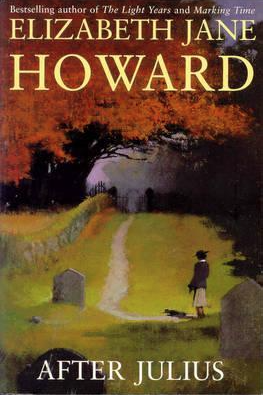
It is twenty years since Julius died, but his last heroic action still affects the lives of the people he left behind. Emma, his youngest daughter, twenty-seven years old afraid of men. Cressida, her sister, a war widow, blindly searching for love in her affairs with married men. Esme, Julius’s widow, still attractive at fifty-eight, but aimlessly lost in the routine of her perfect home. Felix, Esme’s old lover, who left her when Julius died and who is still plagued by guilt for his action. And Dan, an outsider. Throughout a disastrous – and revelatory – weekend in Sussex, the influence of the dead Julius slowly emerges.

Elizabeth Jane Howard is best known for her Cazalet Chronicles, which I haven’t read yet. I don’t know where I came across After Julius, I only know I liked the premise. I’m drawn to stories that deal with the aftermath of an action. While After Julius is more complex than that, all the characters are affected by Julius’ last heroic action, which took place during WWII, twenty years before this story begins.

After Julius is divided into three parts; each part is subdivided into several chapters, each of which is told by another narrator. In lesser hands this might have turned into a fractured story, but Elizabeth Jane Howard is a very skilful writer and, while each chapter is told in a distinct voice, the whole feels seamless.

The narrators are Esme, Julius’ fifty-eight-year-old widow, Cressy, her older daughter, Emma, her younger daughter, Dan, Emma’s friend and Felix, Esme’s former lover. These five people, plus a married couple and an old Major meet for a dinner at Esme’s house in the country.

In the first part we see them all get ready for the weekend. Cressy and Emma live together in a dingy flat in London. Emma works in her late father’s publishing house, while Cressy struggles as a pianist. Like her mother, Cressy’s been a widow since the last war. She’s a great beauty, one of those that make whole rooms go quiet when she enters. A bit like Lily Bart. And, like Lily Bart, her beauty isn’t doing her any good. She attracts many, mostly married men, and all of her affairs end in drama and tears. When we meet her first she’s crying and thinking of ending it with her current lover Dick. Esme lives luxuriously in a big house in the country. Her only occupations are her garden, answering letters, planning meals and instructing the housekeeper. Dan’s a struggling poet and Felix is a doctor, who has spent most of his life abroad.

The dinner turns into a disaster for many reasons. Felix, who is Cressy’s age, was once her mother’s lover. He left her when Julius died and they haven’t seen each other in twenty years. Cressy’s lover is the husband of the woman, Esme invited for the dinner. The friend Emma brings along is an eccentric poet that she’s met only a few hours ago and invited spontaneously.

The last part of the novel shows each character after the disastrous meal.

The plot isn’t the most important thing in this book. What is amazing is how true to life these characters are. How we get to see their vulnerabilities, their disappointments, their hidden motivations. It’s a very outspoken book. Whether it lays bare the hopes of the protagonists, their sexual desires, or their life choices, it’s so honest, it’s occasionally painful to read. We forget that these are characters on paper and think we’re actually looking into someone’s soul.

It’s a beautiful book and a tragic one. We can’t help but wonder—when did things start to go wrong? While Julius’ death sets things in motion, it’s not the real beginning of the drama.

Esme is by far the most tragic character. She’s looking forward to seeing Felix again. Although he’s fourteen years younger, she hopes that there could finally be a future for them. She never assumes that he may have come for other reasons.

I found it hard to believe at times that this book was written in 1965. The open discussion of abortion and sexuality seemed far more modern. It made me wonder if we’re not living in more prudish times now.

Before ending this post I have to mention Elizabeth Jane Howard’s descriptions. They are stunning. When she describes a room, a scene, clothes, anything, she makes full use of these descriptions. It’s never just a random description but it always contributes to the understanding of a character, enhances the mood, sets the tone.

It’s still early but I wouldn’t be surprised if this book would be among my best of this year. Since she reminded me of many writers I absolutely love —Elizabeth Taylor, Rosamond Lehmann, Jean Rhys, Elizabeth Bowen — I know I’ll be reading more of her.

Do you have a favourite Elizabeth Jane Howard novel?