Wednesday is Wunderbar – German Literature Month – Giveaways

Screen Shot 2014-09-24 at 07.23.25

Thanks to the generosity of different publishers, Lizzy and I are able to give away a number of wonderful books.

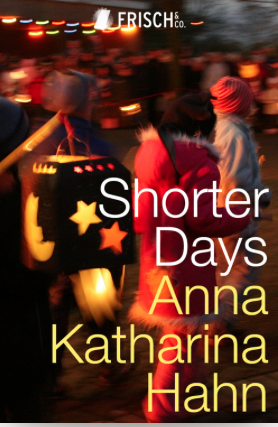
I’m particularly pleased to give away a copy of the e-book of Anna Katharina Hahn’s novel Shorter Days. I’ve often thought that it was sad that her novel hadn’t been translated because I loved it so much. I’ve read it when it came out in Germany, in 2009, at a time when I read far more German than English books. Since then it’s among my top 5 German books of the last decade. I was really happy when I saw that Frisch & Co, an e-book publisher, was going to publish the novel in October.
Screen Shot 2014-10-01 at 10.21.24

Here’s the publisher’s blurb

It’s fall in Stuttgart, just before Halloween, and thirty-something mothers Judith and Leonie are safely ensconced in their upscale apartments in one of the city’s best neighborhoods. Judith has squeezed her life into the straitjackets of stay-at-home Waldorf motherhood—no TV, no sweets, nature hikes, and, above all, routine—and marriage to staid university professor Klaus. Leonie is proud of her work at a bank and her husband Simon’s career, though she worries that she’s neglecting her young daughters, and that Simon’s work distracts him from his family. Over the course of a few days, Judith and Leonie’s apparently stable, successful lives are thrown into turmoil by the secrets they keep, the pressures they’ve been keeping at bay, and the waves of change lapping at the peaceful shores of their existence.

Shorter Days is a heartrending exploration of the joys, challenges, and dangers of modern family life.

The second book I am giving away is a nonfiction book, published by Pushkin Press, Maxim Leo’s Red Love: The Story of an East German Family. I haven’t read it but it sounds very interesting.
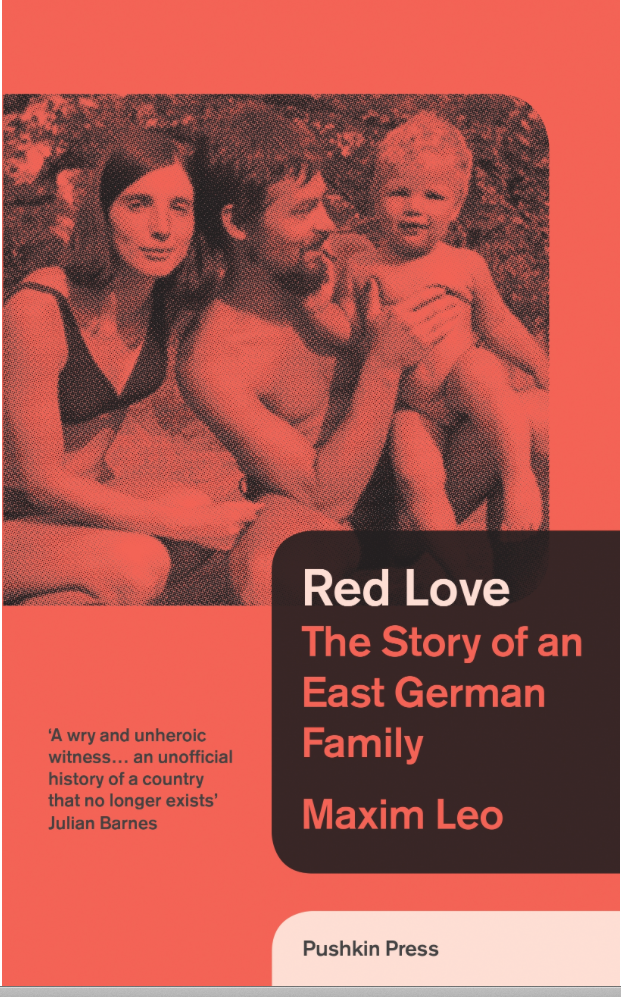
Screen Shot 2014-10-01 at 10.28.30

Here’s the blurb

Growing up in East Berlin, Maxim Leo knew not to ask questions. All he knew was that his rebellious parents, Wolf and Anne, with their dyed hair, leather jackets and insistence he call them by their first names, were a bit embarrassing. That there were some places you couldn’t play; certain things you didn’t say.

Now, married with two children and the Wall a distant memory, Maxim decides to find the answers to the questions he couldn’t ask. Why did his parents, once passionately in love, grow apart? Why did his father become so angry, and his mother quit her career in journalism? And why did his grandfather Gerhard, the Socialist war hero, turn into a stranger?

The story he unearths is, like his country’s past, one of hopes, lies, cruelties, betrayals but also love. In Red Love he captures, with warmth and unflinching honesty, why so many dreamed the GDR would be a new world and why, in the end, it fell apart.

“Tender, acute and utterly absorbing. In fine portraits of his family members Leo takes us through three generations of his family, showing how they adopt, reject and survive the fierce, uplifting and ultimately catastrophic ideologies of 20th-century Europe. We are taken on an intimate journey from the exhilaration and extreme courage of the French Resistance to the uncomfortable moral accommodations of passive resistance in the GDR.

“He describes these ‘ordinary lies’ and contradictions, and the way human beings have to negotiate their way through them, with great clarity, humour and truthfulness, for which the jury of the European Book Prize is delighted to honour Red Love. His personal memoir serves as an unofficial history of a country that no longer exists… He is a wry and unheroic witness to the distorting impact – sometimes frightening, sometimes merely absurd – that ideology has upon the daily life of the individual: citizens only allowed to dance in couples, journalists unable to mention car tyres or washing machines for reasons of state.” Julian Barnes, European Book Prize

With wonderful insight Leo shows how the human need to believe and to belong to a cause greater than ourselves can inspire a person to acts of heroism, but can then ossify into loyalty to a cause that long ago betrayed its people.” Anna Funder, author of Stasiland


I’d like to thank Frisch & Co. and Pushkin Press for their generosity.

If you’d like to enter the giveaway, leave a comment, indicating for which book you’d like to enter. You can enter for both, of course.

Don’t miss visiting Lizzy’s site as she’s giving away titles from other publishers.

The giveaway is open internationally. The winners will be announced on Sunday, 5th October 2014. 

THIS GIVEAWAY IS NOW CLOSED: THE WINNERS HAVE BEEN ANNOUNCED.
Announcing German Literature Month IV – November 2014

Screen Shot 2014-09-24 at 07.23.25

Good morning/afternoon/evening, German(-language) literature lovers.  It’s time to look through your TBR piles and hunt out all the German literature you can find.  #germanlitmonth is returning for year four!

In years past Lizzy and I have structured the whole month for guidance, but now that a wealth of ideas and reviews exists in the blogosphere (see footnote), we no longer think that’s necessary.  This year we’re each going to host a themed week, leaving the rest of the month for you to read as you please. However, to make things more playful, we’re incorporating an optional pick and mix!

The overall structure of the month looks like this.

Nov 1-2      Introductions and reading plans

Nov 3-9      Award Winners Week (hosted by Lizzy)

Nov 10-23  Read as You Please

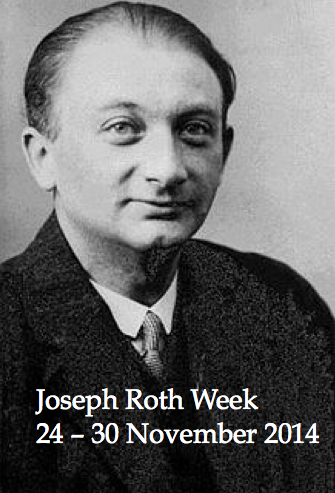
Nov 24-30 Joseph Roth Week (hosted by Caroline, with the Literature and War group read, Flight Without End, on the 29th)

Joseph Roth

At any time during the month you can pick and mix by reading and posting about any of the categories listed below, Each review will receive at least one entry into a prize draw. If the review fits multiple categories, you will earn multiple entries.  For example if you participate in my Literature and War read, you will get two entries: 1 for category 5 and another for category 6.

Pick and Mix Categories

1) Read and review an award winner.

2) Read and review a work that is not a novel.

3) Read and review a recommendation from German Literature Months 1-3. (See footnote)

4)To commemorate the 25th anniversary of The Fall of the Wall, read and review a work relating to the GDR or the Berlin Wall.

5) To commemorate armistice day, read and review a work relating to the First World War

6) Read and review a work written by or relating to Joseph Roth

7) Read a work published in German original or in translation during 2014

For the purposes of clarity, all reviews must relate to works originally written in German, regardless of the author’s nationality.  The winner of the pick and mix prize will be announced during the first week of December.

Apart from that, there are no other rules.  You can participate in the themed weeks and the pick and mix as much or as little as you wish. You can do your own thing too, if you so chose.  If you don’t have a blog, you are welcome to review on librarything or goodreads or similar or even write a guest post for one of the host blogs.

The main focus of the month is to share and enjoy German-language literature.  We hope you  decide to join us.

 *******

Footnote – Indices of reviews from previous years

German Literature Month 2011 (http://lizzysiddal.wordpress.com/2011/12/01/german-literature-month-2011-author-index/)

German Literature Month 2012 (http://lizzysiddal.wordpress.com/2012/12/15/german-literature-month-2012-author-index/)

German Literature Month 2013

(http://lizzysiddal.wordpress.com/2013/12/12/german-literature-month-iii-author-index/)

Looking Back on German Literature Month 2013

image

German Literature Month 2013 is over. It’s time to thank everyone for participating. Some have shown extraordinary enthusiasm. I’m not sure about the statistics of the last years but I’d say with 127 posts, this year was a success.

If you’d like to get an overview, visit our special German Litertaure Month page, which will guide you to all the contributions.

While the month ends on my blog, there is still something going to happen on Lizzy’s. A generous editor has provided a set of books for a lucky winner, who will be announced on Wednesday. Don’t miss visiting her blog then.

I was a bit afraid that there wouldn’t be as much interest this year but that was clearly not the case. Thanks again to all of you.

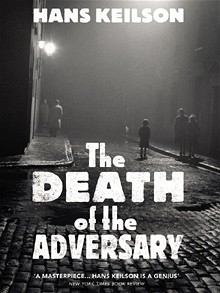
Hans Keilson: The Death of the Adversary – Der Tod des Widersachers (1959) Literature and War Readalong November 2013

Death of the Adversary

I wish it hadn’t happened but it did. I couldn’t finish Hans Keilson’s novel The Death of the AdversaryDer Tod des Widersachers. Not because I ran out of time but because – frankly – I hated it. I hate parables and books that whiff of Kafka (and are not Kafka) and  . . . If  you want to write about Nazism and the rise of Hitler, why don’t you mention it. Why does Hitler have to be referred to as “B”? Why is it never stated that the narrator is Jewish . . . It’s obvious, of course, but the way this is handled is just annoying.  Ilse Aichinger does a similar thing in her novel Herod’s ChildrenDie grössere Hoffnung, but it never feels like mannerism, it’s powerful, expressive and chilling.

I’ve read about 2/3 of The Death of the Adversary and there were passages I thought masterful but they had nothing to do with Nazism and/or oppression but were mainly taken from either childhood or young adult memories. There is a story in which the narrator tells how he forged stamps. This was psychologically subtle. There are other instances in which we see that Keilson’s observations are the result of his being a psychiatrist.

The book’s central story tells how a young Jewish boy first learns about his adversary “B”, a man who slowly rises to political power. His power can be felt in the growing number of followers and how they accept his theories and apply his laws and rules, which first lead to exclusion of the Jews, and then to their persecution. I don’t see what is gained in calling Hitler “B”. Did he want to show the universality of evil? He wanted to show the banality of it, which becomes obvious when he sees the man. And the way he treats the adversary as a recurring motif, showing that he is  s much on the inside as on the outside  . . .  Most of the time, I agree, things are not black or white but I don’t want this concept applied to Hitler and Nazism.

There is also a parable-in-the-parable – the story of the elks and the wolves, which I found particularly ambiguous. Elks were living under the best conditions, however they were not striving but dying. Why? Because there were no wolves. In order to live they would have needed adversaries.

I almost always finish books because some stories need every single passage to become a whole. Given that The Death of the Adversary is not only a parable but a disjointed book – I wouldn’t really call it a novel -,  I’m pretty sure, the end wouldn’t have made me think differently. From what I’ve seen so far, Keilson might be a good writer but he’s not a novelist.

I know that I’m one of a very few who didn’t like this book. But I really didn’t and although I’m sure that Comedy in a Minor Key is different – I’m not going anywhere near Keilson’s fictional work  for a while.

Other (favorable) reviews

Lizzy (Lizzy’s Literary Life)

Mel u (The Reading Life)

*******

The Death of the Adversary was the eleventh book in the Literature and War Readalong 2013. The next is the Vietnamese novel The Sorrow of War aka Thân phận của tình yêu by Bao Ninh. Discussion starts on Monday 30 December, 2013. Further information on the Literature and War Readalong, including the book blurbs can be found here.

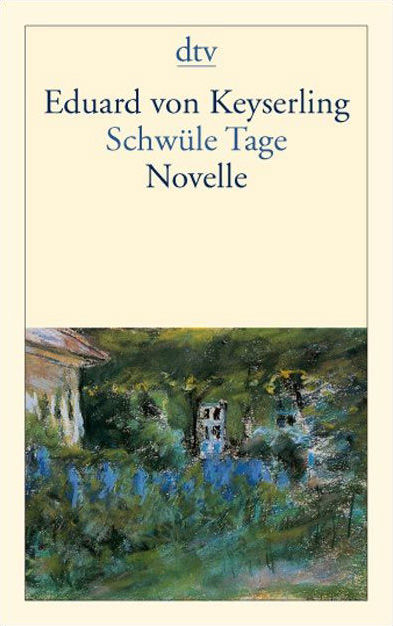
On Eduard von Keyserling’s – Schwüle Tage (Sultry Days) – (1916)

Schwüle Tage

Today we had the first snow. I woke to a fine layer of white in the morning. I don’t think it will stay, it’s already raining. Nonetheless it is strange to write about a book set during a sultry, sweltering summer.

Occasionally critics wonder why Eduard von Keyserling is not as widely read in Germany as Theodor Fontane. I often wonder why he isn’t translated into English. After having read the novella Schwüle Tage (Sultry Days) I think I can say with great certainty that being compared to Fontane may be the reason for both. Not because he isn’t as good and the comparison would be unfavorable, no, just because it’s wrong or, at least, not entirely correct. There is another important author whose work is far closer to Keyserling and that is Arthur Schnitzler. The subconscious plays a far greater role in Keyserling than in Fontane. Suppressed emotions and sensuality are more important than class and the rules of society. This particluar novella put me also in mind of an author I have discovered earlier this year: Hjalmar Söderberg.

None of his works illustrates this better than Schwüle Tage a short novella set during one hot summer. It is told from the point of view of an 18 year-old student who, failing his exams, can’t join his mother and siblings and spend his summer holiday  on the sea-side but has to stay with his patriarchical and domineering father on his estate. The young man is bored to death and quite afraid of his stern and pedantic father. Battling boredom and budding sexuality, he spends his days studying or yearning for fulfilment.

While the estate is busy during the day and servants and maids go about their tasks, mysterious things happen at night. Everyone seessm to lead a secret life during the night. One of the maids sings languorous songs in the park, his father goes for long walks, servants sneak around. Some of the servants tell the young man, that the night is the time during which everyone tries to satisfy their needs. The boy wants to participate and manages to seduce one of the maids.

Secretly the young man is in love with one of his cousins. The two girls are the only young people from the same social background he will see during this summer. He’s sad to know that the older and more seductive will get married and appalled when he finds out that she has a lover. Not only is he disappointed that she belongs to someone else but horrified to find out it is his father.

The end of the novella is unexpectedly tragic and will stay in my mind for a long time.

I loved how this tragic story was rendered, in impressionistic touches, and focussing on the hidden desires and yearnings of these people. They were all trapped in this rigid society and many a stern face was hiding great pain.

When I read this story I was reminded of many of Schnitzler’s tales and found it odd that a German writer, notably one from the Baltic sea, wrote like an Austrian. Only after finishing Schwüle Tage did I discover that von Keyserling studied and lived in Vienna for a long time and later moved to Münich where he stayed until his death. I felt that the influence was palpable. As much as I like Fontane, I love von Keyserling more because he adds a more interior, intimate layer to his writing.

I really hope that editors discover this amazing author and start to translate his work.

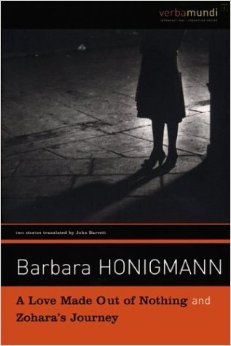
Barbara Honigmann: A Love Made Out of Nothing – Eine Liebe aus nichts (1991)

A Love Made Out of Nothing

Barbara Honigmann’s A Love Made Out of Nothing tells the story of a young expatriate’s journey back to Weimar to attend her father’s funeral. As the narrator remembers her father’s life, she explores her own past and relates her struggle to establish new roots following her emigration from Berlin to Paris. In its portrayal of a young woman’s complex relationship with her father, the novella offers a rich account of German-Jewish history and of the search for identity in the shadow of World War II.

This is my first book by German author Barbara Honigmann but it’s not going to be my last. I loved this novella. A Love Made Out of Nothing  – Eine Liebe aus nichts is written in a very intimate style, almost like a memoir. Honigmann usually weaves her own life into the narrative, blending fact and fiction.

The narrator, who lives in Paris, starts her story with the funeral of her father. He has died in Weimar and she wanted to attend. It’s the first time in years that she goes back to Germany. She’s born in East-Berlin after the war to Jewish parents who had spent WWII in England. After the war the father decides to live in the Russian sector.

Her father has been married four times, her mother was wife number two. She’s returned to her home country Bulgaria years ago and even lost the German language. There is no possibility for the narrator to communicate with her as she doesn’t speak Bulgarian.

During her childhood she spent all of her weekends with her father and stayed in contact with him ever since. A couple of years before his death, she leaves the DDR and moves to Paris, hoping that a new city, a new language would not only bring a new life but her own transformation.

Much of her emotional life is full of shadows and muted grief over the impossibility to live with the man she loves. All they have is a “Love Made Out of Nothing” as it proves to be impossible for them to live together. When she meets someone else that love can’t be lived either because the man returns to the US.

Memory, identity, languages, exile and emigration are the themes this small poetic book explores. The reasons why someone leaves his or her home country are complex. Political reasons, danger, a lack of freedom are triggers, but they are not the only motive. There is always also the wish to become another person and when that isn’t possible what remains is a feeling of loss and unfulfilled yearning. The narrator wishes to be rootless, but, paradoxically, in trying to run away from her home and her parents she imitates their life.

Barbara Honigmann is a Jewish author but she transcends the Jewish experience and captures the universality of her themes, making it easy for non-Jewish readers to identify. I have read the German edition of this book that’s why I can’t tell you anything about the second novella, which is contained in the English edition.

Helmut Krausser: The Great Bagarozy – Der grosse Bagarozy (1997)

the-great-bagarozy

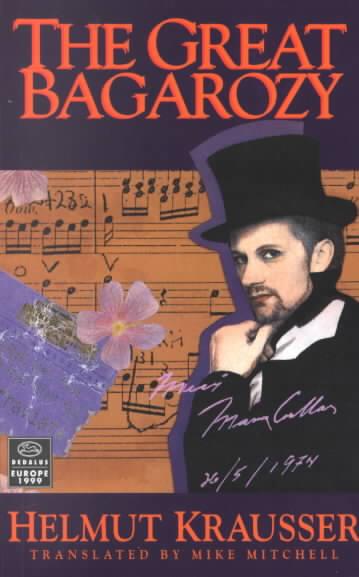
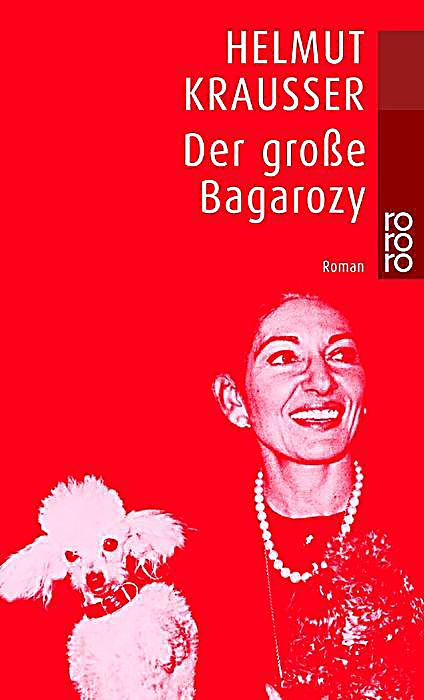
To enjoy this novel you don’t need to be a fan of Maria Callas but you should at least be interested in her life, as The Great Bagarozy – Der grosse Bagarozy is to a large extent an homage to the late Diva. (When you look at the German cover you’ll notice that they chose to make that fact obvious. Not so for the English cover.)

Cora Dulz is a psychiatrist. A very bored one and not exactly someone you’d call compassionate. She’s bored with her marriage to a cardiac tax consultant whose greatest interest is to collect morbid obituaries. There is nothing else in his life he’s this passionate about. Although some hints tell us that he likes to hire cleaning women who perform their tasks naked.

Cora is equally bored by her patients whose ailments make her either yawn or laugh. When two of them commit suicide, she fears for her practice. During this troubled time a new patient appears. Stanislaus Nagy, a man who is obsessed with Maria Callas and states to have known her very well. He pretends to be the devil himself and maintains that he has accompanied Maria during most of her life in the form of a black poodle.

Now this is a story that wakes up Cora. Not only is she interested in this new patient’s story, no, she also falls in love with him and fantasizes constantly about having sex with him. When he doesn’t turn up anymore she looks for him and ends up chasing him until she finds him on the stage of a music hall performing as The Great Bagarozy.

Kraussers novel deliberately blurs every line and confuses assumptions. Is Nagy ill? Or maybe Cora is far more obsessed than he is? Is he really the devil? Could that be?

Whether Nagy is just a devilish man playing tricks on a bored psychiatrist or whether he really is the devil is for you to find out. In any case, he pushes Cora to commit something quite horrible in the end.

I found this novel to be interesting, witty, funny, full of symbolism and extremely well-written. Krausser has a way with words, many of his sentences are worth quoting, and his descriptions are unusual like when he says the sky was the grey of poisoned doves. I’ve always been fascinated by Maria Callas. The woman and the legend and the fact that she’s actually not that good a singer but was considered, and still is considered, one of the greatest. Her life was tragic until the end. If you’re interested in her you’ll learn quite a lot about her life. I loved that Krausser chose to add the macabre obituaries Cora’s husband collects. It added a Six Feet Under feel to the story. He also chose to add many photos of Maria Callas, which add another layer. It’s interesting how her pictures seem to mirror her voice. She could be so beautiful on one photo, and look really rough on the next. When she was younger she managed to sing quite a pure soprano (especially in Tosca) but later on she was much more of a mezzo-soprano (as in Carmen), which, as far as I know, was her true voice type.

The Great Bagarozy is a funny, wicked, entertaining book and a great homage to Maria Callas.

The book has been made into a movie directed by Bernd Eichinger.

der-grosse-bagarozy-072101614