Claudia Piñeiro: All Yours – Tuya (2003) An Argentinian Crime Novel

I had never heard of Claudia Piñeiro before I saw her book All Yours reviewed on Guy’s blog. I wanted to read more Latin American literature this year and an Argentinian crime novel sounded like a good start.

All Yours, or Tuya as it is called in Spanish, is as entertaining as it is amusing. It introduces us to the world of Inés, a middle-aged housewife, mother of Lali and wife of Ernesto. A real perfectionist when it comes to her home and keeping up appearances, a master in the art of self-delusion. More than once while reading I was exclaiming “What a nutter”.  Of course I was glad that she was such a nutter as this is why Tuya is so entertaining.

When Inés discovers a lipstick-written note, a heart signed “All Yours”, in her husbands briefcase, we are at first startled to hear that she doesn’t think it’s all that bad. After all, she believes, sooner or later all men cheat on their wives. The outcome purely depends on how gracefully the wife handles it.

Since her own unfaithful father left her mother after having been confronted with his infidelity, Inés decides not to act but to observe. One night when her husband is called to his office – there seems to be a computer related emergency which happens quite frequently -, she follows him. Of course he doesn’t drive to the office and Inés observes him while he meets with his secretary in Palermo Park. They are fighting and at one point Ernesto pushes the secretary away. The woman trips, falls and breaks her neck in the fall. How wonderful, Inés thinks, she will help her husband to cover up the whole incident. She will provide him with an alibi… But for the time being, she stays in the dark, drives home and doesn’t say a word that she has watched everything. Inés is happy, she believes that the secretary was Ernesto’s lover, and now that she is dead, nothing can separate them anymore. Right? Not quite, as we will see and from here on, things do not go as planned at all.

This isn’t the only instance in which Inés is wrong and we start to learn that absolutely nothing is at is seems in this novel and that what Inés pretends to be a picture book family is in reality rotting from the inside.

All Yours is told in alternating points of view. The most important parts are Inés’ first person narratives. Being a highly unreliable narrator, she tries to pretend everyting is fine until the very end of the book. Other parts of the story focus on Lali, Inés’ daughter. They are in dialogue form and reveal that the daughter has as much to hide as her parents but that she knows everyting about the two of them. Lali blames and hates her mother more than anyone else and towards the end of the book we realize she may have reason. Some of the chapters are police reports and third person narratives. Each of these elements together give the reader the full picture.

All Yours reminded me a lot of German crime writer Ingrid Noll’s novels in which seemingly harmless and invisible women start to develop their criminal and vengeful side. They are perfectionists, driven by an urge to save appearances at any price. We don’t warm to these women, we don’t feel for them but we enjoy the delicious frisson that we experience while following them on their journey towards retribution.

Drive – The Book by James Sallis (2006) and The Movie by Nicolas Winding Refn (2011)

James Sallis’ taut neo-noir novel Drive is nothing if not surprising. All the more so should you have seen the movie first and now want to read the novel. I had barely finished the book when I watched the movie and it was extremely interesting to see what and how they changed it. I don’t want to spoil the fun for those who have read the book first and have not seen the movie yet. I will just mention a few differences.

Sallis’ book is extremely well-crafted and has an interesting structure. I know I will read it again, just because of that. The story can be summarized in a few sentences. At the beginning of the book we see Driver in a pool of blood, three dead bodies next to him. How he got there and why will be revealed in bits and pieces during the novel. The story jumps backwards and forwards in time, only revealing a little in each chapter. The chapters can be read like short stories. They work on their own. This structure and the way information is given, only in the smallest of slices, exemplifies one of the main themes of the book.

Life sends us messages all the time – then sits around laughing over how we’re not gonna be able to figure them out.

Driver is a stunt driver for the movies. He is the best. Driving is what he knows best. His reputation is such that he is contacted by some criminals and hired as the driver for getaway cars in robberies. Driver is non-colloquial to the extent that even his delinquent bosses are stunned. Try to be more mono-syllabic and you’d be reduced to complete silence. Driver doesn’t want to know details. He drives. Period. And tells you that. In very short sentences.

Driver and many other people stay nameless all through the book which symbolizes a lot and mirrors an element of his childhood.

Mostly, when she spoke to him at all, she just called him boy. Need any help with the schoolwork, boy? Got enough clothes, boy? You like those little cans of tuna for lunch, right, boy? and crackers?

With a mother like that no wonder Driver never really attaches any meaning to his name or is much interested in elaborate conversation. This doesn’t mean he isn’t interested in people or relationships. He tries to be with people, he does contact people and hang out with them. He even takes care of some. Despite this lack in open communication, Driver’s interior life is far from empty. Passages like the one below are frequent in the novel.

Driver marvelled at the power of our collective dreams. Everything gone to hell, the two oft them become running dogs, and what do they do? They sit there watching a movie.

It’s rare that I’m this fascinated by a crime novel, this amazed by the writing. After having finished it, I could hardly wait to see the movie.

Maybe it’s lucky book and movie do not have a lot in common. Some story lines that are not very important in the book, have a major importance in the movie. The movie has nothing of the staccato rhythm of storytelling of the novel but delivers the story chronologically, leaving out everything about Drivers’ childhood and developing a major love story.

I didn’t mind those liberties at all because you can see book and movie as two separate things, one serving as a draft to the other. This is one of those movies I see myself re-watching many times. I absolutely loved it and one of the major reasons for that is the soundtrack. This is one of those glossy movies in which picture, story, actors and score form a tight whole and each part is perfect. Remove or change one thing and it would crumble. What I liked best was the extremely soulful, almost dreamlike atmosphere the soundtrack created, those beautiful pictures of the illuminated L.A. skyline at night and the surprisingly tender love story. I have often issues with the cast but it’s perfect in this movie. I couldn’t imagine a better Driver than Ryan Gosling or a better person for Irina than Carey Mulligan.

With a director like Nicolas Winding Refn (Valhalla Rising) it was to be expected that the movie would be visually compelling but not shy away from graphic scenes and strong violence.

You can watch this movie, see the differences with the book and still like it, and you can still admire the book as well.

Probably still under the influence of the movie, I haven’t done the book enough justice. If you want to read more focussed reviews, Guy reviewed it here (that’s the one that made me discover the book) and Max reviewed it here.

Thanks to the major success of this film the books by Sallis are now reissued. I’ve heard a lot of good things about Ghost of a Flea. The re-release is due in May 2012.

M.C. Beaton: A Highland Christmas (1999) A Hamish Macbeth Mystery

I like all sorts of crime and thrillers and while I mostly prefer more character driven psychological novels, I have a weakness for cozy and paranormal crime. Two years ago I discovered M.C. Beaton’s Hamish Macbeth series and fell in love with its charm. Set in the fictitious Scottish Highland village of Lochdubh it has everything we want from cozy crime. Great atmosphere, a very likable inspector, some excentric characters and crime that is far from gruesome. In the case of A Highland Christmas the crime doesn’t even involve a murder.

If you have never read any Hamish Macbeth, this may not be the place to start. It’s one of the more recent ones of a series in which there are already at least 30 books. Part of the charm is the character Hamish Macbeth (there is also a TV series starring Robert Carlyle). He is a very kind, good-looking loner whose love life is far from successful. In the earlier books his main companions are a dog and a wild cat. They are not mentioned here which was a bit of a disappointment but logical as they can hardly live forever. What I like about Hamish is the fact that he treats everyone equally nice, the old and the young, the men and the women and the animals as well.

Lochdubh is described in a way that makes you want to stay there for a while when your own personal life is getting too stressful. Life in the village of Lochdubh, which is surrounded by the picturesque scenery of the Scottish Highlands, is slow, people form a tight-knit community, they are chatty and friendly. Sorrows can be easily forgotten over a cup of tea and a wee dram.

It is winter in Lochdubh and Christmas isn’t far, only in this community of fervent Calvinists, there is no such thing as Christmas and Christmas decorations are unheard of. They are, as some would say, devilish. When this year, for the first time, someone sets up a Christmas tree and Christmas lights, nobody is surprised when they are stolen. Hamish isn’t thrilled that, instead of being somewhere on vacation, he has to chase a petty thief and on top of that find out who stole Mrs Gallagher’s cat.

Mrs Gallagher is a foreigner who has been living in Lochdubh for a while. She is generally hated but when Hamish pays her a visit and sees that she bolts her door, he is a bit surprised. It seems the woman is more frightened than truly unfriendly.

If you want to find out who stole the Christmas tree and if the cat is found, you have to read the book for yourself.

It’s a charming book, set in a charming world and for those who like M.C. Beaton it’s certainly a nice addition to the other books. In any case it’s a nice Christmas themed book with a picture-book Christmas ending, involving snow and good-natured festivities. The book is not too sugary but charmingly old-fashioned, despite the overall positive tone and the depiction of a better world, it still touches on themes like old-age and loneliness.

M.C. Beaton is also the author of the equally well-liked Agatha Raisin series which I haven’t read. Does anyone know  it?

S.J. Bolton: Sacrifice (2008)

Danielle recently wrote about S.J. Bolton’s book Now You See Me and I really liked the tone of it and wanted to read one of her books. I got her first novel Sacrifice instead because I liked the idea of a book set on The Shetland Islands. I know some of the islands off the Scottish coast and I find the landscape incredibly beautiful.

Tora, an obstetrician from London, is married to a man from The Shetland Islands. Duncan hasn’t been living on the islands for over twenty years but now he wants to return and Tora follows him. She has found a job in a local clinic. They live in a house in the country, quite far away from any other houses or farms which doesn’t bother Tora too much as she grew up on a horse farm.

The novel opens with Tora trying to bury her beloved horse Jamie. While digging in the field she finds something utterly disturbing, namely a corpse wrapped in fabric. Whether the dead person has been lying in its peat grave since the earliest days of Shetland Civilization or been buried recently isn’t sure at first but the police soon find out, the body hasn’t been dead for longer than two years. When they unwrap the corpse they discover something quite grisly. The dead womans heart has ben cut out and there are runic symbols carved into the skin of her back. On top of that the dead woman must have given birth right before she was killed.

Tora is a very determined woman and the shock to find a body on her land triggers an urge to help find the killer. Being a doctor allows her to have access to much more information than even the police. She teams up with a police woman, Dana, also a foreigner, who has a hard time being accepted by the locals. The two women start to dig quite deep into some mysterious things. Tora’s investigation isn’t entirely legal but she can’t stop it, even less when she discovers that the dental records of a woman who has died of cancer two years ago match the records of the dead body in her peat field.

From the early moments in the novel, it’s obvious that Tora endangers herself with this investigation. And when she wakes one night and thinks that someone is in her bedroom, she is sure her life is threatened.

The fact that Tora lives in this lonely house on her own most of the time, because Duncan is away for work, heightens the feeling of threat. She and Dana stumble from one eerie discovery to the next and I really speeded through the 550 pages because I wanted to find out what was going on.

This is a book to read in almost one sitting, if you break the speed for a while, which I did, you lose momentum and the end might not go down so well. I saw Danielle reviewed Sacrifice here as well and there is a comment from the author saying that she herself wasn’t too sure about the ending (if you intend to read this book don’t read the authors’ comment it does give away a lot).

I can only say, this is a great read, if you rush through it but a part of the explanation was a disappointment for me. It’s too unbelievable. Still, the book works well on many levels. It’s very suspenseful and has a great atmosphere. Something I really liked was the description of the friendship between Tora and Dana. They both do not easily trust other people but they soon feel quite close. Also these are not your typical “women in jeopardy”, they are threatened but they are gutsy and can fight for themselves. Being threatened worries them but doesn’t keep them from going on. I might very well read another S.J. Bolton. Judging from the comment she left on Danielle’s blog, I could imagine, she did in her more recent books stay away from stretching believability too much.

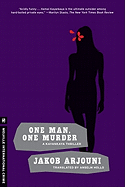
Wednesdays are wunderbar – It’s Crime Time – Jakob Arjouni Giveaway

Today we have another special treat for you, courtesy of Melville House Press we give away one set of Jakob Arjouni’s Kayankaya series to one lucky winner.

This is a great series and anyone who will win it will surely like it.

The giveaway is part of German Literature Month and  is open internationally but if you would like to enter you have to hop over to Lizzy’s blog where the giveaway is taking place.

Good luck!

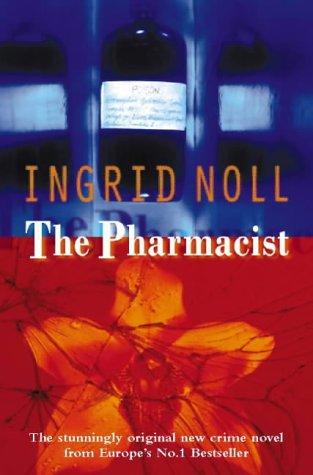
Ingrid Noll: The Pharmacist aka Die Apothekerin (1994) La Grande Dame of German Crime

As much as I like to savour a book, it’s wonderful, once in a while when you start something and the next time you look up the 300 pages have already been read. That’s pretty much what happened with The Pharmacist aka Die Apothekerin by Ingrid Noll. The book is currently only available in English as cheap used paperback or library copy. It has been made into a movie starring Katja Riemann and Jürgen Vogel.

Noll is something like the grande dame of German crime that’s why it’s fitting to kick off the crime week of our German Literature Month with a review of one her books. Not only does she write well, she is famous for her macabre ideas, black humour and psychologically complex characters. These are not whodunnits but explorations of the criminal mind with a twist. A little bit of Patricia Highsmith with a whole lot of very distinctly Ingrid Noll.

The story starts bizarre enough with the narrator Hella Moormann lying in a hospital bed and starting to tell her whole life to a complete stranger, her bed neighbour, the elderly and seemingly inoffensive Rosemarie Hirte. Why Hella is in hospital is not told and it strikes us as uncanny that she would start to tell the most incredible details to someone she doesn’t know.

Hella has two striking features. People constantly die around her and she always falls for the wrong man. Occasionally this is connected, sometimes it isn’t. She is a pharmacist and very well versed in potions and poisons. It seems that her latest lover was far more interested in this feature than in any other of her charms if there are any. Hella is a very unreliable narrator and distorts most things, we can only assume that she is far less attractive than she thinks.

Levin, the young man she moves in with, is studying to become a dentist. His uncle is an extremely rich man and Levin is his only heir. He has a cunning plan involving false teeth and poison but he needs Hella’s assistance.

Until the end of the book, we never really know whether Hell is as naive as she pretends. And while the story progresses we are more and more intrigued by Rosemarie who starts to get a bit too interested in Hella’s story.

The only thing we know for sure is that people keep on dying. I really enjoyed following Hella’s tale, guided by Ingrid Noll’s acerbic wit and fascinated by the incredible pairing of  striking descriptions with gross exaggerations. On top of all that this is a tale about fast cars, a big beautiful house, criminal people, accidents, pregnancies and a narrator who may or may not be innocent.

This isn’t the first Ingrid Noll novel I’ve read. There was none that I didn’t like. In Germany she is compared to Patricia Highsmith, Margaret Millar and Joan Aiken. In any case, Noll is for those who like their crime to be on the more literary side of the genre.

Do you know Ingrid Noll? Do you have favourite German crime writers?

The review is part of German Literature Month Week II – Crime

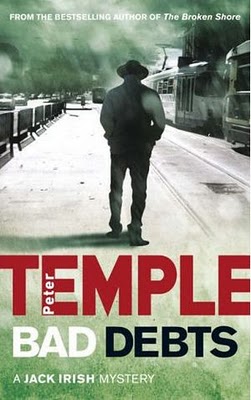
Peter Temple: Bad Debts (1996) A Jack Irish Mystery

Meet Jack Irish: some-time lawyer, part-time private eye, spare-time cabinet maker and full-time lover of strong coffee, swift horses and spirited women.

Bad Debts is the first in Australian crime writer Peter Temple’s Jack Irish series. Temple has won a lot of Australian prizes for his crime and thriller writing. I think it is the first time I read an Australian crime writer. I was very curious and looking forward to the novel and for a total of 50 pages I really enjoyed it.

It’s starts off well enough, quite sarcastic and humorous. Jack Irish seems a typical hardboiled private eye and debt collector. He used to be a lawyer but when his wife is killed he starts drinking and spends a year in total limbo. Sometime during that year he has to defend Danny McKillop, a drunk-driver, who killed a woman. The woman he killed, Anne Jeppeson, was an activist and pain in the neck for many people. The driver had no memory of either driving a car or hitting someone.

Ten years have gone by and all of a sudden Danny McKillop leaves messages on Jack’s answering machine. By the time Jack hears them McKillop has been shot by the police. Jack feels guilty. It seems to him as if he had let down McKillop a second time and he starts to investigate not only his death but also Anne Jeppeson’s death.

After interviewing a few people he finds out that there were and are a lot of strange things going on. People in high places are doing things they don’t want anyone to find out about. His investigation leads Jack deep into corruption and conspiracy and the farther he gets into these things, the more he endangers himself. The last third of the novel is very action-packed.

The beginning of the novel was humorous and I thought it might be one of the series I would like to explore further but after 20-50 pages, there were far too many things I didn’t like. Jack isn’t a lawyer anymore, he tries to make a living collecting debts, betting on horses and doing cabinets. All these different occupations take up time and pages which is very disruptive. On top of that I hate horse-racing stories. Not only do I despise horse-racing I also find it outrageously boring to read about it.

Another problem I had was the language. A large part of the novel consists of dialogue. Australian spoken language seems much closer to British English than to American English. I certainly didn’t mind that. But I did mind that most of the dialogue was composed of swearing and foul language. It was somewhat tiring after a while. And there is the love story. Maybe Jack has been mourning for ten years, but for us, who just got to know him, it’s odd to see him mourn on one page and jump at full speed into a love affair on the next one. And how do I have to picture a woman who is not good-looking but handsome?

I realized that I have a few first and occasionally second books in series at hand and decided to start to read my way through them. Peter Temple’s book was one of them. I’m sure the Jack Irish series has its merits, only I couldn’t find them.

Does anyone know the series? Or any other Australian crime novels/series?