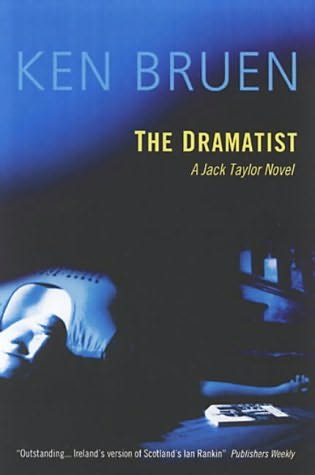
Ken Bruen: The Dramatist (2004) A Jack Taylor Novel

The Dramatist

The impossible has happened: Jack Taylor is living clean and dating a mature woman. Rumour suggests he is even attending mass…The accidental deaths of two students appear random, tragic events, except that in each case a copy of a book by John Millington Synge is found beneath the body. Jack begins to believe that ‘The Dramatist’, a calculating killer, is out there, enticing him to play. As the case twists and turns Jack’s refuge, the city of Galway, now demands he sacrifice the only love he’s maintained, and while Iraq burns, he seems a step away from the abyss.

I probably have to thank Guy (His Futile Preoccupations) for discovering Irish crime writer Ken Bruen as he has reviewed a couple of his books, although not The Dramatist. Bruen has written standalones, one of which London Boulevard, has been made into a movie and he’s written the series, featuring the luckless, loveless, ex-Cop turned PI Jack Taylor.

Jack Taylor is a cynic, disillusioned tough-guy with a good heart. He stumbles through live and his cases, gets beaten up, finds love, loses it again, battles addiction and his demons. All this are ingredients which are quite common in PI series, still I found this to be extremely original. The voice is very unique and the fact that Jack Taylor is a great reader adds an additional layer to the books.

The Dramatist is the fourth in the Jack Taylor series. Jack is newly clean and sober and even gives up smoking in the middle of this novel. It’s not easy for someone like him to stay away from booze as he lives in a hotel and spends most of his free time in bars. At the beginning of the novel he visits his ex-dealer in jail. The guy’s sister was found dead. Allegedly she fell down the stairs but her brother thinks it was foul play and wants Jack to investigate. Jack doesn’t buy the murder idea, but must admit that it’s weird that a book with Synge’s plays was found under the student’s body. When a second student dies the same way, also found with a book by Synge, Jack is convinced as well that it is murder.

I really liked The Dramatist and will read the first in the series soon. The mix between crime, character study and insights into contemporary Ireland and Irish culture worked extremely well for me. The novel is much more about Jack Taylor and his bad luck than it is about the crime, but since I really like this character, I liked the book. I’m tempted to compare Taylor to Marlowe, but I’d say he’s a tad more cynic and much more talkative. While his views on society and his own character are dark, he hasn’t given up the fight. He still hopes for love and a sober life. Maybe this sounds as if this was a one-man show, but it isn’t. Jack has a few enemies, but he also has a lot of friends and a knack to talk with “little people”, which is endearing.
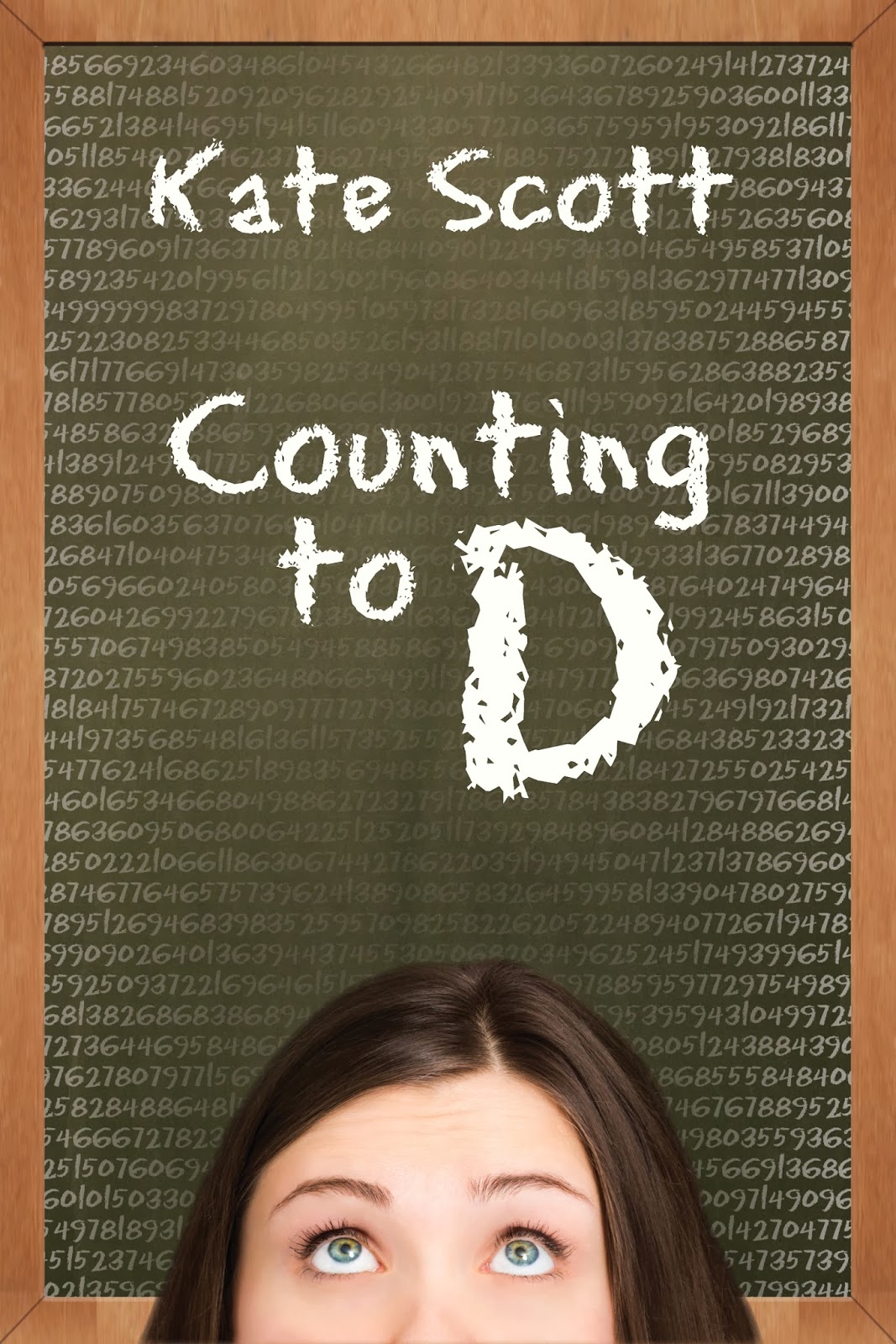
Kate Scott: Counting to D (2014)

Counting to D

I knew when I accepted a review copy of this novel that I wasn’t the ideal reader for it. Not because it’s a YA novel, but because it’s not the kind of YA novel I normally read (Fantasy Dystopian,  . . .). Still I accepted it because I thought it deserved attention. Kate Scott has chosen a hairy topic, one that deserves more understanding and one she knows better than most.

The narrator of Counting to D is 15-year-old Sam who has just moved from San Diego to Portland with her architect mother. Leaving behind best friends is hard. In her case even more so than in the case of other people because she has a special bond with one of her friends, Arden. Arden isn’t only her best friend she’s the person who opens a door for Sam, which would normally stay closed – the door to books and reading. Since they were little Arden reads to Sam. Sam is dyslexic and at the age of 15 she still can’t read any better than a 7-year-old. But Sam is unusually intelligent, a math whiz with an audiographic memory. She can memorize every book that has been read to her and make the most stunning calculations in her head. Math is her joy and her refuge. Whenever things get emotionally stressing, Sam curls up inside of her head, counting and calculating. At times she’s suspected to be autistic.

In her old school Sam was seen as too clever and too dumb at the same time. Leaving San Diego and going to a new school could be her chance to start anew.

The story which follows is one of  hope and encouragement. Sam makes new friends, falls in love for the first time, takes baby reading steps and overcomes prejudice and biased thinking.

While not entirely my cup of tea, I must say, this was a cute, warm book with endearing characters. I would highly recommend it to discussion groups, people who know someone who is dyslexic, parents with dyslexic kids, teachers and, thanks to a special font, it’s a great choice for dyslexic kids too.

The most amazing thing is certainly that Kate Scott is dyslexic herself and that she wrote a novel is a message of hope for all the kids who try to overcome their illiteracy. I have never met a dyslexic person, so it was interesting to read about this. It’s a sad fact that even nowadays once students are labelled “special ed”, many of their co-students will think of them as dumb.

I have no idea how often dyslexic kids show the traits Samantha shows in this book. She’s a genius, only one that cannot read.

Counting to D, which will come out in February, is a cute and important book with a hopeful message.

Thanks to Mindbuckmedia and Elliott Books for the review copy

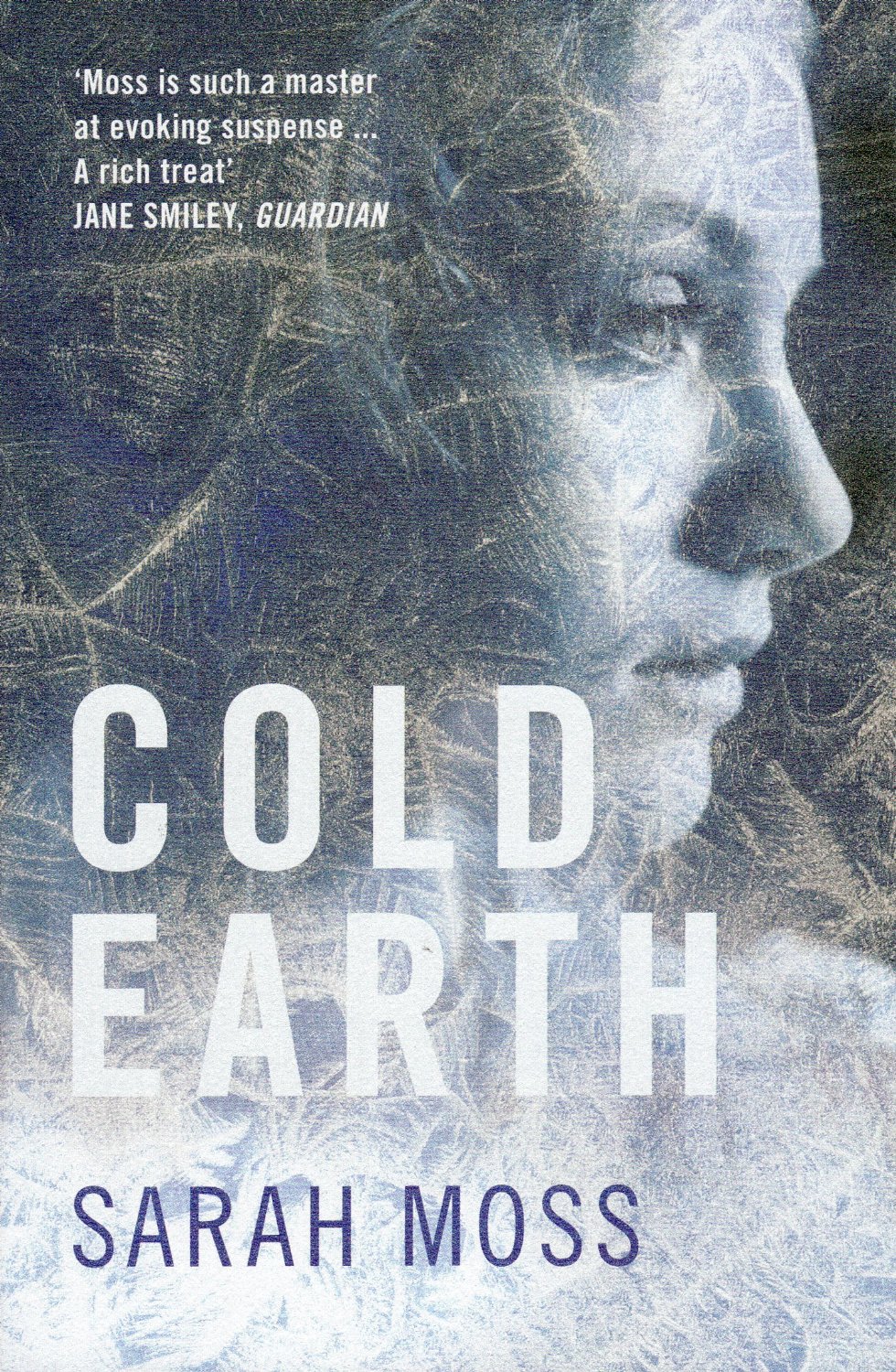
Sarah Moss: Cold Earth (2009)

Cold Earth

Last summer I read Michelle Paver’s excellent ghost story Dark Matter and Max pointed out in a comment that the description reminded him of Sarah Moss’ first novel Cold Earth. Both novels are set in the North, under extreme conditions and both use a similar technique. The protagonists write diaries and/or letters. In Cold Earth the story is told from six different subsequent points of view, while there is only one in Dark Matter.

Cold Earth is the story of an archeological dig, set in a remote part of Greenland. Six young people, under the supervision of one of them, start excavating the remains of a Norse society. Something has wiped out that society, a fact that unsettles our diggers early on. At the same time they are aware that a pandemic is spreading and communication with the outside world isn’t possible. They are not only afraid that their families and friends might die but that nobody will come and get them once the date for their departure arrives. If  that wasn’t enough already, one of the six young people, Nina, the only one who isn’t an archeologist but working on a PhD in literature, pretends that the site is haunted and shows signs of either severe trauma or delusion.

The story is told from the point of view of the six people. The first part, Nina’s part is the longest. She’s the one who reacts the most to the circumstances. She has weird dreams at night that seem to come directly from the past, she is certain that someone or something walks around the camp at night. The others react to that in many different ways. There are those who are affected and those who just find her a pain in the ass. But the letters or journal entries all show that whether they believe in the ghost theory or in the possibility that Nina’s going mad, they have a hard time coping. Some have come carrying a past loaded with grief and sorrow others are badly affected by the idea that the pandemic is killing off their families and friends.

The longer they stay, the colder it gets and they have to expect the worst, namely that nobody will come and get them and that they will run out of food and not be sufficiently prepared to face  the Arctic winter.

I’m sure if I hadn’t read Dark Matter before, I would have liked this better. The elements which are similar, the ghost story parts, are much more scary and convincing in Dark Matter, I even thought that Paver did a better job in using a ghosts story as a means to illustrate fragility of human existence, and the influence of extreme weather conditions and surroundings on people. I also liked the structure better. Cold Earth starts strongly with Nina’s point of view, which takes up almost a third of the book, but the subsequent chapters, narrated by the others are shorter and shorter, as if she’d run out of breath. Of course you could say she chose that approach to create tensions but I felt some parts were too short to be entirely satisfying. What is very well done in Sarah Moss’ book is how she includes the dimension of society. Paver focusses more on the individual, Moss more on society and groups. I found it impressive how she described how hellish the wrong company can be. I’m not exactly a gregarious person and if I choose company it really needs to be the right one. I could sympathize with Nina who felt she wasn’t only among strangers but among people who were even a tad hostile.

I guess it depends on personal preference whether you will like Dark Matter or Cold Earth better. I could relate more to  the idea of a lonely person thrown into an awful situation than to a group facing disaster. I’m glad I read them both, as they are both extremely good, I just loved one more. If, like me, you like extreme and well-captured settings, you shouldn’t miss either one of tem.

If you’re interested here is Max’s very detailed and insightful review.

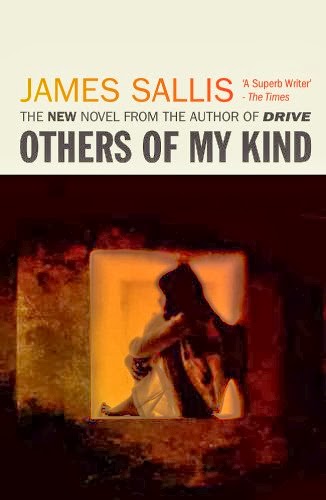
James Sallis : Others of My Kind (2013)

Other of my kind

Back in 2012 I read and reviewed Drive by James Sallis. I’ve been meaning to read more of him ever since and when I saw Others of My Kind at a local book shop I decided to read it.

The narrator of the book is Jenny, a woman who had been abducted as a child and held captive in a box under a bed for a couple of years. When her captor comes home at night, he gets her out, abuses and plays with her.  After managing to escape she lives in mall before she’s found and enters the foster care system. Suing for emancipation she becomes an adult at the age of 16. When the novel opens she works as production editor for a local TV station. One evening, when returning home from work, a detective waits for her in front of her house. Recognizing a fellow loner when she sees one, she asks the handsome detective in and serves him dinner. Right away there’s an intimacy and an understanding between the two. Jack has come to ask Jenny a favour. A twenty year-old woman who has been kept under similar circumstances has been found. The young woman shows signs of trauma and isn’t talking. Jack believes it would help if Jenny spoke to her. She agrees and the incident triggers memoroes of her own past.

Others of My Kind is a slim novel, saying more about the plot would spoil it too much. I found it very unusual in its choice of topic. In a way all of our expectations are turned upside down and we learn to see horrible things form an unexpected angle. I liked the main character Jenny quite a lot. She’s a character who has grown from what has happened to her and who has developed an astonishing capacity for compassion and a genuine ability to do something truly good without asking for anything in return. I found it refreshing that an author attempted to show that horrible circumstances don’t necessarily have to damage a person for life and that he managed to illustrate this without belittling the horrible events that happened in Jenny’s past. The result is a crime novel with an almost Buddhist vibe.

Sallis isn’t your usual crime writer. Not only because his stories are unusual but because of his pared down style. When you pare down sentences and scenes like Sallis, leaving only the most necessary, each and every single of your sentences will have a special power and meaning. Each element is chosen carefully, each scene stripped down to the bare minimum. A lesser writer would achieve something choppy and fragmented, while Sallis reaches another kind of fluidity. 

This book really put me in the mood to read more of him. I want to read The Killer is Dying next but I’m open for other suggestions.

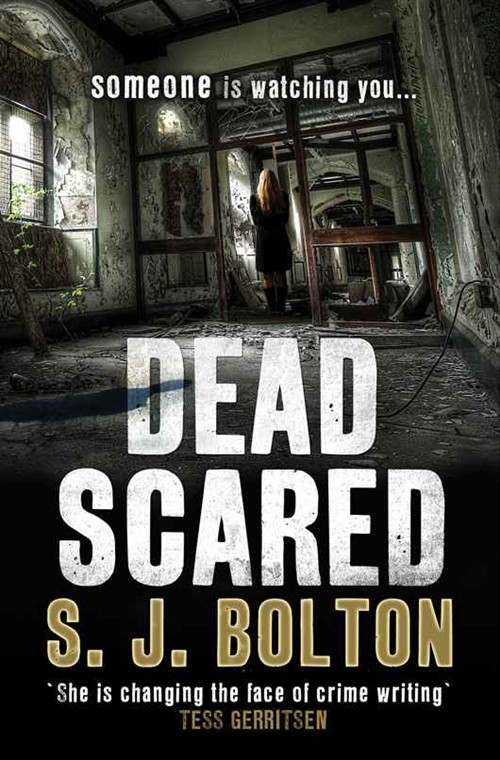
S. J. Bolton: Dead Scared (2012)

Dead Scared

Dead Scared was my third novel by S.J. Bolton. It’s the second novel featuring Lacey Flint and DI Mark Joesbury. I liked Sacrifice and Now You See Me a lot, but I really loved Dead Scared. I think it’s one of my all-time favourite crime novels. It’s got everything I like in a plot-driven crime novel. Great setting, evocative atmosphere, appealing characters, a well-paced plot and a really great story. For once she didn’t even stretch believability all that much.

Evi Oliver is a student counsellor at the university of Cambridge. She has contacted the police because she is alarmed that so many female students commit suicide. Maybe there is an internet community or a group that drives them to take their own lives? The police don’t know what to make of this and decide to send an undercover agent who will pretend to be a vulnerable young student. Lacey Flint seems the right choice. Nobody but Evi knows her identity and even Evi doesn’t know her name.

What is striking in this series of suicides is that the young women choose very violent forms, which are not typically chosen by women. Just when Lacey arrives another woman has tried to take her life. She set herself on fire but could be saved. She has been severely burned and it’s not sure she will survive.

As soon as Lacey moves into her room, she starts to feel weird. It does make her nervous to pretend to be a young student and the many suicides are quite creepy. Additionally she’s targeted right away and becomes the victim of a rather sinister student prank. The fact that she doesn’t sleep well, has peculiar nightmares and wakes feeling groggy doesn’t help either.

After some investigations, Lacey concludes that Evi isn’t imagining things. It’s even possible that there is no online community but that there is something  much more threatening at work. When Evi is suddenly being stalked it becomes obvious that the situation is very dangerous for the two women.

Dead Scared is set in the university milieu of Cambridge and the way Bolton described the city is very evocative, giving the book traits that could have been taken from a Gothic novel.

As readers know from the first Lacey Flint/DI Joesbury book, Lacey isn’t exactly who she seems to be. She’s tough but due to a troubled past also very fragile. The relationship between Lacey and Joesbury intensifies in this book and is even more important than in the first.

The idea behind the crimes is really great and I wondered the whole time what was going on. I had a feeling but still kept on turning pages as quickly as I could.

I had barely finished the book when I already ordered the next in the Lacey Flint series. I’m pretty sure it’s not one of those books that will stay on the unread books pile for long.

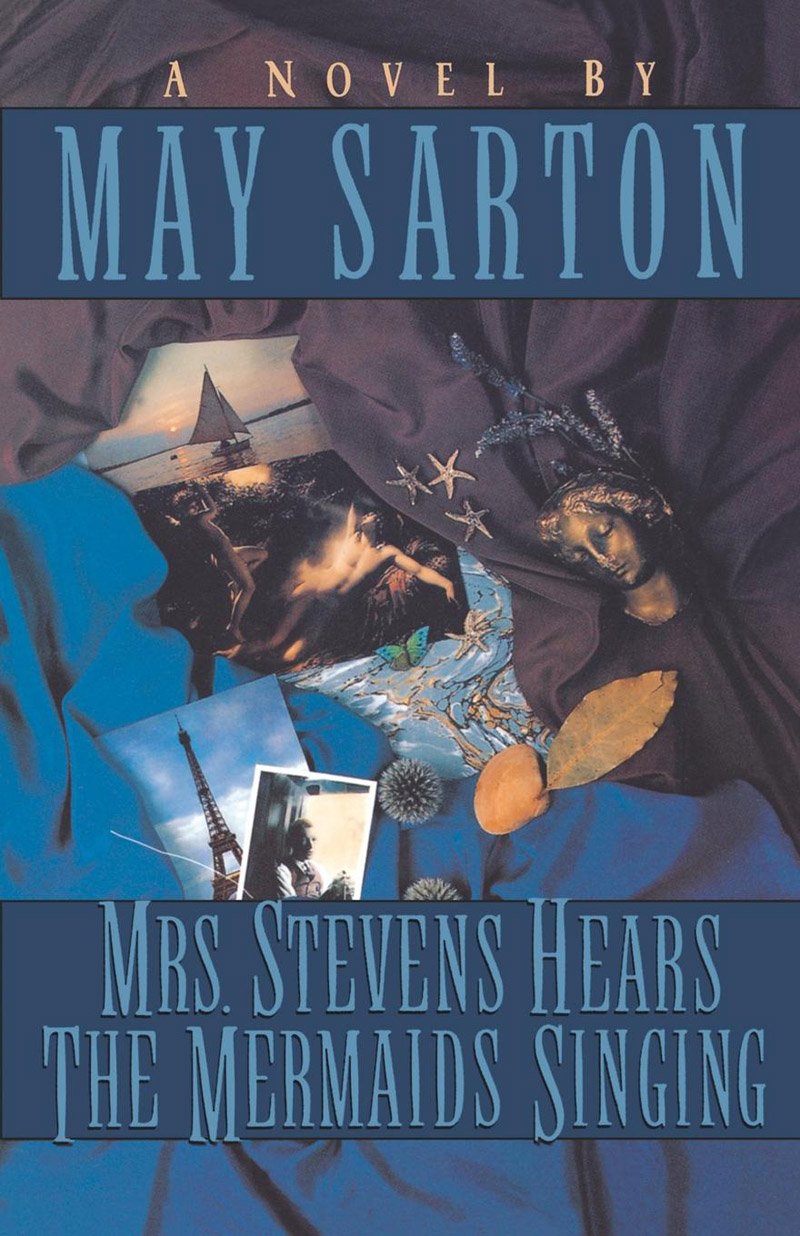
May Sarton: Mrs Stevens Hears the Mermaids Singing (1965)

Mrs Stevens Hears the Mermaids Singing

I came across May Sarton for the first time when I was reading Susan Tiberghien’s memoir Looking for Gold, in which Tiberghien wrote about her year in Jungian analysis. The books she mentioned were Sarton’s famous diaries Plant Dreaming Deep and Journal of a Solitude. I got them both but never read them so far. When Danielle (A Work in Progress) started writing regularly about Journal of a Solitude last year, mentioning in particular one entry in which Sarton wrote how much a negative review of one of her novels hurt her, I realized that I hadn’t even been aware that Sarton had also been a novelist and not only a poet and diarist. That made me curious and I decided to read one of her novels. Since the title Mrs Stevens Hears the Mermaids Singing reminded me of one of my favourite movies I’ve Heard the Mermaids Singing (I’m sure it’s no coincidence that Rozema chose that title) I picked that novel.

Mrs Stevens Hears the Mermaids Singing is the story of an elderly poet, Mrs Hilary Stevens, who has just published a highly successful volume of poems. The story focuses on one particular day on which an interview takes place but her whole life is unfolded as well. Two younger people, an aspiring young woman poet and a male critic are coming to see Hilary to interview her. Mrs Stevens is very anxious. She is aware that if the interviewers are any good, they will dig deep and trigger a lot of buried emotions and memories.

The book consists of four parts. The first called “Hilary” shows us the poet on her own, the morning before the young interviewers arrive. The second part “The Interviewers” describes the two young people on their way to Mrs Stevens and shows just how anxious they are as well. The third part is dedicated to “The Interview” and moves back and forth in time. We follow the interview and flashbacks reveal episodes of Hilary’s life, which she doesn’t want to share with her interviewers. The last part is called “Mar”. Mar is the name of Hilary’s protegé, a young gay poet who reminds her of herself as a young person.

The part I liked best was the first in which we see Hilary on her own. She has chosen to live a solitary life (I guess pretty much like the author) and relishes every minute. She lives close to the sea and finds solace and inspiration in watching the landscape, the trees, how sunlight falls on certain flowers. She has her small rituals and fixed schedule to which she sticks unrelentlessly. In this part she also thinks about what it means to get older and how the inner young self contrasts with the older out self, the aging body, and what it means to face the frailties of old age for someone living a solitary life.

The interview was broken up by pauses. Hilary has to interrupt the interview several times when memories overwhelm her and she retreats to her room, leaving the two interviewers on their own. In these pauses she thinks of the past which is revealed in flashbacks. I found this technique somewhat heavy-handed but it was still powerful. The topics of the interview circle around inspiration, the muse, the difference between men and women as artists.

Mrs Stevens Hears the Mermaids Singing is of importance in Sarton’s work because it is the first book in which she wrote about homosexual love. I found it interesting that Hilary had relationships with men and women and didn’t try to compare but felt each brought out another part of herself. Not all of the relationships are love affairs. The strong bond she has with Mar, for example, is free of physical attraction.

I found this novel highly engaging and inspiring. It’s full of insights and subtle observations on mundane and sublime things alike. There is a moment in the beginning in which Hilary complains that the world seems to strive towards chaos at all times. She takes her ashtrays as an example and states that she sometimes has the feeling, all she’s doing is emptying her ashtrays which get full again within seconds. I can’t say I haven’t had similar thoughts – not with regard to ashtrays -; there definitely is an absurd futility in housework.

At times reading this novel was like meeting a very interesting person who has given thought to everything. She finds thinking about housework, her cat, the light in the corner of a room, just as important as to ponder the deeper meaning of her life, the sources for her creativity, the deep bond between human beings. What I didn’t care for were those many observations on the difference between men and women and the assumption that it is dangerous for a woman to become a poet because it can endanger her fulfillment as a wife and mother. Yeah well. I agree to some extent but the problem isn’t an essential one, as she tries to make us believe, but a social one. If our society was different, these problems wouldn’t exist in that way. Unfortunately these thoughts and reflexions made the book feel quite dated.

As much as I liked reading this, it never really felt like a novel. On the other hand, I loved to get a glimpse at someone’s rich inner life and I might even read this again some day. Since I have a feeling Hilary Stevens is a lot like May Sarton, it certainly made me keen to read Sarton’s diaries, but I’m not sure I’ll read many more of her novels.

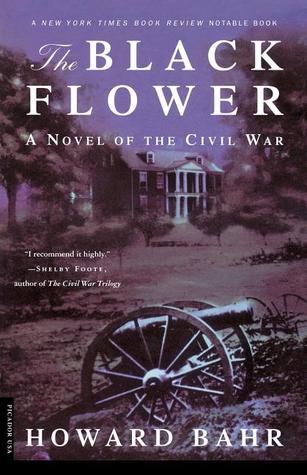
Literature and War Readalong January 31 2014: The Black Flower by Howard Bahr

The Black Flower

As I wrote in my introductory post to this year’s readalong, I was at first tempted to include only books based on WWI but decided against that for numerous reasons. In the first readalong I had included two novels on the American Civil War, one of which had to be removed from the list as 2011 was the first year of the German Literature Month and I wanted to add a German novel in November. The novel on the American Civil War that we read in 2011 and which impressed me a great deal was Cold Mountain and when Kevin (The War Movie Buff) mentioned he’d just read another novel on the American Civil War that he found just as compelling, I decided, to include said novel at a later date. So it’s thanks to Kevin that we’re reading The Black Flower this year. I must say I’m very eager, not only because I hope we will like it, but because I’m glad to return to the American Civil War. This book is the first in a series of three books that are dedicated to that war and I’m sure it will be interesting to see how these very different novels will approach the subject. At first I thought that Bahr might have been inspired by Cold Mountain but since both books were published in 1997, I’d say that wasn’t the case.

Howard Bahr was a school teacher before he started to write. The Black Flower  was his first novel. He’s written other novels since then and they all received awards.

Here are the first sentences

Bushrod Carter dreamed of snow, of big, round flakes drifting like sycamore leaves from heaven. The snow settled over trees and fences, over artillery and the rumps of horses, over the men moving in column up the narrow road. A snowflake, light and dry as a lace doily, lit on the crown of Bushrod’s hat; when he made to brush it away, he found it was not snow but hoe cake dripping with molasses.

And  some details and the blurb for those who want to join

The Black Flower by Howard Bahr (US 1997), American Civil War, Novel, 272 pages

The Black Flower is the gripping story of a young Confederate rifleman from Mississippi named Bushrod Carter, who serves in General John Bell Hood’s Army of Tennessee during the Civil War battle that takes place in Franklin, Tennessee, in November 1864. Written with reverent attention to historical accuracy, the book vividly documents the fear, suffering, and intense friendships that are all present on the eve of the battle and during its aftermath. When Bushrod is wounded in the Confederate charge, he is taken to a makeshift hospital where he comes under the care of Anna, who has already lost two potential romances to battle. Bushrod and Anna’s poignant attempt to forge a bond of common humanity in the midst of the pathos and horror of battle serves as a powerful reminder that the war that divided America will not vanish quietly into the page of history.

*******

The discussion starts on Friday, 31 January 2014.

Further information on the Literature and War Readalong 2014, including all the book blurbs, can be found here.