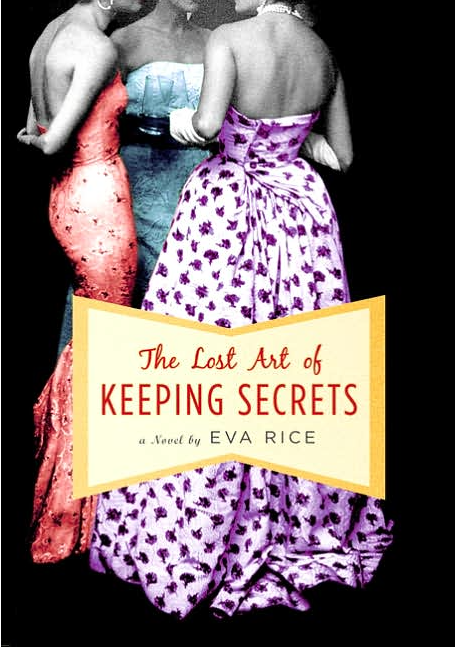
Eva Rice: The Lost Art of Keeping Secrets (2005)

Lost Art of Keeping Secrets

When seeing The Lost Art of Keeping Secrets referred to as pastiche, I was wondering when historical fiction actually crosses the line. Was it because Eva Rice did not only write a novel set in the 50s but a novel that sounded very much like some of the books written in the 40s and 50s? I suppose so. I haven’t read Dodie Smith’s I Capture the Castle, but it seems obvious that there are similarities. Be it as it may, Eva Rice has written a truly charming book.

The story starts in medias res with our narrator, Penelope, an eighteen year-old girl and aspiring writer, being whisked off in a taxi by Charlotte. Charlotte is Penelope’s age, but more self-assured, more stylish, outspoken, and exuberant. Before this day the two girls have never met, but, as the novel will slowly unfold, there are more connections than they see at first.

Charlotte begs Penelope to come with her to tea at Aunt Clare’s and meet Harry, her cousin. A little later they are sitting in Aunt Clare’s messy sitting room, eating scones, drinking tea and Penelope falls under the charm of these three people. They are all eccentric, speak their mind and either say hilarious or almost outrageous things. While Penelope is rather shy, she starts to swim like a fish in water in this stimulating company. Their first afternoon together marks the beginning of a great story and a wonderful friendship.

While the early chapters introduce us to Charlotte’s world, the following will take us to Penelope’s home and introduce us to her mother and her younger brother and the house they live in – Milton Magna Hall, called Magna by its inhabitants. Penelope and her family live in this huge, medieval house in genteel poverty. Her father died in WWII. Her mother, a stunning beauty, who’s only 35 years old, is prone to sudden crying fits and utterly sensitive to everything. Her brother, Inigo, doesn’t care about anything else but pop music. Like Charlotte and Penelope he loves Johnnie Ray, but as soon as his uncle from America introduces him to a new singer, Elvis Presley, who is still unknown in the UK, he only cares for Elvis. Their house, Magna, is as much a character as the people. I love stories that center on big old houses. Magna is such a house but it never sounded beautiful.It sounded rather dreadful, a monstrosity really, and a trap for those living inside. It certainly was one big, money-sucking machine. Sure, it was grand, with its huge galleries and halls, but since they had no money, it was cold, draughty and damp. The furniture had seen better days. Visitors were impressed, but, as Charlotte remarked, they didn’t have to live there.

The Lost Art of Keeping Secrets is a s much a book about the beginning of pop music, youth culture, the young Brits’ infatuation with everything American, as it is about coming of age, the definite end of an era, and new times. It’s a love story and a story of new beginnings but, more than anything, it’s a story of friendship.

The novel moves between a few distinct places,—Aunt Clare’s sitting room, the huge mansion Magna, and public places like The Ritz, where they party and listen to their favourite music.

Some of the most wonderful episodes show the four young people together, drinking champagne and enjoying each others company. My favourite scene is almost surrealist. It features Penelope and Harry together in the huge large gallery at Magna, lying on their backs, drinking, talking, and watching Harry’s doves – he’s a magician – fly around the room.

Books like these are often bitter-sweet, but this one is more sweet than bitter— in spite of some tragedy towards the end—because there are so many opportunities and hope waiting for the characters.

The Lost Art of Keeping Secrets is a smart, charming, exuberant book, filled with witty, endearing and eccentric characters, whose sharp insights, clever repartee, and uncrushable optimism are a delight to follow. If you need some intelligent cheering up—this is the book for you.

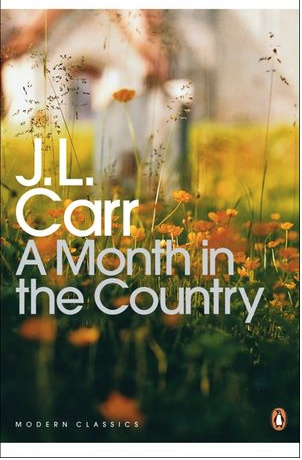
 

J. L. Carr: A Month in the Country (1980)

A Month in the Country

It’s not easy to write about A Month in the Country, but it’s easy to a summarize it. It’s 1920 and Tom Birkin, a man in his late twenties, has come to Oxgodby where he’s hired to spend the summer uncovering a medieval mural in the church. Birkin is a man who feels unmoored. He has a facial twitch, a legacy from his time in the trenches, no money, and his wife ran off with another man. Coming from London to the north of England, he feels like he’s in enemy territory at first, but the stationmaster’s warm welcome and the offer of friendship from the archeologist Moon, a veteran like Birkin, make him soon feel at home. His keen sense of detail and his fondness of things, people, flora and fauna, soon help him to recover. Birkin enjoys these blissful, enchanted moments in the country and even falls in love. As the days go by, he becomes more and more part of the village life, uncovers the stunning wall-painting, and makes friends. The book ends with the first days of autumn and a dramatic, tragic twist, which illustrates that even really awful things we experience are often not as fatal as our own hesitations.

That rose  . . . Sara van Fleet . . . I still have it. Pressed in a book. My Bannister-Fletcher, as a matter of fact. Someday, after a sale, a stranger will find it there and wonder why.

In a review, I read that this was an account of happiness, which puzzled me. Yes, we are told that Birkin was happy, but we never feel it. Or rather, I never felt it, because the narrator of this story isn’t the young Birkin, but the old Birkin looking back. And we also know, early on, that his life didn’t turn out happy and that he mourns not only this summer but a whole way of life that’s long gone in 1978.

She lived at a farmhouse gable end to the road – not a big place. Deep red hollyhocks pressed against limestone wall and velvet butterflies flopped lazily from flower to flower. It was Tennyson weather, drowsy, warm, unnaturally still. Her father and mother made me very welcome, both declaring they’d never met a Londoner before.

A Month in the Country is a stunning book. Not so much for the story but for the fine observations and subtle descriptions. And most of all for the structure and use of time. There’s very little backstory clogging up the story; only a few sentences, inserted here and there, paint a full picture of what happend before. What’s masterful as well is that not only does the narrator look back but he writes about himself in 1920 and how he did then look back at his time in the trenches. This really gives away the main theme of the novel – the passing of time and the fleetingness of life.

Ah, those days . . . for many years afterwards their happiness haunted me. Sometimes, listening to music, I drift back and nothing has changed. The long end of summer. Day after day of warm weather, voices calling as night came on and lighted windows pricked the darkness and, at day-break, the murmur of corn and the warm smell of fields ripe for harvest. And being young.

If I’d stayed there, would I always have been happy? No, I suppose not. People move away, grow older, die, and the bright belief that there will be another marvellous thing around each corner fades. It is now or never; we must snatch at happiness as it flies.

The painting Birkin uncovers illustrates this perfectly. It is more than just a story element, it’s a symbol. It’s magnificent but has been covered up. Nobody knows why. It’s a painting of a man at the height of his art but it’s not finished, Yet, you can see that he wasn’t an old man. The brushstrokes are too vigorous. So why did he stop? Birkin uncovers it all in the end

Death and the passing of time are ever present in the book and all the joy that Birkin experiences—the Sunady meals with the stationmaster, the strong tea in a tea room, his early morning talks with Moon, the funny outings with the villagers, talking to the woman he’s in love with— it all speaks of bliss but it is tainted with sorrow. Carr achieves this through authorial intrusions, which never allow that we stay in the moment, but always remind us that the moment is long gone and the man telling us about it is looking at things past.

I liked him from that first encounter: he was his own man. And he liked me (which always helps). God, when I think back all those years! And it’s gone. It’s gone. All the excitement and pride of that first job, Oxgodby, Kathy Ellerbeck, Alice Keach, Moon, that season of calm weather—gone as though they’d never been.

I can’t praise this novel enough and would really like to urge everyone to read it. It’s not only a joy to read but illustrates what great writing can do. It will be on my “best of list” at the end of the year and I might even add it to my all-time favourites.

I’ll end with one of my favourite quotes

It would be like someone coming to Malvern, bland Malvern, who is halted by the thought that Edward Elgar walked this road on his way to give music lessons or, looking over to the Clee Hills, reflects that Housman had stood in place, regretting his land of lost content. And, at such a time, for a few of us there will always be a tugging at the heart— knowing a precious moment gone and we not there.

I first read about A Month in the Country on Max’s blog here and knew right away it would be a book for me.

Two Read Alongs You Might Be Interested In

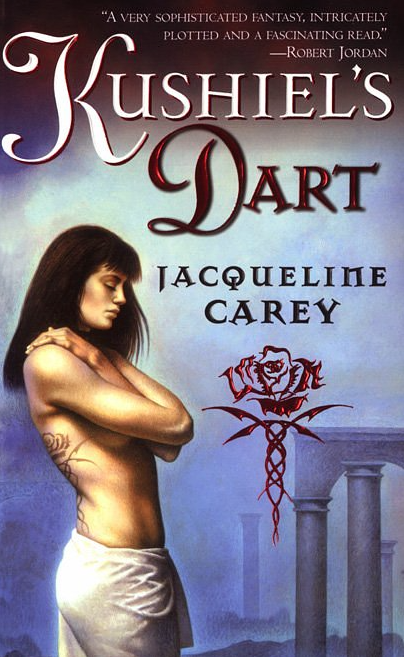
Kushiel's Dart

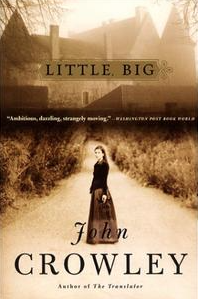
May seems to be a readalong month. I’m hosting my own Literature and War Readalong at the end of the month, signed up for the readalong of Kushiel’s Dart at Dab of Darkness, and am extremely tempted to join Bellezza (Dolce Bellezza), Tom (Wuthering Expectations), and Helen (a gallimaufry) in their joint reading of John Crowley’s Little, Big.

Jacqueline Carey’s mentioned the readalong on her Facebook page!

Here’s the blurb of Jacqueline Carey’s Kushiel’s Dart:

The land of Terre d’Ange is a place of unsurpassing beauty and grace. It is said that angels found the land and saw it was good…and the ensuing race that rose from the seed of angels and men live by one simple rule: Love as thou wilt. PhEdre nO Delaunay is a young woman who was born with a scarlet mote in her left eye. Sold into indentured servitude as a child, her bond is purchased by Anafiel Delaunay, a nobleman with very a special mission…and the first one to recognize who and what she is: one pricked by Kushiel’s Dart, chosen to forever experience pain and pleasure as one. PhEdre is trained equally in the courtly arts and the talents of the bedchamber, but, above all, the ability to observe, remember, and analyze. Almost as talented a spy as she is courtesan, PhEdre stumbles upon a plot that threatens the very foundations of her homeland. Treachery sets her on her path; love and honor goad her further. And in the doing, it will take her to the edge of despair…and beyond. Hateful friend, loving enemy, beloved assassin; they can all wear the same glittering mask in this world, and PhEdre will get but one chance to save all that she holds dear. Set in a world of cunning poets, deadly courtiers, heroic traitors, and a truly Machiavellian villainess, this is a novel of grandeur, luxuriance, sacrifice, betrayal, and deeply laid conspiracies. Not since Dune has there been an epic on the scale of “Kushiel’s Dart”-a massive tale about the violent death of an old age, and the birth of a new.

If you’d like to join – head over to Dab of Darkness. Below you find the schedule and the list of participants.

Week 1: May 10, Chapters 1-8, Hosted by Dab of Darkness
Week 2: May 17, Chapters 9-18, Hosted by Tethyan Books
Week 3: May 24, Chapters 19-26, Hosted by Over the Effing Rainbow
Week 4: May 31, Chapters 27-36, Hosted by Beauty is a Sleeping Cat
Week 5: June 7, Chapters 37-45, Hosted by Violin in a Void
Week 6: June 14, Chapters 46-54, Hosted by Books Without Any Pictures
Week 7: June 21, Chapters 55-63
Week 8: June 28, Chapters 64-73, Hosted by Lynn’s Book Blog
Week 9: July 5, Chapters 74-83
Week 10: July 12, Chapter 84-END

Allie at Tethyan Books
Lisa at Over the Effing Rainbow
Lynn at Lynn’s Book Blog
Grace at Books Without Any Pictures
Caroline at Beauty Is a Sleeping Cat
Lauren at Violin in a Void
Celine at Nyx Book Reviews
Bellezza at Dolce Bellezza
Susan at Dab of Darkness

Little, Big

Here’s the blurb of Little, Big:

Edgewood is many houses, all put inside each other, or across each other. It’s filled with and surrounded by mystery and enchantment: the further in you go, the bigger it gets.

Smoky Barnable, who has fallen in love with Daily Alice Drinkwater, comes to Edgewood, her family home, where he finds himself drawn into a world of magical strangeness.

Crowley’s work has a special alchemy – mixing the world we know with an imagined world which seems more true and real. Winner of the WORLD FANTASY AWARD, LITTLE, BIG is eloquent, sensual, funny and unforgettable, a true Fantasy Masterwork.

Winner of the WORLD FANTASY AWARD FOR BEST NOVEL, 1982.

If you’re interested in reading along John Crowley’s Little, Big, you should visit Bellezza’s blog here where you can find the details.

Unfortunately both books, Kushiel’s Dart and Little, Big are hefty tomes, that’s why I don’t think I’ll manage to join both. I’m glad if I succeed in finishing one.

Will you join?

Jacqueline Carey’s mentioned the readalong on her Facebook page!

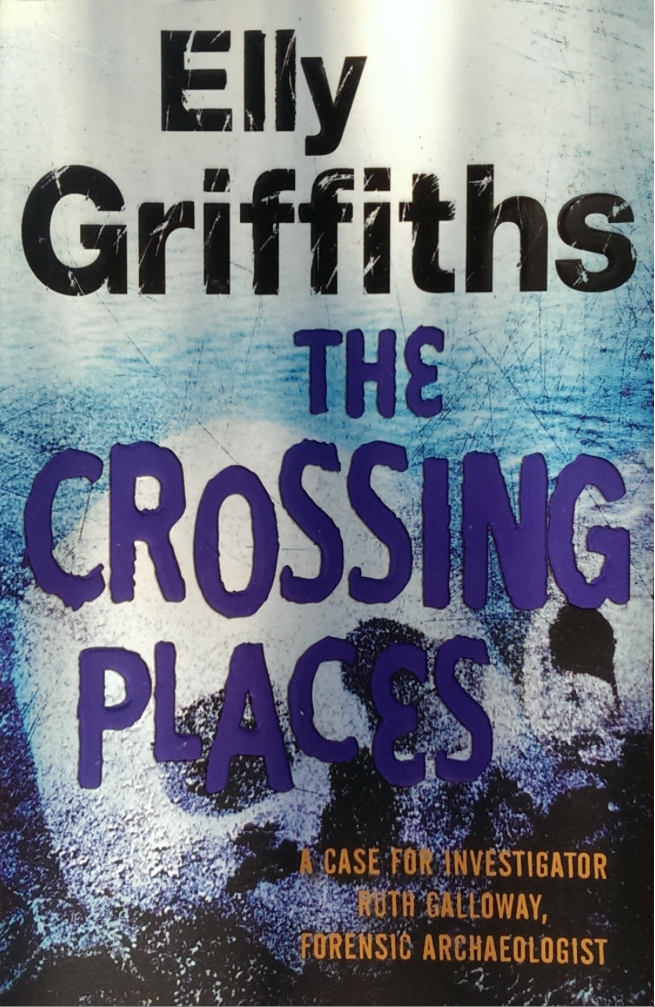
Elly Griffiths: The Crossing Places (2009) Ruth Galloway 1

The Crossing Places

Elly Griffiths’ The Crossing Places is the first novel in her Ruth Galloway series. Ruth Galloway is a forensic archaeologist, who lives and works in Norfolk. Ever since she participated in a dig ten years ago, she’s loved the marshes and is, since then, renting a cottage that overlooks an empty, wild landscape, and the North Sea.

This is a novel with a leisurely pace and Elly Griffiths takes a lot of time to introduce Ruth Galloway. I liked her right away. She’s a single woman, a bit on the clumsy side, and not exactly slim or very attractive. But that doesn’t make her a beggar when it comes to men. She doesn’t need anyone to feel whole and rather lives alone than in the wrong company. This was one of many character traits that made me like her instantly. And of course she’s an expert in her field.

The second main character in the series, DCI Harry Nelson, is likable in a gruff kind of way. The two complement each other rather nicely.

They first meet when human bones are discovered on the marshes and Nelson asks Ruth to identify them. Ten years ago, a little girl went missing. She was never found, but Nelson never gave up hope that they still might find her one day. Naturally, he assumes that these are her bones, but Ruth tells him they are over two thousand years old.

Shortly after this another small girl goes missing and Ruth is threatened. It looks as if she’s somehow roused the murderer and got in his way.

If, like me, you love your crime novels with a strong sense of place, then Elly Griffiths’ Ruth Galloway series is for you. It’s one of those, in which the setting is a character in its own right. The saltmarshes, the weather, the loneliness of the place, and the fauna, are all intricate parts of this book. But that’s not all this atmospheric book has to offer. Ruth is a great character and I’m curious to see how she will develop. Since she’s a forensic archaeologist, we learn a few things about archaeology, which I found interesting, although the way we learn about it, is a tad clumsy at times. But that’s really my only reservation.

I thoroughly enjoyed this book. It’s not edge-of-your-seat gripping and, in spite of the many suspects, I thought it was pretty clear who was the bad guy, but that didn’t diminish the story one bit.

I have to admit that I’m partial to Elly Griffith’s choice of setting. I’ve been in Norfolk and loved it and the way she captures it is great.

I discovered the novel thanks to a review on Crimeworm. If you love crime and mystery it’s worth checking out her blog. You’ll discover some great books.

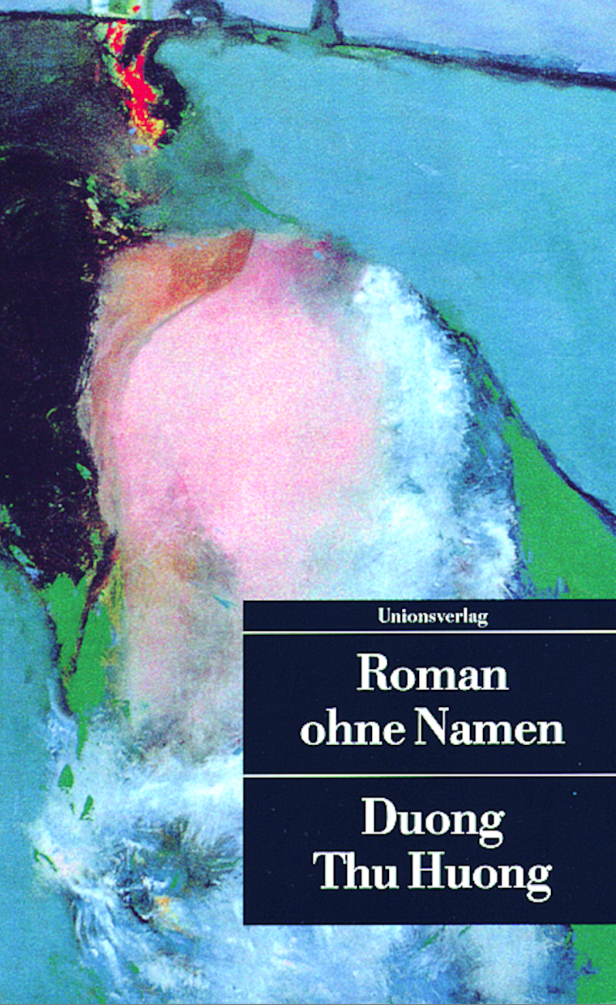
Literature and War Readalong May 29 2015: Novel Without a Name – Tiêu thuyêt vô dê by Duong Thu Huong

Novel Without A Name

Two years ago we read Bao Ninh’s moving novel on the war in Vietnam The Sorrow of War. Quite a few of those who participated and others who read our posts stated that they would be interested in reading novels by Vietnamese authors. That’s why I chose to include Novel Without a Name – Tiêu thuyêt vô dê, another famous novel on the war in Vietnam. It was written by one of Vietnam’s most prominent authors: Duong Thu Huong. She is well-respected outside of her native country. If you read French you’ll find translations of many of her books. Duong Thu Huong is not only a great writer but a courageous one. Many of her novels have been forbidden in Vietnam and she was imprisoned for her political views.

Duong Thu Huong

This link will lead you to the website of Swiss publisher Unionsverlag. Unionsverlag is a pioner when it comes to world literature. On their website you’ll find newspaper articles and interviews on and with Duong Thu Houng – in English.

Here are the first sentences (which I had to translated from my German copy)

I heard the wind howl all through the night, out there, over the ravine of the lost souls.

It sounded like a constant moan, like sobbing, then again like cheeky whistling, like the neighing of a mare during copulation. The roof of the pile dwelling trembled, the bamboo poles burst and whistled every time like reed pipes. They played the mournful melody of a country burial. Our nightlight flickered as if it was going to die down. I stretched my neck from under the quilt, blew out the light, and hoped that the shadow of the night would cover up all the senses . . .

And some details and the blurb for those who want to join

Novel Without a Name – Tiêu thuyêt vô dê by Duong Thu Huong (Vietnam 1995), War in Vietnam, Novel, 304 pages.

Vietnamese novelist Huong, who has been imprisoned for her political beliefs, presents the story of a disillusioned soldier in a book that was banned in her native country.

A piercing, unforgettable tale of the horror and spiritual weariness of war, Novel Without a Name will shatter every preconception Americans have about what happened in the jungles of Vietnam. With Duong Thu Huong, whose Paradise of the Blind was published to high critical acclaim in 1993, Vietnam has found a voice both lyrical and stark, powerful enough to capture the conflict that left millions dead and spiritually destroyed her generation. Banned in the author’s native country for its scathing dissection of the day-to-day realities of life for the Vietnamese during the final years of the “Vietnam War, ” Novel Without a Name invites comparison with All Quiet on the Western Front and other classic works of war fiction. The war is seen through the eyes of Quan, a North Vietnamese bo doi (soldier of the people) who joined the army at eighteen, full of idealism and love for the Communist party and its cause of national liberation. But ten years later, after leading his platoon through almost a decade of unimaginable horror and deprivation, Quan is disillusioned by his odyssey of loss and struggle. Furloughed back to his village in search of a fellow soldier, Quan undertakes a harrowing, solitary journey through the tortuous jungles of central Vietnam and his own unspeakable memories.

*******

The discussion starts on Friday, 29 May 2015.

Further information on the Literature and War Readalong 2015, including all the book blurbs, can be found here.

Do You Remember the First Book You Bought?

Nuvat the Brave

I still remember that day as if it had been yesterday. I was nine years old and already an avid reader. I had a little bit of money, pocket money I hadn’t spent on comics and some of the sour gums I liked to eat. It was strange to go to school on a Saturday afternoon. Usually that’s when school was off, but it was a special day, a special occasion, and I was keen on spending what little money I had saved.  I still see the entrance of the school, smell the linoleum floor, and heavy chalky air. No other school ever smelled as chalky as this. The display tables took up all the space of the entrance hall and my heart began to beat incredibly fast as soon as I was close to them. I wouldn’t be able to buy a lot. I had to choose carefully and wisely. It wouldn’t be enough money to buy more than one or two books.

The used book sale was a charity event. Children had brought the books they didn’t want anymore, and the school library had contributed those, which were not circulated any longer. There wasn’t a lot I loved more than books, not even at the age of nine. My mother always bought me the latest children’s books and the old classics. Whenever she heard that someone sold the books of their older children, she bought those too. That was wonderful and I loved it, still nothing could compare to that day and the used book sale in my elementary school because that day I bought my very first book.

I still have it somewhere in the attic. It’s torn, the spine is broken, the pages are loose, but the linen cover is still intensely blue and the little Inuit boy in his canoe is still standing upright on the front cover promising a tale of adventure and a world I didn’t know, a world long gone by now. The title was simple, embossed in bold, black letters: “Nuvat the Brave“ by Radko Doone —or rather “Nuvats grosse Fahrt“ in its German translation. It was one of the books the library discarded, an old book that no child had ever checked out.

The book wasn’t only the first book I bought, it opened a door to something, which I have been passionate about ever since – foreign cultures, the promise of strange and haunting tales, other life styles and mysterious rites and habits. A whole wide, wondrous world for me to discover.

Which was the first book you bought?