German Literature Month Giveaway – Grimm’s Fairy Tales T-shirt by Literary Book Gifts

A while ago I was contacted by a small company – Literary Book Gifts – that produces gifts for book lovers. I had a look and liked their products so much that I decided to feature them for German Literature Month and offer one of their T-shirts, The Grimm’s Fairy Tale shirt,  as a give-away (co-sponsored by Literary Book Gifts).

The company produces T-shirts for women and men and tote bags. All of them with great book-related art work as you can see below where I share some of my favourites. Each T-shirt comes in various sizes and colors.

And some of the tote bags:


GIVEAWAY

The T-shirt I’m giving away is a Grimm’s Fairy Tales T-shirt. This too, is available for men and women and in various colors.

If you would like to win a T-shirt, leave a comment below.

The giveaway is open internationally. The winners will be announced on Sunday November 4 2018, around 18:00 Central European time.

******

If you’d like to buy something from Literary Book Gifts, you can use the promo code beautyisasleepingcat20. It will give you a discount of 20%.

Thanks to Literary Book Gifts for co-sponsoring the T-shirt and for offering a code.

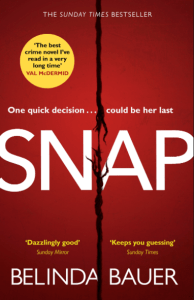
A Very Short Review – Belinda Bauer: Snap (2018)

I’ve wanted to read Belinda Bauer for ages because I’ve heard so many good things about her books. Even so, I was surprised to see her on the Man Booker longlist. I don’t think many crime novels are included usually. And so, even though Rubbernecker is on my piles, I went and got Snap. I finished it two days ago and am still baffled. Baffled it made the Booker longlist. Not only baffled – sad really – because if the typical Booker longlist reader usually doesn’t read crime and this is his introduction to the genre  . . . Not ideal. Baffled also because it’s such a weak book. There’s some nice writing there, good characterisations, but the story is unbelievable, relies heavily on coincidences – one after the other  – and the killer’s motive is so far-fetched that it’s painful.

The premise is interesting enough. A pregnant mother leaves her kids in the car to get petrol and never returns. Later, her body is found. She’s been murdered. There are no suspects and soon it’s a cold case. Three years later, the three kids are living on their own in the messiest place one could imagine. What happened? The dad couldn’t cope and left the three children to fend for themselves. The oldest, Jack, provides for them by breaking and entering into houses whose owners are on holidays. Unfortunately, (biggest coincidence) one house isn’t abandoned and inside Jack finds not only a pregnant woman, but an object he believes had something to do with his mother’s death.

If I didn’t already own Rubbernecker, I’m pretty certain, I would not return to Belinda Bauer. But since I do, I might give her another try. I’m not sure though. I’ve read many great crime novels this year and also a few mediocre ones, but none was as unbelievable as this.

Why did I finish it, you may wonder? For the longest time, I thought it might go into another direction. Sadly it didn’t. And there was zero atmosphere.


Announcing German Literature Month VIII – November 2018

German Literature Month is eight years old this year, and part of the literary calendar. Lizzy and I know that because of the chatter that continues throughout the year about books purchased and set aside for the event. And that makes us very happy.  We’re even happier when you read them during November.

For those though who are wondering what this is all about, and may wish to join us for the first time, November is the month for reading works originally written in German: fiction, non-fiction, poetry, plays, essays, comics, graphic novels.  Anything you fancy really, in any language you fancy, as long as the original language was German. Then tell the world about it: on your blog, facebook, twitter, instagram, goodreads, amazon, wherever. It all adds up to one great banquet of Austrian, German and Swiss literary goodness. This, for example, was last year’s menu. https://lizzysiddal.wordpress.com/2017/12/05/german-literature-month-vii-author-index/

The last couple of years have been entirely read as you please, but this year Lizzy and I wanted to introduce new themes and add in more social reading opportunities. So we’ve devised the following plan.

Week 1: Children and Young Adult Fiction (November 1-7)

November 7 – Readalong with Lizzy: The Book Jumper – Mechthild Glaser

Week 2: Crime Week (November 8-14)

November 14 – Readalong with Caroline: Blue Night – Simone Buchholz

Week 3: 1918 Week (November 15-21)

November 21 – Readalong with Lizzy: The Emperor’s Tomb – Joseph Roth

Week 4: Swiss Literature Week (November 22-28)

November 28 – Readalong with Caroline: A Long Blue Monday – Erhard von Büren

Week 5: Read as you please (November 29-30)

As always, you may read as you please for the month, or you may choose to join in any (or all) of the specific themes and readalongs.  It’s entirely up to you.  The main thing is to enjoy yourself!  Will you join us?

To Cull or Not to Cull? – A Book Lover’s Dilemma

Like most book lovers, I own far too many books. Unlike most, I haven’t reduced their number in a very long time. In my teens, I went through a radical culling phase and gave away and sold a fair amount. Since then . . . I just kept on adding to the piles.

Some people only keep unread books and favourite books. That’s not a bad option, only I’ve got tons of favourite books and/or books I hope to read again someday in the future. Nonetheless, I’m sure I could find at least 500 I will never ever read again. Not because they were not good, but because life’s just too short and my TBR pile easily surpasses that number, which means I’m more likely to read something I haven’t read before.

Very courageous people cull books they haven’t even read yet. I find the idea of giving away an unread book even more painful than giving away a book I’ve read.

One thing I have been doing for a while, is putting books I really didn’t like in bags. That way, at least, they don’t clog up my shelves.

Given my reluctance to part with books, I thought it would be interesting to hear what others do.

Do you cull? And if so, what books do you give away/sell/chuck/donate . . .?

Dorthe Nors: Mirror, Shoulder, Signal – Spejl, Skoulder, Blink (2016) Danish Literature

Dorthe Nors is a Danish writer who has written novels, novellas, and short stories. Her short stories have appeared in Harper’s Magazine, the Boston Review, and The New Yorker. Mirror, Shoulder, Signal was shortlisted for the Man Booker International Prize last year. Several of her books have been translated.

Mirror, Shoulder, Signal tells the story of Sonja, a single woman in her forties, who lives in Copenhagen and wants nothing more than learning to drive. It seems such a modest wish but for Sonja, who suffers from positional vertigo, it’s huge. The doctor actually told her she cannot learn how to drive but here she is anyway, getting driving lessons and failing miserably. Not because of the vertigo but because she just can’t figure out how to change gear. In itself, even though she urgently wants to learn to drive, this wouldn’t be so dramatic but there’s so much more that doesn’t really work in Sonja’s life that the failed driving lessons take on gigantic proportions.

Sonja moved to Copenhagen from rural Jutland. She’s the first of her family to study and after getting her degree in literature she moves to the exciting big city where she works as a translator of Swedish crime writer Gösta Svensson’s bloody serial killer novels. Not exactly the life she’d expected but then again what life did Sonja expect? That’s the question that not only Sonja asks herself during the course of this novel but also the reader. Sonja is the kind of character many readers seem to hate. She’s almost anachronistic in her failure to figure out what she wants and then go and get it. Because she is in many ways weak, people take advantage of her. Strangers and friends alike. Most people see her as someone they can use to talk endlessly about themselves, to show off, to bully, to patronise or, as her newest driving instructor, to have an affair with.

Sonja knows that her life is off its rails and she knows she’s missing direction but she can’t figure out how to get out of this mess other than to daydream or think about the past.

I was so not sure whether I liked this book or not until I read the last pages and everything came together. The ending was so sad, moving, and poignant that I ended up really liking this novel and it’s passive, at times annoying protagonist.

Everybody wants to read about strong, assertive characters and, of course, that’s inspiring but there’s so much truth in Sonja. I’m sure there’s so much hidden human misery in every big city, certainly also in small cities, that I found this story of a woman who had big dreams but ended up lonely and miserable very touching. It takes a special kind of character to survive in big, cold cities, especially when you were born elsewhere. And not everyone is capable of forming meaningful relationships, not everyone has the knack to be socially integrated. I’m very glad that Dorthe Nors chose to write about a quiet character whose struggles go unnoticed by those who surround her. At first even Sonja herself doesn’t notice. Only when she realises all of her struggles are futile does it dawn on her.

This could have been a sad and depressing story but it’s not because there are many funny moments. Sonja may not see herself as clearly as she should at first but she sees others all the more clearly. She has no illusions about those around her and her observations are often funny and laconic. There are the scenes with her massage therapist who also wants her to join her meditation group that are absolutely priceless.

As I said, there were moments when I wasn’t too sure about this book but in the end I liked the book and its old-fashioned heroine very much.

Maggie O’Farrell: Instructions For a Heatwave (2013)

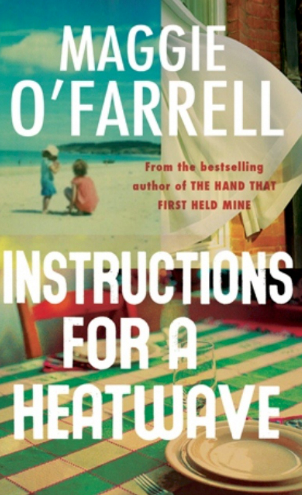
I’m so behind with book reviews that it’s highly unlikely, I’ll ever catch up. This would have been one of many I was going to put aside “for later”, but the title’s too fitting to postpone reviewing it. And it was enjoyable.

The heatwave of the title refers to the heatwave of 1976, one of the worst the UK has ever seen. I don’t know anyone who was alive back then, no matter how small, who wouldn’t remember it. While it’s possibly as hot now as it was then, the heat started earlier, I think, in June and there were massive water shortages. Let’s hope that it won’t come to that. Although it looks dire already. “Over here”, where I live, Continental Europe, it’s even hotter. And, just like in the UK, we have no air conditioning. In Switzerland it’s even forbidden to have them in your own home. Small ones, yes, but they don’t help much. Before diving into the review, let me moan some more – yesterday, the thermometer in our flat showed 35°! Only two degrees less than outside. Sleeping, you wonder? Not so much. My poor cats crawl into dark corners, hoping dark means cool and stay there until the evening. Normally, they run around all day. Unfortunately, he’s afraid of the fan, while she enjoys it

Now on to Maggie O’Farrell. As I mentioned already, Instructions For a Heatwave is set in 1976 during the heatwave and tells the story of the Riordan family. One morning, the dad, Robert Riordan, leaves the house and doesn’t come back. His wife Gretta is shocked and flustered. She calls her children hoping they will come and help her. Already the first phone calls show the family dynamics. There are misunderstandings, half-truths, accusations, exaggerations, tensions. And the three children are facing troubles of their own, that are now, through this family emergency, magnified. At the same time, the emergency shows how frail their family bonds are, how dysfunctional. Gretta is a hypochondriac. She changes subjects when she feels she doesn’t want to talk about something and that is often. She pops pills, makes stuff up and has her kids constantly on alert. Some of the reasons for her behaviour will be revealed later.

Michael Francis is the oldest sibling and in the middle of his own family crisis. It may very well be that his wife, who is reinventing herself, will leave him. He’s not entirely without fault though. Monica, the first daughter, married for the second time, is also doubtful about the future of her marriage. And Aoife, the youngest, is in New York, trying desperately to hold on to a life she loves but that is threatened because it’s built on a lie – nobody knows that she’s a functional illiterate.

When they hear of their dad’s disappearance they all return home. At first, the reunion is frosty and awkward. There are too many things that have been left unsaid in the past and too many family secrets. The biggest is the reason for their dads’ disappearance.

It will take them a few days to sort some things out and then they take a family trip to Ireland, where the parents originally come from.

Instructions for a Heatwave is in many ways an astonishing book. It’s so intricately told, the stories are so tightly interwoven that I was constantly wondering – how did she do that? She moves in out of characters’ minds, switches from the present to the past and back again, but it’s never confusing because it’s so well done.

This is the story of a dysfunctional family but one with hope. They do not give up on each other nor on themselves. Gretta was possibly my favourite character although she reminded me of my late mother (minus my mother’s meanness that is). It’s fascinating to see a character description that resonates so much. Just like Gretta, my mother would always change the subject if she didn’t want to talk about something, pretending she hadn’t heard what had been said and then pretending she had an attack of something (cough, sickness, stomach cramps, “nerves”) and urgently needed her pills. Also, like Gretta, she would start chatting with anyone, finding out family stories and other people’s secrets without ever revealing any of her own. Since the Riordan’s are Irish and Catholics, that was something I could relate to as well. Looking back, it was no fun being brought up by a Catholic mother – my dad was anti-clerical, so that balanced things out a bit.

While this book resonated a lot with me because of my own history, I still think anyone who loves complex family stories would like this very much. In the past, I had mixed experiences with Maggie O’Farrell. I loved The Vanishing Act of Esme Lennox, but didn’t care for another one of her books (I think it was After You’d Gone). This rich and lovely novel has put me in the mood to read more by her. Her memoir I Am, I Am, I Am is already on my piles.

Paris in July 2018 – Willy Ronis’ Cats – Les Chats de Willy Ronis

I always try to participate in Thyme for Tea’s Paris in July event but I don’t always get the time. This year, time was just as scarce and so I was glad the event has been extended. I decided to participate with a beautiful book I discovered a while ago in a book shop: Les chats – The Cats by Willy Ronis.

The book has not been translated but since there’s only a short intro and the rest are photos, any cat or photography lover could enjoy this.

Willy Ronis, who lived from 1910 to 2009, was a French photographer who was famous for his post-war pictures of some of the lesser known Parisian districts like Ménilmontant and Belleville. Together with Brassaï, Doisneau, and Cartier-Bresson, he is one of the most important French photographers of his time, and by many called the most important Paris photographer.

Ronis was also known for his nudes, one of which you can see below, and for his love of cats. His cat photos have such a special charm. They come in so many variations. Close-up photos of his own cats, cats in landscapes, cats he saw on travels. All of his photos are black and white. They are simple and effortless, but when you look at them for a while you discover many charming details and you simply have to admire his compositions and his use of light and shadow.

The nude above, which shows his wife, is one of his most famous photos. I guess that’s why it was included in the picture although there’s no cat on it. The book also offers an intimate look at his family life. Many of the photos show his wife and son, together with a cat.

After the war, Ronis lived and taught  in the South of France, that’s why there are many photos in the book that haven’t been taken in Paris.

I’m sure this is a book that would appeal to many people, whether they love cats or photography. His delicate use of light and shadow alone transforms every picture into a work of art.

Here’s an interesting article from April 2018 in the New York Times about Ronis.

And there’s an exhibition of his work at the Pavillon Carré de Baudoin, which lasts until September.