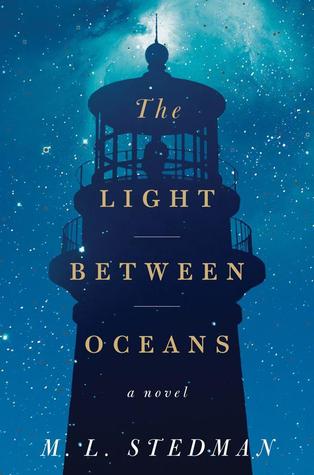
M.L.Stedman: The Light Between Oceans (2012)

The Light Between Oceans

A boat washes up on the shore of a remote lighthouse keeper’s island. It holds a dead man – and a crying baby. The only two islanders, Tom and his wife Izzy, are about to make a devastating decision.

They break the rules and follow their hearts. What happens next will break yours.

Last week I went to a book shop and saw a neatly arranged table with the titles of the long list of the Women’s Prize for Fiction. I read most blurbs and browsed a few books and finally ended up buying The Light Between Oceans.

Tom and Izzy live on an island off the Australian coast, near Point Partageuse. Tom is haunted by memories of WWI. The things he saw, the men he killed. He was reluctant at first to let Izzy come closer, didn’t want to take this young lively woman with him on a forlorn island. While he loved being a lighthouse keeper, didn’t mind the loneliness and how barren the island was, he was not so sure it would be the right place for a woman. But Izzy loved him and wanted to follow him.

Their first months on the island are bliss but when Izzy loses her first baby things start to darken. When a boat with a dead man and a little baby are washed ashore, Izzy has just miscarried for the third time. Seeing the tiny infant makes her loose perspective and she convinces Tom that it is the right thing to keep the child. Of course it isn’t the right thing and the tragedy is programmed. The book has a handful of main protagonists and it’s amazing to watch one after the other make bad decisions.

I have to tell you right away, I didn’t like this book. To some extent I even hated it. It’s sentimental, melodramatic, mawkish… I’m maybe the only one as most people loved it. I was wondering why on earth this was on the Women’s Prize for Fiction long list. The writing is quite artless. I expected something more sophisticated. There is nothing stylish or special about it. It’s the type of book Jodi Picoult could have written, only I’d say she would have done a better job. The exploration of a moral dilemma, what is right, what is wrong, make this a book many book clubs will love to discuss.

I have this habit that I must finish books and it annoys me often. On the other hand, even this book improved on the last 150 pages. The first choice they make is to keep the baby but later Tom and Izzy and a few other people make other choices and some of those are much more interesting.

What made me hate the book was Izzy and the way everyone spoke about and to the baby: “Sweet thing”, “Sweetheart”, “Little one”, “Darling”…. Every character in this book is constantly cooing over the child. That got on my nerves big time.

What I liked was how she evoked this lonely lighthouse. We get a really good feel for what it must be like to be a lighthouse keeper, to be confined to an island for 3 – 6 months without any contact with the outside world.

While I hated Izzy, I really liked her husband Tom. The portrayal of a man who has survived the trenches of WWI but never manages to shake this experience was well done.

The only thing that was very positive is the fact that M.L.Stedman made me understand Izzy in the end despite the fact that I hated her big time.

It was very interesting to see my reaction. Usually – and contrary to many readers – I don’t love or hate characters in books. The things I love are descriptions, style, atmosphere, mood. The experience to hate a character was unsettling. I wonder what it says about me that I reacted so strongly. The idea that someone thinks it’s OK to steal  someone else’s child and keeps on saying it’s for the child’s good, made me so angry. I thought it was a very violent act. 

If you like books which explore moral dilemmas and choices, you might like this. It’s certainly a book that can generate interesting discussions.

Halfway through the novel I noticed that it consists almost exclusively of scenes. No wonder the film rights have already been sold.

Has anyone else read this book? Did you like it?
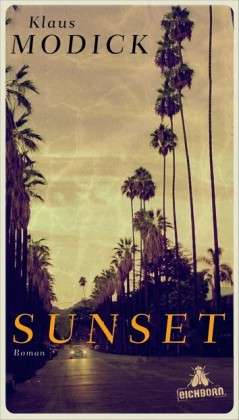
A Day in Lion Feuchtwanger’s Life – On Klaus Modick’s Sunset (2011)

Sunset

Apologies for using this misleading title. Sunset is the German title but, unfortunately, it hasn’t been translated yet.

Klaus Modick is a German author whose books regularly win prizes. He is also well-known as a translator of English and American books. John O’Hara and Nathanael West are a few of the authors he has translated. He wrote his PhD on the Jewish German writer Lion Feuchtwanger and frequently returns to him in his writing.

Sunset tells about one day in Lion Feuchtwanger’s life. Using flashbacks and memory tags, we are given insight into his life, an era and his lifelong friendship with Bertolt Brecht.

It’s a day in 1956. Feuchtwanger is alone in his home in Pacific Palisades. His wife is out of the house for the day. In the early morning he receives a telegram. Feuchtwanger is the last of the great German authors who is still living in California. During the war a lot of them stayed here. The Manns, Brecht, Werfel, Baum… Feuchtwanger was the most successful one, the one who made the most money. His house in Pacific Palisades is a huge villa. Unlike most others he doesn’t want to return to Germany. He thinks of his home country, of his childhood, he misses using the language and the snow and many other things but he loves the US and the Germany he once knew, is gone anyway.

The telegram he receives informs him of Brecht’s death. What a shock. Not only does he lose his best and maybe only friend, he is reminded of his own mortality. He is 16 years older than Brecht, it should have been him first.

The book then moves back in time and describes how the two met in Germany, how Feuchtwanger became the young Brecht’s mentor, how he knew immediately that he met a genius.

The beauty of the language struck me from the very first sentence. Modick uses images sparingly but to great effect.

In the inner courtyard the roses wither in tired opulence. It almost looks as if they were bleeding to death.

or

The smell of paper and dust wafts through the open door of the salon. The ink of the night trickles from the east into the fog.

Modick uses one day in the life of Feuchtwanger to unfold a whole life, exploring various different aspects and themes. Feuchtwanger’s books are infused with stories from his life. The daughter who died barely one year old, things people say, characters, such a lot is taken from his life.

He loves the US but like so many others he is scrutinized by the McCarthy government, suspected to sympathize with Stalin.

An early memory haunts him on the afternoon of the telegram. As a child, on an excursion with the whole family, Lion fell into a swamp. He was scared of drowning, cried for help but nobody came to his assistance, neither his parents, nor any of his eight siblings. They only laughed. This episode points to a recurring theme in Feuchtwanger’s life – being ridiculed. People like Thomas Mann and many others envied him his whole life and tried to mask this with mockery.

The friendship with Brecht is peculiar. They are so different but influence each other. Brecht has ideas, Feuchtwanger money and discipline. They often work together. They share a passion for women; both are adulterous men.

Towards the end of his life, writing is what keeps Feuchtwanger going. He writes one long novel after the other. After his prostate operation there is not much more left, he thinks. Passion is gone. And now Brecht is dead. But he doesn’t despair. He works out, works hard on his novels, enjoys life, loves the US and still hopes for citizenship.

Modick let’s us experience the way Feuchtwanger wrote – collecting ideas, noting down dreams, fleeting thoughts, images, symbols – nothing is lost, everything kept in notebooks. It takes a long time until he captures the perfect sentence, the perfect description. He approaches his work slowly, using information, memories, dreams.

Modick is a translator. It isn’t surprising that language is important in the book.Feuchtwanger mediates on language. On how you can translate things but they still don’t mean the same . The German word “Eisblume” which haunts him on this afternoon is a good example. In English “Eisblume” means “frost pattern” but literally “Eisblume” means “flower of ice”. A world of difference.

Modick paints the portrait of an interesting man. Successful and proud of it, yet modest and incredibly kind and generous. Without Feuchtwanger’s money many an author would have suffered greatly. Yet most of them didn’t even know the money came from him.

I have been fascinated since years by the German writers who escaped Germany and fled to California. The names in the novel are illustrious. Not only the German ones. Feuchtwanger knew them all, the actors, film makers, studio bosses. The German authors were all hoping to make money in Hollywood but that didn’t happen for most. Brecht and many others failed. Feuchtwanger regularly sold the movie rights to his books but they were hardly ever made into movies.

Feuchtwanger was a passionate collector of books. He first collected books when he was still in Germany but those were confiscated and probably burned by the Nazis. In his French exile he started another collection, most got lost when he fled. Finally in the US he started again and when he died he owned far over 30,000 books.

Sunset is a wonderful title for a book which describes the evening of the life of a writer and an era which is long gone. It is infused with the fading light of a dying sun, sinking slowly into the ocean. The title is perfect and so is the German cover with its sepia photo.

Modick is compared to authors like Grass, Lenz and Walser, it’s easy to see why. It is a real shame he hasn’t been translated.

525 Free Movies Online – Classics, Indies, Noir, Western and Shorts

Maybe I’m the last to find out about this but if I’m not, I’m sure a lot of you will be interested in this amazing resource. Open Culture provides links to 525 movies which you can watch for free online. Some on YouTube, some on their own page.

I’ve been meaning to watch some of the Tarkovsky movies like Solaris and Stalker again and they are available here. So are Ivan’s Childhood, and Mirror and some more.

Of course you’ll find many other movies and film directors too.

I also like that they included some short movies which won prizes like the French short J’attendrai le prochain which I included above. There are quite a few silent movies and documentaries too.

For people interested in film and film history, this is an invaluable site.

Should you not be interested in film, you may still have a look and find other interesting things like free courses and books. The categories are listed in the side bar.

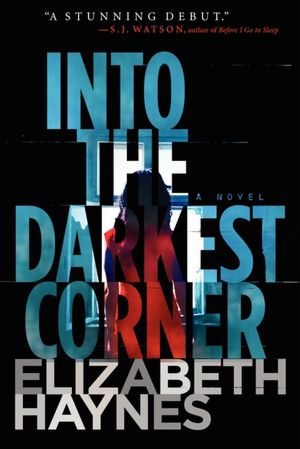
Elizabeth Haynes: Into the Darkest Corner (2011)

Into_the_Darkest_Corner

I just finished Elizabeth Haynes’ first novel Into the Darkest Corner and for once I can see why it was such a success. It’s gripping, interesting and exceptionally well crafted.

Usually I’m not keen on books which contain so many chapters and follow two different timelines but maybe that was just because I haven’t seen it done this well before. Elizabeth Haynes manages to cut the storyline without ending on a cliffhanger but still keeping the reader interested. It’s a page turner but not one that manipulates and forces you to rush through but one that allows you to read at a steady pace.

The novel starts with the transcript of a court room scene, switches to 2001 where a murder is committed and then moves to 2003 – 2005, adding a second timeline 2007/2008.

At the beginning of the novel, in 2003, 24 year-old Cathy lives in Lancaster and is a real party animal. She is out every night, drinks far too much, wakes up with strangers, and repeats the very same thing the next day. On one of these nights out she meets the dashingly handsome Lee. Soon she is in a relationship with him and at first it seems to be very good for her. She doesn’t go out as much anymore, drinks a bit less. Unfortunately Lee is very possessive, domineering and plays odd games. What is even more unfortunate is the fact that nobody believes Cathy. The Lee  the world sees is kind and loving. Nobody knows what a master manipulator he is.

In 2007 Cathy lives in London. She suffers from OCD and panic attacks. She spends almost all of her free time checking her door, her windows, drinking tea at specific times, made a specific way, avoids places and colours. It’s her anxiety and her panic attacks which trigger the OCD, the more she’s afraid, the more she needs checking. When Stuart, a psychologist, moves in, it’s obvious for him right away that Cathy suffers from PTSD. It will take all of his patience and understanding to get to know her and help her.

What happened to Cathy? How did she become like this? Will she be able to heal? These are some of the fascinating questions the book asks and answers. The description of panic attacks and OCD is amazingly realistic. I’ve never seen this described so well.

We know early on that Lee is in prison and that he will be set free soon. When this happens, the book turns from a psychological study into a fast paced thriller with a great ending.

As far as thrillers go Elizabeth Haynes has done everything right. Main story, back story and side stories form an organic whole. I was for example wondering for far over 100 pages why on earth Cathy was behaving in such a self-destructive way even before she meets Lee and was pleasantly surprised that this question is answered later in the book.

If you are looking for a gripping thriller, you might enjoy this. If you are interested in OCD and PTSD and how they can be treated, you might like this a great deal as well. I feel I need to mention that the book is quite violent in places.

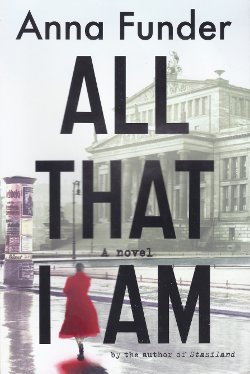
Literature and War Readalong May 31 2013: All That I Am by Anna Funder

All That I AM

When I first heard of Anna Funder’s novel All That I Am  I wanted to start reading it right away as it sounded so appealing. The novel is inspired by – or based on – the tragic life of German-Jewish left-wing playwright Ernst Toller. Some have termed the book “faction” but judging from what I read about it, Funder took a lot of liberties, which makes the term “fiction” more appropriate in the  end. All That I Am is Funder’s first novel but she had a huge publishing success with her book Stasiland: Stories From Behind the Berlin Wall.

The book starts in 1933 with Hitler’s rise to power and tells the story of four young German exiles who try to raise awareness in the UK for the threat the new German government poses. Toller is one of them. In 1933 he lost his citizenship, left Berlin and went to live in London.

Here are the first sentences

When Hitler came to power I was in the bath. Our apartment was on the Schiffbauerdamm near the river, right in the middle of Berlin. From its windows we could see the dome of the parliament building. The wireless in the living room was turned up loud so Hans could hear it in the kitchen, but all that drifted down to me were waves of happy cheering, like a football match. It was Monday afternoon.

*******

The discussion starts on Friday, 31 May 2013.

Further information on the Literature and War Readalong 2013, including all the book blurbs, can be found here.

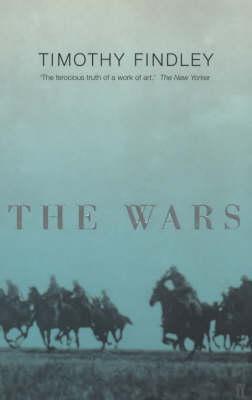
Timothy Findley: The Wars (1977) Literature and War Readalong April 2013

The Wars

Is it possible to write about WWI – including the trenches, the incapable high command, shell shock, gas attacks, rats, mud, facial wounds, the immense body count – and still be original and have something profound and thought-provoking to say? Before reading Timothy Findley’s  The Wars I might have said “possibly” but after finishing it, I have to say “definitely”. This novel proves that in the hands of a powerful writer anything can become extraordinary.

The Wars has an episodic structure but still tells a coherent story, exploring what happened one day, during WWI, when young Officer Robert Ross, broke the ranks, committing an act of total insubordination, shot another officer and freed dozens of horses. How did it come to this? The story is told in a circular way, starting with the end, withholding all the vital information, and then moving back to  the beginning, unfolding every step which led to that fatal day.

I said in my intro post that I was worried the book would contain a lot of animal suffering and it did but in an unusual way. The strength of Findley’s work is that he manages to show, just like Coetzee – another defender of animals – that, at the end of the day, animals and humans are equal. Both feel pain; their lives are precious and must be protected. Being alive is nothing short of a miracle.

This first quote is central in the book and illustrates perfectly what kind of person Robert Ross is

In another hole there was a rat that was alive but trapped because of the waterlogged condition of the earth that kept collapsing every time it tried to ascend the walls. Robert struck a match and caught the rat by the tail. It squealed as he lifted it over the edge and set it free. Robert wondered afterwards if setting the rat free had been a favour – but in the moment that he did it he was thinking: here is someone still alive. And the word alive was amazing.

The instances in which animals die at the hand of men who have gone crazy or are saved by compassionate men are numerous. Madness is an important topic in this novel. Not just in the sense of war is madness but because people lose their minds during battle or under attack. And often they take it out on weaker ones. Wounded Germans, prisoners or animals.

Many of the soldiers in the book question the decisions of their superiors

This – to Bates – was the greatest terror of the war: what you didn’t know of the men who told you what to do – where to go and when. What if they were mad – or stupid? What if their fear was greater than yours? Or what of they were brave and crazy – wanting and demanding bravery from you?

Life in the trenches is constant terror, trying to stay sane and attempting to survive.

Robert had only taken eight hours sleep in the last three days. He was living on chocolate bars and tea and generous portions of rum which he took from the supply wagons. His body was completely numb and his mind had shrunken to a small, protective shell in which he hoarded the barest essentials of reason.

The novel is divided in many short chapters which could be read separately but definitely work as a whole. This isn’t a collection of snapshots, it is a novel but this approach of unfolding the story in short chapters, which change point of view, narrative technique, tone and mood, make every part very powerful. Findley is probably one of the most assured writers I’ve read. This could have been difficult to read but most chapters contain strong and expressive scenes. There is far more show than tell in this book, which makes it accessible but also painful. Death, pain, loss and grief are described in a civilian setting and during war, and finally illustrate that love is all that counts. War is mad, inflicting pain is mad and treating people without respect is mad as well.

What came as a surprise were the many funny moments in this book. Rodwell is an officer who saved some injured animals after an attack

“Where did you find the hedgehog?” Robert asked.

“Under a hedge,” said Rodwell.

Everybody laughed.

“I suppose that means you found the bird in the sky,” said Devlin.

“Would that I had, Mister Devlin,” said Rodwell. “No sir – I found him with the hedgehog. They were crouched there side by side when I got them by putting out my hand to secure the toad. We were all there together, you see. It was a popular hedge just at that moment.”

There are many other funny moments. I was glad for those, otherwise the book would have been really dark.

The Wars is populated by likable characters which makes it a painful read. There are not many men or animals who survive in this book. It’s not too gruesome as wounds and pain are not dwelt on but it has many explicit moments which make it an equally beautiful, powerful and painful read.

Other reviews

Anna (Diary of an Eccentric)

Buried in Print

Danielle (A Work in Progress)

The review is also a contribution to The Canadian Book Challenge.

*******

The Wars was the fourth book in the Literature and War Readalong 2013. The next is the WWII novel All That I Am  by Australian writer Anna Funder . Discussion starts on Friday 31 May, 2013. Further information on the Literature and War Readalong, including the book blurbs can be found here.

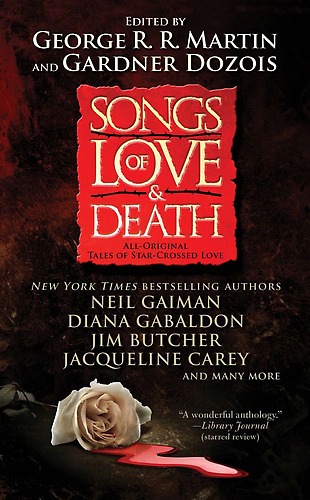
Songs of Love & Death edited by George R.R.Martin and Gardner Dozois

Songs of Love and Death

It took me over a year to finish this anthology. No wonder, Songs of Love & Death is quite chunky, over 600 pages. The individual stories are all rather long, around 50 pages each. The subtitle of the book is All-Original Tales of Star-Crossed Love which is not entirely accurate as most stories have a happy ending.

While I didn’t like all of the stories equally, I liked that there were so many different genres or rather sub genres of fantasy and romance. Historical Romance, Sci-fi Romance, Dark Fantasy, High Fantasy. Most of the authors were new to me but there were also people like Neil Gaiman, Peter S. Beagle, Lisa Tuttle and Tanith Lee.

Many people bought this anthology for Diana Gabaldon’s story A Leaf on the Wind of All Hallows. It’s a tale set in her Outlander series with characters who are important in the series or rather back story of some characters. I can’t say I liked it much. It’s the story of an RAF pilot on a mission to Poland. His plane crashes and he somehow lands in another time. He tries hard to get back to his wife and young son. I suppose that when you are familiar with the series that it’s an interesting story but when you are not it’s not very gripping.

That’s a problem of some of the other stories too. Many of the authors write series and the stories are set in those worlds. Reading just one small story about those worlds can be a bit confusing. Fortunately most writers submitted an original standalone story.

Each story comes with an introduction, naming the author’s genre and most important work. It’s certainly the first time that I have read sci-fi romance. It wasn’t my cup of tea but quite interesting.

These were my favourite stories:

Jim Butcher’s Love Hurts tells a tale of love sickness with an interesting twist.

Carrie Vaughn’s Rooftops is nothing special as story but the voice is charming and made me buy the first in her Kitty Norville series.

M.L.N. Hanover Hurt Me is a horror story dealing with abusive relationships. Really good.

Robin Hobb’s Blue Boots was just a very lovely love story set in pre-industrial England.

Neil Gaiman’s The Thing About Cassandra is typical Gaiman. So original. A story with a really stunning twist that shows that you have to be careful when you make things up.

Lisa Tuttle’s His Wolf was my favourite. It’s some sort of werewolf story but including a real wolf. The story as such is so realistic, the characters so well drawn, one forgets easily that it’s fantasy.

Peter S. Beagle’s Kaskia is a sic-fi story. Very eerie. Has the computer come alive or what is going on here?

Yasmine Galenorn is another writer I didn’t know. Her Man in the Mirror is a very unusual ghost/horror story of a man trapped between the worlds. It has a bittersweet ending.

I was quite disappointed in Tanith Lee’s story Under/Above the Water, and didn’t really understand Marjorie M. Liu’s dystopian vampire story After the Blood. Too bad, both stories are very well written.

With the exception of a few stories the anthology is much more romance than dark fantasy. If that is your thing, don’t miss it. But even if you prefer Dark Fantasy and Fantasy you will still find at least half a dozen really great stories. I guess what I liked most and what made this overall a really enjoyable experience was to discover so many new subgenres. That was really fun. A bit like eating a box of Quality Street.

Delia has reviewed this a while back here.

A warning for the George R.R.Martin fans – he is only the editor, he didn’t contribute to the collection.