Taichi Yamada: In Search of a Distant Voice – Toku no koe wo sagashite (1986)

Last year I read Taichi Yamada’s Strangers and it was one of the best books I’ve read that year. It haunted me for weeks. The mood, the atmosphere, it was beautiful and sad at the same time. I knew that it wasn’t his first book but the first to be translated into English. There are two other of his novels available in English one of which is In Search of a Distant Voice.

Just like Strangers, Yamada’s older novel In Search of a Distant Voice is a ghost story. But what a peculiar ghost story. Tsuneo works as an immigration officer in Tokyo. This means he chases illegal immigrants, takes part in raids, arrests people and sends them back to their country. Early on in the novel we learn that he has complex emotions which he fights and tries to repress. Some of them are linked to his professional life, some to his personal, very lonely life and another part has something to do with an incident which lies back ten years and took place in Portland, Oregon.

At the opening of the novel, Tsuneo has to get up in the middle of the night and take part in a raid to arrest Bangladeshi immigrants on the outskirts of Tokyo near a cemetery.

First he was overcome by a sense of foreboding. A second self would realize this back-and-forth was just part of the program. And the he would notice that even this realization itself was part of a ritual he had performed many hundreds of times. He was used to holding back moods. Keeping his feelings suppressed. Today, too, everything was happening as it always did.

When he runs after one of the immigrants and wants to arrest the man in the cemetery he is suddenly overwhelmed by an intense feeling which he cannot define at first but seems to be of an intense sexual nature. Tsuneo is delighted and shocked at the same time about the intensity of this experience. Something, a ghost, he thinks has flooded him with his or her emotions. When he returns home that day, he starts to hear the voice of a woman who speaks to him. At first he thinks he is going mad but then he is sure the voice is outside and not inside of his head. And although nobody else hears her, she seems real. It’s like having a phone conversation, only with a ghost.

Tsuneo’s has a lot on his mind these days. He feels pity for those people he arrests and he is wary of the arranged marriage he has agreed to. He is not in love with the woman but she isn’t a bad choice. But the more the book progresses, the more Tsuneo talks to the invisible woman, the more absurd the arranged marriage seems to be. He has a hard time to suppress his feelings and during the engagement ceremony when everyone is performing meaningless gestures and speaking empty words he starts to laugh uncontrollably and in the end breaks down and cries.

There is too much, Tsuneo has never told anyone. What happened in Portland for example or why he even went there. He cannot talk to his fiancée about that nor about the voice but he opens up to that invisible woman and tells her everything, the whole tragic episode that happened in Portland.

More than a ghost story, this is the portrait of a man who, at only 29, has given up on his hopes and dreams, who has repressed all of his feelings but cannot cope anymore. It’s the story of a breakdown, an analysis of guilt, suppressed sexuality, loneliness and search for meaning. There is a moving scene in which Tsuneo tells his friend that his life is completely meaningless. The friend is quite affected and answers that if this was the case, then his life would be meaningless as well.

It’s a flawed book as the end of the ghost story is not as satisfying as in Strangers – and the book is certainly pale in comparison to Strangers – but it’s still a very interesting book.  There are many beautiful scenes and reflections and I don’t think I’ve read a lot of novels which dealt as powerfully with the two complementary themes “strangers” and “immigrants” as this book. I didn’t love it as much as Strangers but I liked it too.

There is a third book available in English I Haven’t Dreamt of Flying for a While which I’d like to read as well.

The review is a contribution to Bellezza’s Japanese Literature Challenge 6 and Carl’s R.I.P. VII.

Nicci French: Secret Smile (2004)

I really like Nicci French or I wouldn’t have picked the third book in such a short time. The last two I have read were the first two installments of the new series, Blue Monday and Tuesday’s Gone. Both were really good books. Unfortunately that’s not exactly the case here. Secret Smile has a lot of what I truly like about Nicci French but it’s painfully unbelievable. Still, call me weird, I liked it.

The story, if one doesn’t want to spoil the book, is told in a few sentences. Miranda has been dating Brendan for three weeks when she catches him reading her diary. She immediately ends the relationship. In a way she is relieved because he annoyed her. He was far too obtrusive and possessive. Brendan takes the break up very badly, still she manges to get rid of him. Or so she thinks. A few weeks later he is introduced to her as her sister’s new boyfriend. She is quite shocked and the idea to have to see him regularly really bothers her but on top of that Brendan pretends that he ended the relationship.

What follows is at first manipulation, then pure psychological terror. This premise as such isn’t unbelievable but what is unbelievable is the fact that Miranda doesn’t try to clarify right away who broke up with whom and when she does, nobody believes her anymore.

I always find it annoying when a whole plot relies on one person’s silence, a silence at that which isn’t realistic but has to be maintained in order to get the plot moving. If you can forgive this major flaw or if it is in character with you – let’s say you’re the type who always speaks up too late – then you might not find this unbelievable and would enjoy the book because I think there are a lot of really appealing elements in it. Nicci French is really good at creating atmosphere. The change of seasons is captured well and there are a lot of scenes in which Miranda is on her own and they are all nicely created. Plus she is an interesting character. She is independent, attractive, makes a living as a decorator, all things which work quite well.

Despite the fact that there are unrealistic elements, Secret Smile was a page turner and I really wanted to find out how it would end. Surprisingly the end is different from what I expected which was a pleasant surprise.

As you can see, a mixed bag, but still an enjoyable, quick read.

This is my first contribution to Carl’s R.I.P. VII. Here are the links to the posts of the other participants.

Contemporary Chinese Artist Ye Hongxing in London – 13 September – 20 October 2012

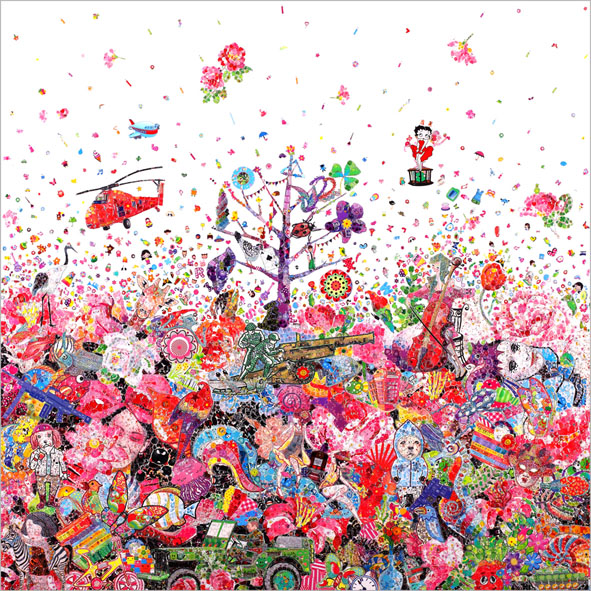
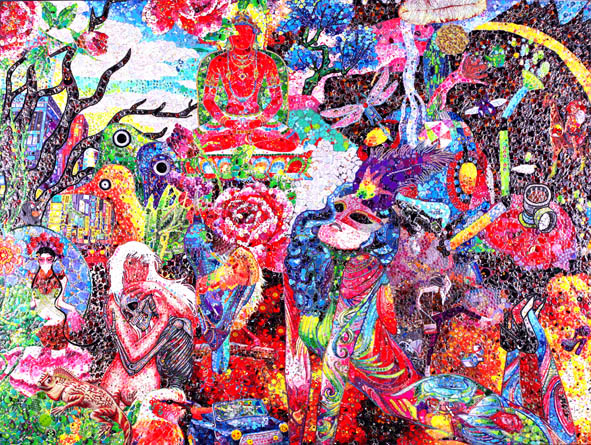
As you may remember, this summer I went to the ART fair in Basel where I discovered the work of Chinese artist Ye Hongxing. She was one of those artists who stunned me not only because of the art she created but also because of the technique she used. Her art is very colorful, some pictures are Mandalas, like the one above, others are depictions of colorful gardens or dreamlike landscapes.

You may like this or not but once you stand in front of her work you’re in for a major surprise. This is art you need to see close up to appreciate how amazing it is as only when you stand quite close will you see that the individual pieces are collages made of hundreds of stickers. The result is stunning and surprising. A mass-product, something we might all have collected as children, creates powerful images which represent religious symbolism, fantastic landscapes and modern technology alike.

I’m glad Lee Sharrock PR informed me of her upcoming exhibition in London. Ye Hongxing is based in Bejing and this is her first UK exhibition. At the same time this is Scream’s opening of their new gallery space on 27 – 28 Eastcastle Street, London W1.

I will not be able to see the exhibition as I will not be in London during that time but for all those who live in London or the UK, don’t miss it. It’s really amazing what she does.

Ye Hongxing is considered to be one of the Top 20 rising Chinese artists. The exhibition is called The Modern Utopia and runs from 13 September to 20 October. As the press release states

 The title of the exhibition references the 1905 novel ‘A Modern Utopia’ by H.G Wells and is suggestive of the artist’s investigation into society and modern life.

Here is a bit more about Ye Hongxing.

Literature and War Readalong September 2012: Peace by Richard Bausch

This year’s readalong is a chance for me to read some of the great novelists and authors I hadn’t had an opportunity to read before. Since I’ve first read something about Richard Bausch he was on my list of authors I must read. He is quite famous as a short story writer, his work has appeared in numerous collections and magazines. Peace (2008) is set in Italy during WWII. This isn’t a tale of the home front but from the point of view of American soldiers. It is towards the end of the war, in 1944. Critics called it one of the best books they’ve ever read. A.L. Kennedy called it, lean, compact, layered, darkly humorous, unflinching and lyrical.

Here are the first sentences

They went on anyway, putting one foot in front of the other, holding their carbines barrel down to keep the water out, trying, in their misery and confusion – and their exhaustion – to remain watchful. This was the fourth straight day of rain – a windless, freezing downpour without any slight variation of itself.

*******

The discussion starts on Friday, 28 September 2012.

Further information on the Literature and War Readalong 2012, including all the book blurbs, can be found here.

Guy de Maupassant: Bel-Ami (1885)

When I used to think of Maupassant, I used to think of short stories. That was all I had read by him so far and because he is so excellent at it – probably one of the very best short story writers you can read – I thought that his novels might be pale in comparison. I was wrong. After having read Bel-Ami, I think that he might very well be one of the best writers in any genre. It’s one of the most perfect books I’ve ever read. I couldn’t name one single flaw. As much as I like Balzac there is always this and that, minor things, sure, but still, some imperfections. Not with Maupassant. What also surprised me is that this book could have been written nowadays. The society has changed, the world has changed but the way he writes about love, sex, power, money, careers… It’s outspoken and modern.

More than anything Bel-Ami is a character portrait paired with the portrait of a society, the Parisian high society. Georges Duroy, who receives the nick name Bel-Ami from the daughter of his lover Mme Marelle, is one of the most unlikable characters of French literature. An arriviste who has only one striking feature, his good looks, and one talent, the talent to know how to use people or, to be more precise, women.

At the beginning of the  novel he is working as a clerk and hardly knows how to pay his meals. He was a sergeant in the colonial army and served in Algeria. One evening, strolling down the boulevards of Paris and debating with himself how to use his last francs, he bumps into Forrestier, a former comrade. Forrestier has become a journalist in a new and not very respected newspaper which belongs to a Jewish man, Mr Walter. Forrestier is married to a beautiful and very intelligent woman and lives a cushy life. It wasn’t entirely clear to me why he chose to help Bel-Ami but he does and in doing so sets in motion the spectacular ascension of Georges Duroy. Forrestier opens the door to his house and helps him to a position as assistant journalist. Although, just like Forrrestier himself, he isn’t capable of writing one coherent piece, he will become a famous journalist. I’m not going to tell you how, you have to read it to find out.

One trait I found interesting in the novel is to see why people invite other people into their houses. Women invite Bel-Ami because they want him close, they are in love with him. Men on the other hand invite him because he doesn’t have a lot and they all love to display their riches. The women in this society are all easily seduced and the men become victims of their vanity.

While he is still somewhat naive but envious at the beginning of the novel, once he has understood how easily he gets access to the high society and can achieve almost anything through these two weaknesses, the easy seduction of women and the vanity of their men, he turns into a manipulative and calculating machine. Using one woman after the other, duping one husband after the other, he ascends the social ladder with dizzying speed.

While Bel-Ami is the central character, the women and their husbands are not less well-drawn. One perfect little scene after the other shows Bel-Ami “at work”. It’s amazing that he becomes a famous journalist although he isn’t capable of writing. And later he even becomes a politician despite the fact that he is clueless and knows nothing about politics. He is just clever enough to know who does and to get to their knowledge via the one or the other woman.

Bel-Ami is vain, he is self-centered and cares only about his own pleasure, power and money. He seduces people and uses them and when they are no longer of any value he discards them which leads to some fantastic scenes. While he is unlikable, one has to be fair, he doesn’t force women, he seduces them and it’s ultimately their weakness which leads him to success. Men like Bel-Ami still exist and things have not changed much in our society in that regard. I still see women falling for this type of guy who has nothing to offer but looks and sweet talk. And an erotic appeal. Let’s face it, without that erotic appeal not even Bel-Ami would have gotten that far. It’s obvious in the novel, and quite explicit too, that the women  do not fall for him because he is bright or because they want to spend hours gazing into his eyes. They want to go to bed with him. Even the very young ones like Mme Marelle’s daughter who invented the nickname Bel-Ami, cannot hold back and want physical contact.

Maupassant’s novel is one of those that should be read by people who think 19th Century literature is old-fashioned and has nothing to offer to contemporary readers. It could open a door to a whole new reading experience. 

Bel-Ami is an entirely captivating and well-told story, combining descriptions of opulent interiors and detailed character portraits with the analysis of a society addicted to power and fame and one man who knows how to exploit it all.