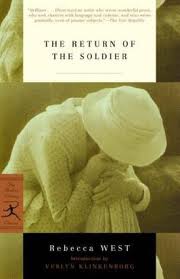
Rebecca West: The Return of the Soldier (1918) Literature and War Readalong March

The soldier returns from the front to the three women who love him. His wife, Kitty, with her cold, moonlight beauty, and his devoted cousin Jenny wait in their exquisite home on the crest of the Harrow-weald. Margaret Allington, his first and long-forgotten love, is nearby in the dreary suburb of Wealdstone. But the soldier is shell-shocked and can only remember the Margaret he loved fifteen years before, when he was a young man and she an inn-keeper’s daughter. His cousin he remembers only as a childhood playmate; his wife he remembers not at all. The women have a choice – to leave him where he wishes to be, or to ‘cure’ him. It is Margaret who reveals a love so great that she can make the final sacrifice.

The Return of the Soldier is unusual because it has been written by a woman and during the war. But it is also unusual in its treatment of the war. Although a tale that takes place on the home-front, the horrors of the war in the trenches shine through constantly.

The novel is a first person narrative,  told by Jenny, Chris’s cousin. It opens on a domestic scene showing Kitty, Chris’ wife and Jenny together in the nursery. We learn immediately that the child who lived there is dead and we also learn a lot about the very different characters of these two women. Kitty is not easily alarmed even though they haven’t heard from Chris for weeks. The very first paragraph shows that she treats the war lightly, does maybe not take it very seriously at all, rather like some adventure, while Jenny is aware of the dangers.

“Ah, don’t begin to fuss!” wailed Kitty. “If a woman began to worry in these days because her husband hadn’t written to her for a fortnight—! Besides, if he’d been anywhere interesting, anywhere where the fighting was really hot, he’d have found some way of telling me instead f just leaving it as “Somewhere in France. He’ll be alright.”

Jenny will tell us later what a very shallow woman Kitty is. Appearances is all that is important to her.

Now, why did Kitty, who was the falsest thing on earth, who was in tune with every kind of falsity, by merely suffering somehow remind us pf reality?

The initial scene is almost idyllic as the house and its surroundings are so lovely and Jenny cannot help but think of how much Chris must miss his life there. Rebecca West is excellent when she describes the surroundings. She chooses words like a painter who tries to get every little shade of what he paints right. Her writing is nuanced and poetical.

The house lies on the crest of Harrowweald, and from its windows the eye drops to miles of emerald pastureland lying wet and brilliant under a westward line of sleek hills blue with distance and distant woods, while nearer it ranges the suave decorum of the lawn and the Lebanon cedar whose branches are like darkness made palpable, and the minatory gauntness of the topmost pines in the wood that breaks downward, its bare boughs a close texture of browns and purples, from the pond on the hill’s edge.

Of the two women, Jenny is the one that brings the war into the novel through her worrying. It is deeply rooted in her consciousness as well as in her subconscious. Her feelings for her cousin are so intense, the identification is total at times and she seems to be the one experiencing the battlefield. Through Jenny we get a clear picture of how much was known on the home-front. In the movie theaters they were shown black and white footage of the front line. To be like Kitty, unaware of the real dangers, you had to be really determined to keep them away from you.

Of late I had had had dreams about him. By night I saw Chris running across the brown rottenness of No Man’s Land, starting back here because he rod upon a hand, not even looking there because of the awfulness of an unburied head, and not till my dream was packed full of horror did I see him pitch forward on his knees as he reached safety—it was that. For on the war-films I have seen men slip down as softly from the trench parapet, and none but the grimmer philosopher would say that they reached safety by their fall.

Into the initial idyll breaks a shabby and elderly looking woman. She is badly dressed and seems of the lowest social class. Both women feel revolted and when they hear why she has come they are quite shocked. Margaret has come to inform them that Chris has been is in a hospital in France and suffers from severe shell-shock. He is amnesic and has eradicated the last 15 years of his memory, believing to still have a relationship with Margaret. The reactions of the two women towards this member of the lower classes is quite disturbing. They almost react as if she was contaminating the house.

Soon after this conversation, Chris is brought back and has indeed lost every memory of his wife and barely recognizes his cousin who is now fifteen years older.

In what follows we see how each of the three women reacts so differently, how each wishes and longs for other things. We learn also about the relationship Chris had with Margaret and why he broke it off and what happened to her after he left her. Despite all this there is no sign of his recovering his memory and finally a doctor is called. At first he isn’t successful but he points out that there may have been a reason why Chris repressed the memory of his marriage. It is only after Margaret suggests to show Chris something that will trigger a strong emotion – in this case things that belonged to the dead child – that he will be able to regain his memory. I the moments before he is shown the baby’s things Jenny is suddenly painfully aware of what a recovery truly means. Should he recover, he will have to go back to the front. In sharp contrast to this, Kitty doesn’t care. She wants her husband to recognize her again, that’s all she cares about. Once the recovery has happened, it’s Jenny again who states clearly what will be.

He walked not loose limbed like a boy, as he had done that very afternoon, but with the soldier’s thread upon the heel. It recalled to me that, bad as we were, we were yet not the worst circumstance of his return. When he dad lifted the yoke of our embraces from his shoulders he would go back to that flooded trench in Flanders under that sky more full of flying death than clouds, to that No Man’s Land where bullets fall like rain on the rotting faces of the dead.

I found it very interesting that The Return of the Soldier can be read in many different ways. Considering the theme of the readalong, I focused on the way she treated WWI but that is not the only topic in this novel. One could also explore the psychological theories or the sociological dimension.

I think The Return of the Soldier is an incredibly subtle and artful novel. The war and it’s horrors are like threads that are woven into the fabric of the story. As a journalist Rebecca West was interested and did report on the war but she was also very interested in Freud’s theories, some of which she has applied in the novel. I think to make of Chris a shell-shocked soldier suffering from amnesia which was not realistic, shows us that she wanted this to be taken symbolically. The psychologist Glen Clifford kindly and eloquently pointed out in a comment on my introductory post that PTSD is characterized by the incapability to forget and amnesia is a very unlikely occurrence.

The three women all symbolize something else and represent different levels of consciousness. Kitty, the wife he has forgotten is the symbol of all the forces that contribute and maintain the class system and the war. She is a typical representative of the British upper class, of those who decide to send  thousands of young men to a certain death. Those who don’t care what is going on “over there”. She symbolizes the unconscious. Margaret on the other hand stands for the working classes, simplicity, those who have to endure what others force upon them. That seems to be pretty much how Chris feels as well. She may be read as the subconscious. Jenny is by far the most intriguing. She moves back and forth between the different levels of consciousness with a capability of seeing things clearly. She is his cousin but thinks and feels rather like a lover. She seems the most authentic, the most emotional, the one who feels what either Kitty or Chris should feel, namely the horror and despair caused by this horrible war and the sadness about the loss of the little boy. It may very well be that the death of the child drove the spouses apart.

I would like to say thanks to Ann Norton from the International Rebecca West Society, for pointing me towards a new critical edition by Bernard Schweizer and Charles Thorne. It contains invaluable material and background information to the book. If you want to have a look at the content here’s the link to the broadview press.

Ann Norton wrote the introduction to the Barnes and Noble Library of Essential Reading Edition.

I am really curious to read what others have to say about this complex novel, be it in a review or in comments.

Other reviews:

Anna (Diary of an Eccentric)

Bookaroundthecorner

Danielle (A Work in Progress)

*****

The Return of the Soldier was the third book in the Literature and War Readalong. The next one will be Carol Ann Lee’s The Winter of the World. Discussion starts on Friday April 29, 2011 .
Literature and War Readalong March 25 2011: The Return of the Soldier by Rebecca West

There is still plenty of time for anyone who wants to join the Literature and War Redalong this month to get a copy of Rebecca West’s The Return of the Soldier. It is only 90 pages long which makes it all the more feasible. If all those of you who expressed an interest in this book will read along we might be quite a crowd. We will see. There are at least two different paperback editions available. I got the one from The Modern Library with an introduction by Verly Klinkenborg. The other one is a Virago edition with an afterword by Sadie Jones.

Rebecca West’s book is unique as it was published in 1918, before the war had ended. She tells the story of a returning soldier who suffers from shell-shock. I am particularly interested in this topic and curious to compare her handling of it with Pat Barker’s Regeneration trilogy which is for me still one of the greatest books on WWI, shell-shock and the development of the new medical discipline, psychiatry.

I was very surprised to find out that The Return of the Soldier that seems so well-known in the English-speaking world has not been translated into German. The only two of her books that made it into German are Black Lamb and Grey Falcon and The Fountain Overflows.

Rebecca West was only 24 when she wrote this novel but already an acclaimed journalist and women’s rights activist. This isn’t an account of the front line but purely a story that takes place on the home front.

Shell-shock is extremely typical for most WWI accounts. It seems as if there had never been so many cases of shell-shock in any war as in WWI. Psychologists state that one of the reasons for this lies in the trench warfare. Being in the trenches for such a long time infused the soldiers with a deep feeling of helplessness that makes shell-shock much more probable than any othe type of warfare. The moment the soldiers were allowed to leave the trenches and move about shell-shock was far less frequent.

Here is the link to the Rebecca West Society if you want to find out more about the author, upcoming conferences and events.

The Return of the Soldier has also been made into a movie.

Literature and War Readalong February Wrap up: How Many Miles to Babylon?

I wanted to thank all of you who have participated this month. I loved the book and enjoyed the discussions.

Even though there is also a friendship at the heart of How Many Miles to Babylon? this book is totally different from Susan Hill’s novel Strange Meeting which we read in January. As you can easily see my review doesn’t emphasize the role of the friendship between Alec and Jerry as much as Anna’s or Danielle’s (and here as well) does.

I realized when reading the other posts and a few of the comments that some had a bit of a problem with this novel. There were different reasons for this. For one Alec doesn’t appear to be a very likable character, he was even called a coward by some. For several reasons I never thought of him like that and was wondering why. I realized that from the start, I was totally fixed on his going to be executed. I saw him like some Breaker Morant character (which he isn’t) and thinking he did something that would have this consequence set the tone for me from the beginning. Another point of criticism which, with hindsight, seems fair, is the fact that the WWI elements are toned down. WWI seems to serve more as a pretext for the tragic story and to write about Irish history. WWI itself is rather just a backdrop. I did not mind this at all but can understand that this can bee seen differently.

I think we all equally agreed that the mother in this book was an extremely negative figure, the whole family situation, as Kevin pointed out, is highly dysfunctional.

What I couldn’t really solve was the question about the title. Why did she choose this nursery rhyme as the title for her novel? In an article on the net I found one tiny hint, saying that it did underline the relationship between the soldier and his superior.

On Wikipedia I found this list which enumerates how many times the rhyme has been used in popular culture

In popular culture

In literature

In film

In popular music

  • It is parodied as “How many miles to Babyland?” on Lenny and the Squigtones– a comedy album by the characters Lenny and Squiggy from the 1970s sitcom “Laverne & Shirley”.

This is quite a considerable list. It eludes me why this rhyme is so popular with writers and I am still open for any interpretation why Jennifer Johnston chose it as her title.

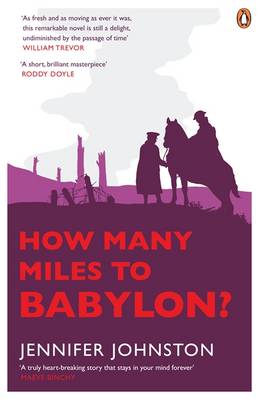
Jennifer Johnston: How Many Miles to Babylon? (1974) Literature and War Readalong February

Alec and Jerry shouldn’t have been friends: Alec’s life was one of privilege, while Jerry’s was one of toil. But this hardly mattered to two young men whose shared love of horses brought them together and whose whole lives lay ahead of them. When war breaks out in 1914, both Jerry and Alec sign up – yet for quite different reasons. On the fields of Flanders they find themselves standing together, but once again divided: as officer and enlisted man. And it is there, surrounded by mud and chaos and death, that one of them makes a fateful decision whose consequences will test their friendship and loyalty to breaking point.

We know from the beginning of this novel that it is not going to end well. Alec is held in detention and knows that he will die. Because he is an officer and a gentleman, as he states, they have given him his notebooks, pen and ink and he writes down the story of his life. The story spans from his lonely isolated childhood in rural Ireland to the war-torn trenches in France. The tone of the novel is melancholic, full of nostalgia for a world that has been lost and is at the same time infused with the profound love of a country.

By now the attack must be on. A hundred yards of mournful earth, a hill topped with a circle of trees, that at home would have belonged exclusively to the fairies, a farm, some roofless cottages, quiet unimportant places, now the centre of the world for tens of thousands of men. The end of the world for many, the heroes and the cowards, the masters and the slaves.

Alec’s childhood was a lonely one. Caught between two parents who hated each other and who kept a polite and icy distance, he was the pawn with which his mother played. He didn’t like his mother, a haughty, cruel but beautiful woman whose strict rules and relentless following of etiquette ruined every childhood joy. What his parents do not know for a long time is that Alec has a secret friend. Alec and Jerry have a lot in common. Their love of horses, their sense of humour, they share so much, unfortunately not the social class. Alec is an only child of a wealthy Anglo-Irish couple whereas Jerry is part of the Catholic underclass. When their friendship is found out, Alec’s mother freaks out and decides to go on a 4 month trip to Europe with Alec.

When Alec comes back he doesn’t see Jerry anymore. Jerry is working while Alec is still studying. And then the war breaks out. At first there seems to be only a rumour of war. Jerry knows it long before Alec hears it and most people think it isn’t really true.

We paid very little attention to the war when it happened first. Belgium and Flanders seemed so far away from us. Our fields were gold and firm under our feet. Autumn began to stroke the evening air with frost. Smoke from bonfires was the only smoke to sting our eyes. Cubbing began in the early morning, the earth temporarily white with mist and dew. A few familiar faces disappeared. War was on the front pages of the newspapers daily brought from Dublin on the train.

Many do not feel that this is their war or that they should assist the British. Tensions inside of Ireland start to be palpable, tensions that bear the foreboding of the things that will come, the striving towards independence. However people who feel loyal towards Britain send their sons. Alec’s father considers it to be foolish to go to a war when you are not forced to go but his mother, out of spite and vengeance against his father, drives Alec away.

Meanwhile Jerry had already enlisted and the two young men meet in the training camp near Belfast in which they stay for six weeks until they get shipped to France. Their superiors do not like to see an officer talk to an enlisted man. Alec, due to his social class, has become an officer immediately.

When they finally arrive in France they stay separated. Alec shares quarters with a British officer, Bennett, a guy with a lot of humour, while Jerry sleeps with the other enlisted men. Still the three of them meet occasionally and ride about the country together.

They hardly see any action for a long time and stay far off the trenches for a while. When they are finally sent to the front line they will spend a lot of their time cleaning and reconstructing the badly damaged trenches.

We spent three more days in the front trenches, mainly shoveling and making props. It rained a considerable amount of the time. Sometimes sleet cut into the men’s bare hands, and at night there was sharp frost that covered the bottom of the trenches with a thin film of ice. We extended the line to our left. It was hard work moving the earth, heavy with water, always crouching till ones back and shoulders ached pitifully. The men hated it and worked slowly, grumbling most of the time. For most of the day there was concentrated shelling of the German lines by our artillery. The shells screeched over our heads sometimes for hours at a time. After a while I became so used to the noise that I felt strangely unprotected when it stopped, then slowly the process of thinking had to begin again.

The cold is unbearable and Alec suffers a lot from it. They constantly drink rum as it is the only way to warm up. Here again Alec and Jerry are caught talking together and the superior officer forbids it. But that is not the only trouble they are in. The Irish are not appreciated at all. On top of that there are rumors of a movement that wants to fight for the independence of Ireland. Jerry is suspected to be part of that movement and one day he confides in Alec.

“I don’t know how you can contemplate ever fighting again.”

“It won’t be like this. There’ll be no trenches, no front lines. No waiting. Every town, every village will be the front line. Hill, rock, tree. They won’t know which way to look. Even the children, for God’s sake, will fight them. It won’t be like this, I promise you that. Oh, Alec, it’s some thought.”

When Jerry receives a letter from his mother in which she informs him that his father has gone missing, he runs off to look for him and the tragedy unfolds.

I loved How Many Miles to Babylon? I think it is a beautiful book. It doesn’t teach you as much about WWI as Strange Meeting (see post 1) but it says a lot about Irish history. I found this look at the first World War from an Irish perspective extremely fascinating.

As Jennifer Johnston said, she wanted to write about the Troubles but didn’t feel ready yet. This is the prehistory of the Troubles. The Irish War of Independence started right after WWI in 1919 and was closely followed by the Irish Civil War. This succession of wars was the reason why Ireland stayed neutral during WWII. They simply couldn’t afford to be in another war in such short time.

How Many Miles to Babylon? hints at all this. But it is not only a very Irish novel because of the historical elements but also for its imagery, the symbolism and the many references to Irish mythology and culture.

The motif of the swans is a recurring element. There are swans on the lake on the property of Alec’s parents, they see swans in France, some soldiers shoot a swan which does upset Alec terribly. Since Alec reads W.B. Yates at the beginning of the book I think the swans are an allusion to Yates’ famous poem The Wild Swans at Coole which seems to mourn a time long gone.

In contrast to the gratuitous killing of the swans stand the mercy killings. Wounded horses are killed, a wounded man is killed…

I really liked this enchanting novel. I loved the poetical prose, the melancholic tone and the feeling of nostalgia that pervaded it.

What did you think of the novel in general and its treatment of WWI?

Other reviews:

Anna (Diary of an Eccentric)

Danielle (A Work in Progress) and here as well

Fence (Susan Hated Literature)

*****

How Many Miles to Babylon? was the second book in the Literature and War Readalong. The next one will be Rebecca West’s The Return of the Soldier. Discussion starts on Friday March 25, 2011 .

Literature and War Readalong February 25 2011: How Many Miles to Babylon? by Jennifer Johnston

This is just a quick note to remind you to make sure to get your copy of Jennifer Johnston’s WWI novel How Many Miles to Babylon? in time, should you want to read along this month. This is the second novel in the Literature and War Readalong. It is, like Strange Meeting, a very short novel, only 160 pages. The story adds another twist as the protagonists are Irish. Jennifer Johnston has been quoted saying that she had a passion for WWI but that it was also a substitute for her. What she really wanted to write about were the Troubles.

I found these interesting quotes on contemporarywriters

Prohibited friendship is also at the heart of How Many Miles to Babylon? The first-person narrator is Alec Moore, an only child and heir to the Big House; his ‘private and secret friend’ is Jerry Crowe, a village boy he has known since childhood. In 1914, fighting together near the Belgian border, the friends’ loyalty is tested by a brutal enforcement of class divisions and a code that brooks no sentiment or mercy. Johnston is adept at suggesting her characters’ interior lives through image and symbol, and invites her readers to join the dots between what is said and felt, as in this incident, related by Alec, at his parents’ dinner table: ‘[My mother] looked at [my father] with contempt and said nothing. I blushed and looked down, away from them, at the smooth glowing silver neatly ordered around my plate. A griffin raised its talon in an angry gesture on the handle of each spoon and fork.’

The First World War is a ‘passion’ for Johnston, one she initially used as a metaphor. ‘When I started writing prose, I had it very seriously in my mind that I wanted to write about the Troubles … yet I couldn’t face taking them head-on. So I started to write about the First World War…  how people try to keep their lives normal, their feet on the ground, even though terrible things are going on’ (The Irish World, 24 October 2007).

I hope many will feel tempted to join me in reading and discussing Jennifer Johnston. Should you not have read anything by this wonderful Irish writer, this is a good opportunity.

Susan Hill: Strange Meeting (1971) Literature and War Readalong January


John Hilliard, a young subaltern returning to the Western Front after a brief period of sick leave back in England, finds his battalion tragically altered. His commanding officer finds escape in alcohol, there is a new adjutant and even Hilliard’s batman has been killed. But there is David Barton. As yet untouched and unsullied by war, radiating charm and common sense, forever writing long letters to his family. Theirs is a strange meeting and a strange relationship: the coming together of opposites in the summer lull before the inevitable storm.

Strange Meeting, is set in the English countryside and the trenches in France, at the beginning of WWI. The book is divided into three parts. The first is written from John Hilliard’s point of view, the second mostly from David Barton’s and the third could be called the combined one. At the heart of the story is the juxtaposition of two very different themes; the intense and emotionally intimate friendship between John Hilliard and David Barton on the one hand, and the horrors of WWI on the other. The following quotes taken from page 158 illustrate this perfectly well:

“But they (the Germans) must know we are up to something.”

“Oh yes, though that fact is never obvious to High Command, whose faith in the Element of Surprise in the attack is really very touching and quite unshakeable.”

And a few lines later:

“Has it always been like that? Has it always been so easy for you to love people? To get on with them, to bring them out, say the right things at the right time? Have you always made friends as you’ve done out here?”

Whoever is familiar with novels or movies on wars knows that one of these two will die. It is the aim of books and movies on war to show an individual, to pick one person out of an anonymous number and to tell his story. As horrible as it is for us to know that in some offensives – especially in the early WWI ones – far over 100 000 young men were killed in less than an afternoon and millions died senselessly during the course of this war, we still need to be told an individual’s story and not only a huge number, to be touched emotionally. From the beginning of the novel until its end, the shadow of death hangs over these two young people and this is what makes it so touching. We know, one of them is doomed. It’s like a Greek tragedy.

Hilliard and Barton meet in France, during the first summer of WWI, in a bombed out village, away from the trenches and the front line. Hillard has just returned from a short sick leave to England. He is shocked to find his company reduced to a fraction. His commanding officer is drinking and seems to have lost his faith completely.

We lost three quarters of the Battalion in a day and a half. Getting on for two dozen officers. Mayor Gadney, young Parkinson, Ward – all the best. Half of them went because we didn’t get an order telling us the second push was cancelled. They just went on. You were well out of it. I’m glad you were out of it.

But Hilliard’s stay in England was horrible too. He couldn’t sleep, had no one to talk too. He showed signs of  shell-shock, only not enough to not return. The mindless cheerfulness of the people around him who had no idea what it was like to be in the trenches was unbearable. They did neither realize how useless the losses were, nor how futile the missions. The newspapers only gave a purified version and people everywhere were convinced, the war would be over by Christmas. Hilliard was suffering from this feeling of isolation and haunted by the images and smells that were stuck in his mind. He found the smell of roses revolting, the sweetness reminded him of the smell of dead bodies. He would have liked to talk to his sister, the only person from his family he felt close to, but finds her estranged. She is about to get married and he doesn’t approve of her choice until he realizes, there is really no one else left, most other young men are dying in France.

When he returns to France and finds out that most of the men of his company are dead, he also hears that there is a new guy that he will share his quarters with.  They don’t meet directly at first, instead we follow Hilliard into the room that they will share and discover Barton through his things.

The lettering (on the valise) was upright and plain and clear, done in black ink. The leather of the valise still shone, the buckles were not yet tarnished. There was a tortoise-shell backed hairbrush and comb and a slab of chocolat Meunier. A copy of The Turn of the Screw and of the complete works by Thomas Browne, and one of the Psalms, bound in navy morocco. Hilliard reached out a hand towards it, hesitated, drew his hands back.

This passage tells us such a lot in a few words. The new guy is still untarnished, naive, it seems he has prepared himself for a summer camp. Hilliard resents this at first but when he finally meets Barton and gets to know him, he understands that Barton would always have packed the same things, no matter where he would have gone. His belongings mirror his being and how he always tries to see the sunny side of things and make the best of it. Hilliard has never met anyone like Barton. He is cheerful, easygoing, open, direct and very communicative. Even though he is reluctant at first, Hilliard is swiped away by Barton’s exuberance. For the first time in his life he starts to open up to another person and speaks about himself and his feelings.

Part II is mostly told from Barton’s point of view and consists in large parts of letters home to his family. Barton writers the longest letters Hilliard has ever seen. This strikes him as his family sends expensive parcels but short, polite and distant notes.

The two friends are not at the front yet, Barton will still have to find out what life in the trenches is like but he already sees someone killed and feels responsible for the man’s death.

There is something all the men hate about this place. Now, I can sense it myself. Something old and bad and dead, a smell a feeling you get as you walk across the street. It is not simply the bodies lying all about us, and the fact that the guns are firing, it is something else, something…

Part III is set in the trenches and we see a considerably changed and disillusioned Barton who has been sent on a reconnaissance mission on which he has seen people get killed. They know by now that High Command prepares for a big offensive. Since most of these are high in losses their morale is low. Being the new guy,  Barton is sent on several reconnaissance missions without Hilliard who goes almost crazy when he imagines Barton might get hurt or killed. When the offensive finally begins the two friends are separated in the chaos and one of them dies.

Strange Meeting does an incredible job at rendering what it was like to be in France in the summer of 1914. It captures the difference between the relative luxury encountered by the companies who wait off the front line and the ugliness and ordeal of the trenches. Susan Hill describes all the details that we can also find in history books, memoirs and letters. She describes various elements that were typical for WWI, the futility and high losses of the offensives, the chaotic and bad planning, the underestimation of the situation and possible duration of the war. The trenches are rendered accurately. Once they are there we read about the constant shelling, the noise, the rats, the mud, the dirt, the stink, the wetness and the cold.

As accurately as she renders the dreary trenches and the sadness and futility of it all, it is not surprising to read the following in her afterword:

Yet I have not told the whole truth, for although I have accounted for my obsession with the First World War, I am still sometimes troubled by thoughts of those two young men of whom I became so very fond while I was writing about them and who stand for thousands upon thousands of others, so full of youth, strength and bright promise, who were slaughtered in a war perhaps more futile and meaningless than any other in history. I wrote the novel in memory of them and in tribute to them. But I hope it is not thought of only as a novel whose “subject is the war and the pity of war”, for, more than anything else it is about human love.

Srange Meeting is indeed a novel about friendship, much more than about the war. The war serves as a backdrop and an explanation for this very intimate exchange. In civilian life, men were not this close, opening up would have taken much longer. Strange Meeting excels in rendering the intensity of the feelings of two people for one another and the tragedy of their fate. As strange as this may seem, although the description of their feelings for each other can only be called love and Barton does also tell Hilliard that he loves him, I never had the feeling they were gay. Apparently Susan Hill has been asked if Hilliard and Barton did have a physical relationship and she denied this. As said this never occurred to me either. It is really about emotional love. It is sad that we immediately have to think that there must be some sexual attraction involved as soon as two people have very strong feelings for each other.

I read somewhere that it wasn’t possible to say if Strange Meeting had been written by a man or a woman. I would contradict this. I think we can feel that it was  written by a woman. This is mostly due to Barton’s narrative voice and the nature of their conversations. They constantly ask each other how they feel, speak out everything, clarify, share their emotions.

I think Strange Meeting is  a beautiful novel about a unique and fateful meeting that took place during one of the darkest moments of European history.

What did you think?

Other reviews:

Anna (Diary of an Eccentric)

Danielle (A Work in Progress)

*****

Strange Meeting was the first book in the Literature and War Readalong. The next one will be Jennifer Johnston’s How Many Miles to Babylon. Discussion starts on Friday February 25, 2011 .