Ferdinand von Schirach: Guilt – Schuld (2010)

After having read Ferdinand von Schirach’s excellent first collection CrimeVerbrechen (here is my review), I had to have his second collection Guilt – Schuld and his novel Der Fall Collini right away. The novel isn’t out in English yet but it is due end of 2012.

Any which way you want to look at von Schirach’s books, “literary”, “true story”, whatever, they make for pretty addictive reading. I finished this in a sitting or two.

The angle in this collection is a bit different but some of the striking features of the first are present here as well. Most of the crimes are astonishing, many go wrong, often the perpetrator ends up being the victim and not everybody gets punished.

The focus is less the tipping point than the question of guilt. Interestingly not only the criminal’s guilt but to a certain degree even the lawyer’s guilt. There are a few cases, some date back to von Schirach’s early days as a criminal defense lawyer, where at the end I had the feeling that he felt guilty. Guilty because someone walked who shouldn’t have.

Like in the first collection, we get a close look at the German criminal system. I find it interesting how important it is for the lawyer to follow the law 100% even if the punishment doesn’t sound just. I always find it fascinating how a definition can alter the sentence completely. There is one case in which it is crucial to establish whether if someone kills a sleeping man it can ever be anything else than murder. Can it be manslaughter or even self-defence when the person is asleep? Or let’s say someone tries to kill someone, hurts the person badly but then stops before he is dead. That changes everything as well. These details were the best parts in this collection.

There are cases in which you even wonder whether there is not some superior justice at work, for example when a perpetrator gets run over by a car before being even able to commit the gruesome murder he had planned in many details and written down in his diary.

The tone is close to the first book, laconic, brief, to the point. There is no judging of people, no pointing the finger, just a very factual account of what happened.

All in all I liked this collection but not as much as the first. Whether there is a difference – I felt the cases in the first collection were more astonishing as a whole – or whether they are too alike, I’m not sure but I found it a bit less original and not as touching but still well worth reading. I’m really looking forward to read the novel and as I know it will be published soon in English, I will review it in a couple of weeks. If you don’t have any of the two collections yet it may be worth waiting as they will be released together in September Crime and Guilt.

If you are interested in hearing Ferdinand von Schirach talking about crime, punishment, guilt and his very special laconic writing style you might enjoy watching this interview (English and German with translation).

Ferdinand von Schirach: Crime – Verbrechen (2009)

Are they true? Are they not? The discussion of Ferdinand von Schirach ‘s stories circled to a large extent around these questions  in Germany  and what the respective answers might mean. For the book. For life. And human nature in general. In English speaking countries there is no emphasis on whether they are based on true cases or not. People admire the crisp, precise, unadorned prose, the philosophical background, the look into human depravity, into guilt, gruesome crime and its possible punishment. They are seen as literature and not as true crime accounts. I find this interesting. In this faz interview von Schirach says that all the cases happened and are true. A lot has been changed to guarantee anonymity of the people involved but other than that, this is what happened. Does it matter? Maybe not.

Von Schirach is a famous German defence lawyer. His grandfather Baldur von Schirach was even more famous. He was one of the Nazi criminals convicted in Nuremberg.

The stories in Crime – Verbrechen are astonishing. Some are shocking, some made me laugh, some are puzzling, others thought-provoking, even very touching at times. Often the person who sets out to commit a crime isn’t the person the lawyer in the story will have to defend. Somewhere along the line, the roles are reversed. The initial victim can become the perpetrator. This happens especially in those cases in which silly small-time-crooks inadvertently attack a “big fish”. Some of those stories are hilarious.

But there are stories in which a lot of pain and cruelty pushes a person over the edge. As von Schirach writes in the introduction, this is what the stories are about; the tipping point. We are all, as he says, walking on thin ice, but not all of us make it to the other side. The moment when the ice crashes, is the moment he is interested in.

Punishment is one of the key themes of all of those stories and surprisingly, for various reasons, not many of the delinquents get sentenced. The book, being written by a defence lawyer, gives a lot of insight into the German criminal system, comparing it to other systems, showing how it has changed over time, how it has become more just but much more complicated as well.

I cannot write all that much about the individual stories as that would spoil the fun of discovering what happened. I’m glad I discovered the review of the book on Lizzy’s blog last year.

Some of the stories are gruesome but the majority is just absolutely fascinating and thought-provoking. Many give insight into the German society, it’s problems and challenges; many illustrate that some people are just born unlucky.

Crime was von Schirach’s first book. It was an immense success in Germany and translated into 30 languages. One of the stories of the collection have been made into a movie Glück – Bliss by none other than Dorries Dörrie. It’s in the cinemas in Germany right now.

Another short story collection Guilt – Schuld and a novel Der Fall Collini have followed. Guilt just came out in English.

Der Fall Collini which Die Welt calls a”cristal clear story of disconcerting amorality” will certainly be translated very soon. I want to read both, Schuld and Der Fall Collini. And watch the movie.

Have you read von Schirach or heard about him?

Irish Short Story Week March 12 – 22

Just like last year Mel u from The Reading Life is organizing an Irish Short Story Week.

He has already published his tentative plans and some resources for those who want to join. Some of the authors and topics he will review are James Joyce, Lord Dunsany, Elizabeth Bowen, Sheridan LeFanu, Oscar Wilde, Frank O’Connor, Irish fairy tales. I really like his plans, they manage to capture nicely how diverse the topic is. If you are interested in joining and want to know more about Mel u’s plans, you can find them here.

I’m not sure at all what I’m going to read. I have a few collections on my TBR pile and one anthology which looks promising. I know I will not be able to read more than one or two stories but that’s better than nothing, I guess.

Here are a few of the possibilities:

Frank O’ Connor’ s The Genius

James Joyce’s Araby 

Seán O Faoláin’s Innocence

Do you have a favourite Irish Short Story writer?

Best and Worst Books 2011

Looking back I must say that this was a very good reading year. That’s fortunate for me because to be honest in many other areas it was a nightmare and I hope that next year will be better. But readingwise it was wonderful. So many new authors, so many really great books. It couldn’t have been much better.

It’s always so difficult to say which books I liked the most but I noticed that whenever I thought “Best Books” and started to make a mental list, the same 12 books popped up again and again and only when I went back to the blog and looked at all the posts, did I remember many more. So, like last year, I’m cheating and do not present a Top 10 but a best of per category.  The 12 that popped up immediately can all be found under the category beautiful and enchanting.

All the quotes are taken from my reviews.

Most beautiful and enchanting books 

Saraswati Park by Anjali Joseph

“The calm, quiet and floating feeling that permeates Saraswati Park makes this one of the most beautiful novels I have read recently. Saraswati Park is about love and marriage, loss and discoveries but also about the power of imagination and memories, the beauty and danger of reading and ultimately also about writing.”

Three Horses by Erri de Luca

Three Horses was my first Erri de Luca but it will not be the last. “The scent of earth, sage and flowers pervades a story of love, pain and war.”

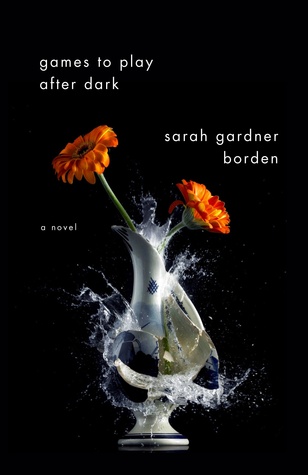
Games to Play After Dark by Sarah Gardner Borden

“It is hard to believe that Games to Play After Dark is Sarah Gardner Borden’s first novel. The topic, a marriage that falls apart, may not be the most original, the young mother who tries to combine the demands of her children and her husband and her personal needs, isn’t new but how she describes it, the details she evokes, the way she looks at what has been swept under the carpet and the bed and what is hidden in the closets is extremely well done.

Back When We were Grownups by Anne Tyler

Back When We Were Grownups is a novel about possibilities, lost dreams, second chances, family and love and ultimately about chosing the right path and belonging. I really loved this book. I liked Rebecca and many of the other characters, especially Poppy, the great-uncle. I liked how it shows that choosing a partner also means choosing a life and that maybe sometimes when we feel we are just drifting we are actually just sliding along because we are on the right path.

The Fish Can Sing by Halldór Laxness

Have you ever read a book and caught yourself smiling almost all the time? The Fish Can Sing is so charming I couldn’t help doing it. It’s also quite funny at times and certainly very intriguing. I’m afraid I can’t really put into words how different it is. As a matter of fact, Halldór Laxness’ book is so unusual and special that I have to invent a new genre for it. This is officially the first time that I have read something that I would call mythical realism.

The Square Persiommon by Takashi Atoda

I think the most intense reading experience is one that connects you to your own soul, that triggers something in you and lingers. Atoda’s stories even made me dream at night. I almost entered an altered state of consciousness while reading them.  The Square Persimmon managed to touch the part in me where memories lie buried and dreams have their origin.

Stranger by Taichi Yamada

Strangers is an excellent ghost story but it is also so much more than just a ghost story. It’s a truly wonderful book with a haunting atmosphere, a melancholy depiction of solitude and loneliness with a surprisingly creepy ending.

Enchanted Night by Steven Millhauser

Hot summer nights have a special magic. In the middle of the night, when everyone is sleeping and only night creatures are awake, the hot still air is heavy, time seems to stand still and the world is indeed enchanted. This is the magic captured by Steven Millhauser in his beautiful and poetical novella Enchanted Night. I have never read this book before but the images, the atmosphere felt so familiar. It was a bit like looking into my own imagination.

Goldengrove by Francine Prose

Reading Francine Prose’s novel Goldengrove felt at times like holding the clothes and belongings of a dead person in my hands. While I read it, and for a long while after I finished it, I felt as if I was grieving. It’s a really sad novel but at the same time it’s a very beautiful novel. It also reminded me of the series Six Feet Under. There is something very similar in the mood and the characters. Although I absolutely loved this novel I could imagine it isn’t for everybody.

Nada by Carmen Laforet

 Nada deserves to be called a classic. However it isn’t a classic because of the plot which can be summarized in a few sentences but because of the style. This is a young writer’s book who manages to capture the intensity of living typical for the very young and passionate.

The Cat by Colette

La Chatte has a subject to which I relate but it is far more than the story of a relationship between a man and his cat. It is a subtle analysis of love versus passion, of marriage versus celibacy, of childhood and growing up, of change and permanence. The story also captures the dynamics of disenchantment following the recognition that one’s object of desire is flawed.

So Long, See You Tomorrow by William Maxwell

So Long, See You Tomorrow  is a beautiful and melancholic short novel that explores a wide range of themes like memory, the past, isolation, loneliness, friendship, jealousy and violence. The central theme is that of the omission and the following regret. There are so many things left unsaid, things not done or too late in a life, that this core theme will speak to almost all of us. It’s often little things but they resonate for a long time in our lives and we might wish to turn back time and undo what has happened.

Most engrossing reads

These were the books where I never checked how many pages were left because I had finished them before even getting the chance to do so. In other words, the page-turners.

Underground Time by Delphine de Vigan

Les Heures souterraines or Underground Time is a chillingly good novel and shockingly topical. It’s accurate in its depiction of life in a corporate setting and of  life in a big city. It’s a very timely book, a book that doesn’t shy away to speak about the ugly side of  ”normal lives”.

Whatever You Love by Louise Doughty

Whatever You Love is a book of raw emotions. And that from the first moment on when we read about the police knocking on Laura’s door to inform her that her daughter Betty has been killed. Laura is a very emotional woman, she feels everything that happens to her intensely, her reactions are very physical. There are many elements in the book that made me feel uneasy.

You Deserve Nothing by Alexander Maksik

You Deserve Nothing was certainly one of the most entertaining reads this year. It offers an interesting mix of alternating and very realistic sounding voices, a Parisian setting and a wide range of themes.

A Kind of Intimacy by Jenn Asworth

I already jokingly “said” to Danielle in a comment that her top 2010 might become my top 2011 and,  yes, this book is certainly a candidate as it is astonishingly good. Very dark, absolutely fascinating, engrossing, and very well executed. While starting it I had forgotten Jenn Ashworth was compared to Ruth Rendell but the association immediately occurred to me as well.

everything and nothing by Araminta Hall

everything and nothing was one of those super fast reads, a book that I could hardly put down. Really riveting. The only complaint I have is that this is labelled as a psychological thriller. Although there is a part of it reminiscent of Ruth Rendell, it is like a background story and not really very gripping. At least not for me. Still I consider this to be a real page-turner for the simple reason that it captures chaotic family life in so much detail and explores some of the questions and problems parents who work full-time would face.

Best Books – Literature and War Readalong

How Many Miles To Babylon? by Jennifer Johnston

I loved How Many Miles to Babylon? I think it is a beautiful book. It doesn’t teach you as much about WWI as Strange Meeting (see post 1) but it says a lot about Irish history. I found this look at the first World War from an Irish perspective extremely fascinating.

The Things They Carried by Tim O’Brien

I expected The Things They Carried to be a very good book. A very good book about the war in Vietnam. What I found is not only an outstanding book about the war in Vietnam but also about the art of storytelling. I’m really impressed.

The Silent Angel by Heinrich Böll

Böll has a gift for description which is rare. And he represents a rare model of moral integrity, he is an author who wrote for those who have nothing, who tried to unmask hypocrisy and uncover everything that was fake and phony in post-war Germany. I don’t know all that many authors who are so humane.

Most touching

On the Holloway Road by Andrew Blackman. I read this novel in the summer and it’s one of a few books I haven’t reviewed. In this case because the reading caught me completely unawares. I had such an emotional reaction that I had to talk about it all the time. I still feel like reviewing it but I need some distance

Best classics

Mme de Treymes by Edith Wharton

Madame de Treymes has a Parisian setting which always appeals to me, as sentimental as this may be. It is a cruel little book and a very surprising one. All in all there is not a lot of description of the city itself, the novel rather offers an analysis of the society. It is interesting to see how Americans perceived the Parisian society and the differences in their respective values.

Hotel Savoy by Joseph Roth

Hotel Savoy has really everything. It is funny, sad, picturesque, touching and bitter-sweet and the ending is perfection. Roth describes people, the hotel and the little town with great detail. And every second sentence bears an explosive in the form of a word that shatters any illusion of an idyllic life. Roth served in WWI and never for once allows us to forget that the horror of one war and subsequent imprisonment have only just been left behind  while the next one is announcing itself already.

Grand Hôtel by Vicki Baum

Grand Hôtel is set in a luxurious hotel in Berlin between the wars. It’s walls shelter a microcosm of German society. The novel draws a panorama of the society and the times, reading it is fascinating and gives a good impression and feel for the time and the people. Vicki Baum includes a wide range of characters, the porter who waits for his wife to give birth to the first child, the aristocratic head porter Rohna, the many drivers and maids as well as some very interesting guests. Including the employees of the hotel gives the book a bit of an upstairs-downstairs feel and permits insight into the lives of the “simple people” who earn just enough not to starve.

Pedro Parámo by Juan Rulfo

It’s a powerful novel infused with the spirit of the Mexican Día de los muertos or Day of the Dead at the same time it is an allegory of oppression and freedom that comes at the highest cost. When you read Pedro Páramo it becomes obvious that “magic realism” has many faces.

Best non-fiction books

Making Toast by Roger Rosenblatt

I found Making Toast wonderful. It contains a lot of little endearing episodes like the one that gave the book its title, in which Rosenblatt states that the only thing he is really good at is making toast for the whole family in the morning. He describes how he gets up very early and, taking into consideration each family member’s taste, he produces a multitude of personalized breakfast toasts.

The Film Club by David Gilmour

The relationship between these two is unique. So much honesty, trust and friendship between a father and a son is wonderful. Not every parent has the chance to spend as much time with his kid, that is for sure, but every parent has certainly spent enchanted moments with his/her child and will be touched by this story. For us film lovers The Film Clubis  a great way to remind us how many movies there are still to discover, how many to watch again and in how many different ways we can watch them.

Howard’s End is on the Landing by Susan Hill

I can’t tell you exactly how long it took to read Howards End is on the Landing. An evening? Two? Certainly not longer. I devoured it. What is more fascinating to read than a bookish memoir? And written by a writer.

The Gifts of Imperfection by Brené Brown

Brené Brown is a researcher, specialized in topics like shame and perfectionism and analyzing how they are linked and keep us from living wholeheartedly. She is an incredibly honest and open person who is able to show her vulnerability.

Natural History of Destruction by W.G. Sebald

On the Natural History of Destruction is one of the most amazing books I have read this year. For numerous reasons. It is in line with the topic of my reading projects and readalong and contains descriptions that I have never read like this. On the other hand it gave me the opportunity to see another side of Sebald. One that I didn’t expect.

Cinderella Ate My Daughter by Peggy Orenstein

What happens when a feminist who knows exactly how things should be, gets pregnant and the child is – horror on horror – a girl? This is pretty much how Peggy Orenstein opens her entertaining, thought-provoking and occasionally quite shocking account Cinderella Ate my Daughter about what she sub-titles “Dispatches from the front-lines of the new girlie-girl culture”.

The Equality Illusion by Kat Banyard

Kat Banyard’s The Equality Illusion: The Truth about Men and Women Today takes an unflinching look at what it means to be a woman today and, due to the fact that Banyard is British, especially in the UK . Still, whether you are an Afghan woman fighting for girl’s rights of literacy or an American doctor performing late stage abortions, you have one thing in common: you lead a dangerous life and might end up being killed. Both things happened.  The first happened in Afghanistan in 2006, the second in the US in 2009. They illustrate the illusion of equality and show what a global phenomenon it is.

New Author Discoveries

These are the authors that made me think “I would like to read all of his/her books”.

Beryl Bainbridge,  William Maxwell, Jennifer Johnston, Peter Stamm, Annie Ernaux

The worst book this year

There is a lonely winner this year and it has so far not even been reviewed. I’m still determined to do so but I find adding quotes so tedious, only in this case it’s necessary to illustrate the problem I had with the book. Now you are dying to know the title, aren’t, you?

In a Hotel Garden by Gabriel Josipovici
Peter Stamm: In Strange Gardens and Other Stories – Blitzeis und In fremden Gärten (1999/2003)

In Strange Gardens: And Other Stories by Peter Stamm

In these stories, Stamm’s clean style expresses despair without flash, through softness and small gestures, with disarming retorts full of derision and infinite tenderness. There, where life hesitates, ready to tip over—with nothing yet played out—is where these people and their stories exist. For us, they all become exceptional.  “Sensitive and unnerving. . . . An uncommonly intimate work, one that will remind the reader of his or her own lived experience with a greater intensity than many of the books that are published right here at home.”

I had a hard time picking a Swiss author for German Literature Month as there are so many good ones to pick from. I chose Peter Stamm because the reviews in Swiss and German newspapers tend to be full of praise but I have never read anything by him. Most of what Stamm has written is translated into English, his novels as well as his short stories. I got Agnes (Agnes German), his first novel but from the English and German reviews I know, it’s his only controversial book, one that you either love or hate. I was much more in the mood to read something that critics called one of “the most beautiful and important books” or “one of the most remarkable achievements of contemporary literature written in German”. And so I chose to read his short story collection Blitzeis. You can find it in the English collection In Strange Gardens and Other Stories that combines two German collections, Blitzeis and In fremden Gärten.

Since I have finished the book I tiptoe around this review. The stories are saturated with a fleeting beauty that is hard to capture. What exactly was it that made me love those stories so much? So much that for the first time, I regretted reading short stories and not a novel. I would have loved to go on reading each and every single one of those stories. Nothing much happens in these pages. People dream and float and meet others. They live some moments of intensity, of joy, of disappointment, of regret. The stories take place in different countries, one is set in Switzerland, some in New York, one in Sweden, another one in Italy, one in the Netherlands. The characters are often from Switzerland, they meet people abroad, are fascinated by the cities and the landscapes they don’t know, some are happy to return to Switzerland, some will stay abroad. They enjoy moments in which nothing much happens.

These stories are, as I said, not so much about plot or even atmosphere but about mood. They achieve to convey a wide range of moods. Sadness, melancholy, joy, apathy… each and every story captures either one or more of these emotional states. At times I was reminded of some Japanese stories and their celebration of fleetingness, at times they reminded me of Anna Gavalda’s first short story collection Je voudrais que quelq’un m’attende quelque partI Wish Someone Were Waiting For Me Somewhere.

To give you a better impression I will pick two stories.

In the Outer Suburbs (In den Aussenbezirken) is the story of a chance encounter. A young Swiss man is walking the streets of New York on an early Christmas morning. He is hung over from the night before in which he had a party with friends. Too much alcohol and too many cigarettes were involved. He walks aimlessly through the streets and feels as if he sees them for the first time. He finally enters a bar and is drawn into a conversation with a drunk whom everyone seems to avoid. Without prejudice or preconceived ideas he listens to the man and they drink together. The drunk is full of wisdom, talks about poetry, and the difference of love poems written by men or women. After a long while they leave the bar together. The afternoon is still bright, although they expected that the night had already fallen. When they part, the drunk thanks him for a beautiful afternoon.

Passion (Passion) is the story of a love in its final hours. The beauty of the Italian summer, the happiness of the narrator who lies awake in the hot night listening to his friends talk below the open window of his sleeping room, contrast with the feeling of an imminent ending. He wants to break up with his girlfriend but when she finally leaves him, he is disappointed.

Peter Stamm’s stories may very well be the greatest discovery of German Literature Month for me. I loved each and every one of them and wanted to go on reading. I can’t wait to read one of his novels. I already got An einem Tag wie diesem – On a Day Like This and it’s likely that I will review it during the last week of German Literature Month.

The review is part of German Literature Month – Week 3 Switzerland and Austria

Jenny Erpenbeck, Clemens Meyer and Berlin City-Lit Giveaway -The Winners

It’s finally Sunday again and here are our three lucky winners drawn by random.org list generator.

The winner of Clemens Meyer’s short story collection All the Lights, courtesy of And Other Stories, is

Rise from in in lieu of a field guide

Jenny Erpenbeck’s Visitation which we give away courtesy of Portobello Books has been won by

neer from A Hot Cup of Pleasure 

City-Lit Berlin, a contribution from Oxygen Books goes to

John (I think your site isn’t up and running yet?)

Happy reading, Rise, neer and John!

Please send me your contact details via beautyisasleepingcat at gmail dot com.

The giveaways are part of Lizzy and my German Literature Month in November.

The next giveaway will take place on Wednesday 26 October.

Btw. Those who won can participate again. 🙂

Wednesdays are wunderbar – Jenny Erpenbeck, Clemens Meyer and Berlin City-Lit Giveaway

Today we have a double giveaway. One on Lizzy‘s blog (that will be posted around 18.00 UK time) and the other one here. The giveaways are part of our German Literature Month in November.

Lizzy is giving away Pereine titles  (Next World Novella, Portrait of The Mother as A Young Woman and Maybe This Time) and two copies of Berlin City-Lit (see below). Her giveaway is UK only.

I’m very happy to be able to offer you three great book choices.

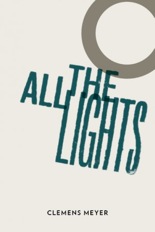
The first is Clemens Meyer’s short story collection All the Lights, courtesy of And Other Stories. Meyer started as a very young author and since he has entered the literary scene he has received a lot of praise.

Fifteen stories, laconic yet full of longing, from the young star of German fiction.’ GQ ‘The best crafted, toughest and most heart-rending stories in Germany.’ Spiegel ‘Respect to him. He’s the real deal.”

A man bets all he has on a horserace to pay for an expensive operation for his dog. A young refugee wants to box her way straight off the boat to the top of the sport. Old friends talk all night after meeting up by chance. She imagines their future together…Stories about people who have lost out in life and in love, and about their hopes for one really big win, the chance to make something of their lives. In silent apartments, desolate warehouses, prisons and down by the river, Meyer strikes the tone of our harsh times, and finds the grace notes, the bright lights shining in the dark.

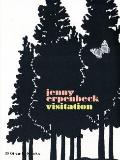
The second book is Jenny Erpenbeck’s Visitation which we give away courtesy of Portobello Books. I’m sure you have seen the one or the other review of this book. It was a huge success in Germany and is now equally appreciated everywhere else.

`This haunting novel beautifully dramatises how ordinary lives are affected by history’

By the side of a lake in Brandenburg, a young architect builds the house of his dreams – a summerhouse with wrought-iron balconies, stained-glass windows the color of jewels, and a bedroom with a hidden closet, all set within a beautiful garden. But the land on which he builds has a dark history of violence that began with the drowning of a young woman in the grip of madness and that grows darker still over the course of the century: the Jewish neighbors disappear one by one; the Red Army requisitions the house, burning the furniture and trampling the garden; a young East German attempts to swim his way to freedom in the West; a couple return from brutal exile in Siberia and leave the house to their granddaughter, who is forced to relinquish her claim upon it and sell to new owners intent upon demolition. Reaching far into the past, and recovering what was lost and what was buried, Jenny Erpenbeck tells an exquisitely crafted, stealthily chilling story of a house and its inhabitants, and a country and its ghosts.

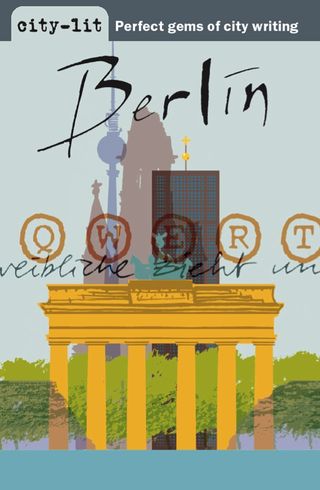
The third book is a contribution from Oxygen Books. You can win a copy of City-Lit Berlin. An anthology of stories set in Berlin. There are a lot of interesting authors included. Many German ones but also others.

If you would like to win one of those books, or enter for more than one, please let me know which ones you would like. Ideally you would read and review the book that you win.

Don’t forget to visit Lizzy’s Literary Life if you are located in the UK. She will post this evening (18.00 UK time).

The giveaway is open internationally, the books will be shipped by the editors. The winners will be announced on Sunday 23 October 20.00 – European – (Zürich) time.