On Ketil Bjørnstad’s De udødelige (The Immortals) – Norwegian Author and Composer

Ketil Bjornstad

Two months ago I went to a book shop and, on a table displaying books in German translation, I found a novel written by Ketil Bjørnstad. I’d not heard of him before, which isn’t surprising, as only two of his novels have been translated into German so far. None has made it into English. There are a few available in French though. Still, it’s a huge loss because Bjørnstad is one of those multi-talented authors that are so fascinating. Not only has he written far over 20 novels, but also poetry and essay collections, and he is a famous musician and composer.

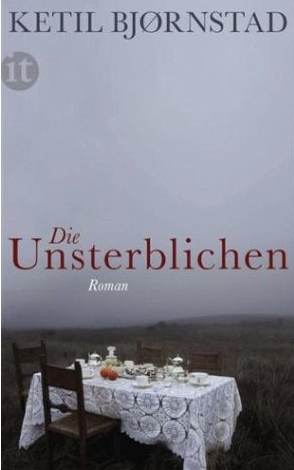
The novel I bought is called De udødelige (The Immortals – Die Unsterblichen). It was published in Oslo in 2011. The main character, Thomas Brenner, a general practitioner is one of the most complex characters I’ve come across in recent literature. He’s sensitive, kind, a born caregiver, who is acutely aware of other’s needs. But there’s another layer, buried deep within him— guilty feelings and cowardice. As much as he wants to help, it drags him down, frustrates him, and angers him that he has to give endlessly. Brenner is an example of what I’ve seen called the “sandwich generation”, the generation who has to care simultaneously for their children and their elderly parents, drawn by both sites into opposite directions, exhausting their strength and financial means.

The key plot element is his wife’s, upcoming 6oth birthday. And a planned trip to Chicago, the home of Saul Bellow, his wife’s favourite author. The success of the birthday party is threatened and overshadowed by many things. Brenner has heart problems and he’s pretty sure his wife, Elisabeth, is hiding health problems of her own. His mother, who is over 90, has to go to a nursing home, while his father stays at home, getting more demanding every day. Elisabeth’s parents live in the same house, and so does their older daughter Annika. She’s almost 30, but still not capable to make money and unwilling to move out. All these things burden Thomas, but he doesn’t want to confront anyone. He has to be pushed into a corner before he says anything unpleasant to anyone, even if this behaviour costs him his own health and happiness in the end. His wife Elisabeth isn’t much different. She has even stopped working a few years ago to look after her parents who don’t even thank her for this.

Brenner is a very sensitive, introspective man. And aware of hist shortcomings. He knows, he’s a coward, he knows that his kindness is to some degree weakness. He hasn’t learned how “to be cruel to be kind”.

Many of his Brenner’s thoughts circle around the so-called immortals— very old people who simply don’t want to die or change the way they live and are kept alive endlessly thanks to modern medicine. (The quote is taken from the author’s page)

My God, he thought, there were patients who had been living in nursing homes for over 15 years. They never died, because their lives were always saved by anticoagulants and heart medications. Their bodies could be disintegrating, but their hearts kept on beating. Even if their memories had vanished, what did not vanish was their agitation and anxiety, their restless wandering from room to room in the hope of finding peace, finding a home, finding a person, a Jesus or a God who could both comfort them and explain everything to them.

That these older people, like Elisabeth’s mother, cling to their old way of life, infuriates him. At the same time he feels deeply ashamed for thinking so and is happy that, in some cases, others take things into their hands. If it wasn’t for the authorities, Elisabeth’s mother, who is over 90 and not able to hold a steering wheel anymore, would still be driving. The older she gets, the more stubborn she becomes.

The Immortals is a timely book, one that addresses contemporary problems without dressing them up in a post-apocalyptic or dystopian horror scenario. Thomas Brenner’s life is one that many people live, especially the quiet ones who hardly ever complain but suffer in silence. Those who abuse them never even wonder what it means for them to be at their service constantly. I felt a lot of compassion while reading this. But I was sad for his children and his parents too. The daughters and the parents were filled with anxiety, feeling helpless and dependent. Caring for the ever-growing number of very old, frail people is a problem for our whole society. Not everyone can stop working and take care. I suppose we will see this intensify because more and more people have their children very late in life, which means many might be in their forties, while their parents are already well over 80.

I’m not sure this book will be translated, although I wish it will. The writing is light and subtle. With only a few sentences Bjørnstad captures a mood, an atmosphere. Brenner feels deeply at all times, is always honest to himself; listening to his thoughts, is like listening to a good friend. The end of the novel, which takes place in Chicago, is radical. I didn’t see it coming and I’m not going to forget it soon.

Luckily, music needs no translation and so all of those who will not be able to discover this sensitive author, may at least get a taste of his wonderful music.
Anne Brontë: Agnes Grey (1847)

Screen Shot 2014-10-05 at 15.33.49

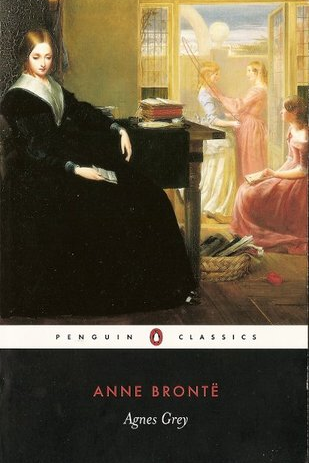
Last year I read all the Jane Austen novels I hadn’t read yet. This year I wanted to do the same with the Brontë novels. Agnes Grey was one of those I hadn’t read yet. Unfortunately starting my project with this book wasn’t a good choice. I found it so dark, I don’t think I’ll pick up The Tenant of Wildfell Hall any day soon, nor Villette or Shirley. Don’t get me wrong, I did expect a bleak story as I knew the book was based on Anne Brontës experience as a governess; an experience that was so negative that it led to her writing of Agnes Grey, hoping it would raise awareness and maybe help change a few things for future governesses. The description of the loneliness and social isolation of a governess were bound to be depressing but what really got to me are the many instances of cruelty against animals. I didn’t see that coming and really struggled through this novel. All the negative characters in this book—children and grownups alike— share a common trait— they see themselves as superior. If they think they are superior to other human beings, how much more must they feel superior to animals? Descriptions of torturing birds, hitting and kicking cats and dogs abound, and turned reading this novel into a nightmare. There’s even an instance in which Agnes, who loves animals, crushes a bird’s nest, to save the small birds from being tortured. Awful!

The book begins with the description of Agnes Grey’s childhood. Unlike most other Brontë heroines, she has a happy childhood and loving parents. They are not very rich but live comfortably until the day when her father loses everything due to an unfortunate investment. There is no urgent need for the two Grey girls to work, but Agnes would like to help her parents financially and decides to become a governess. Thanks to a reference from an acquaintance, she soon finds employment, although she’s only 19 years old and doesn’t have a lot of qualifications.

Her first employment is with the Bloomfields. Agnes knows it will be hard to live far away from her family and that she won’t be able to see them more than once a year. She is sure that her time away will not be easy but she didn’t expect she would be so miserable. Not only is she treated like a servant, but the children of the family are monstrous. They kick and scream and rebel. They are so badly behaved, only a very strong hand would be able to tame them. At the same time they are spoilt and Agnes isn’t even allowed to raise her voice, let alone punish them. She is shocked. She didn’t even knew that children could be like this. One boy in particular is very nasty and enjoys torturing small animals.

After a year she leaves the Bloomfield family and finds new employment with the Murrays. The children are slightly better behaved. There are four of them, two boys and two girls. Luckily the boys are sent away and Agnes does only have to teach the two girls. They are not interested in learning anything and treat Agnes just like their parents: condescending and as if she was a slave. One of the girls is a nasty piece of work. She’s very beautiful and uses her looks to manipulate and flirt. It’s her biggest joy to refuse and humiliate the men who fall in love with her. When she becomes aware that Agnes is interested in the curate Mr Weston, she tries to seduce him as well.

I can understand that people at the time were shocked when they read the book. I wasn’t shocked about Agnes’ treatment, because I knew that governesses had a hard life, due to their awkward situation. They come from the same class as their employers but they have no money and are forced to work. Because they have to work they are seen as inferior, at the same time they are not accepted by the servants because their social class and education places them above. It’s hard to imagine how lonely and helpless these women must have felt.

What shocked me as a modern reader is not so much that they didn’t accept Agnes as one of their own, but how mean and nasty those children were. How spoilt and misbehaved. They were as cruel and mean to Agnes as they were to their animals. They made her suffer on purpose, played tricks on her, disobeyed constantly, had no interest in anything.

If this was what poor Anne Brontë had to endure it’s quite appalling. I don’t know why any parents would have put up with such behaviour. These children have not the tiniest feeling for good and bad, no morals at all. They know what’s socially acceptable, and act accordingly, but only as long as it brings them some benefit or other.

What I found  most disturbing are the scenes among the destitute and the poor. Many rich girls and women did (and still do) charity work. The Murray girls are no exception. They visit the poor, bring things and money but they are never good or kind. They have been taught to give but they do so condescendingly, while Agnes spends time with them, reads for them or just sits and chats with them.

The end felt a bit like wish fulfilment. In a way you could say that the good are rewarded and the bad are punished.

I can see why Agnes Grey isn’t as famous as Wuthering Heights or Jane Eyre. Nor why it is not as well-known as Villette and The Tenant of Wildfell Hall. I found it interesting but dry and shocking. It’s not very descriptive and the character’s voice lacked life. I suspect, should I go on with my Brontë project, that this will remain my least favourite of their novels.

Have you read Agnes Grey? What did you think of it?

Louisa Young: My Dear, I Wanted to Tell You (2011) Literature and War Readalong September 2014

My Dear I Wanted To Tell You

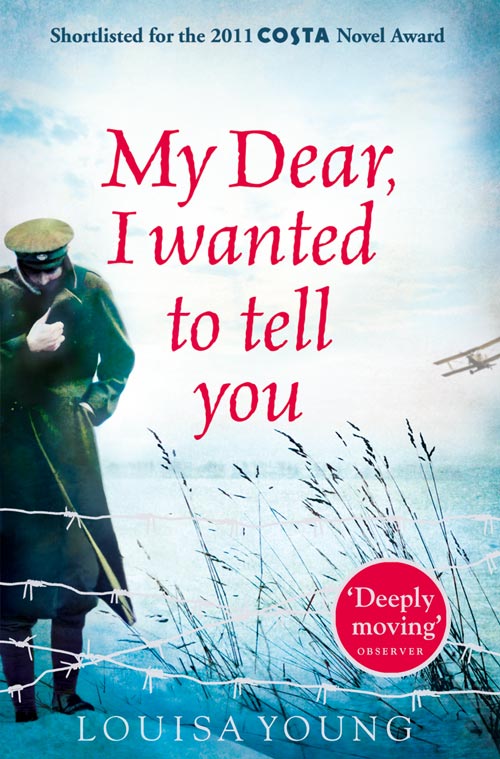
Louisa Young’s novel My Dear, I Wanted to Tell You is one of the most surprising reads for me this year. After having been disappointed in Pat Barker’s Toby’s Room and Helen Dunmore’s The Lie, I was a little worried this would be the third in a series of underwhelming contemporary WWI novels. Well, it wasn’t. I loved this book and could hardly put it down. Not only because the story was so engaging and the characters so likable but because Louisa Young is a skillful storyteller with a very unique style. It’s not easy to tell a WWI story, including all the common themes, and manage to do that in a fresh and original way, but that’s just what Louisa Young did.

Riley Purefoy and Nadine Waveney meet when they are still small children. Although from very different backgrounds – he’s a poor working-class boy, she’s from a rich upper-class family – they become friends and their friendship turns into love eventually. They both share a passion for art and both want to become artists. Just before the war breaks out, Riley works as an assistant to an artist. He sees Nadine regularly and they know they are in love. However, when her parents find out, they are not thrilled and make Riley understand that he isn’t welcome in the Waveney’s home anymore. Feeling hurt and insulted, Riley impulsively joins the army and within a few weeks is sent to the trenches. Nadine on her side, becomes a nurse. They keep in contact and write to each other regularly, even meet during one of Riley’s leaves.

Thanks to influential people at home and thanks to Peter Locke, Riley’s commanding officer, who understands that Riley is very cultured and intelligent, Riley becomes an officer in spite of his background.

Peter Locke and his wife, Julia, are the second important couple in this novel. The book moves back and forth between these four characters.

The first half of the book is intense and beautiful and drew me in so much that when tragedy strikes it made me gasp. What followed wasn’t an easy read. It was tragic but so well done. There are numerous ways to write about facial mutilation and the way Louisa Young did it was outstanding. She combines the themes of body image, art, and beauty, and weaves them together in way that I found extremely thought-provoking. Peter’s wife, Julia, is obsessed with her beauty. She thinks she has nothing else to offer and, although not yet 30, already wants to undergo plastic surgery. Her thoughts and her anguish mirror the thoughts and the anguish of the mutilated men. I also liked that Louisa Young set the book in an artists’ milieu at the beginning because it underlines that we humans are extremely visual beings and while we might not all feel the same about beauty, we all feel the same about looks and mutilation. Making beauty, even more than mutilation, a main theme was a unique choice and even daring. Daring, because Louisa Young doesn’t spare us. She shows us what those mutilations looked like, what they did to a soldier. And how the society reacted. Even mothers screamed and fled at the sight of their disfigured sons.

The second part of the novel focusses almost entirely on the surgeries and the despair of the mutilated men and on the toll the war takes on the minds of those who survive intact.

One of the strengths of the book is its accuracy, another one is that Louisa Young makes us care about her characters. Not only about the main characters but about the minor characters as well. She captures a society and an event, and thus achieves what the best historical fiction should achieve— make us we feel we’ve been there too.

Although My Dear I Wanted to Tell You tells a horrific story, it’s an amazingly beautiful book, full of sentiment and rich descriptions. Louisa Young has already published the sequel (The Heroe’s Welcome) and more books centering on the same characters are still to come. As she said in an interview: “I think I may be writing the twentieth century, through these characters.” I’m eager to read more of her novels.

Other reviews

 Anna (Diary of an Eccentric)

Danielle (A Work in Progress)

My Book Strings

*******

My Dear, I Wanted to Tell You is the ninth book in the Literature and War Readalong 2014. The next book is the Fantasy novel Phoenix and Ashes by Mercedes Lackey. Discussion starts on Friday 31 October, 2014. Further information on the Literature and War Readalong 2014, including the book blurbs can be found here.

Announcing German Literature Month IV – November 2014

Screen Shot 2014-09-24 at 07.23.25

Good morning/afternoon/evening, German(-language) literature lovers.  It’s time to look through your TBR piles and hunt out all the German literature you can find.  #germanlitmonth is returning for year four!

In years past Lizzy and I have structured the whole month for guidance, but now that a wealth of ideas and reviews exists in the blogosphere (see footnote), we no longer think that’s necessary.  This year we’re each going to host a themed week, leaving the rest of the month for you to read as you please. However, to make things more playful, we’re incorporating an optional pick and mix!

The overall structure of the month looks like this.

Nov 1-2      Introductions and reading plans

Nov 3-9      Award Winners Week (hosted by Lizzy)

Nov 10-23  Read as You Please

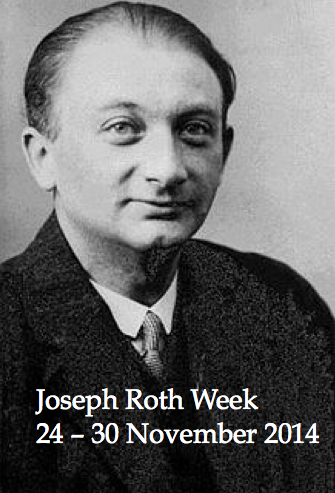
Nov 24-30 Joseph Roth Week (hosted by Caroline, with the Literature and War group read, Flight Without End, on the 29th)

Joseph Roth

At any time during the month you can pick and mix by reading and posting about any of the categories listed below, Each review will receive at least one entry into a prize draw. If the review fits multiple categories, you will earn multiple entries.  For example if you participate in my Literature and War read, you will get two entries: 1 for category 5 and another for category 6.

Pick and Mix Categories

1) Read and review an award winner.

2) Read and review a work that is not a novel.

3) Read and review a recommendation from German Literature Months 1-3. (See footnote)

4)To commemorate the 25th anniversary of The Fall of the Wall, read and review a work relating to the GDR or the Berlin Wall.

5) To commemorate armistice day, read and review a work relating to the First World War

6) Read and review a work written by or relating to Joseph Roth

7) Read a work published in German original or in translation during 2014

For the purposes of clarity, all reviews must relate to works originally written in German, regardless of the author’s nationality.  The winner of the pick and mix prize will be announced during the first week of December.

Apart from that, there are no other rules.  You can participate in the themed weeks and the pick and mix as much or as little as you wish. You can do your own thing too, if you so chose.  If you don’t have a blog, you are welcome to review on librarything or goodreads or similar or even write a guest post for one of the host blogs.

The main focus of the month is to share and enjoy German-language literature.  We hope you  decide to join us.

 *******

Footnote – Indices of reviews from previous years

German Literature Month 2011 (http://lizzysiddal.wordpress.com/2011/12/01/german-literature-month-2011-author-index/)

German Literature Month 2012 (http://lizzysiddal.wordpress.com/2012/12/15/german-literature-month-2012-author-index/)

German Literature Month 2013

(http://lizzysiddal.wordpress.com/2013/12/12/german-literature-month-iii-author-index/)

Across the Universe (2011) A Sci-Fi Thriller

Across the Universe is the first Sci-Fi thriller I’ve ever read. It’s also a YA novel and the first in a trilogy. Luckily it’s not the type of series beginning without a proper ending. There are open questions but the mystery is resolved, the perpetrator is caught.

Amy follows her parents on a mission to a planet that is three hundred years away from Earth. Her parents are part of a project crew needed to terraform Centauri-Earth. They have agreed to board the spaceship Godspeed and to be cyrogenically frozen. Three hundred years in the future they will be unfrozen. Amy didn’t have to follow her parents. They gave her a choice: she could stay with her grandparents and her boyfriend or travel to a new planet with her parents. Her love for her parents is stronger than anything else and she accepts to be frozen. The description of this is actually extremely well done. I could almost feel the ice in my veins.

Fifty years before they should land, someone brutally unplugs Amy. Luckily Elder, the future leader of Godspeed, Eldest’s heir, finds her in time. He’s fascinated by Amy, who is a redhead with translucent white skin and green eyes. Nobody looks like Amy on Godspeed. Everyone looks exactly the same: olive skin, dark eyes, brown hair, tall and strong. Eldest, the current leader, is far less thrilled. He’d like to open a hatch and throw Amy into space. He thinks that having someone on board who looks so different, who knows what it was like on earth, poses a huge threat to peace and stability on Godspeed.

Amy and Elder find out that Amy’s attempted murder probably was a mistake. Someone is targeting the crew of the project, which means Amy’s parents are in danger.

The plot is gripping enough but that wasn’t what I liked about this book. What I liked was the world Beth Revis created. The spaceship Godspeed is like a snow globe. I happen to love snow globes, those mini-worlds inside of glass bubbles filled with water. So naturally, I loved the setting. Godspeed has many layers and is like a replica of the earth. While there are no seasons, there’s still weather; they have rain and wind and they grow plants and have cattle.

For those who were born aboard Godspeed their environment poses no problem, but for Amy the ship is claustrophobic. She knows that the stars on the ship’s ceiling are fake. When they discover that there is a hidden window which allows to look out into space, things become dramatic. People are only docile and agreeing to work like slaves because they know nothing else. But once they would realize how vast the world is outside of the ship, things could change. We soon understand that Godspeed is not so much peaceful but totalitarian.

Amy and Elder try to find out who wants to kill the frozen crew members and they try to make sense of many inconsistencies. Someone, for example, has changed the books on Earth’s history. Facts are distorted and used to manipulate people.

I enjoyed this novel. I loved the setting, I thought the book had many thought-provoking elements, the plot was suspenseful, and Beth Revis has a knack for descriptions. There’s a love story but it’s not too romantic. The character’s are a bit flat and Amy thinks a few silly things, but I didn’t mind. I read this as highly entertaining guilty pleasure. Plus it’s an interesting genre mix that works really well. A bit like a locked room mystery set in space.

Anthony Trollope: The Warden (1855)

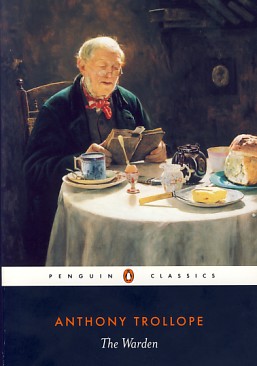
The Warden

Memory is a funny thing. For years I have been haunted by a sensual impression of a place. I remember being in England and walking along a row of houses. It’s a very peaceful, mild, warm autumn afternoon. The houses are part of a larger compound, overshadowed by a huge cathedral. I remember walking away from the cathedral close and coming to a small river that was flowing through the grassy meadow, on the same level as the soil. There were weeping willows and sheep. Walking around that place was like visiting a time long gone. These haunting images returned periodically. The light outside of my windows sometimes triggered the memory. It was always nice to go back in my mind, the only trouble was – I couldn’t remember where this had been. I’ve been in England many times, stayed there for a couple of months or weeks. I’ve visited many places and many cathedrals, but as much as I thought about it – I had no clue where I’d been on that warm autumn afternoon. Not until reading The Warden. The moment I opened the book and read the description of Barchester I knew – this is where I had been. But how could that be? Barchester doesn’t exist. Although I like to keep the introduction of a book until I’ve finished it, I had to read it to find out more. In the introduction I learned that Trollope based Barchester on Salisbury and Winchester. I immediately went online and looked up photos of Salisbury cathedral, the cathedral close and the meadows around and, yes, indeed, that’s where I’ve been some years ago. I found it pretty uncanny that Trollope was so capable at describing a place. I still don’t know why I forgot that the images were images of Salisbury. I’ve never forgotten a place like that. Maybe because it was so dreamlike?

I’ve meant to read Trollope for a while. Actually ever since I’ve read Guy’s (His Futile Preoccupations) and Brian’s (Babbling Books) reviews of his novels. Most of Trollope’s books are chunky but The Warden, the first in the Chronicles of Barsetshire, is a mere 180 pages.

According to the introduction, Henry James called The Warden “the history of an old man’s conscience”. That’s true, however, it’s only one of at least three major themes Trollope exlpores and which all contribute to make The Warden a highly worthwhile and interesting book and one of those you’d love to discuss with other people.

Septimus Harding is precentor and warden of an almshouse. With these positions come 800£ per year. In order to obtain this money Mr Harding doesn’t have to work a lot. As a precentor he’s in charge of the choir in the cathedral and as warden he’s the moral support of the twelve destitute men who are allowed to spend their last years in the almshouse. Since the almshouse was founded in the 15th century, the warden has received  more money every year because of the revenue of the land. The twelve men’s allowance however would have been still the same as in the 15th Century if Mr Harding hadn’t given them some of his own money.

At the time when this story takes place, numerous reformers are hunting down greedy clergymen, showing how they abuse of their power and enrich themselves at the expense of others. Dr Bold is just such a reformer. When he meets the warden and his daughter, with whom he falls in love, he learns about the founder’s will and instigates an investigation which leads him to the conclusion that Mr Harding receives money that is due to the almsmen. His inquiry quickly gets out of hand when the biggest newspaper publicly accuses the warden of greed and malpractice.

Mr Harding is an excessively private man. He’s weak but kind and good-hearted. Being dragged into the spotlight like this, accused and shamed, is more than he can bear. He never thought that he might be doing something wrong but once he starts to think about it, he’s not so sure that he wasn’t enriching himself at the expense of the twelve poor men. While he doesn’t want to fight the accusation, his son-in-law, archdeacon Dr Grantly and the bishop of Barchester, fight for him and soon both parties involve lawyers. The warden has another strong supporter in his daughter who begs Dr Bold to abandon the cause.

The three themes which are explored each center on another figure. Mr Harding has to examine his conscience. Will he stay warden if it has been proven that he’s legally entitled to his money or will his own conscience tell him to let go?

Mr Bold shows how good intentions at the wrong moment and without thinking about consequences can be fatal. Maybe Mr Harding gets too much money, but why make this a matter of public interest and involve the newspaper? Why does he disregard the peace and quiet that reigns at the almshouse? Neither Mr Harding nor the twelve men are wanting anything. They live together amicably but once Dr Bold tells the twelve men that they should get more money, peace is lost forever.

For contemporary readers it might be interesting to read about the role of the press and the journalist Tom Towers. Trollope was inspired by true stories and what he lets us experience is the beginning of the value of public opinion and the power of the press.

Trollope chose to show us the end of an era. The tone of the book is elegiac throughout. In the introduction Robin Gilmour makes an interesting point. The warden’s garden is a strong symbol of this dying of an era. At the beginning of the novel it’s lush, green and lovely. At the end:

The warden’s garden is a wretched wilderness, the drive and paths are covered with weeds, the flowerbeds are bare, and the unshorn lawn is now a mass of long damp grass and unwholesome moss.

I had a very strong reaction when I read how content Mr Harding was in the beginning and how quickly a lifetime of ease was destroyed. At the same time I had to agree with Bold. Not in this matter, but in general. Why would a clergyman be given so many riches, a huge house with gardens, and a large income without doing any work? Still, I was sad for Mr Harding who was threatened to lose everything he held dear, even though he might not have been entitled to have it.

What annoyed me about Mr Bold’s doing was that the man he attacked was a kind and generous man and – compared to other clergymen – a tiny fish.

Before ending this rather lengthy review, I’d like to say a few things about Trollope’s writing. I enjoyed the descriptions and I had to laugh out loud a few times when he characterized people, notably the archdeacon, using caricature and satire. I found many of his authorial intrusions interesting but there were too many for my taste. I had problems with the parodies of Carlyle and Dickens because they felt glued on and were not a part of the story. I didn’t mind that Trollope spoke to the reader directly but some of the more hidden intrusions were annoying.

I’m glad I read The Warden. It made me remember my stay at Salisbury and I loved the descriptions. I liked his choice of themes and think they are just as important today as they were then. I also think he’s a wonderful satirist. Will I read the next in the series? In all honesty – I’m not so sure. I can’t pretend I fully warmed to Trollope and although I’ve started a small Victorian literature reading project, I think I’ll move on to Elizabeth Gaskell and the Brontës.

If you’d like to read more reviews on Trollope visit Guy’s  (His Futile Preoccupations), Brian’s (Babbling Books) and Tony’s (Tony’s Reading List) blogs. Brian’s reading and reviewing The Barsetshire Chronicles (here’s his review of The Warden). Tony has reviewed both the Barchester and the Palliser novels – and some more and  Guy has written about many of the other novels.


Helen Dunmore: The Lie (2014) Literature and War Readalong July 2014

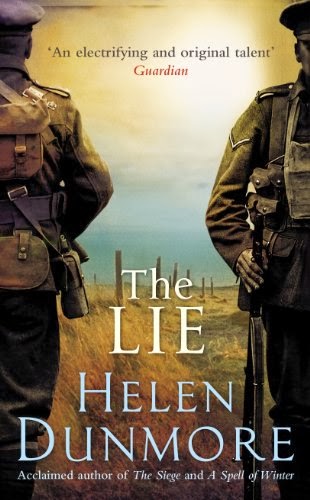
The Lie

The Lie is not the first WWI novel Helen Dunmore has written. Nor is it her first book about war. While you certainly don’t have to read Zennor in Darkness, or The Siege, or her ghost story The Greatcoat, before you read The Lie, it’s interesting to see how she approaches war from different angles. The Lie is foremost about the aftermath of war. About the scarring, the wounds, in the souls, the bodies, the land.

The Lie is set after WWI in Cornwall. The narrator, Daniel, lives on a forlorn piece of land, overlooking the sea. He’s shell-shocked, but unlike so many other soldiers with post-traumatic stress disorder, who populate literature, he’s taciturn and withdrawn. Even people who know him, like his childhood friend Felicia, would not be able to tell what is going on inside of his head.

I’ve been quiet a long time, I know that. It happens. I go back in my mind. It’s not the same thing as remembering, because it has colour and smell and taste.

The land on which Daniel lives belongs to Mary Pascoe, an old woman, almost blind and frail, who lived outside of society, far from the town, all of her life. WhenDaniel returns from the war, she let’s him seek shelter on her land. When she becomes very ill and blind, Daniel takes care of her and moves into her cottage with her. She makes him promise not to fetch a doctor and to stay on her land once she’s dead.

He takes care of her until her last moment and buries her on her land. Daniel is an able gardener and can live of the land, whose soil is rich. There’s a goat and hens as well. When people start to inquire about Mary, he tell’s them she’s still alive.  The lie will be his undoing.

The story moves back and forth in time, is interwoven with flashbacks of his childhood during which he was friends with Frederick and Felicia, and flashbacks of the war.

I was green as grass. And there was first aid drill, which was like no first aid I ever saw in France. We had a dummy which kept still and didn’t scream, bleed, or stink of shit because its insides were falling out. They taught us to tie a tourniquet, and apply field dressings, and that gas lies in pockets close to the ground long after you think it’s cleared.

You’d think selfishness would be the stronger force, but it turns out that it’s not so. Tell a man to unwrap his puttees, take off his boots, dry each toe individually, examine his feet for sores and rub them all over with whale oil, and tell him if he doesn’t he’ll get trench foot which will cause his feet to go black and stink and maybe even have to cut off — well, you’d think he’d do it. But he doesn’t. He’s cold and wet and dead beat and all he wants is to get some kip. Tell him he’s responsible for the feet of the man next to him, and he does it.

Daniel fights on his own at first and later, with Frederick. Frederick and Felicia come from money, while Daniel is the son of a poor housekeeper. Frederick’s and Daniel’s friendship is tested often due to these class differences; it ultimately survives, because the attachment is so profound.

During the war the class difference almost splits them up, but their friendship survives even this test. It even survives death. We know from the beginning that Frederick is killed in France. We just don’t know how, but assume that Daniel must have witnessed it and feels guilty, as he’s haunted by his death. And by Frederick’s ghost. I thought it was strange that she chose to write another ghost story, right after The Greatcoat, but this isn’t a ghost story. I read the ghost as a symbol for how deeply rooted the trauma of war is.

All at once I know he’s going to come. The dead aren’t tied to one place. He’s as fearful as I am, more maybe. He knows what’s coming to him, and he can’t get away from it. Something’s gone wrong. Thing’s out to stop, once they’re finished, but this won’t stop. They say the war is over, but they are wrong. It went too deep for that. It opened up a crack in time, a crater maybe. Once you fall into it, you can’t get out again. The mud is too deep and it holds you.

Daniel isn’t the only one grieving. Felicia has lost her husband and her brother in the war. When they meet again for the first time, they are both wary. They have changed and are not sure  whether there is more than their connection with Frederick that brings them together, or if there is a possibility of friendship, even love.

The Lie is a poetical story. The flashbacks are so tightly woven into the progressing story that they become part of it. Nothing that Daniel does, doesn’t remind him of the war. When he repairs Felicia’s furnace, he’s transported back to the trenches. When he cultivates the land, and digs in the soil, he’s reminded of the mud in France.

The most beautiful parts are the descriptions of this forlorn country, covered in furze and bracken, smelling of salty sea air and the richness of its soil. But in spite of these beautiful passages, I found the novel and its tragic ending, extremely depressing. And I didn’t get why the lie had such tragic consequences.


Other reviews

Danielle (A Work in Progress)

TJ (My Book Strings)

Violet (Still Life With Books)


*******

The Lie is the seventh book in the Literature and War Readalong 2014. The next book is the WWI memoir Undertones of War by Edmund Blunden. Discussion starts on Friday 29 August, 2014. Further information on the Literature and War Readalong 2014, including the book blurbs can be found here.